
Mildred Pierce (Winslet)



 Jalopy survivalism in the aftermath of apocalypse became the central theme of George Miller’s hyper Argosy tale The Road Warrior. That wasn’t the original intention; the director had in mind a Joseph Campbell-inspired myth about a loner hero warring against anti-chivalry. The story
would evolve
into an inflated Jung-heavy pulp journey mixing greed for the 7 Sisters oil and other natural resources with tongue-in-cheek s & m among the lususes naturae. In Mad Max: Fury Road, the super-revved up jalopies, including a Valiant Charger, Cadillac DeVille, Mercedes-Benz Limo, plus a few new contraptions, remain prominent and likewise ready for a spread in the annual post-nuke edition of
Auto Restoration. Even Rolling Stone will want to wax poetic about the traveling stage complete with multiple speakers and a cuming-with-fire guitar, in essence an update on the history of music in battle. For most of this 34-years-later demolition derby, the war games remain highly entertaining and pulse-quickening, with visually stunning sandy-eyed candy supplied by John Seale. Then the inevitable: the de rigueur chase-to-the-deadly-climax takes over and in spite of Miller’s
aim to rely on “real” effects to reduce the expensive fakery—he claims that 90% of the movie has “practical” effects, code for real or as close to real as possible, and there are multiple YouTube uploads confirming what he says—everything begins to look like an overload of CGI. One tiresome example comes early: butching up Charlize Theron isn’t enough so Miller instructs some of the hundreds of the visual effects tricksters, employed to polish up what “practical” action-stunt scenes can’t accomplish, to
give her a gratuitous prosthesis. Her one-arm attempt to save a dangerously dangling Tom Hardy, who has to weigh at least 100 pounds more than she does, reaches the ridiculous level on the belief gauge in that she also endures a dagger stab in her side just before grabbing his arm while still at the wheel of the huge tanker. Filming in the Namib Desert, Namibia from 7/2012 to 12/20/2012, with additional shooting during November, 2013, Miller much more quietly proceeded with nearly two years of post-production, most of it centered on enhancing visual effects and almost all of them achieved by what the credits list as compositors, working with digital Arri Alexa M, Panavision Primo, Ultra Speed MKII and Angenieux Optimo Lense output. In other words, computerization, the avoidance of acknowledgement an insult to those creating this composite masterpiece. Devotees, including the striplings over at
FSM, talk about the movie’s “depth” and “intelligence,” as if Theron as stand-in for Sigourney Weaver’s Ripley qualifies, neglecting the fact viewers have to overlook a few of her lassie charges appearing to be creepy groupies not very eager to be rescued from or by the Outback’s chief baby-making ogre (who could use clarifying subtitles). And those lady breeders called the Vuvalini are, by optical appraisal, a terminal fancy. The cheat of Miller’s scorched, desolate domain is that sex seems the province of the
aberrant, but what are we to make of his addition of ghostly white kohl-eyed saltpeters out of Cirque du Soleil as sub for the Hell’s Angels deserteers in TRW? As the pole cats joyfully vault, and the villains and maryters crash and burn, there’s a growing exhaustion from being storyboarded to death—both the movie and the audience need the salvation of Hardy’s wasted testosterone. What’s allowed, once the iron bar facial covering is removed, manages to sufficiently eroticize his glinting eyes and strapping frame
as potentials in re-charging Max’s batteries and in the next outing hopefully confirm he can get it up for someone, moving beyond suspicions of autosexuality. (He saves Ripley II as an act of “redemption” which further dampens potential ardor; Miller is to be blamed, as the stump is already an impotence inducer.) There is one surprise: occasionally suggesting a British Tom Berenger, Hardy becomes a bonnie version as well as the ideal candidate to do the bio of Charles Laughton.
Jalopy survivalism in the aftermath of apocalypse became the central theme of George Miller’s hyper Argosy tale The Road Warrior. That wasn’t the original intention; the director had in mind a Joseph Campbell-inspired myth about a loner hero warring against anti-chivalry. The story
would evolve
into an inflated Jung-heavy pulp journey mixing greed for the 7 Sisters oil and other natural resources with tongue-in-cheek s & m among the lususes naturae. In Mad Max: Fury Road, the super-revved up jalopies, including a Valiant Charger, Cadillac DeVille, Mercedes-Benz Limo, plus a few new contraptions, remain prominent and likewise ready for a spread in the annual post-nuke edition of
Auto Restoration. Even Rolling Stone will want to wax poetic about the traveling stage complete with multiple speakers and a cuming-with-fire guitar, in essence an update on the history of music in battle. For most of this 34-years-later demolition derby, the war games remain highly entertaining and pulse-quickening, with visually stunning sandy-eyed candy supplied by John Seale. Then the inevitable: the de rigueur chase-to-the-deadly-climax takes over and in spite of Miller’s
aim to rely on “real” effects to reduce the expensive fakery—he claims that 90% of the movie has “practical” effects, code for real or as close to real as possible, and there are multiple YouTube uploads confirming what he says—everything begins to look like an overload of CGI. One tiresome example comes early: butching up Charlize Theron isn’t enough so Miller instructs some of the hundreds of the visual effects tricksters, employed to polish up what “practical” action-stunt scenes can’t accomplish, to
give her a gratuitous prosthesis. Her one-arm attempt to save a dangerously dangling Tom Hardy, who has to weigh at least 100 pounds more than she does, reaches the ridiculous level on the belief gauge in that she also endures a dagger stab in her side just before grabbing his arm while still at the wheel of the huge tanker. Filming in the Namib Desert, Namibia from 7/2012 to 12/20/2012, with additional shooting during November, 2013, Miller much more quietly proceeded with nearly two years of post-production, most of it centered on enhancing visual effects and almost all of them achieved by what the credits list as compositors, working with digital Arri Alexa M, Panavision Primo, Ultra Speed MKII and Angenieux Optimo Lense output. In other words, computerization, the avoidance of acknowledgement an insult to those creating this composite masterpiece. Devotees, including the striplings over at
FSM, talk about the movie’s “depth” and “intelligence,” as if Theron as stand-in for Sigourney Weaver’s Ripley qualifies, neglecting the fact viewers have to overlook a few of her lassie charges appearing to be creepy groupies not very eager to be rescued from or by the Outback’s chief baby-making ogre (who could use clarifying subtitles). And those lady breeders called the Vuvalini are, by optical appraisal, a terminal fancy. The cheat of Miller’s scorched, desolate domain is that sex seems the province of the
aberrant, but what are we to make of his addition of ghostly white kohl-eyed saltpeters out of Cirque du Soleil as sub for the Hell’s Angels deserteers in TRW? As the pole cats joyfully vault, and the villains and maryters crash and burn, there’s a growing exhaustion from being storyboarded to death—both the movie and the audience need the salvation of Hardy’s wasted testosterone. What’s allowed, once the iron bar facial covering is removed, manages to sufficiently eroticize his glinting eyes and strapping frame
as potentials in re-charging Max’s batteries and in the next outing hopefully confirm he can get it up for someone, moving beyond suspicions of autosexuality. (He saves Ripley II as an act of “redemption” which further dampens potential ardor; Miller is to be blamed, as the stump is already an impotence inducer.) There is one surprise: occasionally suggesting a British Tom Berenger, Hardy becomes a bonnie version as well as the ideal candidate to do the bio of Charles Laughton.
 Having watched the seven season Mad Men three times, with every likelihood a few more binges in the future, I’ve come to agree with others who call the series a true original novel for television. Creator Matthew Weiner
zeroes in on carefully weighed structure, on people we are or know, on incisive dialogue and incidents, on questions unable to be answered simply, if at all. He stresses and mostly succeeds in getting actors equal to the explorations and tentativeness; he profusely name-drops and incorporates social and cultural epochs and moods, enhanced by spot-on settings, wardrobe & hair & makeup—boomers forget the blond correctitude of Grace Kelly and the
opposite impact of Elizabeth Taylor—and he insists on integration of pop music classics as evocations of our own personal experiences. (We still want to get up and dance to Chubby Checker’s “The Twist” and when hearing Lani Hall’s vocality in “Going Out of My Head” blaring from a kitchen radio, we empathetically connect to Don’s temporary despondency.) In the same way readers argue over a great novel’s intents and resolutions, viewers are enjoying debating the significance and closures of the series. With all
this said, here are very subjective thoughts along the way to the wrap. One unsettling touch of reality is the camera panning from daughter Sally doing the dishes to mother Betty, who continues to smoke. We flash on family or friends who did the same right up to the very end. Dousing flareups of sexual jealousy and regretting the hurt, Betty tries to logically express the wish Don not interfere with the kids. Yeah, like it’s gonna happen. Megan, Don’s third wife, is more beautiful in
b
& w than in living color. A boozing complusive womanizer who occasionally flashes a sadistic streak, Don finding himself through a Big Sur version of Erhard’s tunic-clad est—scenes out of Bob & Carol & Ted & Alice—is a bit much but, even with all the whammies besetting him, he’s figuring out a way to get back to the ad agency to produce the famous “Real Thing” Coke commercial. (Conceivably he’d have burnt-out to get any blame for
the fiasco of “The New Coke” in 1985.) Though Peggy’s probably instrumental in Don’s return, it can’t be dismissed big boss Hobart has a vicarious thing for wonder boy; he’ll tolerate the prized crotch as troublemaker but not the B-52 bomber queen who’s threatening legal action. While Betty’s immoderate tribulations are linked to the dangers of self-indulgence, Joan does seem to get the worst of it, not unexpectedly: bouncy, sashaying Rubenseques always have the toughest time convincing
others they should be taken seriously. Certainly not business savvy to be bashing a model airplane at an office ditz, no matter how funny the moment is, yet something about the reactions of all those droolers over her set, and the cash-induced surrendering to the pressure to prostitute herself in order to get the prestige of the Jaguar account, will have her “burning this place down.” An ouch of a cultural reference:
reading over Peggy’s bulletin board ad for a Manhattan roommate using the words “clean,” “responsible” and “TV,” Joan says it’s like stage direction from an Ibsen play when in fact he died twenty years before the advent of television; a more apt reference might be William Inge, from whom Peggy’s mother gallingly springs. The series avoids Salvatore’s future, other than his NYC park cruising, but it’s hoped Joan would hire him as a director. Peggy’s summation isn’t any more satisfying: as
much as we grow to love her, root for her and
revel in her clashes and reconciliations with Don—they are the show’s most exhilarating and emotionally moving moments—she ends up with a bearded repulsive? Okay, he earns a short reprieve by giving her the finger at just the right moment. When inevitably named creative director at McCann Erickson or starts her own agency and re-gazes at the pussycat-adorned Dream of the Fisherman’s Wife hanging in the office, she’ll ditch him, as she seems well on the way to be a distaff, albeit dignified,
version of her mentor. Their botherations and the unsolved mystery of his mother’s disappearance aside, Peter and wife Trudy deliver a Charleston presaging a later flight to yesteryear. Clotheshorse super quipster Roger partners with Megan’s glam hag mother Marie as another and perhaps last gold-digging mismatch, so here’s trusting he’s finally wised up about pre-nups. His second wife, btw, looks far too much like a mascaraed-to-the-max Debra Messing. (Look-alikes pop up elsewhere: conflicted Conrad
Hilton and batty secretary Miss Blankenship are, respectively, spitting images of John Waters and Penny Marshall; a drug pusher shows up as a Tom Cruise replicant.) As a reflection of the corruption of Madison Avenue, Mad Men is the more exacting of the metropolitan white collar cesspool environment of Sloan Wilson’s The
Man in the Gray Flannel Suit, Rona Jaffe’s The Best of Everything and, to a lesser degree, O’Hara’s From the Terrace and Richard Yates’ Revolutionary Road strive to be. Likewise founded on the brutally shallow and prejudicial Eisenhower era, Weiner puts his volatile comers through the grinder to intermesh the misogyny of oversexed Philip Roth with an unexamined Ayn Rand and the trash phenomenon Jackie Susann to reveal the contradictions and obsessions inherent in the illusions about philosophic egoism, violence and American life advertised (also used as synonym
for what’s enacted as message) on the boob tube and in magazines and books. (More than 100 salient books are either glimpsed, referred to, or being read by various characters throughout the seven seasons; can not recall ever seeing its like before.) Glimpsing into the early 70s, the show dabbles with the fantasy of peace and harmony out of Hair and previews the “jump-your-bones” of cocaine. We’re not told what’s forecasted at the office: the end of smoking; drinking will be closeted; sex, bigotry
and psychosis continue to simmer on burners;
ads for Lucky Strike and Burger Chef to be replaced by tequila and bipolar pharmaceuticals. Excluding personal favorites, and in the end the only fair assessment of what is, the universally accepted perfect novel doesn’t exist; at the same time, acknowledging television was for decades the vast wasteland, persistently false assessments remain that there’s little perfection generating from it. As sociological binge on our penchant for faking standards and mores
we don’t believe in or practice except to find ways to profit from, and which become enigmatic essences for Jon Hamm to masterfully infuse complexity into Don, the quintessential American male at his most fluidly fucked up, Mad Men comes close to being a perfect reflection of the way we were and still are all these years later.
Having watched the seven season Mad Men three times, with every likelihood a few more binges in the future, I’ve come to agree with others who call the series a true original novel for television. Creator Matthew Weiner
zeroes in on carefully weighed structure, on people we are or know, on incisive dialogue and incidents, on questions unable to be answered simply, if at all. He stresses and mostly succeeds in getting actors equal to the explorations and tentativeness; he profusely name-drops and incorporates social and cultural epochs and moods, enhanced by spot-on settings, wardrobe & hair & makeup—boomers forget the blond correctitude of Grace Kelly and the
opposite impact of Elizabeth Taylor—and he insists on integration of pop music classics as evocations of our own personal experiences. (We still want to get up and dance to Chubby Checker’s “The Twist” and when hearing Lani Hall’s vocality in “Going Out of My Head” blaring from a kitchen radio, we empathetically connect to Don’s temporary despondency.) In the same way readers argue over a great novel’s intents and resolutions, viewers are enjoying debating the significance and closures of the series. With all
this said, here are very subjective thoughts along the way to the wrap. One unsettling touch of reality is the camera panning from daughter Sally doing the dishes to mother Betty, who continues to smoke. We flash on family or friends who did the same right up to the very end. Dousing flareups of sexual jealousy and regretting the hurt, Betty tries to logically express the wish Don not interfere with the kids. Yeah, like it’s gonna happen. Megan, Don’s third wife, is more beautiful in
b
& w than in living color. A boozing complusive womanizer who occasionally flashes a sadistic streak, Don finding himself through a Big Sur version of Erhard’s tunic-clad est—scenes out of Bob & Carol & Ted & Alice—is a bit much but, even with all the whammies besetting him, he’s figuring out a way to get back to the ad agency to produce the famous “Real Thing” Coke commercial. (Conceivably he’d have burnt-out to get any blame for
the fiasco of “The New Coke” in 1985.) Though Peggy’s probably instrumental in Don’s return, it can’t be dismissed big boss Hobart has a vicarious thing for wonder boy; he’ll tolerate the prized crotch as troublemaker but not the B-52 bomber queen who’s threatening legal action. While Betty’s immoderate tribulations are linked to the dangers of self-indulgence, Joan does seem to get the worst of it, not unexpectedly: bouncy, sashaying Rubenseques always have the toughest time convincing
others they should be taken seriously. Certainly not business savvy to be bashing a model airplane at an office ditz, no matter how funny the moment is, yet something about the reactions of all those droolers over her set, and the cash-induced surrendering to the pressure to prostitute herself in order to get the prestige of the Jaguar account, will have her “burning this place down.” An ouch of a cultural reference:
reading over Peggy’s bulletin board ad for a Manhattan roommate using the words “clean,” “responsible” and “TV,” Joan says it’s like stage direction from an Ibsen play when in fact he died twenty years before the advent of television; a more apt reference might be William Inge, from whom Peggy’s mother gallingly springs. The series avoids Salvatore’s future, other than his NYC park cruising, but it’s hoped Joan would hire him as a director. Peggy’s summation isn’t any more satisfying: as
much as we grow to love her, root for her and
revel in her clashes and reconciliations with Don—they are the show’s most exhilarating and emotionally moving moments—she ends up with a bearded repulsive? Okay, he earns a short reprieve by giving her the finger at just the right moment. When inevitably named creative director at McCann Erickson or starts her own agency and re-gazes at the pussycat-adorned Dream of the Fisherman’s Wife hanging in the office, she’ll ditch him, as she seems well on the way to be a distaff, albeit dignified,
version of her mentor. Their botherations and the unsolved mystery of his mother’s disappearance aside, Peter and wife Trudy deliver a Charleston presaging a later flight to yesteryear. Clotheshorse super quipster Roger partners with Megan’s glam hag mother Marie as another and perhaps last gold-digging mismatch, so here’s trusting he’s finally wised up about pre-nups. His second wife, btw, looks far too much like a mascaraed-to-the-max Debra Messing. (Look-alikes pop up elsewhere: conflicted Conrad
Hilton and batty secretary Miss Blankenship are, respectively, spitting images of John Waters and Penny Marshall; a drug pusher shows up as a Tom Cruise replicant.) As a reflection of the corruption of Madison Avenue, Mad Men is the more exacting of the metropolitan white collar cesspool environment of Sloan Wilson’s The
Man in the Gray Flannel Suit, Rona Jaffe’s The Best of Everything and, to a lesser degree, O’Hara’s From the Terrace and Richard Yates’ Revolutionary Road strive to be. Likewise founded on the brutally shallow and prejudicial Eisenhower era, Weiner puts his volatile comers through the grinder to intermesh the misogyny of oversexed Philip Roth with an unexamined Ayn Rand and the trash phenomenon Jackie Susann to reveal the contradictions and obsessions inherent in the illusions about philosophic egoism, violence and American life advertised (also used as synonym
for what’s enacted as message) on the boob tube and in magazines and books. (More than 100 salient books are either glimpsed, referred to, or being read by various characters throughout the seven seasons; can not recall ever seeing its like before.) Glimpsing into the early 70s, the show dabbles with the fantasy of peace and harmony out of Hair and previews the “jump-your-bones” of cocaine. We’re not told what’s forecasted at the office: the end of smoking; drinking will be closeted; sex, bigotry
and psychosis continue to simmer on burners;
ads for Lucky Strike and Burger Chef to be replaced by tequila and bipolar pharmaceuticals. Excluding personal favorites, and in the end the only fair assessment of what is, the universally accepted perfect novel doesn’t exist; at the same time, acknowledging television was for decades the vast wasteland, persistently false assessments remain that there’s little perfection generating from it. As sociological binge on our penchant for faking standards and mores
we don’t believe in or practice except to find ways to profit from, and which become enigmatic essences for Jon Hamm to masterfully infuse complexity into Don, the quintessential American male at his most fluidly fucked up, Mad Men comes close to being a perfect reflection of the way we were and still are all these years later.
 Other than Mittens and Queen Ann convincing themselves they’d be “gifted” with four years at the ultimate residence, the best laugh to come out of batshit craziness in 2012 is EW.com’s blurb about Steven Soderbergh’s Magic Mike being “the
Citizen Kane of stripper movies.”
From start to finish it’s a bore; it also looks jaundiced, a little like Traffic, and excepting Channing Tatum the male cast matches the atmosphere by appearing to be zapped of energy, merely going through the motions to pick up their unearned tips. We all know why this phony butch frippery made $160 million on an investment of $7 mil, but even those drawing cards, including the deleted segments, are tiresome. The “La Bare” phenomenon deserves attention, if for no other reason than the reality all
but
hardcore dykes have it bad for cock. But can’t there ever be a movie about strippers who relish what they do? Something, say, beyond Gypsy Rose Lee’s teasing but not the affront of Showgirls, a one-woman titstacular as a graphic comic book. Why must the only one enjoying what he does be Matthew McConaughey who, despite having buffed up, reeks of a Floridian Hugh Hefner repulsiveness? (When the camera moves in on his repressively hungry face and greasy curls, regurgitation starts.) Screen
writer Reid Carolin used Tatum’s real-life experiences as a stripper without much regard to the supporting cast, resulting in one of the more unaccountable wastes of potential in recent years. What were Carolin and Soderbergh thinking to allow the depressant Alex Pettyfer to push aside rushes like Adam Rodriguez, Matt Bomer and Joe Manganiello? They end up having so little to do the viewers, who want to see them in action, start smirking at what they actually do: with the most inviting rump since Natalie
Wood’s, Bomer is irredeemably coupled with a mammary gland freak and Rodriguez shakes some pretty flabby cheeks. Tatum’s “sexiest man alive” routines confirm he’s got the moves, though less erotic than calisthenic bboying; flexing his stuff, his upper back muscles flare out like a cobra about to strike. Soderbergh’s triple duty as director, cameraman and editor is an X-ray exposing barricades to dampen the sensations of lust. Not ten minutes into the gratuitous sequel, I hit the fast forward button.
Unhappy with the progress, I pressed max. Tatum, Rodriguez, Bomer and Manganiello deserve to be de-attributed.
Other than Mittens and Queen Ann convincing themselves they’d be “gifted” with four years at the ultimate residence, the best laugh to come out of batshit craziness in 2012 is EW.com’s blurb about Steven Soderbergh’s Magic Mike being “the
Citizen Kane of stripper movies.”
From start to finish it’s a bore; it also looks jaundiced, a little like Traffic, and excepting Channing Tatum the male cast matches the atmosphere by appearing to be zapped of energy, merely going through the motions to pick up their unearned tips. We all know why this phony butch frippery made $160 million on an investment of $7 mil, but even those drawing cards, including the deleted segments, are tiresome. The “La Bare” phenomenon deserves attention, if for no other reason than the reality all
but
hardcore dykes have it bad for cock. But can’t there ever be a movie about strippers who relish what they do? Something, say, beyond Gypsy Rose Lee’s teasing but not the affront of Showgirls, a one-woman titstacular as a graphic comic book. Why must the only one enjoying what he does be Matthew McConaughey who, despite having buffed up, reeks of a Floridian Hugh Hefner repulsiveness? (When the camera moves in on his repressively hungry face and greasy curls, regurgitation starts.) Screen
writer Reid Carolin used Tatum’s real-life experiences as a stripper without much regard to the supporting cast, resulting in one of the more unaccountable wastes of potential in recent years. What were Carolin and Soderbergh thinking to allow the depressant Alex Pettyfer to push aside rushes like Adam Rodriguez, Matt Bomer and Joe Manganiello? They end up having so little to do the viewers, who want to see them in action, start smirking at what they actually do: with the most inviting rump since Natalie
Wood’s, Bomer is irredeemably coupled with a mammary gland freak and Rodriguez shakes some pretty flabby cheeks. Tatum’s “sexiest man alive” routines confirm he’s got the moves, though less erotic than calisthenic bboying; flexing his stuff, his upper back muscles flare out like a cobra about to strike. Soderbergh’s triple duty as director, cameraman and editor is an X-ray exposing barricades to dampen the sensations of lust. Not ten minutes into the gratuitous sequel, I hit the fast forward button.
Unhappy with the progress, I pressed max. Tatum, Rodriguez, Bomer and Manganiello deserve to be de-attributed.
 Remember Tom Cruise’s psychotic jumping on Oprah’s couch? Sooner or later the nuttiness would show up on screen and, however altered for concealment, it does in Paul Thomas Anderson’s The Master, a Rorschach test ostensibly about Scientology founder L. Ron Hubbard
and a few composites as initial followers. If the movie’s opaqueness about the subject is a phony measure to keep the director from being harassed, it also explains why we’re feeling appreciatively rescued by the showing off of Philip Seymour Hoffman and Joaquin Phoenix. In this muzzy universe of Dianetics detouring to avoid going where it wants to go, master Hoffman and slave Phoenix act out the scuttlebutt surrounding Scientology—simplifying, a cult overlord controls the minds of his male adherents
who in turn control their women. Hoffman’s powerful character acting seldom disappoints these days. Where does it come from? Is it possible he’s found a way to use his broadening gut not as crutch but to feed his fermentations, in the traditions of Sidney Greenstreet, Charles Durning, Brian Dennehy? Not yet having reached their level of physical blimpishness, he has exceeded their acting formulas by keeping his characters’ repulsiveness fresh and volatile. (Or is it all about his heroin snorting?) Unusually
handsome this time out, Phoenix’s forward drooping shoulders, hands-on-hips, thinness and clefty palate are fascinating props to support the psychotics. He has to himself the movie’s showpiece sequence—in a spacious department store—during which as a photographer he gets into an altercation with someone. Liked the sudden and shuddery tension in it and while easy to believe it doesn’t really fit into whatever the movie’s scheme of things, the probable truth is it does: you have to already be a scary nut to
follow a bigger one. Beyond the showboating of the
two actors, The Master allows us to be grateful for the reprieve from all the lemon-tinted digitals of late like Woody’s Tours du Jaunisse and the self-immolating Seven Psychopaths; photographer Mihai Malaimare Jr. reminds movie lovers how much they didn’t realize they’ve missed the beauty of 65mm imagery. The spread is not a full banquet, but, as with some of the plates in Jane Fonda’s Julia
served by Douglas Slocombe, you won’t go home starving.
Remember Tom Cruise’s psychotic jumping on Oprah’s couch? Sooner or later the nuttiness would show up on screen and, however altered for concealment, it does in Paul Thomas Anderson’s The Master, a Rorschach test ostensibly about Scientology founder L. Ron Hubbard
and a few composites as initial followers. If the movie’s opaqueness about the subject is a phony measure to keep the director from being harassed, it also explains why we’re feeling appreciatively rescued by the showing off of Philip Seymour Hoffman and Joaquin Phoenix. In this muzzy universe of Dianetics detouring to avoid going where it wants to go, master Hoffman and slave Phoenix act out the scuttlebutt surrounding Scientology—simplifying, a cult overlord controls the minds of his male adherents
who in turn control their women. Hoffman’s powerful character acting seldom disappoints these days. Where does it come from? Is it possible he’s found a way to use his broadening gut not as crutch but to feed his fermentations, in the traditions of Sidney Greenstreet, Charles Durning, Brian Dennehy? Not yet having reached their level of physical blimpishness, he has exceeded their acting formulas by keeping his characters’ repulsiveness fresh and volatile. (Or is it all about his heroin snorting?) Unusually
handsome this time out, Phoenix’s forward drooping shoulders, hands-on-hips, thinness and clefty palate are fascinating props to support the psychotics. He has to himself the movie’s showpiece sequence—in a spacious department store—during which as a photographer he gets into an altercation with someone. Liked the sudden and shuddery tension in it and while easy to believe it doesn’t really fit into whatever the movie’s scheme of things, the probable truth is it does: you have to already be a scary nut to
follow a bigger one. Beyond the showboating of the
two actors, The Master allows us to be grateful for the reprieve from all the lemon-tinted digitals of late like Woody’s Tours du Jaunisse and the self-immolating Seven Psychopaths; photographer Mihai Malaimare Jr. reminds movie lovers how much they didn’t realize they’ve missed the beauty of 65mm imagery. The spread is not a full banquet, but, as with some of the plates in Jane Fonda’s Julia
served by Douglas Slocombe, you won’t go home starving.
 The Merchant Ivory movies are banquets of good taste. But ingesting all the stellar acting, directing, intended fidelity to original source material and the lush fixings of The
Bostonians, Mr. & Mrs. Bridge, Howards End, The Remains of the Day, Jefferson in Paris and The Golden Bowl we ask ourselves why we’re undernourished, as if having missed the main course. Apparently not always the Yin-Yang relationship fronted, Merchant and Ivory are sometimes too gentlemenly
as movie makers; they’re resolute
in being as “literary” as the novels they adapt and in doing so they often reduce the elements of surprise in central themes, they seem accidentally absent-minded of the differences in expectations and emotional responses we derive from the word and the kinds we need from a movie. Two examples: the audience doesn’t perceive any punch when Emma finds out she’s bequeathed Howards End—it’s like “Oh, really?” as she slides her arm through Anthony Hopkins’s—and in Remains the audience is
robbed way too early of the irony of
the new owner of Darlington Hall. With E.M. Forster’s Maurice, Merchant and Ivory are finally connecting, this is material they feel through the flush of real experience and know where they’re going with it; they’ve found the heat in Forster in much the same fearless way director Iain Softley found it in Henry James with The
Wings of the Dove. The fright for Maurice and his ilk in Edwardian England is the fear their closeted sexuality might be discovered and what would await them: social ruination, blackmail, entrapment, prison and/or corporal punishment. Yet love in the time of “obscene imaginings” is only mildly abated and in the longing caused by painful celibacy there can be ladders to explosive orgasms. When Maurice is just about at the end of his hold on mental well-being, he sees from his bedroom window the object of consummation. What young man in his virginal or over-excited state hasn’t come close to or be unable to prevent premature ejaculation in the throes of first lustful embrace? If in Maurice Ivory gives us a case of claustrophobia with so many confining and fussied-up settings, he doesn’t narrow the scope of what’s going on in them—his actors
relish the chances to keep in perpetual heat. He and Merchant deliver a meal so tasty we want to return for seconds. And provided by Ferzan Özpetek’s 2023 Nuovo Olimpo.
The Merchant Ivory movies are banquets of good taste. But ingesting all the stellar acting, directing, intended fidelity to original source material and the lush fixings of The
Bostonians, Mr. & Mrs. Bridge, Howards End, The Remains of the Day, Jefferson in Paris and The Golden Bowl we ask ourselves why we’re undernourished, as if having missed the main course. Apparently not always the Yin-Yang relationship fronted, Merchant and Ivory are sometimes too gentlemenly
as movie makers; they’re resolute
in being as “literary” as the novels they adapt and in doing so they often reduce the elements of surprise in central themes, they seem accidentally absent-minded of the differences in expectations and emotional responses we derive from the word and the kinds we need from a movie. Two examples: the audience doesn’t perceive any punch when Emma finds out she’s bequeathed Howards End—it’s like “Oh, really?” as she slides her arm through Anthony Hopkins’s—and in Remains the audience is
robbed way too early of the irony of
the new owner of Darlington Hall. With E.M. Forster’s Maurice, Merchant and Ivory are finally connecting, this is material they feel through the flush of real experience and know where they’re going with it; they’ve found the heat in Forster in much the same fearless way director Iain Softley found it in Henry James with The
Wings of the Dove. The fright for Maurice and his ilk in Edwardian England is the fear their closeted sexuality might be discovered and what would await them: social ruination, blackmail, entrapment, prison and/or corporal punishment. Yet love in the time of “obscene imaginings” is only mildly abated and in the longing caused by painful celibacy there can be ladders to explosive orgasms. When Maurice is just about at the end of his hold on mental well-being, he sees from his bedroom window the object of consummation. What young man in his virginal or over-excited state hasn’t come close to or be unable to prevent premature ejaculation in the throes of first lustful embrace? If in Maurice Ivory gives us a case of claustrophobia with so many confining and fussied-up settings, he doesn’t narrow the scope of what’s going on in them—his actors
relish the chances to keep in perpetual heat. He and Merchant deliver a meal so tasty we want to return for seconds. And provided by Ferzan Özpetek’s 2023 Nuovo Olimpo.
 What Woody Allen didn’t get at in Vicky Cristina Barcelona—even with a Spanish cinematographer—was his pivotal star, second only to Paris as the quintessence of a sophisticated and photogenic
European metropolis.
Perhaps Allen didn’t have adequate time for personal scouting of good locales, maybe he didn’t rely enough on his photographer to suggest better ones, but any one who’s been to Barcelona knows they came up woefully short, sacrificing its attributes to a piddling sex farce. It’s clear Allen’s not going to repeat his slipup in Midnight in Paris—permitting overly sufficient “scenery porn” to make audiences want to pull out
their cell
phones and book Paris for spring or summer. It’s somewhat complimentary as many of us engage in imagery foreplay long enough to want to shoot our wads and making the climaxes more fulfilling—we’re getting not one Paris but two. Reportedly Allen and photographers Darius Khondji and Johanne Debas used the digital intermediate process which provides higher resolution but we all notice the “current” Paris looks like it’s in the early stages of hepatitis and
the 20s night scenes as retrovision sometimes want to overpower with a dingy tinge. Allen’s always had a fondness for magic displacement yet seldom has he been this natural and nonchalant about it. His device—a 1920 Peugeot Landaulet—is used with simplicity; only the big literary names and artists are the special effects. With semi-doofus demeanor and (still!) topped off in washed-out surfer whirls, Owen Wilson doesn’t seem to be anyone’s choice to play a literary-minded romantic lead, and there’s never
any
authenticity to his writer’s angst, yet Allen’s very clever in mixing author anxieties with life-changing bedazzlement of the famous. Rightly, because we have more appetite for Scott and Zelda (played with tipsy zest by Alison Pill who flashes some Mary Kay Place) and Hemingway and Gertrude Stein than we have for Wilson’s ensnarement with a future bride (Rachel McAdams looking like a beautiful Tuesday Weld) or his prospective in-laws out of Romney’s gated La Jolla. Allen’s writing isn’t up to his usual smart-ass
glib; too many of his characters pontificate, particularly Michael Sheen, who suffers from both pompousness and the cruelty of not having enough hair on the back of his head. Based on borrowings, there’s a lot of verbose grandstanding: Corey Stoll’s Hemingway reciting stanzas and administering sexual declaration as advise, Kathy Bates’s Gertrude issuing critical assessments with diffident assuredness—for example, measuring the impact of Picasso’s “La Baigneuse.” But she brings a bounce to the pastiche and
gives Gertrude the bulldyke persona without a trace of recoil. After Nine and Inception, I began to wonder if movie makers might want to finish off Marion Cotillard because they appeared to enjoy abusing her talents. Allen saves her with Adriana, who without the slightest understanding
of time warp is not at all reluctant to jump into the dandy conceit of living in the dreams of the storied past. Lucky girl.
What Woody Allen didn’t get at in Vicky Cristina Barcelona—even with a Spanish cinematographer—was his pivotal star, second only to Paris as the quintessence of a sophisticated and photogenic
European metropolis.
Perhaps Allen didn’t have adequate time for personal scouting of good locales, maybe he didn’t rely enough on his photographer to suggest better ones, but any one who’s been to Barcelona knows they came up woefully short, sacrificing its attributes to a piddling sex farce. It’s clear Allen’s not going to repeat his slipup in Midnight in Paris—permitting overly sufficient “scenery porn” to make audiences want to pull out
their cell
phones and book Paris for spring or summer. It’s somewhat complimentary as many of us engage in imagery foreplay long enough to want to shoot our wads and making the climaxes more fulfilling—we’re getting not one Paris but two. Reportedly Allen and photographers Darius Khondji and Johanne Debas used the digital intermediate process which provides higher resolution but we all notice the “current” Paris looks like it’s in the early stages of hepatitis and
the 20s night scenes as retrovision sometimes want to overpower with a dingy tinge. Allen’s always had a fondness for magic displacement yet seldom has he been this natural and nonchalant about it. His device—a 1920 Peugeot Landaulet—is used with simplicity; only the big literary names and artists are the special effects. With semi-doofus demeanor and (still!) topped off in washed-out surfer whirls, Owen Wilson doesn’t seem to be anyone’s choice to play a literary-minded romantic lead, and there’s never
any
authenticity to his writer’s angst, yet Allen’s very clever in mixing author anxieties with life-changing bedazzlement of the famous. Rightly, because we have more appetite for Scott and Zelda (played with tipsy zest by Alison Pill who flashes some Mary Kay Place) and Hemingway and Gertrude Stein than we have for Wilson’s ensnarement with a future bride (Rachel McAdams looking like a beautiful Tuesday Weld) or his prospective in-laws out of Romney’s gated La Jolla. Allen’s writing isn’t up to his usual smart-ass
glib; too many of his characters pontificate, particularly Michael Sheen, who suffers from both pompousness and the cruelty of not having enough hair on the back of his head. Based on borrowings, there’s a lot of verbose grandstanding: Corey Stoll’s Hemingway reciting stanzas and administering sexual declaration as advise, Kathy Bates’s Gertrude issuing critical assessments with diffident assuredness—for example, measuring the impact of Picasso’s “La Baigneuse.” But she brings a bounce to the pastiche and
gives Gertrude the bulldyke persona without a trace of recoil. After Nine and Inception, I began to wonder if movie makers might want to finish off Marion Cotillard because they appeared to enjoy abusing her talents. Allen saves her with Adriana, who without the slightest understanding
of time warp is not at all reluctant to jump into the dandy conceit of living in the dreams of the storied past. Lucky girl.
 Kate Winslet is so good in the HBO 2021 Mare of Easttown I decided there’s a need to revisit her previous HBO series in order to compare. Revised thoughts are highlighted in blue: Winslet is no Joan Crawford in the 2011
Mildred Pierce and I’m now sure that’s not a compliment. Crawford’s indelible, iconic 1945 melodrama is sublime trash, truncated for speed and given a noirish complexion, justified or not, suiting
the characters and the attempted murderousness erupting. Under the direction of Todd Haynes, who master-cloned the Douglas Sirk era with the impeccably produced Far From Heaven, the five part Mildred Pierce is studiously adapted from the James Cain novel and, filmed mostly in New York, exudes the California period of the 30s with
such authenticity many of us overly familiar with the story spend an inordinate amount of time absorbing the environs’ details and, not our fault either, spend less time on the actors’ efforts than we do in comparing them to the originals. Not now. Crawford, using her whorey movie training, couldn’t help converting her character into a suffering diva; Kate,
despite real gifts, can’t do much other than hope to make us forget about Joan—by going all out for drab. But she doesn’t wear drab, it wears her. (Her ordinary is very credible in Mare.) Zackery Scott’s Monty is thinness as slimy marauder; Guy Pearce’s Monty adds dangling
forehead hair not hiding his ever-steady resemblance to Scott Glenn or his catwalk physique. He’s so skinny his spine pops out at his neck; what is he—an androgynous alien out of V? When the grown up Veda played by Evan Rachel Wood is seen naked in the last part, we might think she’s a knockoff of Guy. Against Joan, Ann Blyth’s bitch is face-slapping jail bait from the start; against Kate, Morgan Turner’s young nail-quickening Veda—in the first three parts before replaced for age requirement—is
a budding prodigy-snooper who needles over what she uncovers and is dangerous because she won’t prevent herself from becoming a troublemaker, the origins appearing to be based on having been mollycoddled. If viewers know only the Crawford movie and not the novel, Veda’s additional talent as a coloratura will come as a shock and very unbelievable, but Evan Rachel, otherwise acting terribly, lip synchs her way through the singing very
nicely. (A further shock is Sumi Jo’s singing for her not earning sufficient credit.) The miniseries’ climax has close to zero build up. Cain’s bent is making a continuous fool of Mildred until she explodes, but at the moment she discovers Veda in Monty’s bed, Haynes’ direction of the action feels like a polite afterthought and the attempt to choke the bitch daughter a bungled construct. (Faye Dunaway makes a better and more vicious effort in Mommie Dearest.) The anti-climax is likewise botched: the private plotting of Veda and Monty to use Mildred’s violence as a ploy to get out of a stingy singing contract to enrich herself with a better one confounds guilt-ridden Mildred until at last fathoming she didn’t destroy Veda’s voice after all.
The realization isn’t what it needs to be—another kick-me-in-the-groin. What audience satisfaction is there in duped parents as retards getting stinko? (Unless they got sloshed at one of the restaurants Mildred no longer owns and end up in the hoosegow to sober up.) Winslet isn’t just miscast in the 5½ hours of lethargy, she’s boringly lost—not even near Carol
Burnett’s classic sendup “Mildred Fierce” (available at YouTube) which gets right a deserving resolution in less than half an hour.
Kate Winslet is so good in the HBO 2021 Mare of Easttown I decided there’s a need to revisit her previous HBO series in order to compare. Revised thoughts are highlighted in blue: Winslet is no Joan Crawford in the 2011
Mildred Pierce and I’m now sure that’s not a compliment. Crawford’s indelible, iconic 1945 melodrama is sublime trash, truncated for speed and given a noirish complexion, justified or not, suiting
the characters and the attempted murderousness erupting. Under the direction of Todd Haynes, who master-cloned the Douglas Sirk era with the impeccably produced Far From Heaven, the five part Mildred Pierce is studiously adapted from the James Cain novel and, filmed mostly in New York, exudes the California period of the 30s with
such authenticity many of us overly familiar with the story spend an inordinate amount of time absorbing the environs’ details and, not our fault either, spend less time on the actors’ efforts than we do in comparing them to the originals. Not now. Crawford, using her whorey movie training, couldn’t help converting her character into a suffering diva; Kate,
despite real gifts, can’t do much other than hope to make us forget about Joan—by going all out for drab. But she doesn’t wear drab, it wears her. (Her ordinary is very credible in Mare.) Zackery Scott’s Monty is thinness as slimy marauder; Guy Pearce’s Monty adds dangling
forehead hair not hiding his ever-steady resemblance to Scott Glenn or his catwalk physique. He’s so skinny his spine pops out at his neck; what is he—an androgynous alien out of V? When the grown up Veda played by Evan Rachel Wood is seen naked in the last part, we might think she’s a knockoff of Guy. Against Joan, Ann Blyth’s bitch is face-slapping jail bait from the start; against Kate, Morgan Turner’s young nail-quickening Veda—in the first three parts before replaced for age requirement—is
a budding prodigy-snooper who needles over what she uncovers and is dangerous because she won’t prevent herself from becoming a troublemaker, the origins appearing to be based on having been mollycoddled. If viewers know only the Crawford movie and not the novel, Veda’s additional talent as a coloratura will come as a shock and very unbelievable, but Evan Rachel, otherwise acting terribly, lip synchs her way through the singing very
nicely. (A further shock is Sumi Jo’s singing for her not earning sufficient credit.) The miniseries’ climax has close to zero build up. Cain’s bent is making a continuous fool of Mildred until she explodes, but at the moment she discovers Veda in Monty’s bed, Haynes’ direction of the action feels like a polite afterthought and the attempt to choke the bitch daughter a bungled construct. (Faye Dunaway makes a better and more vicious effort in Mommie Dearest.) The anti-climax is likewise botched: the private plotting of Veda and Monty to use Mildred’s violence as a ploy to get out of a stingy singing contract to enrich herself with a better one confounds guilt-ridden Mildred until at last fathoming she didn’t destroy Veda’s voice after all.
The realization isn’t what it needs to be—another kick-me-in-the-groin. What audience satisfaction is there in duped parents as retards getting stinko? (Unless they got sloshed at one of the restaurants Mildred no longer owns and end up in the hoosegow to sober up.) Winslet isn’t just miscast in the 5½ hours of lethargy, she’s boringly lost—not even near Carol
Burnett’s classic sendup “Mildred Fierce” (available at YouTube) which gets right a deserving resolution in less than half an hour.
 Mindhunter is the crime series smart audiences, fed up with ever more media violence, have been waiting for, even though it deals with
some of the most sensationally
sickening American serial murderers of the 70s. Based on author John E. Douglas’s factual efforts in the FBI’s Behavioral Sciences unit to move out of “old school” assumptions to get a deeper understanding of the proliferation of psychopaths, two special agents and a PHD interview the more infamous, interacting close to verbatim record with Edmund Kemper, Jerry Brudos, Richard Speck, Son of Sam David Berkowitz, Charles Manson and henchman Tex Watson, and Wayne Williams. Small fry liquidators are examined
too, sacrificing Ted Bundy and John Wayne Gacy. These three civilized analytic inquisitors—Jonathan Groff ’s Holden Ford, Holt McCallany’s Bill Tench and Anna Torv’s Dr. Wendy Carr—have varied reactions, from disgust and revulsion, fear and loathing, to fascination and challenge. As do we, held rapt by the intelligent word heaps with and about the criminals and the peripheral horrors. From our 21st century perspective the only “new” here, and it’s enough, is revealing historic turning points in the FBI’s belated
recognition of “motive” for abominable sprees would necessitate profiling, establishing protocols and recognizing signatures, unleashing a metamorphic catalog of criminal psychopathology. And this: only a few FBI agents detect media as conveyance for the spread of “being played with.” (Already ominous in 1955: Chicago and its suburbs experienced shock at inexplicable atrocity of the naked bodies of three boys discovered in a forest preserve ditch and, eight years old at the
time,
producing my own jolt in seeing the bodies tabloided on the front pages of the Chicago American and Chicago Sun Times, and hearing the adults talk in hushed tones about some sort of abuse we kids weren’t suppose to know about.) Attractive as a “fresh-scrubbed
pussy,” Groff’s agent, also an on-the-road instructor of hostage situation techniques illustrated by Dog Day Afternoon, has difficulties as a Blue Flamer not following guidelines, loquaciously opinionating and theorizing, covering up slips of ethics, and pushing for risky intervention, particularly with the Atlanta child murders with its racial animus overtones, and seems well on his way to be efficient at cunnilingus. (The “fuck me heels” ploy he uses to get a killer to spill the beans backfires;
he also seems short in the driver’s seat.) The obligatory conservative suit as champion of his co-workers, McCallany’s Tench is a common senser regarding the deranged he’s helping uncover and document, an amused nuance catcher on words like “beau” or associated labeling, and at the same time handicapped by worries his adopted seven-year-old son is likely to be a future case file. A close dead ringer as the born-ten-years-later feminist twin to Cate Blanchett, Torv’s Wendy coldly spouts the then-latest psycho
jargon—and a bit ironical in quoting the APA classifying gay as “a sexual orientation disturbance”—in the period fashion of a hungry ball-buster on Phil Donahue. They’re compelling in their characters’ struggles to get keep from bringing home all the “crazy”; they nevertheless face consequences, and McCallany, in Marine flattop and with near-perpetual cig, emerges from the shadows after thirty five years of typecasting to be the empathetic standout. When the actors playing the serial killers register
their scariness—Cameron Britton’s Kemper and Happy Anderson’s masturbating Brudos the scariest?—Groff, Torv and McCallany become lifelines for our sanity. Adapter and co-writer of Mindhunter, Joe Penhall is Wikipedic with 70s data weighing through self-hatred, sexual inadequacy, mothers and misogyny, compulsive thrill-kills. The first
rate choice
in David Fincher as producer and tent pole director of seven of the 19 episodes in the two season run grant his Se7en, Gone Girl and The Girl with the Dragon Tattoo to be glanced—without in-your-face graphics; words and the way the killers express them are the reel violence. Similarly successful, the selections of music Fincher and soundtrack interpolator Jason Hill use what are meant to be “little interstitial wake-up calls” for sociological connectives. Director Carl
Franklin’s
kinship with and fidelity to Fincher, having started with their work together on Kevin Spacey’s House of Cards, bear fruit in the last four episodes of season two, concentrating on Atlanta’s injudicious response to the unresolved killings of black children. (23 children and six adult males were murdered, one body of a child not recovered; Williams was convicted of killing two of the adults and while not yet indicted and tried for the others, forensic testing assigns him as probable
murderer of all six men and 18 children. Coincidently June Carryl as Camille Bell, mother of one of the first victims, not only looks like and essays the moral spirit of Esther Rolle but also carries uncanny resemblance to the real Williams.) The remaining shows in both seasons are helmed by non-Americans Andrew Douglas, Asif Kapadia, Tobias Lindholm and Andrew Dominik. Uniformity of the six helmsmen is the highest of compliment. Another kind of high is an elevator scene in which “The Basement Boys” Groff,
Torv
and McCallany are facing the sliding doors while descending to their dingy subterranean offices. Just minutes before they’re quietly anxious about the possibility of being fired—re Groff’s on-going insubordination, Torv’s covert solicitation for more funds, McCallany’s ineffective control of his colleagues—and while one of them gets mildly chewed out, their boss informs their Behavioral Sciences department, in consideration of groundbreaking work, has been awarded two grants totaling $385,000. In the
lift, with McCallany looking at Groff who’s looking at Torv who intuits but doesn’t acknowledge being looked at, three self-satisfied smiles slowly appear.
Mindhunter is the crime series smart audiences, fed up with ever more media violence, have been waiting for, even though it deals with
some of the most sensationally
sickening American serial murderers of the 70s. Based on author John E. Douglas’s factual efforts in the FBI’s Behavioral Sciences unit to move out of “old school” assumptions to get a deeper understanding of the proliferation of psychopaths, two special agents and a PHD interview the more infamous, interacting close to verbatim record with Edmund Kemper, Jerry Brudos, Richard Speck, Son of Sam David Berkowitz, Charles Manson and henchman Tex Watson, and Wayne Williams. Small fry liquidators are examined
too, sacrificing Ted Bundy and John Wayne Gacy. These three civilized analytic inquisitors—Jonathan Groff ’s Holden Ford, Holt McCallany’s Bill Tench and Anna Torv’s Dr. Wendy Carr—have varied reactions, from disgust and revulsion, fear and loathing, to fascination and challenge. As do we, held rapt by the intelligent word heaps with and about the criminals and the peripheral horrors. From our 21st century perspective the only “new” here, and it’s enough, is revealing historic turning points in the FBI’s belated
recognition of “motive” for abominable sprees would necessitate profiling, establishing protocols and recognizing signatures, unleashing a metamorphic catalog of criminal psychopathology. And this: only a few FBI agents detect media as conveyance for the spread of “being played with.” (Already ominous in 1955: Chicago and its suburbs experienced shock at inexplicable atrocity of the naked bodies of three boys discovered in a forest preserve ditch and, eight years old at the
time,
producing my own jolt in seeing the bodies tabloided on the front pages of the Chicago American and Chicago Sun Times, and hearing the adults talk in hushed tones about some sort of abuse we kids weren’t suppose to know about.) Attractive as a “fresh-scrubbed
pussy,” Groff’s agent, also an on-the-road instructor of hostage situation techniques illustrated by Dog Day Afternoon, has difficulties as a Blue Flamer not following guidelines, loquaciously opinionating and theorizing, covering up slips of ethics, and pushing for risky intervention, particularly with the Atlanta child murders with its racial animus overtones, and seems well on his way to be efficient at cunnilingus. (The “fuck me heels” ploy he uses to get a killer to spill the beans backfires;
he also seems short in the driver’s seat.) The obligatory conservative suit as champion of his co-workers, McCallany’s Tench is a common senser regarding the deranged he’s helping uncover and document, an amused nuance catcher on words like “beau” or associated labeling, and at the same time handicapped by worries his adopted seven-year-old son is likely to be a future case file. A close dead ringer as the born-ten-years-later feminist twin to Cate Blanchett, Torv’s Wendy coldly spouts the then-latest psycho
jargon—and a bit ironical in quoting the APA classifying gay as “a sexual orientation disturbance”—in the period fashion of a hungry ball-buster on Phil Donahue. They’re compelling in their characters’ struggles to get keep from bringing home all the “crazy”; they nevertheless face consequences, and McCallany, in Marine flattop and with near-perpetual cig, emerges from the shadows after thirty five years of typecasting to be the empathetic standout. When the actors playing the serial killers register
their scariness—Cameron Britton’s Kemper and Happy Anderson’s masturbating Brudos the scariest?—Groff, Torv and McCallany become lifelines for our sanity. Adapter and co-writer of Mindhunter, Joe Penhall is Wikipedic with 70s data weighing through self-hatred, sexual inadequacy, mothers and misogyny, compulsive thrill-kills. The first
rate choice
in David Fincher as producer and tent pole director of seven of the 19 episodes in the two season run grant his Se7en, Gone Girl and The Girl with the Dragon Tattoo to be glanced—without in-your-face graphics; words and the way the killers express them are the reel violence. Similarly successful, the selections of music Fincher and soundtrack interpolator Jason Hill use what are meant to be “little interstitial wake-up calls” for sociological connectives. Director Carl
Franklin’s
kinship with and fidelity to Fincher, having started with their work together on Kevin Spacey’s House of Cards, bear fruit in the last four episodes of season two, concentrating on Atlanta’s injudicious response to the unresolved killings of black children. (23 children and six adult males were murdered, one body of a child not recovered; Williams was convicted of killing two of the adults and while not yet indicted and tried for the others, forensic testing assigns him as probable
murderer of all six men and 18 children. Coincidently June Carryl as Camille Bell, mother of one of the first victims, not only looks like and essays the moral spirit of Esther Rolle but also carries uncanny resemblance to the real Williams.) The remaining shows in both seasons are helmed by non-Americans Andrew Douglas, Asif Kapadia, Tobias Lindholm and Andrew Dominik. Uniformity of the six helmsmen is the highest of compliment. Another kind of high is an elevator scene in which “The Basement Boys” Groff,
Torv
and McCallany are facing the sliding doors while descending to their dingy subterranean offices. Just minutes before they’re quietly anxious about the possibility of being fired—re Groff’s on-going insubordination, Torv’s covert solicitation for more funds, McCallany’s ineffective control of his colleagues—and while one of them gets mildly chewed out, their boss informs their Behavioral Sciences department, in consideration of groundbreaking work, has been awarded two grants totaling $385,000. In the
lift, with McCallany looking at Groff who’s looking at Torv who intuits but doesn’t acknowledge being looked at, three self-satisfied smiles slowly appear.
 Evan S. Connell’s Mrs. Bridge and the follow up Mr. Bridge are sometimes called satirical looks at the upper middle class American WASP out of 30s/40s Kansas. And somewhere on the Internet there’s a lousy essay making
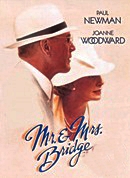
the couple analogous to politician Robert Dole and presumably his wife Elizabeth. The essay didn’t have the guts to say its gist is that no whitey is really racist if the blacks and Jews and other minorities just do what the Bridges and the Doles tell them to. Another but more perceptive essay on the net asserts a reader can never be sure which side Connell finds less repellant, as he’s trying for fairness in observing the lives of his parents not yet coming to grips with their shortcomings. (Mirroring the fate of Elizabeth Dole’s reëlection campaign, mindsets rarely change.) The movie of Mr. & Mrs. Bridge by producer Ismail Merchant, director James Ivory and adapter Ruth Prawer Jhabvala endeavors to combine both books to present evenly the frictional sides of old codger Walter as a sex-starved uptight lawyer who’s got a yen for one of the daughters, and old frumpy India who seldom exercises her brain. Because the Newmans—Paul and his wife Joanne Woodward—are on board, the social hatreds of Walter and the ignorance of India are constricted; the characters remain clearly what they are but any deep offenses of bigotry or stupidity are given the customary softening we’ve seen in other movies by the movie-making team. Newman and Woodward are first rate, acting better in this than anything they’ve done together since their “Methody” sexplication in The Long, Hot Summer. Would give Newman the edge as his Walter is rigidity cracking—he can’t really say no to his kids, despite their rejection of his intolerable conservativism. Woodward reportedly said Walter’s closer to who Newman was than any other character he played; related to fatherly concerns, yes, but not the same politics. Her India’s a fumbling mess who during one crisis or another thinks tea or hot chocolate or the “Mystery of Marriage” pamphlet can be problem soothers; she’s unable to enforce even a single proscription—like stopping Saundra McClain’s scene-stealing maid Harriet from boozing on the job. Nor cognize, at end, the car’s horn could be used to summon a rescue. As for Woodward the actress, readers might recall one of the great laughs from the Kael years when she quipped Woodward was “turning into the educated people’s Lana Turner.” But with Mr. & Mrs. Bridge, and another Hazelesque performance in Breathing Lessons—and I’ll refrain from comment on her version of Come Back, Little Sheba—she fermented into Shirley Booth.
Evan S. Connell’s Mrs. Bridge and the follow up Mr. Bridge are sometimes called satirical looks at the upper middle class American WASP out of 30s/40s Kansas. And somewhere on the Internet there’s a lousy essay making
the couple analogous to politician Robert Dole and presumably his wife Elizabeth. The essay didn’t have the guts to say its gist is that no whitey is really racist if the blacks and Jews and other minorities just do what the Bridges and the Doles tell them to. Another but more perceptive essay on the net asserts a reader can never be sure which side Connell finds less repellant, as he’s trying for fairness in observing the lives of his parents not yet coming to grips with their shortcomings. (Mirroring the fate of Elizabeth Dole’s reëlection campaign, mindsets rarely change.) The movie of Mr. & Mrs. Bridge by producer Ismail Merchant, director James Ivory and adapter Ruth Prawer Jhabvala endeavors to combine both books to present evenly the frictional sides of old codger Walter as a sex-starved uptight lawyer who’s got a yen for one of the daughters, and old frumpy India who seldom exercises her brain. Because the Newmans—Paul and his wife Joanne Woodward—are on board, the social hatreds of Walter and the ignorance of India are constricted; the characters remain clearly what they are but any deep offenses of bigotry or stupidity are given the customary softening we’ve seen in other movies by the movie-making team. Newman and Woodward are first rate, acting better in this than anything they’ve done together since their “Methody” sexplication in The Long, Hot Summer. Would give Newman the edge as his Walter is rigidity cracking—he can’t really say no to his kids, despite their rejection of his intolerable conservativism. Woodward reportedly said Walter’s closer to who Newman was than any other character he played; related to fatherly concerns, yes, but not the same politics. Her India’s a fumbling mess who during one crisis or another thinks tea or hot chocolate or the “Mystery of Marriage” pamphlet can be problem soothers; she’s unable to enforce even a single proscription—like stopping Saundra McClain’s scene-stealing maid Harriet from boozing on the job. Nor cognize, at end, the car’s horn could be used to summon a rescue. As for Woodward the actress, readers might recall one of the great laughs from the Kael years when she quipped Woodward was “turning into the educated people’s Lana Turner.” But with Mr. & Mrs. Bridge, and another Hazelesque performance in Breathing Lessons—and I’ll refrain from comment on her version of Come Back, Little Sheba—she fermented into Shirley Booth.
 George Clooney spent roughly $70 million dollars directing The Monuments Men as a private buddy movie, only I didn’t feel much personal camaraderie and doubt if others will either. He opens it very unconvincingly—his
voice and urgent appeal to
save art stolen
by the Nazis are as weak and obscure as the two-man audience he’s addressing. Rolling out the cast, there’s not a single moment of belief in any its members as historians of art or curators of museums or, much less, John Goodman as American sculptor Walker Hancock. (John’s in imminent danger of becoming a bad joke whore.) Beyond the blahs the performers spread, we don’t find much to dislike about the picture other than a country house sequence as a limpy nod to Inglorious Basterds and the clumsiness of a hero’s death in a Bruges church. What’s disappointing is there’s not much to like: there’s a minimal interest if only to compare it to John Frankenheimer’s The Train; I like the use of the tie Cate Blanchett gives Matt Damon; Nora Sagal furnishes a very uncluttered version of “Have Yourself a Merry Little Christmas.” We’re not anticipating the let’s-go-get-’em energy
of The Dirty Dozen, but when Phedon Papamichael’s camera pans the actors on a freight elevator we’re not expecting to see so many pronounced frowns on a wasted cast. They look like they know the party’s over.
George Clooney spent roughly $70 million dollars directing The Monuments Men as a private buddy movie, only I didn’t feel much personal camaraderie and doubt if others will either. He opens it very unconvincingly—his
voice and urgent appeal to
save art stolen
by the Nazis are as weak and obscure as the two-man audience he’s addressing. Rolling out the cast, there’s not a single moment of belief in any its members as historians of art or curators of museums or, much less, John Goodman as American sculptor Walker Hancock. (John’s in imminent danger of becoming a bad joke whore.) Beyond the blahs the performers spread, we don’t find much to dislike about the picture other than a country house sequence as a limpy nod to Inglorious Basterds and the clumsiness of a hero’s death in a Bruges church. What’s disappointing is there’s not much to like: there’s a minimal interest if only to compare it to John Frankenheimer’s The Train; I like the use of the tie Cate Blanchett gives Matt Damon; Nora Sagal furnishes a very uncluttered version of “Have Yourself a Merry Little Christmas.” We’re not anticipating the let’s-go-get-’em energy
of The Dirty Dozen, but when Phedon Papamichael’s camera pans the actors on a freight elevator we’re not expecting to see so many pronounced frowns on a wasted cast. They look like they know the party’s over.
 As contraction of involuntary celibate, “incel” has become both an urban slur aimed at and a popular badge worn by misogynists who can’t get any action. Not as derogatory as “faggot” yet close, as numbers of incels are probably closeted, unable to deal with what strokes their boners. The central
character in Barry Jenkins’s Oscar-winning Moonlight, Chiron isn’t too sure about his feelings toward women in general, being unsympathetic to and ambivalent about his drug-addicted mother. This is implicitly linked to his sexual identity crisis. A virgin as safety factor, he’s in fear of his neighborhood bros’ reactions to anyone outside the accepted norm. Making matters perilous, Chiron looks outside the norm, a bright-eyed
Miami ghetto ghoul ready to be pounced on. Asking about himself if he’s a faggot, the response from his mother’s drug pusher is No, that’s a word others use to denigrate. How do I know I’m gay, then? The answer from the same source is stunning to hear and likely the reason for Mahershalo Ali winning a supporting actor Oscar: time will tell. During the first third I wanted to shout “Get on with it!” (A similar response, in different context, to those dawdlers in Call Me By Your Name.) Less impatient
in the second part, having rather liked the chair smashing over a thug and being startled by an outdoor down-low sequence. The last third offers three moments—an apology, an admission and the visible shakes—allowing us to get into the director’s tempered rhythm. For a while, the Peggy Lee question “Is that all there is?” comes to mind anyway, because it does seem a lot falls away in the time jumps. Then the delayed reaction hits: irrespective of our skepticism
in an age of intense sex obsession, the sparseness is of a whole, we are getting all there is of the matter. A Euro somnambulate artiness permeates throughout Moonlight; this is not USC textbook movie making in the John Singleton fashion of Boyz N the Hood or the urban guerilla of angry Spike Lee. The black Miami vicinage is a unified vision: Jenkins and his movie school buddies James Laxton
as cinematographer and Joi McMillon and Nat Sanders as film editors, all of whom would join to do 2018’s If Beale Street Could Talk, find harmony in measured aesthetics and economy. (Production cost said to be somewhere around $4 million and highly laudable; Beale Street shot up to $12 million.) The diligence extends to Tarell Alvin McCraney’s script; based on his drama school assignment In Moonlight Black Boys Look Blue, the dialogue has the sound of fractured urban-ethnic
conversations to the point we need flash translations to make sure we’re following the syntax. Economy is also present in the acting; excepting Naomie Harris, the principals are absent of showiness. Alex R. Hibbert as the first and Ashton Sanders the second actor playing Chiron have significant resemblance and graduated consistency; Trevante Rhodes as number three is the buffed survivalist out of the shadows but for his sexual latency. Everyone’s favorite Moneypenny who should be the female Bond,
Harris doesn’t quite sway as a mother with regrets; she’s flashing the reminder of an addict’s remorse as inconclusive about its sincerity. (She’s substantially more persuasive shaving Daniel Craig.) A few years late with remonstration but still deserving: when Bonnie Dunaway and Clyde Beatty couldn’t defrost their brain freezes fast enough to look at the envelope heading and went on to ignore the printed words on the inside card—Emma Stone for La La Land—and instead feebishly
announced La La Land as the Oscar winner for best picture of 2016, their joint gaucherie and goosey excuses symbolized the rot in presumptuous Sunset Boulevard divas. The far more just reversal of fortune took place minutes later, in a multiple roadkill as the best awards finale ever, continues to impact and strengthen the slow build of power in the real winner.
As contraction of involuntary celibate, “incel” has become both an urban slur aimed at and a popular badge worn by misogynists who can’t get any action. Not as derogatory as “faggot” yet close, as numbers of incels are probably closeted, unable to deal with what strokes their boners. The central
character in Barry Jenkins’s Oscar-winning Moonlight, Chiron isn’t too sure about his feelings toward women in general, being unsympathetic to and ambivalent about his drug-addicted mother. This is implicitly linked to his sexual identity crisis. A virgin as safety factor, he’s in fear of his neighborhood bros’ reactions to anyone outside the accepted norm. Making matters perilous, Chiron looks outside the norm, a bright-eyed
Miami ghetto ghoul ready to be pounced on. Asking about himself if he’s a faggot, the response from his mother’s drug pusher is No, that’s a word others use to denigrate. How do I know I’m gay, then? The answer from the same source is stunning to hear and likely the reason for Mahershalo Ali winning a supporting actor Oscar: time will tell. During the first third I wanted to shout “Get on with it!” (A similar response, in different context, to those dawdlers in Call Me By Your Name.) Less impatient
in the second part, having rather liked the chair smashing over a thug and being startled by an outdoor down-low sequence. The last third offers three moments—an apology, an admission and the visible shakes—allowing us to get into the director’s tempered rhythm. For a while, the Peggy Lee question “Is that all there is?” comes to mind anyway, because it does seem a lot falls away in the time jumps. Then the delayed reaction hits: irrespective of our skepticism
in an age of intense sex obsession, the sparseness is of a whole, we are getting all there is of the matter. A Euro somnambulate artiness permeates throughout Moonlight; this is not USC textbook movie making in the John Singleton fashion of Boyz N the Hood or the urban guerilla of angry Spike Lee. The black Miami vicinage is a unified vision: Jenkins and his movie school buddies James Laxton
as cinematographer and Joi McMillon and Nat Sanders as film editors, all of whom would join to do 2018’s If Beale Street Could Talk, find harmony in measured aesthetics and economy. (Production cost said to be somewhere around $4 million and highly laudable; Beale Street shot up to $12 million.) The diligence extends to Tarell Alvin McCraney’s script; based on his drama school assignment In Moonlight Black Boys Look Blue, the dialogue has the sound of fractured urban-ethnic
conversations to the point we need flash translations to make sure we’re following the syntax. Economy is also present in the acting; excepting Naomie Harris, the principals are absent of showiness. Alex R. Hibbert as the first and Ashton Sanders the second actor playing Chiron have significant resemblance and graduated consistency; Trevante Rhodes as number three is the buffed survivalist out of the shadows but for his sexual latency. Everyone’s favorite Moneypenny who should be the female Bond,
Harris doesn’t quite sway as a mother with regrets; she’s flashing the reminder of an addict’s remorse as inconclusive about its sincerity. (She’s substantially more persuasive shaving Daniel Craig.) A few years late with remonstration but still deserving: when Bonnie Dunaway and Clyde Beatty couldn’t defrost their brain freezes fast enough to look at the envelope heading and went on to ignore the printed words on the inside card—Emma Stone for La La Land—and instead feebishly
announced La La Land as the Oscar winner for best picture of 2016, their joint gaucherie and goosey excuses symbolized the rot in presumptuous Sunset Boulevard divas. The far more just reversal of fortune took place minutes later, in a multiple roadkill as the best awards finale ever, continues to impact and strengthen the slow build of power in the real winner.
 2012 became the year of Matthew McConauhey. After Bernie, Magic Mike,
The Paperboy and Killer Joe, is there a better actor from the red states currently practicing his craft? By any calculation, his prevalence would be overkill yet, so far at least, he’s escaped the contempt of familiarity. (Not for long—the media ginned up his Dallas Buyers Club as Oscar certainty.)
Why he’d skirt the dangers of overdose for so long I’m not sure, though other movie lovers speak of his naturalness, translating into the presumed fact few performers working right now are more simply or more comfortably who they are. Certainly took time for us to be convinced—a slew of bad movies
and performances preceded his present stature—and it’s not farfetched to surmise what’s made him so effective lately is those bummer experiences and fame’s vicissitudes have brought him back home, embracing and sometimes relishing in the acceptance of territory now seeming his almost exclusively. Without suggesting self-limitations—even if there’s evidence he has—I’m according him the honor of being a full length mirror of indigenous panoply. And Mud, made in 2012 and released a year later, reflects another extension of his southern repertoire. He’s pulling magic tricks out of his swamp-soaked Stetson. Wish the movie had similar tricks to pull: so many shallow questions unnecessarily pop up about the characters and if it hadn’t been for Matthew’s expansion of dominion we’d have lost interest. (How does his love interest Reese Witherspoon, who deserves a larger part, pay for her motel room?
How do the boys—who come upon a hiding Matthew on an island in the Mississippi river—pay for all the gas for the boat engine for the return visits? Wouldn’t one of the parents ask why the boys need more gas money?) Except for the ending, writer-director Jeff Nichols appears to have absorbed bits of Weir’s The Mosquito Coast as an Arkansan who hasn’t much interest in tying up loose ends. During the climax of Mud,
he pops an amusing load in an excessive nighttime shoot-out. Thing is, we don’t believe a minute of it. This movie might be the beginning of a down trend for Matthew.
2012 became the year of Matthew McConauhey. After Bernie, Magic Mike,
The Paperboy and Killer Joe, is there a better actor from the red states currently practicing his craft? By any calculation, his prevalence would be overkill yet, so far at least, he’s escaped the contempt of familiarity. (Not for long—the media ginned up his Dallas Buyers Club as Oscar certainty.)
Why he’d skirt the dangers of overdose for so long I’m not sure, though other movie lovers speak of his naturalness, translating into the presumed fact few performers working right now are more simply or more comfortably who they are. Certainly took time for us to be convinced—a slew of bad movies
and performances preceded his present stature—and it’s not farfetched to surmise what’s made him so effective lately is those bummer experiences and fame’s vicissitudes have brought him back home, embracing and sometimes relishing in the acceptance of territory now seeming his almost exclusively. Without suggesting self-limitations—even if there’s evidence he has—I’m according him the honor of being a full length mirror of indigenous panoply. And Mud, made in 2012 and released a year later, reflects another extension of his southern repertoire. He’s pulling magic tricks out of his swamp-soaked Stetson. Wish the movie had similar tricks to pull: so many shallow questions unnecessarily pop up about the characters and if it hadn’t been for Matthew’s expansion of dominion we’d have lost interest. (How does his love interest Reese Witherspoon, who deserves a larger part, pay for her motel room?
How do the boys—who come upon a hiding Matthew on an island in the Mississippi river—pay for all the gas for the boat engine for the return visits? Wouldn’t one of the parents ask why the boys need more gas money?) Except for the ending, writer-director Jeff Nichols appears to have absorbed bits of Weir’s The Mosquito Coast as an Arkansan who hasn’t much interest in tying up loose ends. During the climax of Mud,
he pops an amusing load in an excessive nighttime shoot-out. Thing is, we don’t believe a minute of it. This movie might be the beginning of a down trend for Matthew.
 Simon Curtis’s 2011 My Week with Marilyn has three things going for it: Michelle Williams in an Oscar-nominated performance as the star, Eddie
Redmayne as the young
assistant Colin Clark who’s enamored and, within the story of the making of 1957’s The Prince and the Showgirl, the sweet tale of their questionable fling. Based on Clark’s 1996 The Prince, the Showgirl and Me and his 2000 diary with the same title as the movie, they cover much the same territory as Olivier’s remarks in his Confessions of an Actor. (If you’ve
read
it, you come to the conclusion he doesn’t confess enough.) Clark’s diary, written two years before his death, alleges an affair with her missing in the first book, and the secret stayed mum for around fifty years. This alerted suspicious entertainment watchdogs at The Guardian. No disputing he had been hired as a gofer principally because he was the son of Sir Kenneth Clark, the celebrated art historian, and the ordeals endured by the entire crew are factual. The snoops, however, don’t buy the beddie
bye. But who’s to say, given her fluctuating states of mind and emotions, exacerbated by booze and drugs, what she may have encouraged when alone with Colin, since he was—and is played by Redmayne as—a puppy. Truthiness is at play here: Williams gets to some of Marilyn’s fleeting essence of magnanimity. She and Curtis seem acutely aware viewers are tired of Marilyn’s repetitious conditions—it’s become a bane as well for actresses trying to play her—and lessen
considerably the exasperation
by giving her an open heart with a bit of early history popping out. In this version, Marilyn connects to real people as refuge, to say to someone like Redmayne’s Colin, “Come on, let’s take a dip.” Not at all farfetched the lonely superstar would want to cuddle and play with an adorable puppy, maybe grant a fuck as bestowal to a younker who isn’t trying to enforce dominance over her. Surprising me more than anything else about Williams is she bares a stronger resemblance to Barbara
Nichols than to Marilyn. (And I admit sometimes confusing Williams with Carey Mulligan; they do seem ready-made interchangeables.) Redmayne has been dream casting for several years: in The Theory of Everything, in The Danish Girl, and as Colin, for whom he comes fully equipped: requisitely a cutie with just enough appeal not to overshadow
the star,
sufficiently naïve to be excused for crossing the line, a gallant who won’t kiss and tell for years. A bonus attached: when he grows up, he’ll make a decent Bond. If accounts of her histories with men are even half way true, Marilyn did herself a disservice in not taking Colin home. The generosity might have helped save her.
Simon Curtis’s 2011 My Week with Marilyn has three things going for it: Michelle Williams in an Oscar-nominated performance as the star, Eddie
Redmayne as the young
assistant Colin Clark who’s enamored and, within the story of the making of 1957’s The Prince and the Showgirl, the sweet tale of their questionable fling. Based on Clark’s 1996 The Prince, the Showgirl and Me and his 2000 diary with the same title as the movie, they cover much the same territory as Olivier’s remarks in his Confessions of an Actor. (If you’ve
read
it, you come to the conclusion he doesn’t confess enough.) Clark’s diary, written two years before his death, alleges an affair with her missing in the first book, and the secret stayed mum for around fifty years. This alerted suspicious entertainment watchdogs at The Guardian. No disputing he had been hired as a gofer principally because he was the son of Sir Kenneth Clark, the celebrated art historian, and the ordeals endured by the entire crew are factual. The snoops, however, don’t buy the beddie
bye. But who’s to say, given her fluctuating states of mind and emotions, exacerbated by booze and drugs, what she may have encouraged when alone with Colin, since he was—and is played by Redmayne as—a puppy. Truthiness is at play here: Williams gets to some of Marilyn’s fleeting essence of magnanimity. She and Curtis seem acutely aware viewers are tired of Marilyn’s repetitious conditions—it’s become a bane as well for actresses trying to play her—and lessen
considerably the exasperation
by giving her an open heart with a bit of early history popping out. In this version, Marilyn connects to real people as refuge, to say to someone like Redmayne’s Colin, “Come on, let’s take a dip.” Not at all farfetched the lonely superstar would want to cuddle and play with an adorable puppy, maybe grant a fuck as bestowal to a younker who isn’t trying to enforce dominance over her. Surprising me more than anything else about Williams is she bares a stronger resemblance to Barbara
Nichols than to Marilyn. (And I admit sometimes confusing Williams with Carey Mulligan; they do seem ready-made interchangeables.) Redmayne has been dream casting for several years: in The Theory of Everything, in The Danish Girl, and as Colin, for whom he comes fully equipped: requisitely a cutie with just enough appeal not to overshadow
the star,
sufficiently naïve to be excused for crossing the line, a gallant who won’t kiss and tell for years. A bonus attached: when he grows up, he’ll make a decent Bond. If accounts of her histories with men are even half way true, Marilyn did herself a disservice in not taking Colin home. The generosity might have helped save her.
 The press started piling on 1970’s Myra Breckinridge even before filming started, and when production commenced the negatives grew stronger, often from the people involved in its making. Author Gore Vidal disavowed it; critic
Rex Reed as “Myron” would
write an exposé claiming the movie would never be released; later on, John Huston refused to mention it in his autobio. By the time the movie was released, the universally bad buzz squashed stampedes to the box office and only those desperate for a guilty pleasure fix sneaked in to the late night showings. I was one of them, but I’ll be damned if I remember anything other than the names of those who got duped into it. Then one day E! ran a repeat about movie stinkers and there’s
Myra and I booked via Netflix. Of course it remains a disaster; absent Vidal’s cheeky camp on American sexual mores, it’s an all-out blitz of indecency. Free from any memories, I’m enjoying it now, especially Raquel Welsh’s “go for it” romping; she’s the only one who suggests she wouldn’t dare blow the chance to upstage all the others and in many scenes she does. Clad in Theodora Van Rinkle’s bad taste, Raquel is rather like a Jackie Collins heroine, sashaying with all
the élan of Hollywood and Vine. Mae West was reportedly insistent on not having Raquel in their scenes together, avoiding the age differences exacerbating her wax museum kisser and fearful Raquel would out-diva her in a diva shoot-out. Propped up by muscled emptyheads and gyrating fems, West “sings” Ottis Redding’s “Hard to Handle” and the Alan & Marilyn Bergman “You Gotta Taste All the Fruit” with all the ripeness of a fag hag eating a soft, blackened banana. Huston doesn’t offer any defense—perhaps
he was blissfully zonked. Director Michael Sarne threw in a cavalcade of clips from the Golden Oldies, using the shtick of Rowan and Martin’s Laugh In to navigate the transgender material not mainstream fodder. (Lots of clips initially used were excised after
legal threats from those oldies still on life support.) The high of all the lows is supposedly Raquel’s “tits-in-a-flag” ride in a virginal male ass; for those who love Freudian slips, it’s Rex screaming, “Where are my tits?!”
The press started piling on 1970’s Myra Breckinridge even before filming started, and when production commenced the negatives grew stronger, often from the people involved in its making. Author Gore Vidal disavowed it; critic
Rex Reed as “Myron” would
write an exposé claiming the movie would never be released; later on, John Huston refused to mention it in his autobio. By the time the movie was released, the universally bad buzz squashed stampedes to the box office and only those desperate for a guilty pleasure fix sneaked in to the late night showings. I was one of them, but I’ll be damned if I remember anything other than the names of those who got duped into it. Then one day E! ran a repeat about movie stinkers and there’s
Myra and I booked via Netflix. Of course it remains a disaster; absent Vidal’s cheeky camp on American sexual mores, it’s an all-out blitz of indecency. Free from any memories, I’m enjoying it now, especially Raquel Welsh’s “go for it” romping; she’s the only one who suggests she wouldn’t dare blow the chance to upstage all the others and in many scenes she does. Clad in Theodora Van Rinkle’s bad taste, Raquel is rather like a Jackie Collins heroine, sashaying with all
the élan of Hollywood and Vine. Mae West was reportedly insistent on not having Raquel in their scenes together, avoiding the age differences exacerbating her wax museum kisser and fearful Raquel would out-diva her in a diva shoot-out. Propped up by muscled emptyheads and gyrating fems, West “sings” Ottis Redding’s “Hard to Handle” and the Alan & Marilyn Bergman “You Gotta Taste All the Fruit” with all the ripeness of a fag hag eating a soft, blackened banana. Huston doesn’t offer any defense—perhaps
he was blissfully zonked. Director Michael Sarne threw in a cavalcade of clips from the Golden Oldies, using the shtick of Rowan and Martin’s Laugh In to navigate the transgender material not mainstream fodder. (Lots of clips initially used were excised after
legal threats from those oldies still on life support.) The high of all the lows is supposedly Raquel’s “tits-in-a-flag” ride in a virginal male ass; for those who love Freudian slips, it’s Rex screaming, “Where are my tits?!”
 In Nightcrawler, looking at novice stringer Jake Gyllenhaal’s cruelly intrusive video of a dying accident victim and determined to withhold her pant of the rush of “if it bleeds it leads,” graveyard TV news director
Rene Russo instructs her crew
with the following lingo: “I want to break it up and do a wrap-around from the scene, a walk-in standup, a teaser at 5 and repeat at the half.” Rene sounds suddenly empowered as a fatigued vagabond in the business of TV news, having jumped from one low-rated station to another after her two-year contracts aren’t renewed because she’s not lifting ratings out of the cellar. She’s still unjaded enough not to be an ego-whacker when she sees a spark of commodity in a newbie. Her first
impression of the crawler of the night is probably “from what grave did they dig this guy out of?” because Jake, with 20 pounds of flesh gone, looks like Halt and Catch Fire’s Joe MacMillan as Max Schreck’s Graf Orlok from Nosferatu. This might be what attracts her—his seedy emaciation suggests he’s starving and her circumscribed praise of his insensate work may be happy meals for both. Rene is at her sharpest when she’s at the edge of classlessness. Overly decked out and amusingly
hung over
in Pierce Brosnan’s remake of The Thomas Crown Affair, she wants to play by the rules but she also knows living by them isn’t as satisfying as skirting around them. Her ample gift is in putting dirty smiles on our faces. Though married to Dan Gilroy, the director/writer of Nightcrawler,
she’s not engaged in stealing scenes or hogging the show but she’s very sorely missed when not on screen. The movie’s second asset—the conversations between Rene and Jake which quicken our senses, alert to the dread of a bloodless stalker’s invasiveness. There’s swirling queasiness in the way Reno looks at, listens and talks to him, staying ahead of his creepy trespasses of privacy and insinuations employed as leverage. She doesn’t like being accosted by his effrontery, though it apparently doesn’t
keep her from going to bed with him, if we can believe what Jake says. I choose not to, for Rene’s sake; it’s a hazardous way to pay forward in order to get a fattened up contract renewal.
In Nightcrawler, looking at novice stringer Jake Gyllenhaal’s cruelly intrusive video of a dying accident victim and determined to withhold her pant of the rush of “if it bleeds it leads,” graveyard TV news director
Rene Russo instructs her crew
with the following lingo: “I want to break it up and do a wrap-around from the scene, a walk-in standup, a teaser at 5 and repeat at the half.” Rene sounds suddenly empowered as a fatigued vagabond in the business of TV news, having jumped from one low-rated station to another after her two-year contracts aren’t renewed because she’s not lifting ratings out of the cellar. She’s still unjaded enough not to be an ego-whacker when she sees a spark of commodity in a newbie. Her first
impression of the crawler of the night is probably “from what grave did they dig this guy out of?” because Jake, with 20 pounds of flesh gone, looks like Halt and Catch Fire’s Joe MacMillan as Max Schreck’s Graf Orlok from Nosferatu. This might be what attracts her—his seedy emaciation suggests he’s starving and her circumscribed praise of his insensate work may be happy meals for both. Rene is at her sharpest when she’s at the edge of classlessness. Overly decked out and amusingly
hung over
in Pierce Brosnan’s remake of The Thomas Crown Affair, she wants to play by the rules but she also knows living by them isn’t as satisfying as skirting around them. Her ample gift is in putting dirty smiles on our faces. Though married to Dan Gilroy, the director/writer of Nightcrawler,
she’s not engaged in stealing scenes or hogging the show but she’s very sorely missed when not on screen. The movie’s second asset—the conversations between Rene and Jake which quicken our senses, alert to the dread of a bloodless stalker’s invasiveness. There’s swirling queasiness in the way Reno looks at, listens and talks to him, staying ahead of his creepy trespasses of privacy and insinuations employed as leverage. She doesn’t like being accosted by his effrontery, though it apparently doesn’t
keep her from going to bed with him, if we can believe what Jake says. I choose not to, for Rene’s sake; it’s a hazardous way to pay forward in order to get a fattened up contract renewal.
 Rob
Marshall’s
Nine is about as sexy straight as Elena Kagan. Bloated with neutered incidentals about Daniel Day-Lewis’s Guido as irresistible kingpin director suffering a mid-life crisis in the middle of a creative one, the musical’s a reconciliation with himself, his cinematic wanderings, his long-suffering wife, his mother and his extramarital bimbos. Those sitting through Fellini’s 8½ see it as a vanity blowout on the exhausting meanderings of a genius who just happens to be Italy’s most famous movie maker. Why Marshall is helming this unmelodic roundelay about Fellini’s alter and his dames advertising their Euro-hip acquiescence to him is a little more perplexing. He got away with Chicago because he cut any risk of affection by transforming Roxie Hart into what even equal opportunity offender Family Guy got right about her—she’s a cold-blooded, whiney sexless cartoon. He can’t, however, get away with his avoidance barriers here; this is decidedly a hetero mélange of pseudo reality and fantasy interspersed with boring tunes as confessional adoration. Unable to knead the glitz to an egotist’s angst, some sympathy is due: Arthur Kopit’s musical book is scrambled, like the primary source, with things going every which way, and Michael Tolkin’s screenplay and Anthony Minghella’s polish surrender to the original gamble of Javier Bardem’s Latin magnetism as a seductive Guido coalescing the fragmentation. Then Bardem pulled out and Day-Lewis came in, altering the ethnicity and cultural forces of the character as whammies exacerbating Marshall’s diagrammatics. A gifted thespian who sometimes turns the craft of acting into the art of vacancy, flabless Day-Lewis puts his methodology into smiles, accent, acrobatics on scaffolding, gum-chewing and an overload of cigarettes; his acclaimed disappearance into a role is reversed—it’s Guido who vanishes. Maury Yeston’s score hasn’t much to cream over either; when story elements turn into lyrics and melody, they become discordant and Marshall’s presentations, requiring sensuality but often acceding to gymnastic gyrations, collapse into sour derivativeness. Carmenized in top-heavy curls, Fergie works those chairs from Cabaret and Chicago when belting out “Be Italian,” only to be overwhelmed by the cavernous set; Penélope Cruz slithers down the tiresome phallic symbol while singing without irony “A Call from the Vatican”; Marion Cotillard does a Madonna-like “Take It All” and while warbling “My Husband Makes Movies” she idiotically walks up and down stairs. Kate Hudson’s kinetic “Cinema Italiano” is more 60s homage to her mother’s considerably less orgasmic dancing on Laugh In and in Cactus Flower, yet done with MTV video flare, supported by clone Guidos in dull suits, thin ties and shades, she’s no slouch in giving us the movie’s single high. While one of the songs, “Unusual Way,” has a promise of torch, poignantly voiced by Nicole Kidman, it’s infuriatingly chopped into pieces eliminating the build. Another handicap is her howler formal with its wired-in falsies—we’re pretty sure Anita Ekberg is laughing in the shadows of Roma’s backstreets. An OMG siren goes off when Judi Dench in Anna Wintour cut sings “Folies Bergère” like a dwarfy Maurice Chevalier dropping octaves to insinuate Marlene Dietrich as Queen Latifah in a bustier. Need shock absorbers when Sophia Loren can’t manage a simple waltz with her son, and elsewhere hides in funereal candles ready for a vigil. Retooling the old George Cukor tradition of handholding commiseration with leading ladies, Marshall can’t prevent the same outcome—turning himself into a closeted lesbian.
Rob
Marshall’s
Nine is about as sexy straight as Elena Kagan. Bloated with neutered incidentals about Daniel Day-Lewis’s Guido as irresistible kingpin director suffering a mid-life crisis in the middle of a creative one, the musical’s a reconciliation with himself, his cinematic wanderings, his long-suffering wife, his mother and his extramarital bimbos. Those sitting through Fellini’s 8½ see it as a vanity blowout on the exhausting meanderings of a genius who just happens to be Italy’s most famous movie maker. Why Marshall is helming this unmelodic roundelay about Fellini’s alter and his dames advertising their Euro-hip acquiescence to him is a little more perplexing. He got away with Chicago because he cut any risk of affection by transforming Roxie Hart into what even equal opportunity offender Family Guy got right about her—she’s a cold-blooded, whiney sexless cartoon. He can’t, however, get away with his avoidance barriers here; this is decidedly a hetero mélange of pseudo reality and fantasy interspersed with boring tunes as confessional adoration. Unable to knead the glitz to an egotist’s angst, some sympathy is due: Arthur Kopit’s musical book is scrambled, like the primary source, with things going every which way, and Michael Tolkin’s screenplay and Anthony Minghella’s polish surrender to the original gamble of Javier Bardem’s Latin magnetism as a seductive Guido coalescing the fragmentation. Then Bardem pulled out and Day-Lewis came in, altering the ethnicity and cultural forces of the character as whammies exacerbating Marshall’s diagrammatics. A gifted thespian who sometimes turns the craft of acting into the art of vacancy, flabless Day-Lewis puts his methodology into smiles, accent, acrobatics on scaffolding, gum-chewing and an overload of cigarettes; his acclaimed disappearance into a role is reversed—it’s Guido who vanishes. Maury Yeston’s score hasn’t much to cream over either; when story elements turn into lyrics and melody, they become discordant and Marshall’s presentations, requiring sensuality but often acceding to gymnastic gyrations, collapse into sour derivativeness. Carmenized in top-heavy curls, Fergie works those chairs from Cabaret and Chicago when belting out “Be Italian,” only to be overwhelmed by the cavernous set; Penélope Cruz slithers down the tiresome phallic symbol while singing without irony “A Call from the Vatican”; Marion Cotillard does a Madonna-like “Take It All” and while warbling “My Husband Makes Movies” she idiotically walks up and down stairs. Kate Hudson’s kinetic “Cinema Italiano” is more 60s homage to her mother’s considerably less orgasmic dancing on Laugh In and in Cactus Flower, yet done with MTV video flare, supported by clone Guidos in dull suits, thin ties and shades, she’s no slouch in giving us the movie’s single high. While one of the songs, “Unusual Way,” has a promise of torch, poignantly voiced by Nicole Kidman, it’s infuriatingly chopped into pieces eliminating the build. Another handicap is her howler formal with its wired-in falsies—we’re pretty sure Anita Ekberg is laughing in the shadows of Roma’s backstreets. An OMG siren goes off when Judi Dench in Anna Wintour cut sings “Folies Bergère” like a dwarfy Maurice Chevalier dropping octaves to insinuate Marlene Dietrich as Queen Latifah in a bustier. Need shock absorbers when Sophia Loren can’t manage a simple waltz with her son, and elsewhere hides in funereal candles ready for a vigil. Retooling the old George Cukor tradition of handholding commiseration with leading ladies, Marshall can’t prevent the same outcome—turning himself into a closeted lesbian.
 Movies with bible themes are, like everything else, cyclical; what’s old becomes currency from new chumps. In the fifties and sixties, big screen technology gave the religious-themed spectacles like The Ten Commandments,
Ben-Hur, King of Kings, The Greatest Story Ever Told, The Bible and Hawaii a presumed prestige; their expensiveness kept them from straying too far from the otherwise sadistic fantasies and periods. (Okay, DeMille’s bible study camp is rollicking relief, for which we’re all eternally thankful.) In the seventies some religious movies got hip and we found ourselves singing along in Jesus Christ Superstar and Godspell. Then came Scorsese’s The Last Temptation of Christ and afterwards Gibson’s The Passion of the Christ. Roughly a decade later The History Channel confirmed the reversal of its primary mission with Rona Downey’s miniseries The Bible, a huge ratings hit forecasting God & Company would be returning for some limited engagements. With Darren
Aronofsky’s Noah the prime example, believers got more than they expected. This time movie technology isn’t advancing the biblical simplicity of indecorous bling of wickedness and the promise of good cheer in the afterlife. Instead, as atheist ecology, CGI is being used to destroy the scriptural story of Noah, to make mock of it as Transformer: Extinction of Intelligence. It confirms Bill Maher is on to something:
only a hateful God could destroy the world’s innocents because he’s pissed with a relative few. To what avail is the legend of the great flood anyway? To get away with blaming Noah’s 500 year old sperm for the second round of incestuous monsters spawned? (Who exactly did first son Cain screw to beget his exiled clan?) Unboundedly stupid, inconceivably disrespectful to even primitive cognition in the general audience, to say nothing of the contempt for the sincerely nescient religionists, Noah is the worst prestige epic I’ve seen in my lifetime of watching movies.
Movies with bible themes are, like everything else, cyclical; what’s old becomes currency from new chumps. In the fifties and sixties, big screen technology gave the religious-themed spectacles like The Ten Commandments,
Ben-Hur, King of Kings, The Greatest Story Ever Told, The Bible and Hawaii a presumed prestige; their expensiveness kept them from straying too far from the otherwise sadistic fantasies and periods. (Okay, DeMille’s bible study camp is rollicking relief, for which we’re all eternally thankful.) In the seventies some religious movies got hip and we found ourselves singing along in Jesus Christ Superstar and Godspell. Then came Scorsese’s The Last Temptation of Christ and afterwards Gibson’s The Passion of the Christ. Roughly a decade later The History Channel confirmed the reversal of its primary mission with Rona Downey’s miniseries The Bible, a huge ratings hit forecasting God & Company would be returning for some limited engagements. With Darren
Aronofsky’s Noah the prime example, believers got more than they expected. This time movie technology isn’t advancing the biblical simplicity of indecorous bling of wickedness and the promise of good cheer in the afterlife. Instead, as atheist ecology, CGI is being used to destroy the scriptural story of Noah, to make mock of it as Transformer: Extinction of Intelligence. It confirms Bill Maher is on to something:
only a hateful God could destroy the world’s innocents because he’s pissed with a relative few. To what avail is the legend of the great flood anyway? To get away with blaming Noah’s 500 year old sperm for the second round of incestuous monsters spawned? (Who exactly did first son Cain screw to beget his exiled clan?) Unboundedly stupid, inconceivably disrespectful to even primitive cognition in the general audience, to say nothing of the contempt for the sincerely nescient religionists, Noah is the worst prestige epic I’ve seen in my lifetime of watching movies.
 In Tom Ford’s Nocturnal Animals, Jake Gyllenhaal has been carrying this festering hatred of his former wife Amy Adams—over her dislike of his writings, over their marriage
finally collapsing
after a furtive termination—for some twenty years. His rage metastasizes into a retaliatory novel in manuscript form about a man unable to stop the ugliest of crimes waged against him and his family. We don’t merely see the manuscript delivered to Amy, we see its malignancy depicted. But the fictional details attempting to emotionally correspond to the real life assault he feels are, I think, over-scaled and unjust. The novel wants to affix blame on Amy for the fate of the family as punishment for the
perfidy
she
committed against him. During the picture’s pivot, when Amy’s beside herself with remorse while in the car with future hubby Armie Hammer, she lifts those tear-soaked eyes to look out the front windshield to see Jake standing there, apparently having figured out, either by hearing or lip reading, what she did. Loathe to point this out: he’s kind of wussie (Amy’s mother figures him out early on), the marriage didn’t stand much of a chance, and if numbers count in tit for tat, only one innocent deserves
grief. Three, though, are overkill. The novel’s resolution has the relieving consequence of an accident setting straight the blinding rage. Even this is objectionable: Jake appears to issue a Rod Sterling judgement. Maybe what the waiter needed to deliver as Jake’s excuse for not showing up at the restaurant is the novel in published form as fait accompli. (And Jake probably doesn’t want anyone to see what two decades of hate have done to his looks.) Unsettling too are Ford’s queasy commingling of the lusus
naturae and the use of violence as rectifying comeuppance: the wife and daughter in the novel are victims as objet d’art—arranged as exhibition somewhat mirroring the two horizontal objets d’fattie at Amy’s gallery. Though loose, the connection is enough to wonder how Jake got the similarities into the novel when the gallery presentation is in the present. Is Ford saying “artistic” misogyny is permissible as allegory? He likewise seems to beg as inclusion the delayed weak sister heroics from Straw
Dogs, minus the eroticism. (Similar to his début A Single Man with Colin Firth, he avoids the vicissitudes of sexual arousal.)
For Nocturnal Animals, he’s using unseen evil sex as gateway to recreational murder framed as a sterile aestheticism to whip poor
Amy to death. In the first movie, he’s a neat freak John Schlesinger as a revirginized poof; in the second, he’s a neutered Sam Peckinpah without the toxic Texas sweat. He’s not likely to become a sensualist movie maker until he pulls the rubbers off the meat. The movie’s not a total bummer, as I like the following touches: Laura Linney as racist, materialistic Repug who has the movie’s one revoltingly true line about daughters turning into their worst nightmares; the blubbered nudes; Hammer brushing
away (presumed) sugar-free sweetener onto a spotless Ford kitchen floor; the N.Y. elevator operator exposing a cheater; Jena Malone in a Catholic school blouse under an abbreviated leather straight jacket; the otherwise unthinkable glimpse of shit-stained toilet paper.
In Tom Ford’s Nocturnal Animals, Jake Gyllenhaal has been carrying this festering hatred of his former wife Amy Adams—over her dislike of his writings, over their marriage
finally collapsing
after a furtive termination—for some twenty years. His rage metastasizes into a retaliatory novel in manuscript form about a man unable to stop the ugliest of crimes waged against him and his family. We don’t merely see the manuscript delivered to Amy, we see its malignancy depicted. But the fictional details attempting to emotionally correspond to the real life assault he feels are, I think, over-scaled and unjust. The novel wants to affix blame on Amy for the fate of the family as punishment for the
perfidy
she
committed against him. During the picture’s pivot, when Amy’s beside herself with remorse while in the car with future hubby Armie Hammer, she lifts those tear-soaked eyes to look out the front windshield to see Jake standing there, apparently having figured out, either by hearing or lip reading, what she did. Loathe to point this out: he’s kind of wussie (Amy’s mother figures him out early on), the marriage didn’t stand much of a chance, and if numbers count in tit for tat, only one innocent deserves
grief. Three, though, are overkill. The novel’s resolution has the relieving consequence of an accident setting straight the blinding rage. Even this is objectionable: Jake appears to issue a Rod Sterling judgement. Maybe what the waiter needed to deliver as Jake’s excuse for not showing up at the restaurant is the novel in published form as fait accompli. (And Jake probably doesn’t want anyone to see what two decades of hate have done to his looks.) Unsettling too are Ford’s queasy commingling of the lusus
naturae and the use of violence as rectifying comeuppance: the wife and daughter in the novel are victims as objet d’art—arranged as exhibition somewhat mirroring the two horizontal objets d’fattie at Amy’s gallery. Though loose, the connection is enough to wonder how Jake got the similarities into the novel when the gallery presentation is in the present. Is Ford saying “artistic” misogyny is permissible as allegory? He likewise seems to beg as inclusion the delayed weak sister heroics from Straw
Dogs, minus the eroticism. (Similar to his début A Single Man with Colin Firth, he avoids the vicissitudes of sexual arousal.)
For Nocturnal Animals, he’s using unseen evil sex as gateway to recreational murder framed as a sterile aestheticism to whip poor
Amy to death. In the first movie, he’s a neat freak John Schlesinger as a revirginized poof; in the second, he’s a neutered Sam Peckinpah without the toxic Texas sweat. He’s not likely to become a sensualist movie maker until he pulls the rubbers off the meat. The movie’s not a total bummer, as I like the following touches: Laura Linney as racist, materialistic Repug who has the movie’s one revoltingly true line about daughters turning into their worst nightmares; the blubbered nudes; Hammer brushing
away (presumed) sugar-free sweetener onto a spotless Ford kitchen floor; the N.Y. elevator operator exposing a cheater; Jena Malone in a Catholic school blouse under an abbreviated leather straight jacket; the otherwise unthinkable glimpse of shit-stained toilet paper.
 Progressive yet a realist, I’ve never been able to tolerate writer-activist Larry Kramer when he was in his kick ass mode against the “let ’em die” attitudes about AIDS. He was too prissy, pushy, too much a screamer to be an efficacious advocate for the gay community early on
during the crisis. Clearly he didn’t think so, angrily taking a lion’s share of credit for getting NYC and then the nation to pay attention to the ramifications of the Homocaust, as if the “shock value” of Rock Hudson and Gaëtan Dugas and the emergence of the 24/7 CNN news cycle were merely coincidental. When Streisand optioned Kramer’s play The Normal Heart,
with some leaning toward playing what is now the Julia Roberts role, she experienced the unpleasantness of his constant nagging about delays in moving the project forward. I’m being too kind: even in receptive circles of Hollywood he rubbed people so raw with his abrasiveness the willingness to give money for a production would dissolve after initial meetings. Another big problem: who’d play Kramer? No male with box office appeal was eager to uglify to the degree he’d be referred to as another Harold
(from The Boys in the Band), the commonly heard slur at the cafes on Sunset Blvd. Streisand pulled out and, despite his workload with Glee and American Horror Story, director Ryan Murphy took over. Confirming long delays and difficulties can translate into good fortune, his HBO version is a more focused weeper than what Streisand probably would have directed, since she’s inclined to insert soft-focus vanity interludes. (Surely she and son Jason would
duet the title song over the credits.) And the casting issue has been resolved by a winning and brave twosome—Mark Ruffalo as Kramer and Matt Bomer as his lover. Drawing upon his sneaking-up-on-you magnetism saving The Kids Are All Right, Ruffalo’s crafty dilution of Kramer’s mannerisms—all the annoying ones—grants the audience a reprieve and lessens
the severity of the charges against Kramer for failing to cease and desist with his bellicosity. And, obviously, only in reel life is there a chance a man as attractive as Bomer would be open to being sexed by the likes of Kramer. (In this age of the bootilicious, though, no one needs to be gay or a prison inmate to recognize Bomer as a desideratum.) In real life, as seen in the HBO documentary Larry Kramer in Love and Anger, he marries the distinguished William David Webster, who would become
home care provider until death do they part. It’s what the angry crusader wrote—the raw novel Faggots—and what he said about AIDS as the most crippling health crisis since polio that constitute as warnings. The novel, now considered prophetic, made clear this: if gays continued to live their lives selfishly obsessed as bottom feeders, they’ll destroy themselves. The AIDS explosion, however, isn’t only a reminder of the sex practices spreading a killer virus, it also reminds we never know
what new viral murderer will
spring up. The tables turn: now it’s the GQP being devoured by one.
Progressive yet a realist, I’ve never been able to tolerate writer-activist Larry Kramer when he was in his kick ass mode against the “let ’em die” attitudes about AIDS. He was too prissy, pushy, too much a screamer to be an efficacious advocate for the gay community early on
during the crisis. Clearly he didn’t think so, angrily taking a lion’s share of credit for getting NYC and then the nation to pay attention to the ramifications of the Homocaust, as if the “shock value” of Rock Hudson and Gaëtan Dugas and the emergence of the 24/7 CNN news cycle were merely coincidental. When Streisand optioned Kramer’s play The Normal Heart,
with some leaning toward playing what is now the Julia Roberts role, she experienced the unpleasantness of his constant nagging about delays in moving the project forward. I’m being too kind: even in receptive circles of Hollywood he rubbed people so raw with his abrasiveness the willingness to give money for a production would dissolve after initial meetings. Another big problem: who’d play Kramer? No male with box office appeal was eager to uglify to the degree he’d be referred to as another Harold
(from The Boys in the Band), the commonly heard slur at the cafes on Sunset Blvd. Streisand pulled out and, despite his workload with Glee and American Horror Story, director Ryan Murphy took over. Confirming long delays and difficulties can translate into good fortune, his HBO version is a more focused weeper than what Streisand probably would have directed, since she’s inclined to insert soft-focus vanity interludes. (Surely she and son Jason would
duet the title song over the credits.) And the casting issue has been resolved by a winning and brave twosome—Mark Ruffalo as Kramer and Matt Bomer as his lover. Drawing upon his sneaking-up-on-you magnetism saving The Kids Are All Right, Ruffalo’s crafty dilution of Kramer’s mannerisms—all the annoying ones—grants the audience a reprieve and lessens
the severity of the charges against Kramer for failing to cease and desist with his bellicosity. And, obviously, only in reel life is there a chance a man as attractive as Bomer would be open to being sexed by the likes of Kramer. (In this age of the bootilicious, though, no one needs to be gay or a prison inmate to recognize Bomer as a desideratum.) In real life, as seen in the HBO documentary Larry Kramer in Love and Anger, he marries the distinguished William David Webster, who would become
home care provider until death do they part. It’s what the angry crusader wrote—the raw novel Faggots—and what he said about AIDS as the most crippling health crisis since polio that constitute as warnings. The novel, now considered prophetic, made clear this: if gays continued to live their lives selfishly obsessed as bottom feeders, they’ll destroy themselves. The AIDS explosion, however, isn’t only a reminder of the sex practices spreading a killer virus, it also reminds we never know
what new viral murderer will
spring up. The tables turn: now it’s the GQP being devoured by one.
 Lasse Hallström’s confection The One Hundred-Foot Journey, based on Richard C. Morais’s beloved international bestseller, is safe for those afraid of unexpected jolts (albeit after receiving one within minutes of
its opening), safe for those
wanting a straight romance for a change, safe for those who love Helen Mirren going from grand cru Valrhona to grand noir Michel Cluizel. The movie’s ambiance looks intensely affected even when it isn’t but doesn’t hurt—the postiche is required “magical” component keeping the eyes moving and, with Oprah and Spielberg producing, holds at bay the pro forma of snobby French prejudice. Throughout I was reminded of Ratatouille, which also unifies setting, food and enmity
of rats to create receptiveness for the audience. (Would have liked someone close to Peter O’Toole’s Anton Ego as clever connection but Michelin is loath to notoriety of its raters.) Been forever since an actor’s back is required to act and Mirren’s does so quite nicely when evaluating an omelet as a test of a gourmet’s skills; we can envision her mouth savoring the condiments, measuring how moist and tender the eggs. Om Puri has fun getting back at Mirren when she’s in saboteur mode.
Manish Dayal’s up & coming chef and his romantic interest Charlotte Le Bon stay fresh and appealing. Overall, the charm wears thin, or so I thought until watching a few days later the palate-numbed Magic in the Moonlight, a trifle so antiquated that all there is to do is guess how much creative juice is left in Woody Allen and wonder what kind
of diet Colin Firth used before filming. The deprivation makes The One Hundred-Foot Journey a cinch to get that coveted extra star.
Lasse Hallström’s confection The One Hundred-Foot Journey, based on Richard C. Morais’s beloved international bestseller, is safe for those afraid of unexpected jolts (albeit after receiving one within minutes of
its opening), safe for those
wanting a straight romance for a change, safe for those who love Helen Mirren going from grand cru Valrhona to grand noir Michel Cluizel. The movie’s ambiance looks intensely affected even when it isn’t but doesn’t hurt—the postiche is required “magical” component keeping the eyes moving and, with Oprah and Spielberg producing, holds at bay the pro forma of snobby French prejudice. Throughout I was reminded of Ratatouille, which also unifies setting, food and enmity
of rats to create receptiveness for the audience. (Would have liked someone close to Peter O’Toole’s Anton Ego as clever connection but Michelin is loath to notoriety of its raters.) Been forever since an actor’s back is required to act and Mirren’s does so quite nicely when evaluating an omelet as a test of a gourmet’s skills; we can envision her mouth savoring the condiments, measuring how moist and tender the eggs. Om Puri has fun getting back at Mirren when she’s in saboteur mode.
Manish Dayal’s up & coming chef and his romantic interest Charlotte Le Bon stay fresh and appealing. Overall, the charm wears thin, or so I thought until watching a few days later the palate-numbed Magic in the Moonlight, a trifle so antiquated that all there is to do is guess how much creative juice is left in Woody Allen and wonder what kind
of diet Colin Firth used before filming. The deprivation makes The One Hundred-Foot Journey a cinch to get that coveted extra star.
 If indisputable the vast wasteland of TV sickens with its broadening stupidity, ever more apparent with current mindless political coverage, it’s also the medium which introduced its own art form—the miniseries. Whatever else are pluses and minuses, the form is ideal
for
binge viewing. Especially
the romanticized trash in the first season of Starz’s Outlander. It keeps the focus to a limited populace and it’s not over-scaled; this isn’t the stuff of Game of Thrones. The time travel guide—Caitriona Balfe’s Claire—gathers up enormous goodwill from viewers by the tricky device of always being the modern caught in the web of a darker age. By shutting down the story’s illogicality, we’re right there
with her when she nearly or actually betrays her origins to find ways to get out of desperate situations. Only the obligatory witch trial nettles with its excessive shrilling, though two surprises save it. Obviously an outlandish adventure, fraught with all the expectant perils, and had Claire been played by an established star the gamble might not pay off, as the audience might be less willing to suspend the huge disbelief factor. Balfe’s contemporary husband and dark age
antagonist is Tobias Menzies, known to viewers of HBO’s Rome for playing Brutus and in The Crown as Prince Phillip. He’s a sensation unveiled in a way only women producers, directors and writers could get away with, specifically the elongated and bizarre climax. The “herb of love” has never been more novelistically purple in its powers of seduction.
If indisputable the vast wasteland of TV sickens with its broadening stupidity, ever more apparent with current mindless political coverage, it’s also the medium which introduced its own art form—the miniseries. Whatever else are pluses and minuses, the form is ideal
for
binge viewing. Especially
the romanticized trash in the first season of Starz’s Outlander. It keeps the focus to a limited populace and it’s not over-scaled; this isn’t the stuff of Game of Thrones. The time travel guide—Caitriona Balfe’s Claire—gathers up enormous goodwill from viewers by the tricky device of always being the modern caught in the web of a darker age. By shutting down the story’s illogicality, we’re right there
with her when she nearly or actually betrays her origins to find ways to get out of desperate situations. Only the obligatory witch trial nettles with its excessive shrilling, though two surprises save it. Obviously an outlandish adventure, fraught with all the expectant perils, and had Claire been played by an established star the gamble might not pay off, as the audience might be less willing to suspend the huge disbelief factor. Balfe’s contemporary husband and dark age
antagonist is Tobias Menzies, known to viewers of HBO’s Rome for playing Brutus and in The Crown as Prince Phillip. He’s a sensation unveiled in a way only women producers, directors and writers could get away with, specifically the elongated and bizarre climax. The “herb of love” has never been more novelistically purple in its powers of seduction.
 DELIVERANCE REDUX: Pedro Almodóvar tried for nearly a decade to work a deal to film Peter Dexter’s novel The Paperboy. Obstacles kept him from following through and the project went to director Lee Daniels. Not a poor choice,
it turns out; he’s
got at least as much temerity—that is, real balls—as Pedro. A director would need them to get the phenomenal trash Nicole Kidman lets loose. Often strapped in by an artist’s constraints, as in Portrait of a Marriage, or The Hours in which she won the Oscar by a nose, or in the recent HBO Big Little Lies (she’d have been a revelation if given the time to explore her settling for violence with sex), the fascination of Nicole is in the clock-work craft, how she steadily
ticks through characters, bringing intelligence and respect to the material. The danger is she can sometimes bore: when her Virginia Woolf goes down there’s no more appropriate reaction than relief. In The Paperboy, ratted up as American International slut, she’s as unflinching in her moment of fearlessness as Matthew McConauhey’s in the perfect companion piece Killer Joe—maybe more so because Daniels
dares to allow John Cusack to show the wet evidence. Parked in a car with Zac Ephron and Al Wilson’s “Show and Tell” playing on the radio, she’s lascivious invitation to action. Because it’s rare, Nicole as a ho is a must see. By the time McConauhey (in the Dexter role of journalist) is found beaten to a pulp and in a compromising position and Nicole moves into the forbidden swamps with Cusack, the fun stops; the screenplay by Daniels and Dexter turns darker than we’ve been prepared for and though Macy Gray is
the entertaining narrator clarifying events muddled by the various accents, mumbles and shadiness, we’re shocked out of what otherwise would have been a juicy comic ride. It ends up a History Channel’s “Swamp People” as Deliverance Redux. (The movie was filmed in Los Angeles and New Orleans, yet we’re never certain if we’re in the Louisiana wetlands or Florida’s Everglades.) Ephron and Cusack (minus his trademark black) surprise us and McConauhey has
become unreservedly the most employed icon of the red states.
DELIVERANCE REDUX: Pedro Almodóvar tried for nearly a decade to work a deal to film Peter Dexter’s novel The Paperboy. Obstacles kept him from following through and the project went to director Lee Daniels. Not a poor choice,
it turns out; he’s
got at least as much temerity—that is, real balls—as Pedro. A director would need them to get the phenomenal trash Nicole Kidman lets loose. Often strapped in by an artist’s constraints, as in Portrait of a Marriage, or The Hours in which she won the Oscar by a nose, or in the recent HBO Big Little Lies (she’d have been a revelation if given the time to explore her settling for violence with sex), the fascination of Nicole is in the clock-work craft, how she steadily
ticks through characters, bringing intelligence and respect to the material. The danger is she can sometimes bore: when her Virginia Woolf goes down there’s no more appropriate reaction than relief. In The Paperboy, ratted up as American International slut, she’s as unflinching in her moment of fearlessness as Matthew McConauhey’s in the perfect companion piece Killer Joe—maybe more so because Daniels
dares to allow John Cusack to show the wet evidence. Parked in a car with Zac Ephron and Al Wilson’s “Show and Tell” playing on the radio, she’s lascivious invitation to action. Because it’s rare, Nicole as a ho is a must see. By the time McConauhey (in the Dexter role of journalist) is found beaten to a pulp and in a compromising position and Nicole moves into the forbidden swamps with Cusack, the fun stops; the screenplay by Daniels and Dexter turns darker than we’ve been prepared for and though Macy Gray is
the entertaining narrator clarifying events muddled by the various accents, mumbles and shadiness, we’re shocked out of what otherwise would have been a juicy comic ride. It ends up a History Channel’s “Swamp People” as Deliverance Redux. (The movie was filmed in Los Angeles and New Orleans, yet we’re never certain if we’re in the Louisiana wetlands or Florida’s Everglades.) Ephron and Cusack (minus his trademark black) surprise us and McConauhey has
become unreservedly the most employed icon of the red states.
 Travel in sci-fi movies has never looked as deluxe as it does in Morten Tyldum’s 2016 Passengers. The production
design of the star ship Avalon
by Guy Hendrix Dyas
and Gene Serdena and their company of support is eye-gluing, from its massive serpentine tentacles contoured and rotating to produce gravitation to its inner Spic & Span spotlessmess. (Excluding piles of tools, the climax and the grand concourse’s need for pruning, there are roaming squads of roombas.) These artists honor science’s possibilities and expand the plausibility of consumer atmosphere of 2001: beyond loads of technological upgrades, Avalon is wondrously comfortable
in providing lush suites, a multistory mall, ethnic restaurants, entertainment venues, infinity swimming pool, a cocktail lounge in homage to the one in The Shining and once-in-a-lifetime views. In total this is rare resplendence—a superlative Sarah Greenwood hoped we’d be suckered into using for her grotesque castle in the live action Disney version of The Beauty and the Beast. (That Dyas and Serdena lost the Oscar to La La Land, which no one talks about in terms
of awesome conception or in any other way, requires ballots be recounted.) To populate the space playhouse, Chris Pratt and Jennifer Lawrence are the protagonists, Laurence Fishburne the deck captain and Michael Sheen the bartending android. The three humans are at different times involuntarily awakened from the 120-year hibernation trip to another planet, Chris being first when at the beginning the ship’s shield, guided by autopilot without course correction, fails to prevent damage
from an asteroid cluster, resulting in a few years of domino breakdowns the mainframe supercomputers attempt in vain to rectify. (The other 5,255 as crew and future planeteers remain in blissful deep sleep.) Jon Spaihts’s script was considered “hot” by the standard of studio bidding and big name directors and stars were in and out of consideration and there were the customary qualms about recovering a hundred million dollar investment, in that the movie isn’t going to be one of those Marvel
jobbies culminating in gigantic battles against hideous extraterrestrials to save mankind. American box office didn’t recoup costs but international audiences did and pushed it into profit. Outside of the U.S., Passengers was received with appreciation interstellar journeys don’t have to be filled with a cast of CGI thousands or
reek with deadliness
other than cosmic debris. Altho the “look” of this movie abundantly compensates for Spaihts’s lack of intellectual grip on the proceedings, it doesn’t reduce his flimsiness: in the recognition of quicker mortality depriving Chris, Jennifer and Laurence of the promised land, their expectedly emotional responses are maladaptive, having a filler effect, and the actors don’t perform them very convincingly. Who buys Laurence hibernating in a “goofy” pod inducing 612 anatomical “disorders”? Saying
he had hibernation sickness in the past suggests he’s been on decades-long trips and those, and not pod malfunction, could be the accumulative effect of body deterioration. He doesn’t clarify, nor do Chris and Jennifer inquire; this scene and Laurence’s other moments feel truncated. Having directed The Imitation Game, 2014’s most successful independent feature, Tyldum demonstrated handling both quips and depths in the maze of decoding Germany’s WW II Enigma device, so
why he and Spaihts haven’t more fully shaped these characters hurts the movie’s impact of destiny, which transforms colonists Chris and Jennifer into fabled Star Trekkers in a series of posthumous survivalist ebooks. Convenient: Jennifer’s the writer-chronicler and Chris the handy engineer, who does some pretty nifty things as craftsman and horticulturist. We’d be less indifferent if there were some tibits of human ponderings transpired during their journey: discussions about
wanting children, who’d probably be alive at the time of the crew’s scheduled reawakening and get to do what the couple didn’t. Do Chris and Jennifer plan to expire together? Will the memory chips in Michael Sheen’s robot and any spying eye cameras tell tales? (Salvaging parts, Chris converts a roomba into a roving monitor.) Perhaps interchangeable with a non-serious Sam Worthington, Chris has an easiness of presence; partially stripped of his Guardians of the Galaxy
and Jurassic World doofus shit, though still dancing and briefly in Forrest Gump hirsuteness, he gets a bigger share of tolerance from us than Jennifer, as he did what we’d have done in the same situation. Inner torment from loneliness duly noted, his powerful drives are equally powerful motivators: Laurence couldn’t be more wrong in dismissing Chris as “a drowning man” when hearing the charge he’s a murderer—additional evidence of missing narrative. Twenty five
minutes in Jennifer
appears, thankfully stripped of Mystique’s body suit and very soon flashes the winning smile, gabs merrily and later wears tantalizing heels to invite a PG-rated romp. (Intended as R-rated, she confessed being smashed to film it.) Then comes the furious venting upon discovery she was stalked while supinely vulnerable. Reluctant to forgive the comely molester of her peace, she goes into frantic mode—sort of keying up her insufficient
vocal cords for the soon-to-follow hysteria of the God-awful Mother! She has other excuses: Avalon’s fusion reactor is about to blow, all lives are endangered and Chris’s repair mission is idiotically vague of solution. Otoh, he’s master fixer upper, so she’s entitled to hit willy-nilly all the panel options available on the medical pod to produce the Lazarus effect. They make a cute miracle pair living as legends on Avalon without answering this pressing question: Do they
live long enough to hear from customer service
in response to Chris’s video inquiry, for which he’s charged $6,012?
Travel in sci-fi movies has never looked as deluxe as it does in Morten Tyldum’s 2016 Passengers. The production
design of the star ship Avalon
by Guy Hendrix Dyas
and Gene Serdena and their company of support is eye-gluing, from its massive serpentine tentacles contoured and rotating to produce gravitation to its inner Spic & Span spotlessmess. (Excluding piles of tools, the climax and the grand concourse’s need for pruning, there are roaming squads of roombas.) These artists honor science’s possibilities and expand the plausibility of consumer atmosphere of 2001: beyond loads of technological upgrades, Avalon is wondrously comfortable
in providing lush suites, a multistory mall, ethnic restaurants, entertainment venues, infinity swimming pool, a cocktail lounge in homage to the one in The Shining and once-in-a-lifetime views. In total this is rare resplendence—a superlative Sarah Greenwood hoped we’d be suckered into using for her grotesque castle in the live action Disney version of The Beauty and the Beast. (That Dyas and Serdena lost the Oscar to La La Land, which no one talks about in terms
of awesome conception or in any other way, requires ballots be recounted.) To populate the space playhouse, Chris Pratt and Jennifer Lawrence are the protagonists, Laurence Fishburne the deck captain and Michael Sheen the bartending android. The three humans are at different times involuntarily awakened from the 120-year hibernation trip to another planet, Chris being first when at the beginning the ship’s shield, guided by autopilot without course correction, fails to prevent damage
from an asteroid cluster, resulting in a few years of domino breakdowns the mainframe supercomputers attempt in vain to rectify. (The other 5,255 as crew and future planeteers remain in blissful deep sleep.) Jon Spaihts’s script was considered “hot” by the standard of studio bidding and big name directors and stars were in and out of consideration and there were the customary qualms about recovering a hundred million dollar investment, in that the movie isn’t going to be one of those Marvel
jobbies culminating in gigantic battles against hideous extraterrestrials to save mankind. American box office didn’t recoup costs but international audiences did and pushed it into profit. Outside of the U.S., Passengers was received with appreciation interstellar journeys don’t have to be filled with a cast of CGI thousands or
reek with deadliness
other than cosmic debris. Altho the “look” of this movie abundantly compensates for Spaihts’s lack of intellectual grip on the proceedings, it doesn’t reduce his flimsiness: in the recognition of quicker mortality depriving Chris, Jennifer and Laurence of the promised land, their expectedly emotional responses are maladaptive, having a filler effect, and the actors don’t perform them very convincingly. Who buys Laurence hibernating in a “goofy” pod inducing 612 anatomical “disorders”? Saying
he had hibernation sickness in the past suggests he’s been on decades-long trips and those, and not pod malfunction, could be the accumulative effect of body deterioration. He doesn’t clarify, nor do Chris and Jennifer inquire; this scene and Laurence’s other moments feel truncated. Having directed The Imitation Game, 2014’s most successful independent feature, Tyldum demonstrated handling both quips and depths in the maze of decoding Germany’s WW II Enigma device, so
why he and Spaihts haven’t more fully shaped these characters hurts the movie’s impact of destiny, which transforms colonists Chris and Jennifer into fabled Star Trekkers in a series of posthumous survivalist ebooks. Convenient: Jennifer’s the writer-chronicler and Chris the handy engineer, who does some pretty nifty things as craftsman and horticulturist. We’d be less indifferent if there were some tibits of human ponderings transpired during their journey: discussions about
wanting children, who’d probably be alive at the time of the crew’s scheduled reawakening and get to do what the couple didn’t. Do Chris and Jennifer plan to expire together? Will the memory chips in Michael Sheen’s robot and any spying eye cameras tell tales? (Salvaging parts, Chris converts a roomba into a roving monitor.) Perhaps interchangeable with a non-serious Sam Worthington, Chris has an easiness of presence; partially stripped of his Guardians of the Galaxy
and Jurassic World doofus shit, though still dancing and briefly in Forrest Gump hirsuteness, he gets a bigger share of tolerance from us than Jennifer, as he did what we’d have done in the same situation. Inner torment from loneliness duly noted, his powerful drives are equally powerful motivators: Laurence couldn’t be more wrong in dismissing Chris as “a drowning man” when hearing the charge he’s a murderer—additional evidence of missing narrative. Twenty five
minutes in Jennifer
appears, thankfully stripped of Mystique’s body suit and very soon flashes the winning smile, gabs merrily and later wears tantalizing heels to invite a PG-rated romp. (Intended as R-rated, she confessed being smashed to film it.) Then comes the furious venting upon discovery she was stalked while supinely vulnerable. Reluctant to forgive the comely molester of her peace, she goes into frantic mode—sort of keying up her insufficient
vocal cords for the soon-to-follow hysteria of the God-awful Mother! She has other excuses: Avalon’s fusion reactor is about to blow, all lives are endangered and Chris’s repair mission is idiotically vague of solution. Otoh, he’s master fixer upper, so she’s entitled to hit willy-nilly all the panel options available on the medical pod to produce the Lazarus effect. They make a cute miracle pair living as legends on Avalon without answering this pressing question: Do they
live long enough to hear from customer service
in response to Chris’s video inquiry, for which he’s charged $6,012?
 Barbara Branden’s The Passion of Ayn Rand is the pivotal biography on the 20th Century’s most controversial philosopher; it takes us into murk no one had sloshed through before and from
which just about every subsequent
book about Rand has borrowed. Foremost throughout Branden’s intimate recollections is the revelation of her subject as the ultimate selfish bitch. Finishing the 422 pager, we’re convinced Rand was pernicious as inner person who received—and continues to receive—reverential respect she doesn’t deserve. Branden is incisive as she dives into Rand who, while railing against communism, religion and the contemptible “mob,” fostered her own propaganda and elite clique in the form of Objectivism. But we’re just as struck
how, as intelligent as Branden is, she sacrificed her own sense of self to a dumfounding altruism anathema to the goddess she worshiped. Her apologia not just about her own tolerance of and then justifiable exit from Rand’s ruinous personal influence but also an unsettled forgiveness of the woman she had every right to disdain more than love. Uncomfortable is Branden writing the confession many of us have agonized through when our own star struck entrancement by the mesmerizing
influence of a human nova turns to embarrassing self-clarity, how we acceded subservience to a “smarter” power who “denounces,” “rejects,” “scolds,” “accuses,” “threatens” and “despises” all others by self-righteous decree, who is surreptitious, a lair and an emotional murderer like the rest of us. All of this comes out in Showtime’s The Passion of Ayn Rand directed by Christopher Menaul and adapted by Howard Korder (who
would later write Boardwalk Empire). In a resonating depiction making the movie obligatory companion piece to the book, Helen Mirren once more sheds her own star skin to become a conduit to history. Her Rand is not a pretty picture; the fearsome effrontery is there from the start and the dread steadily builds until the brutal slaps against Barbara’s husband Nathaniel, real assaults the real Rand neither apologized for nor had the perception to see as the beginning of the collapse of her reign
of rationale and reason. Eric Stoltz’s Nathaniel and Julie Delpy’s Barbara, the young freshly scrubbed couple too agog to be aware of the nest of Rand’s venomous narcissism, aren’t incapacitated by Mirren’s viper fangs, a testament to a great actor’s generosity. Both Stoltz and Delpy have the difficult task to get their characters to acquiesce to Rand’s sex demands—ostensibly as musey infusions to help finish writing Atlas Shrugged—and then naïfly think they can withdrawal safely from the arrangement.
(Rand imagined her
intelligence as compensation to counter her uncontestable homeliness.) We might have thought at the beginning, during the credits, Jeff Beal’s sensual, noirish jazz music a bit odd—Rand seemed more like the Wagnerian type when in fact she preferred “malevolent” Beethoven—but it’s choice stuff, as in soothing rescue. Though her popularity ebbs and tides, Rand’s The Fountainhead and Atlas Shrugged, requiring a down payment of forbearance to get past clunky structure, are still entertainingly polemical reads; for simplification’s sake, her philosophy tantalizes for its liberation of self from the shackles of conformity and social remittance, the first MeFirst hashtag. Watching videos of her debates with others, she’s inescapably a blade-sharp, ready to cut to smithereens opposing
views of those who dare to challenge, but, as with the novels, the value is in the drama of the writer, her ideas second. This is the diametric opposite of what she intended; it is, nevertheless, the absolutism of her life.
Barbara Branden’s The Passion of Ayn Rand is the pivotal biography on the 20th Century’s most controversial philosopher; it takes us into murk no one had sloshed through before and from
which just about every subsequent
book about Rand has borrowed. Foremost throughout Branden’s intimate recollections is the revelation of her subject as the ultimate selfish bitch. Finishing the 422 pager, we’re convinced Rand was pernicious as inner person who received—and continues to receive—reverential respect she doesn’t deserve. Branden is incisive as she dives into Rand who, while railing against communism, religion and the contemptible “mob,” fostered her own propaganda and elite clique in the form of Objectivism. But we’re just as struck
how, as intelligent as Branden is, she sacrificed her own sense of self to a dumfounding altruism anathema to the goddess she worshiped. Her apologia not just about her own tolerance of and then justifiable exit from Rand’s ruinous personal influence but also an unsettled forgiveness of the woman she had every right to disdain more than love. Uncomfortable is Branden writing the confession many of us have agonized through when our own star struck entrancement by the mesmerizing
influence of a human nova turns to embarrassing self-clarity, how we acceded subservience to a “smarter” power who “denounces,” “rejects,” “scolds,” “accuses,” “threatens” and “despises” all others by self-righteous decree, who is surreptitious, a lair and an emotional murderer like the rest of us. All of this comes out in Showtime’s The Passion of Ayn Rand directed by Christopher Menaul and adapted by Howard Korder (who
would later write Boardwalk Empire). In a resonating depiction making the movie obligatory companion piece to the book, Helen Mirren once more sheds her own star skin to become a conduit to history. Her Rand is not a pretty picture; the fearsome effrontery is there from the start and the dread steadily builds until the brutal slaps against Barbara’s husband Nathaniel, real assaults the real Rand neither apologized for nor had the perception to see as the beginning of the collapse of her reign
of rationale and reason. Eric Stoltz’s Nathaniel and Julie Delpy’s Barbara, the young freshly scrubbed couple too agog to be aware of the nest of Rand’s venomous narcissism, aren’t incapacitated by Mirren’s viper fangs, a testament to a great actor’s generosity. Both Stoltz and Delpy have the difficult task to get their characters to acquiesce to Rand’s sex demands—ostensibly as musey infusions to help finish writing Atlas Shrugged—and then naïfly think they can withdrawal safely from the arrangement.
(Rand imagined her
intelligence as compensation to counter her uncontestable homeliness.) We might have thought at the beginning, during the credits, Jeff Beal’s sensual, noirish jazz music a bit odd—Rand seemed more like the Wagnerian type when in fact she preferred “malevolent” Beethoven—but it’s choice stuff, as in soothing rescue. Though her popularity ebbs and tides, Rand’s The Fountainhead and Atlas Shrugged, requiring a down payment of forbearance to get past clunky structure, are still entertainingly polemical reads; for simplification’s sake, her philosophy tantalizes for its liberation of self from the shackles of conformity and social remittance, the first MeFirst hashtag. Watching videos of her debates with others, she’s inescapably a blade-sharp, ready to cut to smithereens opposing
views of those who dare to challenge, but, as with the novels, the value is in the drama of the writer, her ideas second. This is the diametric opposite of what she intended; it is, nevertheless, the absolutism of her life.
 TOO MANY FRONTS: Admit to falling prey to the barrage of bad reviews for Michael Bay’s 2001 Pearl Harbor and kept away. Throughout the intervening years when it too frequently aired on cable, I’d tune in for a few minutes
at different points
(never from the beginning) for the quick filler up on its clichés and assumed historic inaccuracies. Liking Kate Beckinsale but already fed up with Ben Affleck and not impressed by Josh Hartnett, it was easier to click onward and forget. Now, raining in Vallarta, with nothing else worth watching, and a chance to see a good print from the start, there is, mea culpa, more to it than the nasty critical responses and Razzie noms. This big fat war rouser ain’t too bad. Guessing, the huge success of the romantic side
of 1997’s Titanic hurt the romantic angle of Pearl Harbor. It would, in part, facilitate a backlash against its screenwriter Randall Wallace for supposedly having lifted the Titanic formula. Another part of the backlash towards him came from having written Mel Gibson’s Bravefart, now regarded as an embarrassment. (More to critics who raved and Hollywood conferring Oscars, both groups having been duped.) Clear now is what survived in Wallace’s original script isn’t the culprit, it’s the additions by uncredited writers and Bay himself in the form of actions without any basis in fact. The most egregious fabrication being the Japanese pilots attacked a hospital and civilians. No alternative facts here;
both sides and witnesses agree it never happened. Bay’s excuse for the hospital being blasted by enemy pilots manning their gunneries was to make the sneak attack even more barbaric. Had he just moved Kate to the vicinity of a hangar, those wowie effects would have been just as powerful. (Her desperate search as nurse for an improvised tool to cut away patients otherwise entangled in beds and help them escape the ensuing explosion is quite potent.) As for the love triangle reeking of drippy opportunism, Bay offers
the defense—and people who lived there before and during have confirmed—that the carefree, idyllic atmosphere of Paradise was true to the period and, with very few privy to the imminent attack, what would occupy its residents with overactive hormones more than hard-ons and wet panties? Possibly due to Armageddon or having directed those Donny Osmond music videos, the critics were gunning for Bay. He has his ace, though—the spectacular attack itself. Tora! Tora! Tora! never gets this close. A combination of real ships and planes, special effects, tons of stunt men and CGI, we’re right there, just as we’re right there when the unsinkable starts sinking, just as we are when Tom Hanks heads for blood-splashed Omaha Beach in Saving Private Ryan and when conscientious objector Andrew Garfield
tries to save lives in Hacksaw Ridge. Some brutality in Pearl Harbor had to be excised from the theatrical cut (restored later) but with every bit believable—even when we can’t believe it: the men hopelessly using their basically worthless rifles to shoot the Japs down—the violence is guarded by the lack of gratuitous overkill. Early
on it’s established the “acting” will alternate between dual indignation: “You love me but when I’m out of sight you start fucking what’s his face?” and the gung ho of “Haul ass to our planes, fellas. Let’s bomb those mother fuckers to oblivion!” (Language restraints exist in the PG 13 release, also restored later.) Affleck very effectively renders a gooey farewell to his buddy who, as the movie’s major sacrifice, manages to leave Affleck’s eventual wife preggers. Sort of keeping all the upchuck in
the family. Bay’s vision suffers from sprawl—too many war fronts; we’re watching an abridged Winds of War. Wouldn’t have hurt any if Ali MacGraw and Jan-Michael Vincent
appeared as guest victims to pay for their acting crimes.
TOO MANY FRONTS: Admit to falling prey to the barrage of bad reviews for Michael Bay’s 2001 Pearl Harbor and kept away. Throughout the intervening years when it too frequently aired on cable, I’d tune in for a few minutes
at different points
(never from the beginning) for the quick filler up on its clichés and assumed historic inaccuracies. Liking Kate Beckinsale but already fed up with Ben Affleck and not impressed by Josh Hartnett, it was easier to click onward and forget. Now, raining in Vallarta, with nothing else worth watching, and a chance to see a good print from the start, there is, mea culpa, more to it than the nasty critical responses and Razzie noms. This big fat war rouser ain’t too bad. Guessing, the huge success of the romantic side
of 1997’s Titanic hurt the romantic angle of Pearl Harbor. It would, in part, facilitate a backlash against its screenwriter Randall Wallace for supposedly having lifted the Titanic formula. Another part of the backlash towards him came from having written Mel Gibson’s Bravefart, now regarded as an embarrassment. (More to critics who raved and Hollywood conferring Oscars, both groups having been duped.) Clear now is what survived in Wallace’s original script isn’t the culprit, it’s the additions by uncredited writers and Bay himself in the form of actions without any basis in fact. The most egregious fabrication being the Japanese pilots attacked a hospital and civilians. No alternative facts here;
both sides and witnesses agree it never happened. Bay’s excuse for the hospital being blasted by enemy pilots manning their gunneries was to make the sneak attack even more barbaric. Had he just moved Kate to the vicinity of a hangar, those wowie effects would have been just as powerful. (Her desperate search as nurse for an improvised tool to cut away patients otherwise entangled in beds and help them escape the ensuing explosion is quite potent.) As for the love triangle reeking of drippy opportunism, Bay offers
the defense—and people who lived there before and during have confirmed—that the carefree, idyllic atmosphere of Paradise was true to the period and, with very few privy to the imminent attack, what would occupy its residents with overactive hormones more than hard-ons and wet panties? Possibly due to Armageddon or having directed those Donny Osmond music videos, the critics were gunning for Bay. He has his ace, though—the spectacular attack itself. Tora! Tora! Tora! never gets this close. A combination of real ships and planes, special effects, tons of stunt men and CGI, we’re right there, just as we’re right there when the unsinkable starts sinking, just as we are when Tom Hanks heads for blood-splashed Omaha Beach in Saving Private Ryan and when conscientious objector Andrew Garfield
tries to save lives in Hacksaw Ridge. Some brutality in Pearl Harbor had to be excised from the theatrical cut (restored later) but with every bit believable—even when we can’t believe it: the men hopelessly using their basically worthless rifles to shoot the Japs down—the violence is guarded by the lack of gratuitous overkill. Early
on it’s established the “acting” will alternate between dual indignation: “You love me but when I’m out of sight you start fucking what’s his face?” and the gung ho of “Haul ass to our planes, fellas. Let’s bomb those mother fuckers to oblivion!” (Language restraints exist in the PG 13 release, also restored later.) Affleck very effectively renders a gooey farewell to his buddy who, as the movie’s major sacrifice, manages to leave Affleck’s eventual wife preggers. Sort of keeping all the upchuck in
the family. Bay’s vision suffers from sprawl—too many war fronts; we’re watching an abridged Winds of War. Wouldn’t have hurt any if Ali MacGraw and Jan-Michael Vincent
appeared as guest victims to pay for their acting crimes.
 Almost painful to say Philomena barely cuts it. Director Stephen Frears is at low ebb, crawling along to reveal more Sins of Holy Mother Church. By the time unrecognizable Barbara Jefford as Sister Hildegarde explains
it all for us there’s insufficient
energy to want to wallop the bitch from here to Hell. As journalist Martin Sixsmith trying to trace the whereabouts of the real Philomena Lee’s long-lost son, Steve Coogan looks ready to do some smacking but, as with The Queen, comeuppance for parasitic institutions is often justice denied. (Intentional or not, Frears enhanced Queen Bee’s stature; hope she thanked Helen when they did lunch.) Philomena is short
on connective
weave; the jolt of a sudden plot expedient indicates Frears and writers Coogan and Jeff Pope realized they weakened their moral purpose with taradiddles on hotels, Big Mama’s House and books unfamiliar to the larger international viewership. Yeah, we get it about the joys in the little people’s lives, but no one wants to see Dame Judi being “little,” even if true to the character right down to the nauseating granny do. It’s off-putting watching Frears neglect his star into atrophy as an aging passivist,
neglecting the audience’s need for requisite ire—a mother’s just inveighing against the damage done by rigid sloganeer nuns gaming adoption. (To say nothing of the stench from the continuing revelations of the Irish Catholic Church’s chicaneries.) Philomena is all too namby-pamby parochial for this recovering Catholic.
Almost painful to say Philomena barely cuts it. Director Stephen Frears is at low ebb, crawling along to reveal more Sins of Holy Mother Church. By the time unrecognizable Barbara Jefford as Sister Hildegarde explains
it all for us there’s insufficient
energy to want to wallop the bitch from here to Hell. As journalist Martin Sixsmith trying to trace the whereabouts of the real Philomena Lee’s long-lost son, Steve Coogan looks ready to do some smacking but, as with The Queen, comeuppance for parasitic institutions is often justice denied. (Intentional or not, Frears enhanced Queen Bee’s stature; hope she thanked Helen when they did lunch.) Philomena is short
on connective
weave; the jolt of a sudden plot expedient indicates Frears and writers Coogan and Jeff Pope realized they weakened their moral purpose with taradiddles on hotels, Big Mama’s House and books unfamiliar to the larger international viewership. Yeah, we get it about the joys in the little people’s lives, but no one wants to see Dame Judi being “little,” even if true to the character right down to the nauseating granny do. It’s off-putting watching Frears neglect his star into atrophy as an aging passivist,
neglecting the audience’s need for requisite ire—a mother’s just inveighing against the damage done by rigid sloganeer nuns gaming adoption. (To say nothing of the stench from the continuing revelations of the Irish Catholic Church’s chicaneries.) Philomena is all too namby-pamby parochial for this recovering Catholic.
 Piñero weaves, bobs, swerves, bounces as bad movie school technique by director-writer Leon Ichaso to tell the depressing and blessedly brief bio of the Puerto Rican-born poet-playwright who was also a boozing drug addict felon with a bum liver slowly killing him.
Without Benjamin Bratt’s
Dramamine-loaded balance as the author of Short Eyes, we’d all end up dead from the overdose of the motion sickness formula. And he’s just about great in spite of being physically miscast: of Peruvian-German descent, with a singularity of masculine Teutonic-tinged Hispanic face, he’s anything but the real skinny little runt Miguel from the island—Marc Anthony is a much closer facsimile. We can see not just Bratt’s willingness to get into the seedy street theatre of Piñero’s life, to which
he gives a toughened up dignity, but also an actor’s liberation in always being on. The surprise—he never tips over. With the horribly conspicuous camera never letting up, Bratt can hardly stop moving; he seems to want to run away from it and so do the rest of us.
Piñero weaves, bobs, swerves, bounces as bad movie school technique by director-writer Leon Ichaso to tell the depressing and blessedly brief bio of the Puerto Rican-born poet-playwright who was also a boozing drug addict felon with a bum liver slowly killing him.
Without Benjamin Bratt’s
Dramamine-loaded balance as the author of Short Eyes, we’d all end up dead from the overdose of the motion sickness formula. And he’s just about great in spite of being physically miscast: of Peruvian-German descent, with a singularity of masculine Teutonic-tinged Hispanic face, he’s anything but the real skinny little runt Miguel from the island—Marc Anthony is a much closer facsimile. We can see not just Bratt’s willingness to get into the seedy street theatre of Piñero’s life, to which
he gives a toughened up dignity, but also an actor’s liberation in always being on. The surprise—he never tips over. With the horribly conspicuous camera never letting up, Bratt can hardly stop moving; he seems to want to run away from it and so do the rest of us.
 Evidently Jeff Goldblum suffered a severe case of the vanities during his two week run of The Music Man in Pittsburgh back in 2004. As treatment he mollycoddled his conceit in a mockumentary about his experiences, eating up roughly 400 hours of celluloid
and taking a year and a half
to edit down to the 84 minute Pittsburgh, officially released in 2006 and, after minuscule distribution, going directly to DVD and Netflix. This trivial pursuit about what is or isn’t real got to me early on and not in a good way. There’s improv but the extempore became scripted and then turned into a hand job. The best part of the mock isn’t in its 84 minutes, it’s in one of the available outtakes—when Jeff conveniently
finds Hawaii Five O’s Scott Caan kissing a lovely on an East coast beach. I like Jeff a lot: on screen, similar to Barbra, he has been both an astonishing beauty and staggeringly ugly, the ethnicity captivating no matter how prejudicially framed. He’s also ace in serving dual purposes: in The Big Chill he’s the party favor among the flummoxed as well as token warning about and acquiescence
to celebrity journalism’s growing insipidities. No one can begrudge him the super hits, either—he’s the relief we need from the ravenous dinosaurs and menacing aliens. Still, he can be annoying—in Will & Grace, for example. And here: though the snippets of The Music Man are filler and not from the original production, they are enough, as are the rehearsals, to confirm Pittsburgh Post Gazette’s description of Jeff’s tendencies as “loosey-goosey.” He’s Danny Kaye, gangling
and elfin as Jolly Giant dwarfing the shi-poop-pi, those on stage as well as off. More annoying is his “engagement” to co-star Catherine Wreford, a Canadian bulimic-anorexic singer-actress about to (maybe) get the immigration heave-ho unless she finds employment or an American sucker. So Who’s Your Daddy gets the starring role of Harold Hill (nobody wanted him for) opposite her Marian just in the nick of time and, since there’s plenty of smooching, probably got some ass as bennie. (Some time after the betrothal
ended she contracted brain cancer.) Jeff’s gaming us; why he thinks we need to be played isn’t clear.
Evidently Jeff Goldblum suffered a severe case of the vanities during his two week run of The Music Man in Pittsburgh back in 2004. As treatment he mollycoddled his conceit in a mockumentary about his experiences, eating up roughly 400 hours of celluloid
and taking a year and a half
to edit down to the 84 minute Pittsburgh, officially released in 2006 and, after minuscule distribution, going directly to DVD and Netflix. This trivial pursuit about what is or isn’t real got to me early on and not in a good way. There’s improv but the extempore became scripted and then turned into a hand job. The best part of the mock isn’t in its 84 minutes, it’s in one of the available outtakes—when Jeff conveniently
finds Hawaii Five O’s Scott Caan kissing a lovely on an East coast beach. I like Jeff a lot: on screen, similar to Barbra, he has been both an astonishing beauty and staggeringly ugly, the ethnicity captivating no matter how prejudicially framed. He’s also ace in serving dual purposes: in The Big Chill he’s the party favor among the flummoxed as well as token warning about and acquiescence
to celebrity journalism’s growing insipidities. No one can begrudge him the super hits, either—he’s the relief we need from the ravenous dinosaurs and menacing aliens. Still, he can be annoying—in Will & Grace, for example. And here: though the snippets of The Music Man are filler and not from the original production, they are enough, as are the rehearsals, to confirm Pittsburgh Post Gazette’s description of Jeff’s tendencies as “loosey-goosey.” He’s Danny Kaye, gangling
and elfin as Jolly Giant dwarfing the shi-poop-pi, those on stage as well as off. More annoying is his “engagement” to co-star Catherine Wreford, a Canadian bulimic-anorexic singer-actress about to (maybe) get the immigration heave-ho unless she finds employment or an American sucker. So Who’s Your Daddy gets the starring role of Harold Hill (nobody wanted him for) opposite her Marian just in the nick of time and, since there’s plenty of smooching, probably got some ass as bennie. (Some time after the betrothal
ended she contracted brain cancer.) Jeff’s gaming us; why he thinks we need to be played isn’t clear.
 Political Animals is escapist trash for junkies. Using the Clintons as the base, with tasty changes, writer Greg Berlanti is a bit like Gail Sheehy as Jackie Susann on a telenovela high. He has fun with the gossip-soaked territory and no one, certainly not Sigourney Weaver, Ciarán Hinds or Ellen
Burstyn, lacks the chance
to catapult some great throwaway lines loaded with kicky adult language. Weaver’s got the physical stature to be a force in politics, though the dresses and those unusual outer corset things she wears as supportive accessory are often unflattering, and sometimes her voice descends into an improbable meekness, and her scenes with the female reporter (Carla Gugino) nose-dive into repetition. Hinds’ sexcapades obviously echo Bill’s, but the persona suitably leans toward LBJ, and his last scene with
Weaver is just right. The real star is brutal realist Burstyn, winning an Emmy for being vogue in her stylized gray hair and oversized garments concealing the booze weight and very convincing when piping in the mota. (Reminded me of Kathy Bates and the other old broads getting high at Frances Convoy’s place in Six Feet Under.) The dish seems to be USA was disappointed by the ratings, hoping the show would catch on and then become a limited recurring series. Not surprised it didn’t do better—familiarity
about politicians breeds contempt in an age when “politics” has become an over-played contact sport. (This has been reversed since Trump.) Weaver’s already lived in the White House under taxing circumstances; would she really want to go back after Dave? She’d likely say yes, to get the paycheck; Hillary, after the runs of “Bill” and “Obama,” should have said no but didn’t.
Political Animals is escapist trash for junkies. Using the Clintons as the base, with tasty changes, writer Greg Berlanti is a bit like Gail Sheehy as Jackie Susann on a telenovela high. He has fun with the gossip-soaked territory and no one, certainly not Sigourney Weaver, Ciarán Hinds or Ellen
Burstyn, lacks the chance
to catapult some great throwaway lines loaded with kicky adult language. Weaver’s got the physical stature to be a force in politics, though the dresses and those unusual outer corset things she wears as supportive accessory are often unflattering, and sometimes her voice descends into an improbable meekness, and her scenes with the female reporter (Carla Gugino) nose-dive into repetition. Hinds’ sexcapades obviously echo Bill’s, but the persona suitably leans toward LBJ, and his last scene with
Weaver is just right. The real star is brutal realist Burstyn, winning an Emmy for being vogue in her stylized gray hair and oversized garments concealing the booze weight and very convincing when piping in the mota. (Reminded me of Kathy Bates and the other old broads getting high at Frances Convoy’s place in Six Feet Under.) The dish seems to be USA was disappointed by the ratings, hoping the show would catch on and then become a limited recurring series. Not surprised it didn’t do better—familiarity
about politicians breeds contempt in an age when “politics” has become an over-played contact sport. (This has been reversed since Trump.) Weaver’s already lived in the White House under taxing circumstances; would she really want to go back after Dave? She’d likely say yes, to get the paycheck; Hillary, after the runs of “Bill” and “Obama,” should have said no but didn’t.
 A little less than eight minutes into Paul W.S. Anderson’s Pompeii, Joe Pingue’s fattie Graecus, in braided beard and a wig with black curls hanging down his forehead, is moaning the gladiator games ain’t cutting it,
he needs “something new,
something fresh” to spark things up. In walks orphaned slave Kit Harington as an Eric Banna wannabe with titanium 6 pack abs and Pingue’s reaction almost delivers the promise of Frank Thring resurrected. From this point onward, we know there will not only be plenty of laughs but also plenty of borrowings, mostly from Gladiator, later from Dante’s Peak and 2012. Kit’s black comrade Adewale Akinnuoye-Agbaje is a Vesuvian Issac Hayes; Kit’s love interest Emily Browning is a deb Sophie Marceau; Kiefer Sutherland revels in his harmless counterfeit acting ala Phoenix (and we enjoy it too) and his champion is Sasha Roiz as a Jewish Paul Ryan. The chariot climax is way over the top, maybe too funny, though who’d want it any other way? The Rodinish “Kiss” gets immortalized in tephra, satisfying the Titanic devotees.
A little less than eight minutes into Paul W.S. Anderson’s Pompeii, Joe Pingue’s fattie Graecus, in braided beard and a wig with black curls hanging down his forehead, is moaning the gladiator games ain’t cutting it,
he needs “something new,
something fresh” to spark things up. In walks orphaned slave Kit Harington as an Eric Banna wannabe with titanium 6 pack abs and Pingue’s reaction almost delivers the promise of Frank Thring resurrected. From this point onward, we know there will not only be plenty of laughs but also plenty of borrowings, mostly from Gladiator, later from Dante’s Peak and 2012. Kit’s black comrade Adewale Akinnuoye-Agbaje is a Vesuvian Issac Hayes; Kit’s love interest Emily Browning is a deb Sophie Marceau; Kiefer Sutherland revels in his harmless counterfeit acting ala Phoenix (and we enjoy it too) and his champion is Sasha Roiz as a Jewish Paul Ryan. The chariot climax is way over the top, maybe too funny, though who’d want it any other way? The Rodinish “Kiss” gets immortalized in tephra, satisfying the Titanic devotees.
 After the box office returns came in on his Alien and then Cameron’s Aliens, Ridley Scott let it be known he’d return to do a prequel to fill us in on how the species we love to see splattered
to smithereens was
conceived. Might be mistaken but I think I heard a collective groan throughout moviedom: does anyone
really care? Even if some do, Prometheus isn’t the conception of origination worth waiting for. At every turn we see the Alien template, which was already a refurbishment of a shit-in-your-pants genre giving audiences the scary good time they didn’t know they wanted so much. This time out, there’s not much to crap over; in fact, it’s all flatulence. What Prometheus seems to be is a respectful check-list amalgam of sci-fi and pop culture: at the very start the music borrows (and repeats throughout) a few notes from the Star Trek theme; the space craft in the opening sequence jointly recalls the symbolic monolith from 2001 and one of those fifteen-miles-in-diameter jobbies moving out of the clouds as it passes over the Brooklyn Bridge in ID4; Michael Fassbender’s wussie-walking-Mao-suited blond android
a “T.E.” O’Toole with the voice of Hal from 2001; the bucolic imagery on the huge screen in the lounge on the ship Prometheus flashes us back to Edward G. Robinson’s farewell in Soylent Green; the tunnels the Prometheus crew walk through similar to ST: The Wrath of Khan; the giant storm out of Stephen Sommers’ Mummy series and one of the Terminator movies; the pregnancy a newfangled take on Rosemary’s Baby; Charlize Theron’s sexy
gait courtesy of J’adore; the hidden croissant-shaped ship’s fate a nod to Titanic and Avatar; some of the visual animation effects echo Jan Kounen’s Renegade; Emun Elliott as Chance strongly resembles Stanley Tucci. I’m sure to have missed plenty of others.
After the box office returns came in on his Alien and then Cameron’s Aliens, Ridley Scott let it be known he’d return to do a prequel to fill us in on how the species we love to see splattered
to smithereens was
conceived. Might be mistaken but I think I heard a collective groan throughout moviedom: does anyone
really care? Even if some do, Prometheus isn’t the conception of origination worth waiting for. At every turn we see the Alien template, which was already a refurbishment of a shit-in-your-pants genre giving audiences the scary good time they didn’t know they wanted so much. This time out, there’s not much to crap over; in fact, it’s all flatulence. What Prometheus seems to be is a respectful check-list amalgam of sci-fi and pop culture: at the very start the music borrows (and repeats throughout) a few notes from the Star Trek theme; the space craft in the opening sequence jointly recalls the symbolic monolith from 2001 and one of those fifteen-miles-in-diameter jobbies moving out of the clouds as it passes over the Brooklyn Bridge in ID4; Michael Fassbender’s wussie-walking-Mao-suited blond android
a “T.E.” O’Toole with the voice of Hal from 2001; the bucolic imagery on the huge screen in the lounge on the ship Prometheus flashes us back to Edward G. Robinson’s farewell in Soylent Green; the tunnels the Prometheus crew walk through similar to ST: The Wrath of Khan; the giant storm out of Stephen Sommers’ Mummy series and one of the Terminator movies; the pregnancy a newfangled take on Rosemary’s Baby; Charlize Theron’s sexy
gait courtesy of J’adore; the hidden croissant-shaped ship’s fate a nod to Titanic and Avatar; some of the visual animation effects echo Jan Kounen’s Renegade; Emun Elliott as Chance strongly resembles Stanley Tucci. I’m sure to have missed plenty of others.
 In Dustin Hoffman’s unendurably affectionate Quartet, Maggie Smith is a retired opera diva who walks out of a restaurant after realizing she’s been set up by her fellow dinner companions to be smoozed into doing one of those glories-of-the-past benefits she loathes. Altho definitely
not
Dustin’s aim, it’s the point
at which I wanted to walk out
too. Maggie’s long earned our respect as an actress of selective gifts, and no one denies she’s the top drawer attraction in the Downton Abbey series and is peaking in justified world-wide popularity. But there are limits and one of them is she could never play an opera singer—period. Scanning Netflix for titles of her movies not yet seen, I noticed her other Quartet, made in 1981 by the trio James Ivory, Ismail Merchant
and Ruth Prawer Jhabvala. Hesitated to queue it; while there’s always a lot to admire in Merchant & Ivory productions, I’ve seen too many not to feel the inevitability of being dispirited because their pictures almost always end with a frustrating lack of conclusiveness. With the risk prepared for, this Quartet likewise failed to deliver a satisfactory finish, yet, fortunately, Maggie keeps it going as tolerating wife
to openly
philandering Alan Bates. She’s loaded with the sort of obsequious patronage we’ve come to expect to see in movies about older women expatriates living in Paris during the late 1920s, and a near-lesbian air of Coral Browne passes by at times to make us wonder if she might secretly want to make a move on Alan’s current paramour Isabelle Adjani. Then again, this isn’t Henry & June. What causes viewer
strain is Isabelle. Strangely forecasting Keira Knightly and Naomi Watts, she can’t shake the nuttiness of Adèle H; loose with emotions, this is an Adèle as Jennifer Jones prematurely released from the local loony bin. Can’t think of another French actress whose career is loaded with so much undeserving adulation. Ivory and Merchant are extraordinaires in managing to give us convincing evocative
period settings on the cheap, and no less impressive here.
In Dustin Hoffman’s unendurably affectionate Quartet, Maggie Smith is a retired opera diva who walks out of a restaurant after realizing she’s been set up by her fellow dinner companions to be smoozed into doing one of those glories-of-the-past benefits she loathes. Altho definitely
not
Dustin’s aim, it’s the point
at which I wanted to walk out
too. Maggie’s long earned our respect as an actress of selective gifts, and no one denies she’s the top drawer attraction in the Downton Abbey series and is peaking in justified world-wide popularity. But there are limits and one of them is she could never play an opera singer—period. Scanning Netflix for titles of her movies not yet seen, I noticed her other Quartet, made in 1981 by the trio James Ivory, Ismail Merchant
and Ruth Prawer Jhabvala. Hesitated to queue it; while there’s always a lot to admire in Merchant & Ivory productions, I’ve seen too many not to feel the inevitability of being dispirited because their pictures almost always end with a frustrating lack of conclusiveness. With the risk prepared for, this Quartet likewise failed to deliver a satisfactory finish, yet, fortunately, Maggie keeps it going as tolerating wife
to openly
philandering Alan Bates. She’s loaded with the sort of obsequious patronage we’ve come to expect to see in movies about older women expatriates living in Paris during the late 1920s, and a near-lesbian air of Coral Browne passes by at times to make us wonder if she might secretly want to make a move on Alan’s current paramour Isabelle Adjani. Then again, this isn’t Henry & June. What causes viewer
strain is Isabelle. Strangely forecasting Keira Knightly and Naomi Watts, she can’t shake the nuttiness of Adèle H; loose with emotions, this is an Adèle as Jennifer Jones prematurely released from the local loony bin. Can’t think of another French actress whose career is loaded with so much undeserving adulation. Ivory and Merchant are extraordinaires in managing to give us convincing evocative
period settings on the cheap, and no less impressive here.
 RATS GALORE: Rats as love objects? Pixar faced some Disney executive consternation when wanting to make 2007’s Ratatouille, about a Parisian restaurant virtually overwhelmed by one of the public’s most detested creatures.
Spotting them rummaging through
garbage or crawling out of sewers, or moving across the lawn late at night more than adequately explain the revulsion. Thus it takes guts to turn rodents into entertainment and the teams responsible for this—way too numerous to mention here—deserve kudos for their audacity in putting them in a kitchen. We’re all thinking the same: how do they decontaminate? Ingeniously. Dependent on the overload of the cutes, this is still daring stuff even for animation, an art some of us only partially respect. We’ve seen too
many Disney productions and the knock offs and the misgivings multiplied after two of the form’s biggest hits—the 1991 Beauty and the Beast and 1994’s The Lion King—received unwarranted lavish praise. Their art work seems labored, with some imagery meeting standards while the bulk lack clarity, contrast and defining details. For example, as the former opens, the pastoral village is colorful in a Thomas Kinkade palette. When discovering the beast’s gargoyled Neuschwanstein and Belle
becomes captive, he offers her his beloved library; it’s a disappointing mass of blur and too quickly discarded. Following the transition of the beast to prince, the castle undergoes a changeover as well but doesn’t appear finished. A lot of shoddiness in, as well as a shortage of, practicality: when wolves are attacking her, the beast and the horse, we haven’t any idea how she gets the massive hulk on the horse or, in another rescue, her fatty daddy. (The horse may be the more neglected love object—he has to
nudge Belle into showing affection.) The artists for The Lion King have conceptualized Africa out of its travel poster lushness, which was intentional; in the course of doing so, they inadvertently sabotaged their efforts with an Africanized spiritual as overture, making just about everything which follows redundant. Two majestic touches in a rat save it: the cunning incorporation of the facial contours of Jeremy Irons into Scar and granting him a full onslaught of drollish maleficent
elocution.
Before Ratatouille, he was the top choice as the best phonation in animation. The honor now shared with Peter O’Toole as Anton Ego, the feared rat as Paris food critic whose favorite pastime is pecking away to kill off all those Chefs Boyardee. Maximizing the vox to a near-poisonous yet at the same time mellifluous British drawl to match the sardonic caricature of his elongated scowling face and stilty fingers, the inimitable
sounds are love play. The joy in his lark, said to be modeled after French actor Louis Jouvet, is sweeping; a new criterion has been established. So too the animation: the clarity and detailing, particularly in the kitchen, are eye-popping. Computer-generated, the graphics don’t produce toil in workmanship or the dreaded puppet twitchiness to bring the deadness to life. Maintaining the energy in abbreviated action, which is one of the assumed charms of animation, there’s brisk polish in the continuity of movement;
the animators are never sloppy in getting exaggerated activities in the restaurant humorously, adroitly right, including the instructive jerking of hair. Bringing a tourist view of the City of Light, which is also intentional, the artists provide a new definition for photosynthetic—altering images with filters to enhance the glowing artifice rivaling reality. (Those artists associated with 20th Century Fox’s 2011 Rio and the Disney/Pixar Coco advanced this technique with breathtaking
results.) CNN’s Anthony Bourdain adds
one more element of praise: “They got the food, the reactions to food, and tiny details to food right—down to the barely noticeable pink burns on one of the character’s forearms.” In the developing and producing stages for more than six years, Ratatouille will accrue a near-infinite list of people to credit and appreciate, with two stand outs as representatives of skill sets: director Brad Bird for his guiding pluck and,
of course, O’Toole. In all of the Academy’s recent attempts to be more inclusive, it’s long overdue that a category for Best Voice Over be added. Wouldn’t be so much a legacy borne out of sentiment as much as necessary recognition. Animation to succeed requires the art of vocality.
RATS GALORE: Rats as love objects? Pixar faced some Disney executive consternation when wanting to make 2007’s Ratatouille, about a Parisian restaurant virtually overwhelmed by one of the public’s most detested creatures.
Spotting them rummaging through
garbage or crawling out of sewers, or moving across the lawn late at night more than adequately explain the revulsion. Thus it takes guts to turn rodents into entertainment and the teams responsible for this—way too numerous to mention here—deserve kudos for their audacity in putting them in a kitchen. We’re all thinking the same: how do they decontaminate? Ingeniously. Dependent on the overload of the cutes, this is still daring stuff even for animation, an art some of us only partially respect. We’ve seen too
many Disney productions and the knock offs and the misgivings multiplied after two of the form’s biggest hits—the 1991 Beauty and the Beast and 1994’s The Lion King—received unwarranted lavish praise. Their art work seems labored, with some imagery meeting standards while the bulk lack clarity, contrast and defining details. For example, as the former opens, the pastoral village is colorful in a Thomas Kinkade palette. When discovering the beast’s gargoyled Neuschwanstein and Belle
becomes captive, he offers her his beloved library; it’s a disappointing mass of blur and too quickly discarded. Following the transition of the beast to prince, the castle undergoes a changeover as well but doesn’t appear finished. A lot of shoddiness in, as well as a shortage of, practicality: when wolves are attacking her, the beast and the horse, we haven’t any idea how she gets the massive hulk on the horse or, in another rescue, her fatty daddy. (The horse may be the more neglected love object—he has to
nudge Belle into showing affection.) The artists for The Lion King have conceptualized Africa out of its travel poster lushness, which was intentional; in the course of doing so, they inadvertently sabotaged their efforts with an Africanized spiritual as overture, making just about everything which follows redundant. Two majestic touches in a rat save it: the cunning incorporation of the facial contours of Jeremy Irons into Scar and granting him a full onslaught of drollish maleficent
elocution.
Before Ratatouille, he was the top choice as the best phonation in animation. The honor now shared with Peter O’Toole as Anton Ego, the feared rat as Paris food critic whose favorite pastime is pecking away to kill off all those Chefs Boyardee. Maximizing the vox to a near-poisonous yet at the same time mellifluous British drawl to match the sardonic caricature of his elongated scowling face and stilty fingers, the inimitable
sounds are love play. The joy in his lark, said to be modeled after French actor Louis Jouvet, is sweeping; a new criterion has been established. So too the animation: the clarity and detailing, particularly in the kitchen, are eye-popping. Computer-generated, the graphics don’t produce toil in workmanship or the dreaded puppet twitchiness to bring the deadness to life. Maintaining the energy in abbreviated action, which is one of the assumed charms of animation, there’s brisk polish in the continuity of movement;
the animators are never sloppy in getting exaggerated activities in the restaurant humorously, adroitly right, including the instructive jerking of hair. Bringing a tourist view of the City of Light, which is also intentional, the artists provide a new definition for photosynthetic—altering images with filters to enhance the glowing artifice rivaling reality. (Those artists associated with 20th Century Fox’s 2011 Rio and the Disney/Pixar Coco advanced this technique with breathtaking
results.) CNN’s Anthony Bourdain adds
one more element of praise: “They got the food, the reactions to food, and tiny details to food right—down to the barely noticeable pink burns on one of the character’s forearms.” In the developing and producing stages for more than six years, Ratatouille will accrue a near-infinite list of people to credit and appreciate, with two stand outs as representatives of skill sets: director Brad Bird for his guiding pluck and,
of course, O’Toole. In all of the Academy’s recent attempts to be more inclusive, it’s long overdue that a category for Best Voice Over be added. Wouldn’t be so much a legacy borne out of sentiment as much as necessary recognition. Animation to succeed requires the art of vocality.
 FRAULEIN
X: Remember Keir Dullea defending Lana
Turner against a murder charge in the soaper Madame X and in
the finale he finds out he’s the son she was forced by a hateful mother-in-law
to give up years ago because of some sudsy crime of social embarrassment?
There’s a very distant kinship to that kind of fear of revelation in
The
Reader, directed by Stephen Daldry
and written by David Hare, the same team who gave us The
Hours, yet another drama about the damages of secrets. Liked
The
Reader because we’re not allowed
to know why German Michael Berg (the younger played by David Kross, the older
by Ralph Fiennes) never revealed exculpatory evidence to lessen the punishment
of WWII crimes by Hanna Schmitz (Kate Winslet) as an Auschwitz/Kraków/Death
March guard who was held chiefly responsible for murdering hundreds of Jews
by locking them in a burning church. It’s obvious initially why Berg doesn’t:
he had a brief but very hot affair with the considerably older Hanna
in 1958 no one knew much about (though his dad might have suspected he was getting
laid). The affair having been over for some years, Berg is now a law student
of Bruno Ganz and required to attend public trials and during one of them
he discovers Hanna is being charged for crimes against humanity he knew nothing
about. (Neither he nor Hanna discussed a whole lot between sex except books;
they didn’t even exchange names during the earlier period of their relationship.)
Despite his embarrassment, he consults with Ganz about knowing information
which would assist her and he even goes to see her before the trial ends.
Arriving at the prison, he gets a case of cold feet, exits before the visit,
and decides not to inform the court of what he knows as fact. Subsequently
Hanna is given a much harsher sentence than the five other guards, who in
effect frame her by claiming it was she who wrote the typical Nazi
fill-in-every-detail report of the extermination in the church. As her personal
reader of novels (including War and Peace, Lady Chatterley’s
Lover, Chekov’s The Lady and the Dog), Berg knows
she couldn’t have written it. Aside from the potential mortification of admitting
he knew and in what ways he knew her, he may have deemed Hanna’s own
testimony, voiced with chillingly curt apathy, was too self-damning.
He might have felt his own generation’s pressure to condemn the Germans who
were villainous Nazis (as a clear distinction from regular German Army),
though the scenes in the theatrical release don’t emphasize this as much
as the deleted ones on the DVD release. Possibly more central to his lack
of help is he was going to punish her, far less for Holocaust
atrocities, much more for having ended their affair so abruptly, for having
literally walked out of his life. But we’re not sure. We’re not sure, either,
why the prison authorities didn’t intervene on her behalf when they would
inevitably discover Hanna lacked literate functionality. When
The
Reader was in the running for some
2008 Oscars and various critics’ associations honors, there were more than
just a few on the Internet, and in the printed press as well, who complained
any major movie dealing with the Holocaust usually gets priority
consideration. Before this movie, there was Sophie Scholl: The Final Days, Polanski’s The
Pianist, and before them Life is Beautiful and
Schindler’s List, and before those The Music Box
and Sophie’s Choice. (Even Italy did a prestige TV special
entitled Angela, and I’m intentionally avoiding other movie examples
and TV’s Holocaust, Playing for Time, Escape from Sobidor and War and Remembrance.)
The complaints have more than a whiff of prejudice, but it doesn’t make them
entirely illegitimate. There’s something about Zyclon B dramas and their
derivatives getting voters to check their ballots; giving awards to them
seems a way of easing a collective guilty conscience, a way of distancing
the painful reality of an unimaginably horrific part of our world history.
Because it’s safely on screen, and not in our neighborhood like Dachau, the
unimaginable becomes the art of irony. While the actor members of the Academy
of Motion Pictures Arts and Sciences nominated Winslet for the right performance
in the best actress category (wisely ignoring her misfittedness in
Revolutionary Road), one of the ironies of her Oscar win is
Hanna’s demise was a self-imposed sentence without reflexive moral mandate.
The audience isn’t stomping for blood due to Winslet’s precisioned balancing
of Hanna’s lack of education with a growing self-discomfiture about war deeds
and actions she originally failed to equate with inhumanity. Ironies perhaps stronger
and arguably more immoral when joined are her reader’s ambiguity and ambivalence.
FRAULEIN
X: Remember Keir Dullea defending Lana
Turner against a murder charge in the soaper Madame X and in
the finale he finds out he’s the son she was forced by a hateful mother-in-law
to give up years ago because of some sudsy crime of social embarrassment?
There’s a very distant kinship to that kind of fear of revelation in
The
Reader, directed by Stephen Daldry
and written by David Hare, the same team who gave us The
Hours, yet another drama about the damages of secrets. Liked
The
Reader because we’re not allowed
to know why German Michael Berg (the younger played by David Kross, the older
by Ralph Fiennes) never revealed exculpatory evidence to lessen the punishment
of WWII crimes by Hanna Schmitz (Kate Winslet) as an Auschwitz/Kraków/Death
March guard who was held chiefly responsible for murdering hundreds of Jews
by locking them in a burning church. It’s obvious initially why Berg doesn’t:
he had a brief but very hot affair with the considerably older Hanna
in 1958 no one knew much about (though his dad might have suspected he was getting
laid). The affair having been over for some years, Berg is now a law student
of Bruno Ganz and required to attend public trials and during one of them
he discovers Hanna is being charged for crimes against humanity he knew nothing
about. (Neither he nor Hanna discussed a whole lot between sex except books;
they didn’t even exchange names during the earlier period of their relationship.)
Despite his embarrassment, he consults with Ganz about knowing information
which would assist her and he even goes to see her before the trial ends.
Arriving at the prison, he gets a case of cold feet, exits before the visit,
and decides not to inform the court of what he knows as fact. Subsequently
Hanna is given a much harsher sentence than the five other guards, who in
effect frame her by claiming it was she who wrote the typical Nazi
fill-in-every-detail report of the extermination in the church. As her personal
reader of novels (including War and Peace, Lady Chatterley’s
Lover, Chekov’s The Lady and the Dog), Berg knows
she couldn’t have written it. Aside from the potential mortification of admitting
he knew and in what ways he knew her, he may have deemed Hanna’s own
testimony, voiced with chillingly curt apathy, was too self-damning.
He might have felt his own generation’s pressure to condemn the Germans who
were villainous Nazis (as a clear distinction from regular German Army),
though the scenes in the theatrical release don’t emphasize this as much
as the deleted ones on the DVD release. Possibly more central to his lack
of help is he was going to punish her, far less for Holocaust
atrocities, much more for having ended their affair so abruptly, for having
literally walked out of his life. But we’re not sure. We’re not sure, either,
why the prison authorities didn’t intervene on her behalf when they would
inevitably discover Hanna lacked literate functionality. When
The
Reader was in the running for some
2008 Oscars and various critics’ associations honors, there were more than
just a few on the Internet, and in the printed press as well, who complained
any major movie dealing with the Holocaust usually gets priority
consideration. Before this movie, there was Sophie Scholl: The Final Days, Polanski’s The
Pianist, and before them Life is Beautiful and
Schindler’s List, and before those The Music Box
and Sophie’s Choice. (Even Italy did a prestige TV special
entitled Angela, and I’m intentionally avoiding other movie examples
and TV’s Holocaust, Playing for Time, Escape from Sobidor and War and Remembrance.)
The complaints have more than a whiff of prejudice, but it doesn’t make them
entirely illegitimate. There’s something about Zyclon B dramas and their
derivatives getting voters to check their ballots; giving awards to them
seems a way of easing a collective guilty conscience, a way of distancing
the painful reality of an unimaginably horrific part of our world history.
Because it’s safely on screen, and not in our neighborhood like Dachau, the
unimaginable becomes the art of irony. While the actor members of the Academy
of Motion Pictures Arts and Sciences nominated Winslet for the right performance
in the best actress category (wisely ignoring her misfittedness in
Revolutionary Road), one of the ironies of her Oscar win is
Hanna’s demise was a self-imposed sentence without reflexive moral mandate.
The audience isn’t stomping for blood due to Winslet’s precisioned balancing
of Hanna’s lack of education with a growing self-discomfiture about war deeds
and actions she originally failed to equate with inhumanity. Ironies perhaps stronger
and arguably more immoral when joined are her reader’s ambiguity and ambivalence.
 The $10 million gamble of Telemundo’s La reina del sur paid
off in 2011 with
spectacular
ratings and splashy attention, both favorable and controversial. Since its unveiling, the breakthrough telenovela has been sold to numerous international
markets, all of which struck ratings gold when airing it. By demand Telemundo’s sister station mun2TV ran the series with English subtitles, increasing its American audience substantially. Not since the peak periods of All My Children and One Life to Live in the very late 70s to early 80s has there been so consistently a high level of consumable trash, made all the more watchable due to the on-going Latin American drug trafficking wars. Many of soap’s chestnuts
are revisited, but what’s
new here is the full-steam-ahead effrontery. La reina is all about sex, betrayals and violence and I can’t remember when I’ve ever relished the trangressions more. At center is one of the strongest female characters in years—Teresa Mendoza, played by Kate del Castillo. (Agnes Nixon, creator of AMC and OLTL, would quickly recognize Kate’s role as a bold first in the medium.) Castillo’s
practically hunky as the unplanned “queen of the south”; her physique is Mexican butch without the hangovers of sexual denigration. For the lez angle, and differentiated from the de rigueur prison rug-eaters, we get Cristina Urgel’s Patricia (Paty) O’Farrell as an Irish-Spanish glam dyke in love with Teresa. Telemundo was reportedly skittish about Paty, fearful the Mexican audience would be repelled. Thanks to Urgel’s flair, a boozy, cocaine-fueled flippancy to all constraints, the audience instead grew into
a surprising infatuation with her. More than Castillo’s let-it-bleed Teresa, Paty’s decadent dramática endears her to us. The series, with 63 epidsodes, hardly looks fake; though some sets were built, most of what we see is in the category of the real thing, and even where expensive locales were cleverly subbed with more economical settings, there’s a genuine sense of place, reeking with HD luster. The one marvel of an attribute throughout is the physical casting of the whole slew of rotten bastards,
bitches and incompetent authorities. Not since North and South
have amantes de basura witnessed a better assemblage of scumbags from Central Casting. Eight years later, in La Reina 2, heavily financed by Netflix, the casting remains paramount: putting Castillo’s Teresa through the drugster mill with another load of exemplary villains, Teresa is quickly challenged when her
daughter, sired by Miguel de Miguel’s Teo Aljarafe, becomes the choice pawn in his mother’s retaliation for his death. Castillo’s got plenty of others out to get her, including a few leftover from the first season, but no one quite so venomous as Luisa Gavasa’s Cayetana, who shifts into overdrive with plots and toxic putdowns. The machinations throughout the 62 episodes can be taxing, particularly with all the nearly endless explications Castillo has to deliver. Added to the mix is a Stockholm Syndrome situation
between her daughter and her kidnapper, played by Italian Raoul Bova, known to American audiences as the love interest to Sarah Jessica Parker in 2005’s All Roads Lead to Rome. Here he’s substantially manned up, engaging in perplexing deeds and comfort riling up Teresa to no end. Castillo’s chief nemesis in the first season is Humberto Zurita’s Epifanio Vargas and in returning for the full second the actor and the character welcomely change tact, from antagonist to implicit comedian.
The $10 million gamble of Telemundo’s La reina del sur paid
off in 2011 with
spectacular
ratings and splashy attention, both favorable and controversial. Since its unveiling, the breakthrough telenovela has been sold to numerous international
markets, all of which struck ratings gold when airing it. By demand Telemundo’s sister station mun2TV ran the series with English subtitles, increasing its American audience substantially. Not since the peak periods of All My Children and One Life to Live in the very late 70s to early 80s has there been so consistently a high level of consumable trash, made all the more watchable due to the on-going Latin American drug trafficking wars. Many of soap’s chestnuts
are revisited, but what’s
new here is the full-steam-ahead effrontery. La reina is all about sex, betrayals and violence and I can’t remember when I’ve ever relished the trangressions more. At center is one of the strongest female characters in years—Teresa Mendoza, played by Kate del Castillo. (Agnes Nixon, creator of AMC and OLTL, would quickly recognize Kate’s role as a bold first in the medium.) Castillo’s
practically hunky as the unplanned “queen of the south”; her physique is Mexican butch without the hangovers of sexual denigration. For the lez angle, and differentiated from the de rigueur prison rug-eaters, we get Cristina Urgel’s Patricia (Paty) O’Farrell as an Irish-Spanish glam dyke in love with Teresa. Telemundo was reportedly skittish about Paty, fearful the Mexican audience would be repelled. Thanks to Urgel’s flair, a boozy, cocaine-fueled flippancy to all constraints, the audience instead grew into
a surprising infatuation with her. More than Castillo’s let-it-bleed Teresa, Paty’s decadent dramática endears her to us. The series, with 63 epidsodes, hardly looks fake; though some sets were built, most of what we see is in the category of the real thing, and even where expensive locales were cleverly subbed with more economical settings, there’s a genuine sense of place, reeking with HD luster. The one marvel of an attribute throughout is the physical casting of the whole slew of rotten bastards,
bitches and incompetent authorities. Not since North and South
have amantes de basura witnessed a better assemblage of scumbags from Central Casting. Eight years later, in La Reina 2, heavily financed by Netflix, the casting remains paramount: putting Castillo’s Teresa through the drugster mill with another load of exemplary villains, Teresa is quickly challenged when her
daughter, sired by Miguel de Miguel’s Teo Aljarafe, becomes the choice pawn in his mother’s retaliation for his death. Castillo’s got plenty of others out to get her, including a few leftover from the first season, but no one quite so venomous as Luisa Gavasa’s Cayetana, who shifts into overdrive with plots and toxic putdowns. The machinations throughout the 62 episodes can be taxing, particularly with all the nearly endless explications Castillo has to deliver. Added to the mix is a Stockholm Syndrome situation
between her daughter and her kidnapper, played by Italian Raoul Bova, known to American audiences as the love interest to Sarah Jessica Parker in 2005’s All Roads Lead to Rome. Here he’s substantially manned up, engaging in perplexing deeds and comfort riling up Teresa to no end. Castillo’s chief nemesis in the first season is Humberto Zurita’s Epifanio Vargas and in returning for the full second the actor and the character welcomely change tact, from antagonist to implicit comedian.
 Reflecting what would become a longtime prima donna-drunk persona, Christopher Plummer’s first major movie role, as Commodus in The Fall of the Roman Empire, was a delight for the connoisseurs of badness and he
belonged in the obscenely lavish sets, to this day unequaled. It’s fitting in the following year he peacocked his way through The Sound of Music, almost as if to poison the sweetener. His actor’s contempt, though, became the insulin saving us from a coma. He’d work steadily for the next twenty six years in basically “I need the money” movies and television and then took the “escapist” plunge to do Star Trek VI: The Undiscovered Country, as the guest star villain
in the Ricardo Montelban tradition. Was a pleasure watching him taking a chance at muttering the bile of Klingon. A few years later he would take another chance in a go against Kathy Bates in Dolores Claiborne, and despite how flummoxed he got when she told him she won’t be entering any beauty pageants, it was a draw between them. Four years later he got loud applause doing Mike Wallace in 1999’s The Insider—for what isn’t clear; the real Wallace was less than
courageous during the 60 Minutes battle with the tobacco executives publicly lying about cigarette addiction. Christopher received considerable attention in 2009’s The Last Station, in which he was Tolstoy to Helen Mirren’s Sofya Tolstoy. Another duel, even a great one. Then came Beginners. Though playing gay characters previously, and movingly in The Shadow Box directed by Paul Newman, he set a standard in the 2010 dramedy as a late blooming senior.
In large part he won numerous accolades, including the Oscar, as a career capper, but chiefly because he didn’t hold back; his actor’s pride was liberation. We didn’t moan about the subject matter, either, as we start to do early into Remember, another one of those guilt & retribution specials. One of its surprises is how surprised we are in the approach to the surprises and the movie’s major surprise is Plummer’s
depiction as victim of dementia. The picture hinges on every step of his character’s descent and every nuance is so spot-on we sometimes wouldn’t bet he’s only acting. Some critics praised the movie as Hitchcockian. Maybe: A slow build, with expectations twisted, the mysteries of Remember aren’t suspenseful in their unraveling, yet the steps into dementia and sudden violence are scary. The mysteries and steps are,
however, all of a piece, reminding us of the adage most of us get what we having coming.
Reflecting what would become a longtime prima donna-drunk persona, Christopher Plummer’s first major movie role, as Commodus in The Fall of the Roman Empire, was a delight for the connoisseurs of badness and he
belonged in the obscenely lavish sets, to this day unequaled. It’s fitting in the following year he peacocked his way through The Sound of Music, almost as if to poison the sweetener. His actor’s contempt, though, became the insulin saving us from a coma. He’d work steadily for the next twenty six years in basically “I need the money” movies and television and then took the “escapist” plunge to do Star Trek VI: The Undiscovered Country, as the guest star villain
in the Ricardo Montelban tradition. Was a pleasure watching him taking a chance at muttering the bile of Klingon. A few years later he would take another chance in a go against Kathy Bates in Dolores Claiborne, and despite how flummoxed he got when she told him she won’t be entering any beauty pageants, it was a draw between them. Four years later he got loud applause doing Mike Wallace in 1999’s The Insider—for what isn’t clear; the real Wallace was less than
courageous during the 60 Minutes battle with the tobacco executives publicly lying about cigarette addiction. Christopher received considerable attention in 2009’s The Last Station, in which he was Tolstoy to Helen Mirren’s Sofya Tolstoy. Another duel, even a great one. Then came Beginners. Though playing gay characters previously, and movingly in The Shadow Box directed by Paul Newman, he set a standard in the 2010 dramedy as a late blooming senior.
In large part he won numerous accolades, including the Oscar, as a career capper, but chiefly because he didn’t hold back; his actor’s pride was liberation. We didn’t moan about the subject matter, either, as we start to do early into Remember, another one of those guilt & retribution specials. One of its surprises is how surprised we are in the approach to the surprises and the movie’s major surprise is Plummer’s
depiction as victim of dementia. The picture hinges on every step of his character’s descent and every nuance is so spot-on we sometimes wouldn’t bet he’s only acting. Some critics praised the movie as Hitchcockian. Maybe: A slow build, with expectations twisted, the mysteries of Remember aren’t suspenseful in their unraveling, yet the steps into dementia and sudden violence are scary. The mysteries and steps are,
however, all of a piece, reminding us of the adage most of us get what we having coming.
 Attention masochists: Alejandro González Iñáritu’s The Revenant is just what you’re looking for. You’ll love the bear attack, the rips of flesh, the soaked-in-snow blood, the long journey crawls and frigid water dips,
the disembowelment of a
horse and, of course, the various shooting arrows, knifings, hatchet chops and, if I have it right, a while-still-alive scalping. (Better be one—it’s the very least the villain deserves.) Throughout I kept thinking of Into the Wild, which I hated more but not for the same reasons. Leonardo DiCaprio here has the “A” list presence to pull off the indulgences;
he’s not acting, he’s hard-laboring through all the suffering. (Nobody else is acting, either, including Tom Hardy.) Into the Wild differentiates as Emile Hirsch as the young man stupefies with his lack of common sense; lo siento, he deserved his fate. For all the toils in The Revenant, the real workhorse deserving qualified praise is the superlative photography by Emmanuel Lubezki, winning
his third consecutive Oscar, this time for scenes of nature’s winter landscapes. (Some of them recall Robert Krasker’s silva in The Fall of the Roman Empire and Freddie Young’s in Doctor Zhivago.) Yet in spite of advances in digital cameras, Lubezki is handicapped by the conspicuous blues
and grays; the sameness of palette is a reminder of how much is missing without real film and Technicolor. (I’ll exempt Game of Thrones.) Iñáritu is the darling of movieland at the moment, and it’s clear he’s the kind of import Trump’s wall would attempt to prevent from coming into the country to steal jobs from our oh so talented hacksters. Looking at what American big budget directors have been giving audiences in recent years—cockamamie fantasy rehashes in which the male stars are
buffed up to be lusted after by predominantly straight men—Iñáritu’s four Oscars and nearly two hundred other awards equal both an earned green card and respect for keeping away from the conventional. But there’s a repeated enigma: excepting Javier Bardem’s intensely felt hug of his daughter in Biutiful, Iñáritu is too distant from emotions; he closes off possibilities
of rooting for someone, for DiCaprio’s recovery and revenge in this film. The grueling odyssey to get to satisfaction stalls out. If audiences had to go through the bear attack and the subsequent hideous healing process and everything else, shouldn’t they be allowed to see the gruesomeness of the knife cutting into the forehead of Mr. Bad as reward for spending two and half hours in a picturesque gulag? Iñáritu transmits dispassion; the movie’s ending contradicts his (current) philosophical
view of life’s meaning, a form of nature’s regeneration. Who more than ultimate survivor DiCaprio deserves renewal? As the camera pans upward to reveal Hirsch’s tragedy in Into the Wild, viewer response is too frozen by his stupidity to have sympathy. When DiCaprio faces the camera, it’s tantamount to Iñáritu giving into the chill of cultural fatalism. (6/24/2016)
Attention masochists: Alejandro González Iñáritu’s The Revenant is just what you’re looking for. You’ll love the bear attack, the rips of flesh, the soaked-in-snow blood, the long journey crawls and frigid water dips,
the disembowelment of a
horse and, of course, the various shooting arrows, knifings, hatchet chops and, if I have it right, a while-still-alive scalping. (Better be one—it’s the very least the villain deserves.) Throughout I kept thinking of Into the Wild, which I hated more but not for the same reasons. Leonardo DiCaprio here has the “A” list presence to pull off the indulgences;
he’s not acting, he’s hard-laboring through all the suffering. (Nobody else is acting, either, including Tom Hardy.) Into the Wild differentiates as Emile Hirsch as the young man stupefies with his lack of common sense; lo siento, he deserved his fate. For all the toils in The Revenant, the real workhorse deserving qualified praise is the superlative photography by Emmanuel Lubezki, winning
his third consecutive Oscar, this time for scenes of nature’s winter landscapes. (Some of them recall Robert Krasker’s silva in The Fall of the Roman Empire and Freddie Young’s in Doctor Zhivago.) Yet in spite of advances in digital cameras, Lubezki is handicapped by the conspicuous blues
and grays; the sameness of palette is a reminder of how much is missing without real film and Technicolor. (I’ll exempt Game of Thrones.) Iñáritu is the darling of movieland at the moment, and it’s clear he’s the kind of import Trump’s wall would attempt to prevent from coming into the country to steal jobs from our oh so talented hacksters. Looking at what American big budget directors have been giving audiences in recent years—cockamamie fantasy rehashes in which the male stars are
buffed up to be lusted after by predominantly straight men—Iñáritu’s four Oscars and nearly two hundred other awards equal both an earned green card and respect for keeping away from the conventional. But there’s a repeated enigma: excepting Javier Bardem’s intensely felt hug of his daughter in Biutiful, Iñáritu is too distant from emotions; he closes off possibilities
of rooting for someone, for DiCaprio’s recovery and revenge in this film. The grueling odyssey to get to satisfaction stalls out. If audiences had to go through the bear attack and the subsequent hideous healing process and everything else, shouldn’t they be allowed to see the gruesomeness of the knife cutting into the forehead of Mr. Bad as reward for spending two and half hours in a picturesque gulag? Iñáritu transmits dispassion; the movie’s ending contradicts his (current) philosophical
view of life’s meaning, a form of nature’s regeneration. Who more than ultimate survivor DiCaprio deserves renewal? As the camera pans upward to reveal Hirsch’s tragedy in Into the Wild, viewer response is too frozen by his stupidity to have sympathy. When DiCaprio faces the camera, it’s tantamount to Iñáritu giving into the chill of cultural fatalism. (6/24/2016)
 TUPPERWARE
ROAD: What is the best actress of
her generation doing in her husband’s poopo profundo
Revolutionary
Road? Kate Winslet plays a morose,
discontented 1950s American wife and mother of two who can’t move beyond
the flop she made of herself in some local theatre production. Not only is
the character second rate whine, Winslet aches out a second-ratedness; the
conspicuous miscasting is too much for her. And for us: the marriage to Leonardo
DiCaprio is in crisis too early into the movie—they start arguing in
the car and DiCaprio pulls into a highway rest stop and they get out and
re-do George and Martha’s “total war” from Who’s Afraid of
Virginia Woolf?—but without any preparatory details we can’t
gauge the depth of their bitter estrangement. The on-going shouts and insults
are glazed, as in impenetrable; the otherwise dollar store grievances
are being viewed through Tupperware, matching the prestige cast. As
the movie bloats forward, somebody forgot to burp Tup’s patented top
because Kate begins to leak flatulence about escape, wanting to drop out
of middle class entrapment and move to Paris so hubby can find himself while
she works as some secretary. Huh?! We don’t believe it for
a minute, and neither can she. In short order she expands her gripes: still
maintaining a spotless home while packing for the trip, she spouts a mix
of Ayn Rand and The Feminine Mystique and the whole dreary
panoply—“the hopeless emptiness” of her life, the search for
“truth,” how she has to find a place for herself, wanting a
“whole other future”—gets trotted out. But the departure to
happier pastures gets stuck in a detour when she discovers she’s pregnant
again and hubby is offered a promotion. Except for some sleazy dancing
and quickie in a parking lot with her neighbor, her mood becomes increasingly
encased in depression; she becomes a female eunuch out of ’night,
Mother. We don’t have to read Richard Yates’ novel to know it’s coming
or welcome it. We do, however, in order to penetrate the movie because
Justin Haythe’s script is inchoate and badgering. The novel, published in
1961 to excellent reviews but never a popular read until now, is a more damning
version (I’d say steal) of Sloan Wilson’s
The Man in the Gray Flannel
Suit. Where Wilson uses WWII as early foundation of problems
to come, Yates attempts to connect the Revolution of 1776 to the need to
be freed from the shackles of the Eisenhower 50s, the handy whipping boy
period supposedly responsible for discontenting people to their deaths. Though
both writers use career drive, materialism and television as culprits for
the decade’s sociological ills, Yates excoriates them as lethal traps, as
they kill individuality. He makes King George’s oppressions and Rand’s warning
of mind-numbing conformity worthy of a two-fer—abortion
and suicide. (So that’s what the Revolution was all about.
Who knew?) Haythe’s screenplay, centering on “poor me” harangues,
booze and adulterous sex, is probably not meant to be this impersonal, but
Sam Mendes’s direction, particularly of his wife, is very and
it’s fatal. His removal of anything we can feel for the couple—for
example, when we see them with their children—seems an intentional omission of emotions so he can give in to
his penchant for being judgmental about American social mores. Just
who the fuck is he to finger-point about our sins? After his freeze-dried
nit-picking in American Beauty and now
Revolutionary
Road, American moviegoers should
insist he be deported back to England and made to take a hard look at the
moral collapse of the promise of Tony Blair’s Labour Party. He’d have plenty
to bitch about. DiCaprio manages not to embarrass himself, though he’s mired
in so many brawling matches it’s difficult to recall his better moments.
Kathy Bates represents Yates’ hatred of duplicity: she periodically incarcerates
her son, played by Michael Shannon, for suffering the scary 50s mental illness
best described as bluntis truthitis. But he brings a bit of energy to the
Tupperware Road wake. The movie’s very ending, right out of the novel, provides
a remuneration for the audience: as Bates
backstabs, her husband turns off his hearing aid and it’s the perfect
gesture reflecting what many of us feel about what we’ve
sat through.
TUPPERWARE
ROAD: What is the best actress of
her generation doing in her husband’s poopo profundo
Revolutionary
Road? Kate Winslet plays a morose,
discontented 1950s American wife and mother of two who can’t move beyond
the flop she made of herself in some local theatre production. Not only is
the character second rate whine, Winslet aches out a second-ratedness; the
conspicuous miscasting is too much for her. And for us: the marriage to Leonardo
DiCaprio is in crisis too early into the movie—they start arguing in
the car and DiCaprio pulls into a highway rest stop and they get out and
re-do George and Martha’s “total war” from Who’s Afraid of
Virginia Woolf?—but without any preparatory details we can’t
gauge the depth of their bitter estrangement. The on-going shouts and insults
are glazed, as in impenetrable; the otherwise dollar store grievances
are being viewed through Tupperware, matching the prestige cast. As
the movie bloats forward, somebody forgot to burp Tup’s patented top
because Kate begins to leak flatulence about escape, wanting to drop out
of middle class entrapment and move to Paris so hubby can find himself while
she works as some secretary. Huh?! We don’t believe it for
a minute, and neither can she. In short order she expands her gripes: still
maintaining a spotless home while packing for the trip, she spouts a mix
of Ayn Rand and The Feminine Mystique and the whole dreary
panoply—“the hopeless emptiness” of her life, the search for
“truth,” how she has to find a place for herself, wanting a
“whole other future”—gets trotted out. But the departure to
happier pastures gets stuck in a detour when she discovers she’s pregnant
again and hubby is offered a promotion. Except for some sleazy dancing
and quickie in a parking lot with her neighbor, her mood becomes increasingly
encased in depression; she becomes a female eunuch out of ’night,
Mother. We don’t have to read Richard Yates’ novel to know it’s coming
or welcome it. We do, however, in order to penetrate the movie because
Justin Haythe’s script is inchoate and badgering. The novel, published in
1961 to excellent reviews but never a popular read until now, is a more damning
version (I’d say steal) of Sloan Wilson’s
The Man in the Gray Flannel
Suit. Where Wilson uses WWII as early foundation of problems
to come, Yates attempts to connect the Revolution of 1776 to the need to
be freed from the shackles of the Eisenhower 50s, the handy whipping boy
period supposedly responsible for discontenting people to their deaths. Though
both writers use career drive, materialism and television as culprits for
the decade’s sociological ills, Yates excoriates them as lethal traps, as
they kill individuality. He makes King George’s oppressions and Rand’s warning
of mind-numbing conformity worthy of a two-fer—abortion
and suicide. (So that’s what the Revolution was all about.
Who knew?) Haythe’s screenplay, centering on “poor me” harangues,
booze and adulterous sex, is probably not meant to be this impersonal, but
Sam Mendes’s direction, particularly of his wife, is very and
it’s fatal. His removal of anything we can feel for the couple—for
example, when we see them with their children—seems an intentional omission of emotions so he can give in to
his penchant for being judgmental about American social mores. Just
who the fuck is he to finger-point about our sins? After his freeze-dried
nit-picking in American Beauty and now
Revolutionary
Road, American moviegoers should
insist he be deported back to England and made to take a hard look at the
moral collapse of the promise of Tony Blair’s Labour Party. He’d have plenty
to bitch about. DiCaprio manages not to embarrass himself, though he’s mired
in so many brawling matches it’s difficult to recall his better moments.
Kathy Bates represents Yates’ hatred of duplicity: she periodically incarcerates
her son, played by Michael Shannon, for suffering the scary 50s mental illness
best described as bluntis truthitis. But he brings a bit of energy to the
Tupperware Road wake. The movie’s very ending, right out of the novel, provides
a remuneration for the audience: as Bates
backstabs, her husband turns off his hearing aid and it’s the perfect
gesture reflecting what many of us feel about what we’ve
sat through.
 Excepting Richard Lester’s Robin & Marian, moviemakers haven’t permitted themselves the dare to provide a somber view of the legend of Robin Hood. They’re rightly
guessing audiences aren’t
up for reality, not after Errol Flynn’s romp in The Adventures of..., Mel Brooks’ takeoff Men in Tights, Kevin Costner’s Prince of Thieves or the Patrick Bergen version bordering on the humorously psychotic. Early into Ridley Scott’s Robin Hood, it’s evident things are going to be relatively straight when Cate Blanchett’s Marion is introduced, Richard the Lionheart
is quickly dispatched and Russell Crowe’s Robin delivers to Eileen Atkins’ Eleanor of Acquitaine Richard’s crown. (For the record, Richard suffered gangrene, the result of a botched medical treatment after being shot at by a vengeful crossbowman, and died in Eleanor’s arms; this should have been used as our intro to Eleanor.) The heavier side of legend gets confirmed when Mommie regally slaps and breaks the skin of idiot son John, played with historically accurate petty spitefulness by Oscar Issac, for insulting
her. Hanging around the trickster king is Mark Strong’s English traitor spy Godfrey as a bald-headed Basil Rathbone, apropos as Mark’s hair was receding fast in Sherlock Holmes. When do the laughs and focus start? Some chuckles and smiles exchanged; the fuzziness of plot, however, is beset by commoners, which may add flavor but many of the actors, including Crowe, often speak unintelligibly, their dialogue dropping off into muddled whispers. Cate, Atkins, Max Von Sydow and William
Hurt earn appreciation for articulating the chaos.
We spend a lot of time watching Cate and Crowe (and his growing warts) hoping for sparks yet what we get isn’t horny jocularity but extended polite foreplay. Maybe they don’t like each other. It isn’t until Robin’s merries booze on Friar Tuck’s bees wine and later use their hives as weapons to loosen things up for a few hundred nanoseconds. In the climatic battle against France’s King Philip comes a laugh we try to muffle:
as an armored Keira out of King Arthur, Cate charges toward nemesis Strong on a pony. By the time Crowe intervenes to save her from getting jabbed to the afterlife and aims one of his magical villain-seeking arrows accompanied by the sound of swarming bees, she’s been submerged in bloody water long enough to suffer brain damage. A second heehaw is likewise a bit jarring: Isaac visibly spitting out a few more vindictive renunciations in his finale. Just as we’re wondering what to make of where
we’ve
been taken we get a flash card alerting the legend is about to begin as the end credits are seconds away from rolling. The movie opens dark and remains under-lit throughout and the Blu-ray isn’t an improvement as we still can’t always tell what’s happening in scenes. If the wattage had been turned up just a bit, we might have been able to see where a lot of money was spent, because this is a tempered spectacle without much computer fakery. Spending in excess of $430,000,000 on Gladiator, Kingdom of Heaven and now Robin Hood, Scott has become Samuel Bronston reincarnated to bankrupt financiers on remakes and prequels.
Excepting Richard Lester’s Robin & Marian, moviemakers haven’t permitted themselves the dare to provide a somber view of the legend of Robin Hood. They’re rightly
guessing audiences aren’t
up for reality, not after Errol Flynn’s romp in The Adventures of..., Mel Brooks’ takeoff Men in Tights, Kevin Costner’s Prince of Thieves or the Patrick Bergen version bordering on the humorously psychotic. Early into Ridley Scott’s Robin Hood, it’s evident things are going to be relatively straight when Cate Blanchett’s Marion is introduced, Richard the Lionheart
is quickly dispatched and Russell Crowe’s Robin delivers to Eileen Atkins’ Eleanor of Acquitaine Richard’s crown. (For the record, Richard suffered gangrene, the result of a botched medical treatment after being shot at by a vengeful crossbowman, and died in Eleanor’s arms; this should have been used as our intro to Eleanor.) The heavier side of legend gets confirmed when Mommie regally slaps and breaks the skin of idiot son John, played with historically accurate petty spitefulness by Oscar Issac, for insulting
her. Hanging around the trickster king is Mark Strong’s English traitor spy Godfrey as a bald-headed Basil Rathbone, apropos as Mark’s hair was receding fast in Sherlock Holmes. When do the laughs and focus start? Some chuckles and smiles exchanged; the fuzziness of plot, however, is beset by commoners, which may add flavor but many of the actors, including Crowe, often speak unintelligibly, their dialogue dropping off into muddled whispers. Cate, Atkins, Max Von Sydow and William
Hurt earn appreciation for articulating the chaos.
We spend a lot of time watching Cate and Crowe (and his growing warts) hoping for sparks yet what we get isn’t horny jocularity but extended polite foreplay. Maybe they don’t like each other. It isn’t until Robin’s merries booze on Friar Tuck’s bees wine and later use their hives as weapons to loosen things up for a few hundred nanoseconds. In the climatic battle against France’s King Philip comes a laugh we try to muffle:
as an armored Keira out of King Arthur, Cate charges toward nemesis Strong on a pony. By the time Crowe intervenes to save her from getting jabbed to the afterlife and aims one of his magical villain-seeking arrows accompanied by the sound of swarming bees, she’s been submerged in bloody water long enough to suffer brain damage. A second heehaw is likewise a bit jarring: Isaac visibly spitting out a few more vindictive renunciations in his finale. Just as we’re wondering what to make of where
we’ve
been taken we get a flash card alerting the legend is about to begin as the end credits are seconds away from rolling. The movie opens dark and remains under-lit throughout and the Blu-ray isn’t an improvement as we still can’t always tell what’s happening in scenes. If the wattage had been turned up just a bit, we might have been able to see where a lot of money was spent, because this is a tempered spectacle without much computer fakery. Spending in excess of $430,000,000 on Gladiator, Kingdom of Heaven and now Robin Hood, Scott has become Samuel Bronston reincarnated to bankrupt financiers on remakes and prequels.
 Alfonso Cuarón’s Roma is a memory piece reflecting about nine months of his early movie-loving youth in Mexico City’s Chapultepec neighborhood known as Colonia Roma during the despised Luis Echeverría presidency. Except for
the inclusion of the infamous 1971 Corpus Christi student massacre, his recollections are unsurprising, shopworn, chronically tedious. What’s surprising is there’s hardly any curbing of enthusiasm for a movie which could be indicted for threatening to be a walkout bore in spite of its very good looking black & white visuals, in spite of the chaos deliberately injected to jack up the plebeian drudgery. (Each actor was given conflicting instructions in an attempt to avoid it.) Having admitted to being
“scarred”
by the era, Cuarón’s working out his conflictions about patriarchal abandonment, his remorse over the plight and abuse of domestic workers and the ominous reëmergence of fascism. (American audiences might conjure the border wall war as additional sprout.) As autobiographer, it’s his prerogative to direct intimately; in lieu, he removes himself and opts to stage epochs, particularly the mowing down of the students, as virtuosity intended to be the sudden impact of bad things happening and not dissimilar
to what he does with the hurling space junk in his overpraised Gravity. Yet Roma chills, not thrills; its threadbare emanations create a lustrous gray tapestry—an objet d’ empty art culminating in a familia Pieta—by Señor De Sica Fellini weaving to produce wizardry as an Altmanesque Wes Anderson. His taking-it-all-in pannings and many editing tricks don’t strengthen the movie’s
cultural atmosphere and emotional tenor; the exacting set decoration placements, the freshly washed streets and tidy stores borrowed from Anderson’s crazed Spic & Span symmetry and the fiddling with Tuxpan’s beach waves block his revived sensitivities at the expense of his current sensibilities. (More on how effects were achieved.) He told the press he
didn’t want to interfere with viewers’ emotions springing from his story, which means what, exactly? That unemotional prowess as director, cinematographer and chief editor will do the trick in unlocking the magic of accumulative force dormant in the script and the actors? (The movie feels sneakily annotative; we’ll have to wait for his DVD commentary to experience less iciness about stagecrafting a 45 years-in-the-making revisionist family reunion.) I did respond
to Cuarón’s father driving his prized status symbol (returning for an amusing curtain call) into the casa’s parking space and one of the tires rolls over dog shit, cueing to one of the idiosyncrasies in Mexican life. Compulsive scrubbers of clothing, bedding and floors, Mexicans are often indifferent not only to picking up their dogs’ craps but also to the rest of us having to navigate around them. Sooner than mañana people experience what happens in the movie: preparing to drive off for another ostensible
business trip, Dad tries to maneuver around the piles but steps in one anyway. After he departs, the anxious clingy wife, who could pass herself off as Kate del Castillo’s sister, shouts an obligatory “goddamn” at the sweet lamebrain mucama for not sweeping away the messes. The bourgeois scatology ignores the moviemaker-to-be and his siblings having neither working smell-detector noses nor assigned chores, two more indictments. Here’s another: the audience is reminded Cuarón’s love of
astronautics likely started with 1969’s Marooned, its title becoming the most regurgitating of feelings received from his currículum. The generosity of Hollywood and the critics toward Mexican directors is admirable, encouraging, a political decency statement, a not so implicit slam against the ruinous American fixation in juvenile remakes. The adulation, however, comes with a price the industry and the critics try to avoid:
Alejandro González Iñárritu’s Birdman and The Revenant, Guillermo del Toro’s Pan’s Labyrinth and The Shape of Water and Cuarón’s Gravity and Roma are, apart from artistic gambles with technical proficiencies, vexatious chores to like. We should all get trophies for sitting through them.
Alfonso Cuarón’s Roma is a memory piece reflecting about nine months of his early movie-loving youth in Mexico City’s Chapultepec neighborhood known as Colonia Roma during the despised Luis Echeverría presidency. Except for
the inclusion of the infamous 1971 Corpus Christi student massacre, his recollections are unsurprising, shopworn, chronically tedious. What’s surprising is there’s hardly any curbing of enthusiasm for a movie which could be indicted for threatening to be a walkout bore in spite of its very good looking black & white visuals, in spite of the chaos deliberately injected to jack up the plebeian drudgery. (Each actor was given conflicting instructions in an attempt to avoid it.) Having admitted to being
“scarred”
by the era, Cuarón’s working out his conflictions about patriarchal abandonment, his remorse over the plight and abuse of domestic workers and the ominous reëmergence of fascism. (American audiences might conjure the border wall war as additional sprout.) As autobiographer, it’s his prerogative to direct intimately; in lieu, he removes himself and opts to stage epochs, particularly the mowing down of the students, as virtuosity intended to be the sudden impact of bad things happening and not dissimilar
to what he does with the hurling space junk in his overpraised Gravity. Yet Roma chills, not thrills; its threadbare emanations create a lustrous gray tapestry—an objet d’ empty art culminating in a familia Pieta—by Señor De Sica Fellini weaving to produce wizardry as an Altmanesque Wes Anderson. His taking-it-all-in pannings and many editing tricks don’t strengthen the movie’s
cultural atmosphere and emotional tenor; the exacting set decoration placements, the freshly washed streets and tidy stores borrowed from Anderson’s crazed Spic & Span symmetry and the fiddling with Tuxpan’s beach waves block his revived sensitivities at the expense of his current sensibilities. (More on how effects were achieved.) He told the press he
didn’t want to interfere with viewers’ emotions springing from his story, which means what, exactly? That unemotional prowess as director, cinematographer and chief editor will do the trick in unlocking the magic of accumulative force dormant in the script and the actors? (The movie feels sneakily annotative; we’ll have to wait for his DVD commentary to experience less iciness about stagecrafting a 45 years-in-the-making revisionist family reunion.) I did respond
to Cuarón’s father driving his prized status symbol (returning for an amusing curtain call) into the casa’s parking space and one of the tires rolls over dog shit, cueing to one of the idiosyncrasies in Mexican life. Compulsive scrubbers of clothing, bedding and floors, Mexicans are often indifferent not only to picking up their dogs’ craps but also to the rest of us having to navigate around them. Sooner than mañana people experience what happens in the movie: preparing to drive off for another ostensible
business trip, Dad tries to maneuver around the piles but steps in one anyway. After he departs, the anxious clingy wife, who could pass herself off as Kate del Castillo’s sister, shouts an obligatory “goddamn” at the sweet lamebrain mucama for not sweeping away the messes. The bourgeois scatology ignores the moviemaker-to-be and his siblings having neither working smell-detector noses nor assigned chores, two more indictments. Here’s another: the audience is reminded Cuarón’s love of
astronautics likely started with 1969’s Marooned, its title becoming the most regurgitating of feelings received from his currículum. The generosity of Hollywood and the critics toward Mexican directors is admirable, encouraging, a political decency statement, a not so implicit slam against the ruinous American fixation in juvenile remakes. The adulation, however, comes with a price the industry and the critics try to avoid:
Alejandro González Iñárritu’s Birdman and The Revenant, Guillermo del Toro’s Pan’s Labyrinth and The Shape of Water and Cuarón’s Gravity and Roma are, apart from artistic gambles with technical proficiencies, vexatious chores to like. We should all get trophies for sitting through them.
 The Romantic Englishwoman is one more example of Helmut Berger stealing scenes from real pros. Done up as a dishwater blond libertine trying with minimal success to hold the swish in, he’d seem easy for Glenda Jackson and Michael Caine to thwart, yet they fail to throw counter punches to protect themselves. Maybe, like the rest of us, they’re too amusingly paralyzed by Berger’s natural extension of effrontery turning into technique. Everyone’s nancy chum “maturing” into a lethal comedienne, whether in The Damned, Ludwig, Ash Wednesday, Conversation Piece or here, he easily becomes funny to watch as he uses his unmanliness and manner of speech as WMDs. When delivering his last line to Caine while being hauled by thugs to his exit—having been on the run as a gigolo-drug courier who lost the stash to inclement weather—the gallows humor detonates. The movie’s title is deliberate misnomer: nearly impossible for Jackson to convincingly play a “romantic,” in whatever varied senses, without first being inner-committed, and nothing in her acting résumé is clearer than eventual deciduousness in most of her relationships on screen. (A few examples: Women in Love, Sunday Bloody Sunday, A Touch of Class.) Badly coiffed ala Louise Brooks, she exudes lesbian drab in attire, bearing no resemblance to the movie’s provocative posters. Caine’s pulling another of his intermittent screamer jobs, but there’s a bit of sympathy offered from viewers after seeing one of the walls of his writer’s den plastered with black & white images of wife & muse Jackson as cause & effect ricocheting back on both in the final scene. A promise for some gaminess—Caine surprises her by hiring house guest Berger as his live-in secretary. She’s already had a borderline male in SBS, so why would she pack it all in for Berger? It’s director Joseph Losey and co-writers Thomas Wiseman (originating the novel) and Tom Stoppard who seem half-attuned to their roamings through settings in which all except Berger appear out of place. (Postscript: many years later on YouTube, Berger’s last words didn’t amuse as much and what may be the case is that during his heyday period, we grew accustomed to—if not await and even be rather protective of—his epicene panache as his rite of passage, which has since been overshadowed by legions of metro pansexuals. The intervening years haven’t diminished his heist of a Baden-Baden hotel-spa room service table.)
 If any viewers are borderline psychotic going into Room, they’ll be full blown coming out. Excruciating. This is an intensely repellant drama reflecting the malignancy of the derangement and ramifications of misogyny,
and while the subject demands
wider exposure and examination, watching the goings-on is a such a depressant most of us will be running away instead of gathering forces to do anything about what’s so socially and culturally ingrained as well as tolerated. The movie’s final scene implies the psycho logic in returning to the scene of the years-long crimes—Brie Larson’s Ma walks away having found something resembling snowy closure. I don’t believe it; about the best she can expect for all the suffering is a walk to the
podium to collect an Oscar for not wearing makeup. More believable is the likelihood little Jacob Tremblay’s Jack will scare the bejesus out of Ma when sometime down the road he grows long hair again and becomes another Caitlyn.
If any viewers are borderline psychotic going into Room, they’ll be full blown coming out. Excruciating. This is an intensely repellant drama reflecting the malignancy of the derangement and ramifications of misogyny,
and while the subject demands
wider exposure and examination, watching the goings-on is a such a depressant most of us will be running away instead of gathering forces to do anything about what’s so socially and culturally ingrained as well as tolerated. The movie’s final scene implies the psycho logic in returning to the scene of the years-long crimes—Brie Larson’s Ma walks away having found something resembling snowy closure. I don’t believe it; about the best she can expect for all the suffering is a walk to the
podium to collect an Oscar for not wearing makeup. More believable is the likelihood little Jacob Tremblay’s Jack will scare the bejesus out of Ma when sometime down the road he grows long hair again and becomes another Caitlyn.
 The dismal box office of Rosewater is hardly unexpected, since the fans of Jon Stewart aren’t inclined to stay imprisoned for about an hour and forty minutes if there isn’t much to mock. Another excuse not to
see it: they neither know
nor have any desire to know about a seminal event in Iran in 1953. (Ramping up war fever, Congress conveniently if perilously dismisses our nasty history as well.) Stewart hasn’t and it’s something to admire about his directorial début: while rah-rahing for freedom of speech and press and condemning prisoner brutality, he’s reminding us we bear responsibility of hearing out the positions of adversaries based on our government’s illicit actions. Conversely, it’s also the movie’s weakness—there’s
a paucity in what we learn. Adapted from Then They Came For Me, the saga of BBC/Newsweek reporter/photographer Maziar Bahari caught up in the tumult of the 2009 Iranian election has, very briefly, the flavor of the romanticized gung-ho of The Year of Living Dangerously until it becomes clear his personal history as an Iranian barely hinders his dumbfounding naïveté.
Arrested for using hidden-in-plain-view satellite dishes atop a neighborhood roof in Teheran to smuggle out footage of Iran’s social unrest, he claims press credentials as shield and ends up in the notorious Evin prison for nearly four months. He’s suspected of being a spy; his bigger crime is having been a guest on Stewart’s The Daily Show. He’s interrogated and brutalized by an Iranian inquisitor nicknamed Rosewater. Showing little if any intellectual curiosity about his captor or bothering to
press geopolitical issues with him to gain insight, Bahari, as played by Gael García Bernal, seems to have retreated from a journalist’s engagement and instead collects quirks like Rosewater’s obsession with New Jersey. (When not making goo-goo eyes at Signourney Weaver, Mel Gibson was at the least attempting to assess the situations about Sukarno and the commies.) Stewart’s comic detonations of politics on The Daily Show are at odds with the namby-pamby he displays here. Okay, we get
it, he wants to play serious; his method, however, turns out to be shallow. Scant as they are, viewers jump way ahead of the old workhorse “free me” premise and end up thinking Shohreh Aghdashloo as Bahari’s mother has become overutilized as stereotyped casualty (her better moments are in Will & Grace and as a detective in Law & Order: SVU), and in spite of Gael García Bernal aging handsomely, he’s fated to be too pocket-sized to be credible as anything beyond
a daddy’s boy toy.
The dismal box office of Rosewater is hardly unexpected, since the fans of Jon Stewart aren’t inclined to stay imprisoned for about an hour and forty minutes if there isn’t much to mock. Another excuse not to
see it: they neither know
nor have any desire to know about a seminal event in Iran in 1953. (Ramping up war fever, Congress conveniently if perilously dismisses our nasty history as well.) Stewart hasn’t and it’s something to admire about his directorial début: while rah-rahing for freedom of speech and press and condemning prisoner brutality, he’s reminding us we bear responsibility of hearing out the positions of adversaries based on our government’s illicit actions. Conversely, it’s also the movie’s weakness—there’s
a paucity in what we learn. Adapted from Then They Came For Me, the saga of BBC/Newsweek reporter/photographer Maziar Bahari caught up in the tumult of the 2009 Iranian election has, very briefly, the flavor of the romanticized gung-ho of The Year of Living Dangerously until it becomes clear his personal history as an Iranian barely hinders his dumbfounding naïveté.
Arrested for using hidden-in-plain-view satellite dishes atop a neighborhood roof in Teheran to smuggle out footage of Iran’s social unrest, he claims press credentials as shield and ends up in the notorious Evin prison for nearly four months. He’s suspected of being a spy; his bigger crime is having been a guest on Stewart’s The Daily Show. He’s interrogated and brutalized by an Iranian inquisitor nicknamed Rosewater. Showing little if any intellectual curiosity about his captor or bothering to
press geopolitical issues with him to gain insight, Bahari, as played by Gael García Bernal, seems to have retreated from a journalist’s engagement and instead collects quirks like Rosewater’s obsession with New Jersey. (When not making goo-goo eyes at Signourney Weaver, Mel Gibson was at the least attempting to assess the situations about Sukarno and the commies.) Stewart’s comic detonations of politics on The Daily Show are at odds with the namby-pamby he displays here. Okay, we get
it, he wants to play serious; his method, however, turns out to be shallow. Scant as they are, viewers jump way ahead of the old workhorse “free me” premise and end up thinking Shohreh Aghdashloo as Bahari’s mother has become overutilized as stereotyped casualty (her better moments are in Will & Grace and as a detective in Law & Order: SVU), and in spite of Gael García Bernal aging handsomely, he’s fated to be too pocket-sized to be credible as anything beyond
a daddy’s boy toy.
 The Rules of the Game (La Règle du jeu) was released in pre-war France in 1939 and met with protests and bans. About an Upstairs/Downstairs flock of empty-headed adulterers who gather for a hunt and surprise masquerade party to relieve their mounting boredom, the
Jean Renior-directed classic
romp is as
much of a mirror of class privilege today as what was reflected then. Because, let’s face it, we haven’t changed; the class-separated money-hungry amoralists, for the most part, are still getting away with crimes paid for by everyone else. Fresh eyes to this work probably will not be as impressed as many previous viewers and critics were; we’ve had and probably have had it with the movie’s “sophisticated” influence in endless refills of upper/lower class dramas—remember The Shooting Party?—and soon the world would go nuts for Downton Abbey. What’s very impressive about Renoir’s movie isn’t only the flowing camera or editing but also, maybe primarily, the aphoristic dialogue, both smartly and hurriedly spoken—we really need to be fast absorbers of loaded subtitles. The lead actress Nora Gregor, as
Christine,
doesn’t
quite emerge as singular a presence as the others in the cast and hardly her fault: for seasoned British and American audiences, she’s a conflation of Sonja Henie, Judith Anderson, Celia Johnson and Pat Nixon (Richard’s wife). The apparent ease with which her Christine jumps from one man to another to corpse and then arrogantly assume protective excuse is lasting barometer. If moralists back then were outraged over rules of retribution not abided by, it’s not known outside of art houses if audiences actually
laughed at the lack of them. The new Criterion Blu-ray edition has a cover inviting titters but don’t be too shocked if our atlas of twittering twats merely shrugs.
The Rules of the Game (La Règle du jeu) was released in pre-war France in 1939 and met with protests and bans. About an Upstairs/Downstairs flock of empty-headed adulterers who gather for a hunt and surprise masquerade party to relieve their mounting boredom, the
Jean Renior-directed classic
romp is as
much of a mirror of class privilege today as what was reflected then. Because, let’s face it, we haven’t changed; the class-separated money-hungry amoralists, for the most part, are still getting away with crimes paid for by everyone else. Fresh eyes to this work probably will not be as impressed as many previous viewers and critics were; we’ve had and probably have had it with the movie’s “sophisticated” influence in endless refills of upper/lower class dramas—remember The Shooting Party?—and soon the world would go nuts for Downton Abbey. What’s very impressive about Renoir’s movie isn’t only the flowing camera or editing but also, maybe primarily, the aphoristic dialogue, both smartly and hurriedly spoken—we really need to be fast absorbers of loaded subtitles. The lead actress Nora Gregor, as
Christine,
doesn’t
quite emerge as singular a presence as the others in the cast and hardly her fault: for seasoned British and American audiences, she’s a conflation of Sonja Henie, Judith Anderson, Celia Johnson and Pat Nixon (Richard’s wife). The apparent ease with which her Christine jumps from one man to another to corpse and then arrogantly assume protective excuse is lasting barometer. If moralists back then were outraged over rules of retribution not abided by, it’s not known outside of art houses if audiences actually
laughed at the lack of them. The new Criterion Blu-ray edition has a cover inviting titters but don’t be too shocked if our atlas of twittering twats merely shrugs.
 Augusten Burroughs’s nutsy memoir Running with Scissors, the first of too many, is a fast read if stuck in airports or waiting for friends to stop texting. Purportedly revelatory about his growing up among cuckoos, it’s more
like an audacious
yarn and you might respond in a similar way many react to Wes Anderson’s The Royal Tenenbaums and Anne Tyler’s The Accidental Tourist—intrigued by the quirky familial flavorings. Reading Burroughs and Tyler before seeing the movie versions, you could resist the adaptations because they reduce or exaggerate unconventionalities, proclivities and untreated inertia, such as never picking up a ringing phone or cleaning house. The 2006 movie of Running with Scissors, for example, does a disservice to the audience in its overkill depiction of Doctor Finch’s pink palace. The book describes its filth so that the reader creates his own vision. The movie loads on the gross extras and they may incapacitate for a while; taking in only a few glimpses of the kitchen, you fear you’re coming down with e.coli or the cooties. You sort of get passed the mise(ry)-en-scène since Ryan Murphy, in his début as movie director, never suppresses Burroughs’s
aims to deliver the warped interactions with degrees of insight ranging from insufficient to deeply shallow. At the age of thirteen, chronically truant Augusten starts a dependency fling with a thirty-three-year-old schizoid ward of psychiatrist Doctor Finch. Augusten wants to blame the selfish seducer—Joseph Fiennes’s Bookman—and, implicitly, Brian Cox’s doctor, who not only tacitly okays the criminal sexual behavior but has also become Augusten’s legal guardian. In point of fact the match-up is the suggestion
of one of Finch’s daughters—Evan Rachel Wood’s Natalie—and the initial seduction hoped for by Augusten generating into a mating process his mouth wouldn’t be ready to endure. His love/hate relationship with Bookman is meant to mildly shock—in the book he occasionally threatens Bookman with charges of statutory rape—and to circumvent moralist outrage Murphy uses 19-year-old Joseph Cross to play adolescence. (Something like the Lolita loophole, with Kubrick
casting
Sue Lyons as the pubescent vixen.) All the actors as looney tune exhibitions rising above complaints, two deserve citation. Melodiously manipulative as scam artist, Cox has our suspicions about psychiatry down pat and at the same time a joy to watch as he watches and maltreats everyone else, a forerunner to Succession. As Deirdre, suffering divorced wife to Alec Baldwin, pathetic poetess with many découpaged submission rejections and unstable drug-addled mother to Augusten, Bening
is near the peak of whatever
it is she has going for her, which I still have trouble connecting with. She has been, remains and likely will continue to be the American queen of cold ass bitches. There is a highly discernible lack of empathy for her and her characterizations, making “natural” she’d help produce a gay child, or become a lesbian or a grifter or the murderess Jean Harris; she seems to want to stick the shears in us as proxy punishment. (Not bad in Mother and Child and The Face of Love,
she can’t unstick their preposterous coincidences.) The mother to Kristen Wiig in Girl Most Likely (aka Imogene), she’s doing one of her infrequent slattern larks, affirming the dumber she appears the more pleasing she is. Comedy aside, she’s very tolerable in smaller roles; we’re not vexed by any heavy insulation to plow through. Which, of course, should be a danger for her as Deirdre as there’s plenty of “what’s her problem now?” to manifest chills, yet somehow she
manages to not quite freeze us out. In looking over the list of movies she’s made, I’m reminded how often I rooted for her in major parts, hoping she’d give something back to make the return on investment worthwhile. Fate intervening, there’s pretty consistent dearth in the package, analogous to diet TaB, even when disguised in Being Julia. Thoroughly pigeonholed in Running with Scissors, the saving grace
is she’s self-groomed for the character and Murphy doesn’t wus out in confirming what we’ve long detected—her eyes reflect purple shadows on a career of willful aloneness, fittingly captured in her final scenes.
Augusten Burroughs’s nutsy memoir Running with Scissors, the first of too many, is a fast read if stuck in airports or waiting for friends to stop texting. Purportedly revelatory about his growing up among cuckoos, it’s more
like an audacious
yarn and you might respond in a similar way many react to Wes Anderson’s The Royal Tenenbaums and Anne Tyler’s The Accidental Tourist—intrigued by the quirky familial flavorings. Reading Burroughs and Tyler before seeing the movie versions, you could resist the adaptations because they reduce or exaggerate unconventionalities, proclivities and untreated inertia, such as never picking up a ringing phone or cleaning house. The 2006 movie of Running with Scissors, for example, does a disservice to the audience in its overkill depiction of Doctor Finch’s pink palace. The book describes its filth so that the reader creates his own vision. The movie loads on the gross extras and they may incapacitate for a while; taking in only a few glimpses of the kitchen, you fear you’re coming down with e.coli or the cooties. You sort of get passed the mise(ry)-en-scène since Ryan Murphy, in his début as movie director, never suppresses Burroughs’s
aims to deliver the warped interactions with degrees of insight ranging from insufficient to deeply shallow. At the age of thirteen, chronically truant Augusten starts a dependency fling with a thirty-three-year-old schizoid ward of psychiatrist Doctor Finch. Augusten wants to blame the selfish seducer—Joseph Fiennes’s Bookman—and, implicitly, Brian Cox’s doctor, who not only tacitly okays the criminal sexual behavior but has also become Augusten’s legal guardian. In point of fact the match-up is the suggestion
of one of Finch’s daughters—Evan Rachel Wood’s Natalie—and the initial seduction hoped for by Augusten generating into a mating process his mouth wouldn’t be ready to endure. His love/hate relationship with Bookman is meant to mildly shock—in the book he occasionally threatens Bookman with charges of statutory rape—and to circumvent moralist outrage Murphy uses 19-year-old Joseph Cross to play adolescence. (Something like the Lolita loophole, with Kubrick
casting
Sue Lyons as the pubescent vixen.) All the actors as looney tune exhibitions rising above complaints, two deserve citation. Melodiously manipulative as scam artist, Cox has our suspicions about psychiatry down pat and at the same time a joy to watch as he watches and maltreats everyone else, a forerunner to Succession. As Deirdre, suffering divorced wife to Alec Baldwin, pathetic poetess with many découpaged submission rejections and unstable drug-addled mother to Augusten, Bening
is near the peak of whatever
it is she has going for her, which I still have trouble connecting with. She has been, remains and likely will continue to be the American queen of cold ass bitches. There is a highly discernible lack of empathy for her and her characterizations, making “natural” she’d help produce a gay child, or become a lesbian or a grifter or the murderess Jean Harris; she seems to want to stick the shears in us as proxy punishment. (Not bad in Mother and Child and The Face of Love,
she can’t unstick their preposterous coincidences.) The mother to Kristen Wiig in Girl Most Likely (aka Imogene), she’s doing one of her infrequent slattern larks, affirming the dumber she appears the more pleasing she is. Comedy aside, she’s very tolerable in smaller roles; we’re not vexed by any heavy insulation to plow through. Which, of course, should be a danger for her as Deirdre as there’s plenty of “what’s her problem now?” to manifest chills, yet somehow she
manages to not quite freeze us out. In looking over the list of movies she’s made, I’m reminded how often I rooted for her in major parts, hoping she’d give something back to make the return on investment worthwhile. Fate intervening, there’s pretty consistent dearth in the package, analogous to diet TaB, even when disguised in Being Julia. Thoroughly pigeonholed in Running with Scissors, the saving grace
is she’s self-groomed for the character and Murphy doesn’t wus out in confirming what we’ve long detected—her eyes reflect purple shadows on a career of willful aloneness, fittingly captured in her final scenes.
 What’s going on in Hollywood that no one is able to offer Denzel Washington a role equal to his talents? Though it’s true not every role he’s done in the last decade is the same, every role seems to be and smart audiences don’t want to see what they might perceive is yet
another actioner in which he appears to be the black Sylvester Schwarzenegger. Or a mad Max as a total recall savant in the approaching-minor-cult-status-but-still-preposterous The Book of Eli. And now with Safe House, the once great hope has added Bourne to his nomenclature. (Contagious? Angelina has done the same in Phillip Noyce’s Salt.) Watching him waste his skills as an ageing spook is
sorry ass. He’s not boring—he rarely is—it’s his repetition feeling like a hangover unshaken. The misery
worsens when the movie’s jig is revealed too early and causes audible moans. This criticism sounds easy, and
petty, but it’s actually painful to write. (And would be the same trying to write about Liam Neeson’s choices after Gun Shy and Kinsey.) Every time his name comes up in conversation about movies the same regret is expressed by others—Denzel isn’t utilizing his gifts, as in Cry Freedom, Glory, Philadelphia, Devil in a Blue Dress, The Hurricane, Malcom X and The Great Debaters. The letdown became exacerbated when he played the rogue in Training Day; the performance being customarily adequate, it mattered more he
and Halle Berry be honored as the Academy’s black Ken and Barbie mantel pieces. The TD “image” also trapped him into the convenience of pigeonhole by producers, directors (especially Tony Scott who used him five times) and writers trying to exploit it. Okay, so he didn’t play “type” in Inside Man, not with the shaved head and flabby midsection, and he can be forgiven for not having a prayer fending off Jodie Foster’s scene-stealing high heels. And he is
trapped
in the other Scott’s American Gangster;
he’s the go-to bro to personify venality. In the blatancy of the rip-off of Safe House, the only fringe benefit is costar Ryan Reynolds is spared the stunt of pretending a romance with Sandra Bullock.
What’s going on in Hollywood that no one is able to offer Denzel Washington a role equal to his talents? Though it’s true not every role he’s done in the last decade is the same, every role seems to be and smart audiences don’t want to see what they might perceive is yet
another actioner in which he appears to be the black Sylvester Schwarzenegger. Or a mad Max as a total recall savant in the approaching-minor-cult-status-but-still-preposterous The Book of Eli. And now with Safe House, the once great hope has added Bourne to his nomenclature. (Contagious? Angelina has done the same in Phillip Noyce’s Salt.) Watching him waste his skills as an ageing spook is
sorry ass. He’s not boring—he rarely is—it’s his repetition feeling like a hangover unshaken. The misery
worsens when the movie’s jig is revealed too early and causes audible moans. This criticism sounds easy, and
petty, but it’s actually painful to write. (And would be the same trying to write about Liam Neeson’s choices after Gun Shy and Kinsey.) Every time his name comes up in conversation about movies the same regret is expressed by others—Denzel isn’t utilizing his gifts, as in Cry Freedom, Glory, Philadelphia, Devil in a Blue Dress, The Hurricane, Malcom X and The Great Debaters. The letdown became exacerbated when he played the rogue in Training Day; the performance being customarily adequate, it mattered more he
and Halle Berry be honored as the Academy’s black Ken and Barbie mantel pieces. The TD “image” also trapped him into the convenience of pigeonhole by producers, directors (especially Tony Scott who used him five times) and writers trying to exploit it. Okay, so he didn’t play “type” in Inside Man, not with the shaved head and flabby midsection, and he can be forgiven for not having a prayer fending off Jodie Foster’s scene-stealing high heels. And he is
trapped
in the other Scott’s American Gangster;
he’s the go-to bro to personify venality. In the blatancy of the rip-off of Safe House, the only fringe benefit is costar Ryan Reynolds is spared the stunt of pretending a romance with Sandra Bullock.
 Yeah, we’ve seen St. Vincent a few times too many but it’s still fun watching Bill Murray as master slob curmudgeon. It’s safely all he can be, even when he’s responsibly playing a president in Hyde Park on the Hudson;
the “messing
around” persona is his second skin. With The King’s Speech released two years before, Hyde is sort of a companion piece since a good deal of the script deals with Bertie’s diffidence, coinciding with his visit to the States. The gist seems to be FDR’s handicaps empowered the king to handle his own. Suppose it’s comforting to know Murray’s president didn’t require John Brinkley’s
pre-Lavitra treatment of goat glands to get it up for Laura Linney. When Murray’s working hard to shed the slobbery, as in the remake of The Razor’s Edge, the image not only creeps in but you want it to creep in. He’s muttering to himself, “What am I doing in this shit?” As opposed to full, small doses of his schlumpiness are often more effective: in an episode of Sarah Jessica Parker’s 1982-83 comedy
Square Pegs, he nails it as a freewheeling substitute teacher who frolics with the students and calls Claudette Wells’s jiving La Donna “Chocolate Lady.” Tailor-made for St. Vincent, he’s both relaxed and lax in the duties of guardianship and paying off gambling debts. You don’t believe any of director-writer Theodore Melfi’s setups—questions popping up are answered in the deleted scenes on the DVD—yet
you find yourself half-sucked in enough to be half-moved when Murray’s canonized. Naomi Watts sounds like Helen Mirren in the throes of affectation and to borrow from quipster Pete Wallace over at rec.arts.movies.current-films, she’s likely to “borscht” at any minute; Melissa McCarthy doesn’t chafe; and Chris O’Dowd reminds many of those Catholic grammar school days when the parish priest as comic was employed to make sense of all the nonsense. This is as good a time as any to remind viewers he
gives a real star-making performance in the
Australian bio-musical The Sapphires, a better movie than the similar Dreamgirls.
Yeah, we’ve seen St. Vincent a few times too many but it’s still fun watching Bill Murray as master slob curmudgeon. It’s safely all he can be, even when he’s responsibly playing a president in Hyde Park on the Hudson;
the “messing
around” persona is his second skin. With The King’s Speech released two years before, Hyde is sort of a companion piece since a good deal of the script deals with Bertie’s diffidence, coinciding with his visit to the States. The gist seems to be FDR’s handicaps empowered the king to handle his own. Suppose it’s comforting to know Murray’s president didn’t require John Brinkley’s
pre-Lavitra treatment of goat glands to get it up for Laura Linney. When Murray’s working hard to shed the slobbery, as in the remake of The Razor’s Edge, the image not only creeps in but you want it to creep in. He’s muttering to himself, “What am I doing in this shit?” As opposed to full, small doses of his schlumpiness are often more effective: in an episode of Sarah Jessica Parker’s 1982-83 comedy
Square Pegs, he nails it as a freewheeling substitute teacher who frolics with the students and calls Claudette Wells’s jiving La Donna “Chocolate Lady.” Tailor-made for St. Vincent, he’s both relaxed and lax in the duties of guardianship and paying off gambling debts. You don’t believe any of director-writer Theodore Melfi’s setups—questions popping up are answered in the deleted scenes on the DVD—yet
you find yourself half-sucked in enough to be half-moved when Murray’s canonized. Naomi Watts sounds like Helen Mirren in the throes of affectation and to borrow from quipster Pete Wallace over at rec.arts.movies.current-films, she’s likely to “borscht” at any minute; Melissa McCarthy doesn’t chafe; and Chris O’Dowd reminds many of those Catholic grammar school days when the parish priest as comic was employed to make sense of all the nonsense. This is as good a time as any to remind viewers he
gives a real star-making performance in the
Australian bio-musical The Sapphires, a better movie than the similar Dreamgirls.
 The disaster flick genre hit a high point with Roland Emmerich’s 2012. He’d been working up to a kind of “pour me another tiny triple” extravaganza
with Independence Day and The Day After Tomorrow, both of which have some decent CGI moments between the slack & hack. In 2012, the effects are more fully realized, for the most part quite satisfying and there’s time to absorb them. (Particularly like when the Vatican gets it.) Had minimal expectations for San Andreas—any
movie
with Dwayne Johnson as marquee lure is suspect—yet there’s always hope for a few wowers. But it doesn’t deliver, and worse, it’s boring. Director Brad Peyton suffers from premature destruction: On DVD the crowded CGI feels unfinished, and never getting to the buildup and subsequent orgasmic thrills. The Hoover Dam is improbable casualty but there’s no cascade sweeping toward the poor sons of bitches in its path. (If L.A. and San Fran have to go, so must Vegas.) The visuals of the cataclysmic fault
have no awe of nature on a rampage—they’re like Windows backgrounds. The debris surges in San Fran seem to pile mostly on top of the central characters who once again are an estranged family guaranteed a sappy miracle. As with John Cusack and Amanda Peet in 2012, Johnson and Carla Gugino cruise the perils of earth cave-ins and collapsing highrises while in transport, this time in a helicopter and later in a Coast Guard-like cutter used to ridiculously mount the tsunami before it rather lamely hits
the Golden Gate and the city. Wipeout movies demand lots of laughs—ID 4 and 2012 have their share and, more than forty years later, even in its shoddiness, the long-standing champion of screamers remains Earthquake. San Andreas offers up is Gugino’s weakling boyfriend Ioan Gruffudd, whose undefined villainy isn’t sufficiently bad enough to shout out a cheerful
boo. As time
waster between barrages of falling girders and toxic ocean water, viewers wonder if Hugo Johnstone-Burt is meant to be the Australian version of the pabulum that is Willie Geist. He is, though, rather entertaining in Australia’s Miss Fisher’s Murder Mysrteries.
The disaster flick genre hit a high point with Roland Emmerich’s 2012. He’d been working up to a kind of “pour me another tiny triple” extravaganza
with Independence Day and The Day After Tomorrow, both of which have some decent CGI moments between the slack & hack. In 2012, the effects are more fully realized, for the most part quite satisfying and there’s time to absorb them. (Particularly like when the Vatican gets it.) Had minimal expectations for San Andreas—any
movie
with Dwayne Johnson as marquee lure is suspect—yet there’s always hope for a few wowers. But it doesn’t deliver, and worse, it’s boring. Director Brad Peyton suffers from premature destruction: On DVD the crowded CGI feels unfinished, and never getting to the buildup and subsequent orgasmic thrills. The Hoover Dam is improbable casualty but there’s no cascade sweeping toward the poor sons of bitches in its path. (If L.A. and San Fran have to go, so must Vegas.) The visuals of the cataclysmic fault
have no awe of nature on a rampage—they’re like Windows backgrounds. The debris surges in San Fran seem to pile mostly on top of the central characters who once again are an estranged family guaranteed a sappy miracle. As with John Cusack and Amanda Peet in 2012, Johnson and Carla Gugino cruise the perils of earth cave-ins and collapsing highrises while in transport, this time in a helicopter and later in a Coast Guard-like cutter used to ridiculously mount the tsunami before it rather lamely hits
the Golden Gate and the city. Wipeout movies demand lots of laughs—ID 4 and 2012 have their share and, more than forty years later, even in its shoddiness, the long-standing champion of screamers remains Earthquake. San Andreas offers up is Gugino’s weakling boyfriend Ioan Gruffudd, whose undefined villainy isn’t sufficiently bad enough to shout out a cheerful
boo. As time
waster between barrages of falling girders and toxic ocean water, viewers wonder if Hugo Johnstone-Burt is meant to be the Australian version of the pabulum that is Willie Geist. He is, though, rather entertaining in Australia’s Miss Fisher’s Murder Mysrteries.
 Saving Mr. Banks, directed by The Blind Side’s John Lee Hancock, is fairly faithful to P.L. Travers’ testy trepidations about the concept, music and animation used in the Disney movie of her Mary Poppins. She was, of course,
dead-on about the last
inclusion and on the night of the Hollywood premiere to which she was not an original invitee, she had the temerity to waste no time telling Walt the penguins and other cockeyed inserts had to go. But she had only one legal card—script approval—and zero say on the tricks of film editing or the final cut. Neither did she have deep pockets to mount a law suit if necessary. In order to receive the $100,000 she’d collect for selling limited rights to the book, she had to agree to a script, which she would in
fact help rewrite,
and despite personally deploring Walt’s penchant for “sentimentality” ever since Snow White and the Seven Dwarfs, and hating Dick Van Dyke and claiming Julie Andrews was just too pretty, she took the money because she was basically broke. (Her uppity disinclinations and fiscal house disorder were well-known to Walt’s brother Roy, who had been trying to secure rights to the Poppins books for more than twenty years.) Once getting beyond Emma Thompson’s sticky
Englishwoman obeisance to manners, what I enjoyed about this movie is its rarity—a Disney about two real adults in combat over fantasy vs. semblance of reality. While there are media reports Walt had little to do with the taxing negotiations with Travers over contested changes and supposedly left the song writing team of Richard and Robert Sherman to deal with her, the available trustworthy information is Walt was not only making periodic visits to the rehearsal hall wherein Travers, the Shermans and
screenwriters Bill Walsh and Don DaGradi were butting heads in the war of compromise, he would also be on the phone with them when situations warranted. (The movie shows Walt flying to London to soothe her feathers; point of fact, he used the blower.) Though some have criticized the movie’s flashbacks as labored analogs somewhat “Disney-fied”—out of dignity and not a whitewash by writers Kelly Marcel and Sue Smith—they are not only central reminders to viewers of Travers having endured the antithesis
of a Mickey
Mouse childhood
before and after her alcoholic father’s death from influenza but also justification for why she resisted turning Poppins into “supercalifragilistic” musicality. One of the movie’s purportings shows Travers as a heroine on white horse saving her mother from suicide before her father passed. Not quite: the mother unsuccessfully attempted to kill herself but only after her husband died leaving the family destitute. It’s at this time Aunt Ellie, the real person on whom Poppins is
modeled, comes into their lives as a heavy duty taskmaster. Substantially taller than the author, Emma gets into her priggishness, comes close to her snobbish vocals and is only minimally softened in the Disney tradition; we have no problem understanding why Travers’ grandchildren reportedly said of her, “She died loving no one and with no one loving her.” Tom Hanks hides Walt’s 2 pack a day habit and anti-Semitism, yet there’s a formidable force at work in the wooing and finessing to get what he wants.
Most of us believe Walt wouldn’t have approved the making of Saving Mr. Banks. The infantilization of the source material would confirm Travers was right all along—his Mary Poppins is a mess worthy of her anguish; for all the scrambled benefaction, it’s a freak show akin to an antsy-pantsy Theatre of the Absurd. She refused to permit the Disney machine anywhere near Poppins again
during her remaining years. Don’t
shed too many tears: her perpetual badmouthing was assuaged
in good measure by the 5% royalties she received against the 1964 movie’s $102 million gross. Big money in those days. The Travers estate has been enriched by the 2018 Mary Poppins Returns.
Saving Mr. Banks, directed by The Blind Side’s John Lee Hancock, is fairly faithful to P.L. Travers’ testy trepidations about the concept, music and animation used in the Disney movie of her Mary Poppins. She was, of course,
dead-on about the last
inclusion and on the night of the Hollywood premiere to which she was not an original invitee, she had the temerity to waste no time telling Walt the penguins and other cockeyed inserts had to go. But she had only one legal card—script approval—and zero say on the tricks of film editing or the final cut. Neither did she have deep pockets to mount a law suit if necessary. In order to receive the $100,000 she’d collect for selling limited rights to the book, she had to agree to a script, which she would in
fact help rewrite,
and despite personally deploring Walt’s penchant for “sentimentality” ever since Snow White and the Seven Dwarfs, and hating Dick Van Dyke and claiming Julie Andrews was just too pretty, she took the money because she was basically broke. (Her uppity disinclinations and fiscal house disorder were well-known to Walt’s brother Roy, who had been trying to secure rights to the Poppins books for more than twenty years.) Once getting beyond Emma Thompson’s sticky
Englishwoman obeisance to manners, what I enjoyed about this movie is its rarity—a Disney about two real adults in combat over fantasy vs. semblance of reality. While there are media reports Walt had little to do with the taxing negotiations with Travers over contested changes and supposedly left the song writing team of Richard and Robert Sherman to deal with her, the available trustworthy information is Walt was not only making periodic visits to the rehearsal hall wherein Travers, the Shermans and
screenwriters Bill Walsh and Don DaGradi were butting heads in the war of compromise, he would also be on the phone with them when situations warranted. (The movie shows Walt flying to London to soothe her feathers; point of fact, he used the blower.) Though some have criticized the movie’s flashbacks as labored analogs somewhat “Disney-fied”—out of dignity and not a whitewash by writers Kelly Marcel and Sue Smith—they are not only central reminders to viewers of Travers having endured the antithesis
of a Mickey
Mouse childhood
before and after her alcoholic father’s death from influenza but also justification for why she resisted turning Poppins into “supercalifragilistic” musicality. One of the movie’s purportings shows Travers as a heroine on white horse saving her mother from suicide before her father passed. Not quite: the mother unsuccessfully attempted to kill herself but only after her husband died leaving the family destitute. It’s at this time Aunt Ellie, the real person on whom Poppins is
modeled, comes into their lives as a heavy duty taskmaster. Substantially taller than the author, Emma gets into her priggishness, comes close to her snobbish vocals and is only minimally softened in the Disney tradition; we have no problem understanding why Travers’ grandchildren reportedly said of her, “She died loving no one and with no one loving her.” Tom Hanks hides Walt’s 2 pack a day habit and anti-Semitism, yet there’s a formidable force at work in the wooing and finessing to get what he wants.
Most of us believe Walt wouldn’t have approved the making of Saving Mr. Banks. The infantilization of the source material would confirm Travers was right all along—his Mary Poppins is a mess worthy of her anguish; for all the scrambled benefaction, it’s a freak show akin to an antsy-pantsy Theatre of the Absurd. She refused to permit the Disney machine anywhere near Poppins again
during her remaining years. Don’t
shed too many tears: her perpetual badmouthing was assuaged
in good measure by the 5% royalties she received against the 1964 movie’s $102 million gross. Big money in those days. The Travers estate has been enriched by the 2018 Mary Poppins Returns.
 Might have zapped right by a cable movie channel’s airing of Daphne du Maurier’s The Scapegoat. But Matthew Rhys, who’s currently playing in The Americans and in Spielberg’s The Post as Daniel
Ellsberg, stars as two
men looking so much alike that, without sharing an ounce of the same blood, one of them plots to steal the other’s identity and the victim ends up rather unwittingly replacing the plotter as husband, lover and father. Directed and adapted by Charles Sturridge in the generally satisfying ITV tradition he’s amenable to—having respectfully co-helmed with Michael Lindsay-Hogg the ITV miniseries of Brideshead Revisited—this 2012 version of The Scapegoat is a disporting stretch. Resisting duplicating the stuffy chit-chat of the novel, which is set in France and has a different ending, Sturridge changes the locale to Britain during the period covering Elizabeth II’s coronation and dabs with some 21st century cynicism. Sometimes we’re not sure what the hell is going on and for a while Rhys doesn’t, either, yet he wins us over by the uncomplicated truth—simply telling his “family” he isn’t the real husband and father, though they
regard his confession as a joke and dismiss it. Not having the physical authority to play Darcy in Masterpiece Theatre’s Death Comes to Pemberly, which is neither a masterpiece nor needed, Rhy’s slightness works for him here; he’s sort of inconsequential—until it matters not to be—and it’s his good fortune he’s acting opposite actors who likewise aren’t of much consequence. Except for Eileen Atkins, who requires an expanded presence; it’s she, not her home care nurse, who needed to tell Rhys
he “smells” differently than the man whose identity he’s replaced. (We do wait for any of the women, including his city paramour, to detect it and/or the differences in his package.) The slightness of Rhys also works in admitting he isn’t much good at setting straight the family’s ruinous finances; in fact, he’s relieved to have to admit it. As the climax is about to arrive, allowing the return of the rogue husband, Sturridge inadvertently confuses: we can’t comprehend how it is the bastard convinces
someone so quickly to commit suicide; scenes seem to be missing. Then the director moves guardedly during culmination, hoping to prevent any hint as to what happens in the clash of the dead ringers in the shadow of a raging furnace to ensure a guessing game. A bit more intriguing is what the movie suggests as the victor watches Elizabeth II ascend to the crown. The B & W 1959 movie version may now be more noteworthy for its star Alec Guinness often looking a lot like Kevin Spacey.
Might have zapped right by a cable movie channel’s airing of Daphne du Maurier’s The Scapegoat. But Matthew Rhys, who’s currently playing in The Americans and in Spielberg’s The Post as Daniel
Ellsberg, stars as two
men looking so much alike that, without sharing an ounce of the same blood, one of them plots to steal the other’s identity and the victim ends up rather unwittingly replacing the plotter as husband, lover and father. Directed and adapted by Charles Sturridge in the generally satisfying ITV tradition he’s amenable to—having respectfully co-helmed with Michael Lindsay-Hogg the ITV miniseries of Brideshead Revisited—this 2012 version of The Scapegoat is a disporting stretch. Resisting duplicating the stuffy chit-chat of the novel, which is set in France and has a different ending, Sturridge changes the locale to Britain during the period covering Elizabeth II’s coronation and dabs with some 21st century cynicism. Sometimes we’re not sure what the hell is going on and for a while Rhys doesn’t, either, yet he wins us over by the uncomplicated truth—simply telling his “family” he isn’t the real husband and father, though they
regard his confession as a joke and dismiss it. Not having the physical authority to play Darcy in Masterpiece Theatre’s Death Comes to Pemberly, which is neither a masterpiece nor needed, Rhy’s slightness works for him here; he’s sort of inconsequential—until it matters not to be—and it’s his good fortune he’s acting opposite actors who likewise aren’t of much consequence. Except for Eileen Atkins, who requires an expanded presence; it’s she, not her home care nurse, who needed to tell Rhys
he “smells” differently than the man whose identity he’s replaced. (We do wait for any of the women, including his city paramour, to detect it and/or the differences in his package.) The slightness of Rhys also works in admitting he isn’t much good at setting straight the family’s ruinous finances; in fact, he’s relieved to have to admit it. As the climax is about to arrive, allowing the return of the rogue husband, Sturridge inadvertently confuses: we can’t comprehend how it is the bastard convinces
someone so quickly to commit suicide; scenes seem to be missing. Then the director moves guardedly during culmination, hoping to prevent any hint as to what happens in the clash of the dead ringers in the shadow of a raging furnace to ensure a guessing game. A bit more intriguing is what the movie suggests as the victor watches Elizabeth II ascend to the crown. The B & W 1959 movie version may now be more noteworthy for its star Alec Guinness often looking a lot like Kevin Spacey.
 UGLY
ANNA: R. J.
Cutler’s The September
Issue isn’t a documentary on Anna
Wintour’s reign at Vogue, it’s a kissumentary. No accident
the chronicler was granted access to Wintour and Vogue a
year after the splash of Streep’s characterization of her in The Devil
Wears Prada—a cunning way to respond to all the media
speculation Streep got too close. What do we get? A reserved frostie
as ringer for Lee Grant who wears her flapper hair and sun glasses as
protective armor. We’re not going to be allowed to know much about her, we’re
only going to be allowed to see she’s as much performance art as the
art Vogue fashion editor Grace Coddington conjures for the
designers deigned worthy by the industry’s most powerful arbiter. Absent
is a single moment of the meaning of “stuff” Miranda Priestly so expertly conveyed; not a single word about Wintour avoiding elevators if they were filled with the little people; not even a wink about why she’s called “Nuclear Wintour.” If power is all about career-making, setting trends
and propelling sales via a print medium, Wintour may be the most influential
print deity of all time. And the worst-dressed: reportedly getting an
annual $200,000 clothing allowance but who’d be caught buried in those
printastrophes, those sleeveless frumpy geometrics and Rorschach tests? For
the movie’s poster, she’s wearing one of those atrocities, accessorized by
a bread loafs-like fur scarf, over-her-calves boots and, as more armor,
a gray coat with a collar suggesting a skinned Chinese Shar Pei. (At the State dinner for Chinese President Hu Jintao, she was equally ugly in a business suit with a Vogue circulation chart as pattern.) In droopy black, looking somewhat like
the bohemian older sister of actress Lindsay Duncan (Servilia in HBO’s Rome), Coddington, a former model, has the flair for extreme
stylistic presentation, and, after decades of a working relationship with
Wintour, a much-needed skill for expressing subterranean bitchery. The design
star of the inside pages, she’s smartly obeisant to her boss. In an industry
taking no prisoners, that sucks on the tits of genuine creative artists
and pansy provocateurs who in turn grovel for glossy spreads and mentions,
Wintour exalts as its supreme cipher, a hag in high-priced rags deconstructing
the glam she’s pushing. The rendition of herself would be contemptuous camp
if not for its contemptible intentions. Wikipedia is more revelatory than Cutler’s ass-kissing.
UGLY
ANNA: R. J.
Cutler’s The September
Issue isn’t a documentary on Anna
Wintour’s reign at Vogue, it’s a kissumentary. No accident
the chronicler was granted access to Wintour and Vogue a
year after the splash of Streep’s characterization of her in The Devil
Wears Prada—a cunning way to respond to all the media
speculation Streep got too close. What do we get? A reserved frostie
as ringer for Lee Grant who wears her flapper hair and sun glasses as
protective armor. We’re not going to be allowed to know much about her, we’re
only going to be allowed to see she’s as much performance art as the
art Vogue fashion editor Grace Coddington conjures for the
designers deigned worthy by the industry’s most powerful arbiter. Absent
is a single moment of the meaning of “stuff” Miranda Priestly so expertly conveyed; not a single word about Wintour avoiding elevators if they were filled with the little people; not even a wink about why she’s called “Nuclear Wintour.” If power is all about career-making, setting trends
and propelling sales via a print medium, Wintour may be the most influential
print deity of all time. And the worst-dressed: reportedly getting an
annual $200,000 clothing allowance but who’d be caught buried in those
printastrophes, those sleeveless frumpy geometrics and Rorschach tests? For
the movie’s poster, she’s wearing one of those atrocities, accessorized by
a bread loafs-like fur scarf, over-her-calves boots and, as more armor,
a gray coat with a collar suggesting a skinned Chinese Shar Pei. (At the State dinner for Chinese President Hu Jintao, she was equally ugly in a business suit with a Vogue circulation chart as pattern.) In droopy black, looking somewhat like
the bohemian older sister of actress Lindsay Duncan (Servilia in HBO’s Rome), Coddington, a former model, has the flair for extreme
stylistic presentation, and, after decades of a working relationship with
Wintour, a much-needed skill for expressing subterranean bitchery. The design
star of the inside pages, she’s smartly obeisant to her boss. In an industry
taking no prisoners, that sucks on the tits of genuine creative artists
and pansy provocateurs who in turn grovel for glossy spreads and mentions,
Wintour exalts as its supreme cipher, a hag in high-priced rags deconstructing
the glam she’s pushing. The rendition of herself would be contemptuous camp
if not for its contemptible intentions. Wikipedia is more revelatory than Cutler’s ass-kissing.
 Too soon into Sex and the City 2, as you’re hearing a chorus
sing “If
Ever I Would Leave You” at the nuptials of Him & Him, you begin to feel a creepiness coming on fast and just a few minutes later, when the mascara-drenched jackal Liza Minnelli shows up several decades removed from Beyoncé’s “Single Ladies,” your worst fears are realized—you’re already sick of the whole shebang and there are almost two hours to go. It gets worse: the over-the-top Patricia Field outfits on every scale, the over-stressing of the latest “women’s issues,” the plot contrivances not germane
but preposterous, the studs never having much to do except fulfil crotch fantasies. (And this time out they’re short on their duties.) Sarah Jessica Parker’s Carrie and Kim Cattrall’s Samantha are self-absorbed Randettes with ever more irritating unattractiveness. No one gives a shit about Carrie’s desire to make a life just for herself and Big, or how they don’t need children, or how she’s crackbrained over a kiss she received from a previous lover in Abu Dhabi. Parker’s Jewish sense of style has become
faulty and never clearer than when buying a pair of pukey Aladdin-like shoes. And what is that parasol-like atrocity she’s wearing in the market? How many more of Samantha’s droolings for meat must we have to endure and why is she’s carrying around a suitcase as a gynecological pharmacy? She’s a hustler going to extremes to salvage the kooze nobody wants anymore.
It’s enough to make us want to booze—permanently. Inexcusably dumbass is the movie’s filmed in Morocco but the settings are pretending to be Abu Dhabi, similar to the idiocy of using Malibu as Mexico in the first S&C movie. Also offensive is Samantha defying the restraints of her host’s country by feeling up a her date in a restaurant in front of native patrons and flips the bird to judgemental gawkers when her purse spills the condoms. What purpose is there
for flaunting
her ugly Americaness? For those infantile violations, she and director Michael Patrick King and writer Candace Bushnell deserve immediate imprisonment at Abu Ghraib. Like the legion of fans for the original series, I’ve often enjoyed the broads, the situations they encountered and how
they sought
resolutions to their dilemmas in about 30 minutes per episode. The superficial accoutrements weren’t too hyperbolized and sometimes the price for the phoniness of fame
was very funny, like when Carrie falls on her ass as a runway model and Stanford gasps, “OMG, she’s fashion road kill.” Sometimes I could be very moved by the interference of real life: when Cynthia Nixon’s Miranda was on the blower telling Carrie about her mom’s sudden death, it was a scene verbatim out of my own life. But movie versions of TV shows suffer inherent danger in elongation, exposing their bibles by using empty filler, the gimmicks and the limitations charming
through installments become taxing when confined. Maybe only the Star
Trek franchise defies this because of scifi nuts’ continuing need for greater special effects and outlandish new worlds. But we know the world of Carrie, Samantha, Miranda and Kristin Davis’s Charlotte too well. Listening to Carrie in this installment, via voice over or on the phone or in direct conversations with all the others, the utterances are mundane, repetitious, without our need to know. It’s fatal for the movie to supply its own review, even if it’s a fictional one in The
New Yorker. The caricature accompanying the piece, with Carrie’s mouth taped shut, says it all.
Too soon into Sex and the City 2, as you’re hearing a chorus
sing “If
Ever I Would Leave You” at the nuptials of Him & Him, you begin to feel a creepiness coming on fast and just a few minutes later, when the mascara-drenched jackal Liza Minnelli shows up several decades removed from Beyoncé’s “Single Ladies,” your worst fears are realized—you’re already sick of the whole shebang and there are almost two hours to go. It gets worse: the over-the-top Patricia Field outfits on every scale, the over-stressing of the latest “women’s issues,” the plot contrivances not germane
but preposterous, the studs never having much to do except fulfil crotch fantasies. (And this time out they’re short on their duties.) Sarah Jessica Parker’s Carrie and Kim Cattrall’s Samantha are self-absorbed Randettes with ever more irritating unattractiveness. No one gives a shit about Carrie’s desire to make a life just for herself and Big, or how they don’t need children, or how she’s crackbrained over a kiss she received from a previous lover in Abu Dhabi. Parker’s Jewish sense of style has become
faulty and never clearer than when buying a pair of pukey Aladdin-like shoes. And what is that parasol-like atrocity she’s wearing in the market? How many more of Samantha’s droolings for meat must we have to endure and why is she’s carrying around a suitcase as a gynecological pharmacy? She’s a hustler going to extremes to salvage the kooze nobody wants anymore.
It’s enough to make us want to booze—permanently. Inexcusably dumbass is the movie’s filmed in Morocco but the settings are pretending to be Abu Dhabi, similar to the idiocy of using Malibu as Mexico in the first S&C movie. Also offensive is Samantha defying the restraints of her host’s country by feeling up a her date in a restaurant in front of native patrons and flips the bird to judgemental gawkers when her purse spills the condoms. What purpose is there
for flaunting
her ugly Americaness? For those infantile violations, she and director Michael Patrick King and writer Candace Bushnell deserve immediate imprisonment at Abu Ghraib. Like the legion of fans for the original series, I’ve often enjoyed the broads, the situations they encountered and how
they sought
resolutions to their dilemmas in about 30 minutes per episode. The superficial accoutrements weren’t too hyperbolized and sometimes the price for the phoniness of fame
was very funny, like when Carrie falls on her ass as a runway model and Stanford gasps, “OMG, she’s fashion road kill.” Sometimes I could be very moved by the interference of real life: when Cynthia Nixon’s Miranda was on the blower telling Carrie about her mom’s sudden death, it was a scene verbatim out of my own life. But movie versions of TV shows suffer inherent danger in elongation, exposing their bibles by using empty filler, the gimmicks and the limitations charming
through installments become taxing when confined. Maybe only the Star
Trek franchise defies this because of scifi nuts’ continuing need for greater special effects and outlandish new worlds. But we know the world of Carrie, Samantha, Miranda and Kristin Davis’s Charlotte too well. Listening to Carrie in this installment, via voice over or on the phone or in direct conversations with all the others, the utterances are mundane, repetitious, without our need to know. It’s fatal for the movie to supply its own review, even if it’s a fictional one in The
New Yorker. The caricature accompanying the piece, with Carrie’s mouth taped shut, says it all.
 With the exception of the riveting fingers-in-the-crotch bar sequence, I didn’t find Shame, Steve McQueen’s “character study” of sexual addiction, very intense. Michael Fassbender hits the right notes of an addict—incapable
of and impotent in personal relationships, obsessed with privacy and resentful of intrusion, cruelly selfish, exhibitionistic, a clean freak and, at center, impulsively subservient to sex urges of all kinds. Don’t get the critical raves or awards, though: is the praise because there are all these silences between words? And as consequence the critics spent their time drooling over his member while trying to relate to the tastefully insatiable? He handles the improvisational dialogue well, his mute gazes
have a low-density erotic charge, and for some time into the movie, he calls to mind a smutty Kevin Kline and later a raunchy Steven Weber. Disappointing McQueen couldn’t
find a less nauseating anthem for Carey Mulligan to sing; given the posh club in which she performs, there’d likely be the same “Not that shit again!” moan from the clientele also heard from viewers. Never been convinced of the necessity for NC-17. What it usually ends up meaning is what you’re about to see isn’t for audiences over seventeen. Shame looks polished and adult; underneath the surface of its neutrality,
you hear “Way to go, man!” for satyriasis.
With the exception of the riveting fingers-in-the-crotch bar sequence, I didn’t find Shame, Steve McQueen’s “character study” of sexual addiction, very intense. Michael Fassbender hits the right notes of an addict—incapable
of and impotent in personal relationships, obsessed with privacy and resentful of intrusion, cruelly selfish, exhibitionistic, a clean freak and, at center, impulsively subservient to sex urges of all kinds. Don’t get the critical raves or awards, though: is the praise because there are all these silences between words? And as consequence the critics spent their time drooling over his member while trying to relate to the tastefully insatiable? He handles the improvisational dialogue well, his mute gazes
have a low-density erotic charge, and for some time into the movie, he calls to mind a smutty Kevin Kline and later a raunchy Steven Weber. Disappointing McQueen couldn’t
find a less nauseating anthem for Carey Mulligan to sing; given the posh club in which she performs, there’d likely be the same “Not that shit again!” moan from the clientele also heard from viewers. Never been convinced of the necessity for NC-17. What it usually ends up meaning is what you’re about to see isn’t for audiences over seventeen. Shame looks polished and adult; underneath the surface of its neutrality,
you hear “Way to go, man!” for satyriasis.
 Avoided the 2009
Sherlock
Holmes for a while because the
previews and clips suggested it’s a little too over the top, and I’m not
crazy about Robert Downey, Jr., or Jude Law, who gets the flesh crawling.
Then my niece hands me the DVD and says, “You liked The
Illusionist, you might like this one.” But a movie by Guy Ritchie compares to one of
2006’s best? With a moody lampblack opening like a 19th Century James Bond
cross-pollinated with Batman and Robin, and with Downey speaking with a winning
accent stolen from Christopher Hitchens (with insertions of Cedric Hardwicke,
Ralph Richardson and Robert Stephens, who also played the sleuth),
Sherlock
Holmes compares
very favorably. With so many surprises to choose from,
the biggest, of course, has to be Ritchie. Who thought he had it
in him to put together a refurbished Holmes & Watson tale? While the
actors’ chatter and some of the action remain at credibility’s edge, tho
never to the detriment of the audience’s reception, Richie’s shared vision
of an industrial charcoal London—the crowded and dealing
alleys, dirt-covered streets and booming construction—is
the joy of this entertainment. Our eyes are often battling
to absorb all the inspired flourishes: Sarah Greenwood’s production design,
the art direction by Niall Moroney and James Foster and James Foster and
Nick Gottschalk and Matthew Gary, Kate Spencer’s set decorations and some
spiffy costumes by Jenny Beavan. And the CGIers, the names too numerous
to mention, honorably spent a mighty portion of the $90,000,000 price tag.
Saving for special mention Philippe Rousselot’s lush Stygian-like lighting
and photography and the sharp blade editing by James Herbert; together they
encase and speed forward the expectant Holmesian cleverness as chimera. The
major villain, first glimpsed with a serpent’s tooth, is Mark Strong giving
homage to Danny DeVito’s Penguin, and the moviemakers even throw in a variation
of Bond’s Jaws—Robert Maillet as Dredger. The tasty pleasure
of this techno eclair is its oozing of rich filling without the dangers of
excess fat.
Avoided the 2009
Sherlock
Holmes for a while because the
previews and clips suggested it’s a little too over the top, and I’m not
crazy about Robert Downey, Jr., or Jude Law, who gets the flesh crawling.
Then my niece hands me the DVD and says, “You liked The
Illusionist, you might like this one.” But a movie by Guy Ritchie compares to one of
2006’s best? With a moody lampblack opening like a 19th Century James Bond
cross-pollinated with Batman and Robin, and with Downey speaking with a winning
accent stolen from Christopher Hitchens (with insertions of Cedric Hardwicke,
Ralph Richardson and Robert Stephens, who also played the sleuth),
Sherlock
Holmes compares
very favorably. With so many surprises to choose from,
the biggest, of course, has to be Ritchie. Who thought he had it
in him to put together a refurbished Holmes & Watson tale? While the
actors’ chatter and some of the action remain at credibility’s edge, tho
never to the detriment of the audience’s reception, Richie’s shared vision
of an industrial charcoal London—the crowded and dealing
alleys, dirt-covered streets and booming construction—is
the joy of this entertainment. Our eyes are often battling
to absorb all the inspired flourishes: Sarah Greenwood’s production design,
the art direction by Niall Moroney and James Foster and James Foster and
Nick Gottschalk and Matthew Gary, Kate Spencer’s set decorations and some
spiffy costumes by Jenny Beavan. And the CGIers, the names too numerous
to mention, honorably spent a mighty portion of the $90,000,000 price tag.
Saving for special mention Philippe Rousselot’s lush Stygian-like lighting
and photography and the sharp blade editing by James Herbert; together they
encase and speed forward the expectant Holmesian cleverness as chimera. The
major villain, first glimpsed with a serpent’s tooth, is Mark Strong giving
homage to Danny DeVito’s Penguin, and the moviemakers even throw in a variation
of Bond’s Jaws—Robert Maillet as Dredger. The tasty pleasure
of this techno eclair is its oozing of rich filling without the dangers of
excess fat.
 Shooter is one hellava rootin’ shootin’ Movie Tavern escape lifting you to a high level of pure visceral pleasure. Sure to recall Payback (either version) though it keeps the “you’re gonna get yours” retaliations away from overt sadomasochism and
misogyny but, arguably
a difference, not sexual assault. Mark Wahlberg is phenomenal as himself, a likeable ruffian who seems to
have come to terms with his own abilities and hones in on what will make them better. With determination he keeps the timbre of his voice low, knows how to breathe and grunt pain and has grown into an action figure without the convenience of sociopathic excuses. Director Antonio Fuqua, who didn’t quite get it right with Tears of the Sun and went wacky with Keira Knightley’s battle getups in King Arthur and who directed Denzel Washington to a questionable Oscar in
Training Day, doesn’t redeem the assassin-3rd world machinations but he definitely knows audiences want their heroes up close—zits and all—and he doesn’t disappoint with Wahlberg. The villains get their share too: Danny Glover is cheerfully despicable, Ned Beatty equally entertaining as a corrupt senator, and Elia Koteas gets his cahonnies off’d more than once. With Michael Peña and Kate Mara terrifically supporting the butch insurgency. Music lovers will note Mark Mancina’s score steals
from James Horner’s Titanic, specifically when the ship hits the iceberg and the stokers are rushing to keep from being trapped by the closing of the water tight doors.
Shooter is one hellava rootin’ shootin’ Movie Tavern escape lifting you to a high level of pure visceral pleasure. Sure to recall Payback (either version) though it keeps the “you’re gonna get yours” retaliations away from overt sadomasochism and
misogyny but, arguably
a difference, not sexual assault. Mark Wahlberg is phenomenal as himself, a likeable ruffian who seems to
have come to terms with his own abilities and hones in on what will make them better. With determination he keeps the timbre of his voice low, knows how to breathe and grunt pain and has grown into an action figure without the convenience of sociopathic excuses. Director Antonio Fuqua, who didn’t quite get it right with Tears of the Sun and went wacky with Keira Knightley’s battle getups in King Arthur and who directed Denzel Washington to a questionable Oscar in
Training Day, doesn’t redeem the assassin-3rd world machinations but he definitely knows audiences want their heroes up close—zits and all—and he doesn’t disappoint with Wahlberg. The villains get their share too: Danny Glover is cheerfully despicable, Ned Beatty equally entertaining as a corrupt senator, and Elia Koteas gets his cahonnies off’d more than once. With Michael Peña and Kate Mara terrifically supporting the butch insurgency. Music lovers will note Mark Mancina’s score steals
from James Horner’s Titanic, specifically when the ship hits the iceberg and the stokers are rushing to keep from being trapped by the closing of the water tight doors.
 Shutter Island is like wading through sludge stolen from Vertigo, from Williams’ threat-of-lobotomy in Suddenly, Last Summer, from The Shining and One
Flew Over the Cuckoo’s Nest
and Scott Hicks’ Hearts in Atlantis. It’s mired down with excessive non-linear
plot and no surprise considering Laeta Kalogridis, who wrote the mazy screenplay, also co-wrote Stone’s Alexander. By the time we get to the crucial revelation, who didn’t want to slap director Martin Scorsese and Kalogridis upside their heads for not making valid the value in their depressing Susan Smith/Andrea Yates redux? Leonardo DeCaprio works valiantly to bring something to the husband/father
but all the psycho twists and turns are too heavily manufactured to keep him afloat. And the experiments at the Shutter Island asylum are in the hands of convenient “experts” like Ben Kingsley and Max Von Sydow, so the consequence of the final escape isn’t a treatment to help rest a troubled mind but paranoia about the obscenity of expediency to hide the failures of psychiatric hocus pocus. The movie’s best features are Dante Ferrretti’s production design and Robert Richardson’s photography, both heightening
the diseased ambiance. The visual effects crew and Thelma Schoonmaker do some commendable
composite imagery and editing in combining various Maine and Massachusetts sights to produce the island and environs. One sound effect I didn’t find effective—the daunting blasts of the fog horn have the unnecessary familiarity of the invaders from Spielberg’s War of the Worlds. The purpose? To keep us awake.
Shutter Island is like wading through sludge stolen from Vertigo, from Williams’ threat-of-lobotomy in Suddenly, Last Summer, from The Shining and One
Flew Over the Cuckoo’s Nest
and Scott Hicks’ Hearts in Atlantis. It’s mired down with excessive non-linear
plot and no surprise considering Laeta Kalogridis, who wrote the mazy screenplay, also co-wrote Stone’s Alexander. By the time we get to the crucial revelation, who didn’t want to slap director Martin Scorsese and Kalogridis upside their heads for not making valid the value in their depressing Susan Smith/Andrea Yates redux? Leonardo DeCaprio works valiantly to bring something to the husband/father
but all the psycho twists and turns are too heavily manufactured to keep him afloat. And the experiments at the Shutter Island asylum are in the hands of convenient “experts” like Ben Kingsley and Max Von Sydow, so the consequence of the final escape isn’t a treatment to help rest a troubled mind but paranoia about the obscenity of expediency to hide the failures of psychiatric hocus pocus. The movie’s best features are Dante Ferrretti’s production design and Robert Richardson’s photography, both heightening
the diseased ambiance. The visual effects crew and Thelma Schoonmaker do some commendable
composite imagery and editing in combining various Maine and Massachusetts sights to produce the island and environs. One sound effect I didn’t find effective—the daunting blasts of the fog horn have the unnecessary familiarity of the invaders from Spielberg’s War of the Worlds. The purpose? To keep us awake.
 DANCING WITH BEEPERS: A firm believer in the less-you-know-about-a-movie-before-seeing-it-the-better-off-you-are, I made a determined effort to shut down all the media overload on Silver Linings Playbook, though becoming
difficult when Jennifer Lawrence
started racking up awards for her performance and Dr. Oz was used as blurb for the movie’s ads to confer skimpy legitimacy. The subject of bipolar disorder is very close to me. I provide (and have for nine years) home care for someone in my family who has it, along with suffering the ravages of a debilitating stroke. Long suspected my charge was off the charts: like Brad Cooper’s character’s behavior, the mood swings, energy levels and verbal tirades were not just dramatic, they were disturbing flash
fires not easily extinguished and like Cooper’s movie family, mine became confused, on-edge, angry and exhausted. In the midst of the last manic session before diagnosis, my patient insisted all the 110v electrical circuits in the house be changed to 220v, wanted me to break high ceiling cathedral windows so there’d be more fresh air, and demanded we go to Home Depot to buy roofing insulation to be installed the same day under the existing roof. Agreeing to go to HD, I instead rushed to the ER
fearing the hyper agitation would result in another stroke. The attending physician asked for an additional example of bizarre behavior: the patient wanted me to wash the ozone off the bathroom walls. As with Cooper’s condition and his family’s responses, our highest frustrations came in trying to break through the wall bipolarity constructs, as it’s impossible to connect when patients are in throes of disturbance; common sense is no avenue, nor argumentation, nor compassion, except to make sure they don’t
harm
themselves or others, and administer their meds. If they haven’t taken them, there’s high anxiety waiting for the medicine to kick in. One of the sloppy errors in Silver Linings Playbook (without which there’d be no story) is he and caretaker parents aren’t taking the scheduled “beeper” maintenance seriously enough. Though the script doesn’t offer clinical explanations, bipolar illness when raging isn’t usually
one of those psychological disorders minus “physical” symptom; sparked by a chemical imbalance in the brain, the tantrum-like bipolar outbursts are often camouflaged by triggers like booze, drugs, sleeplessness, negligently prescribed sleep aids like Temazepam, and, of course, lingering and unresolved emotional issues. Family genetics can play a part: watching Robert De Niro as the father, the “origin” of the son’s condition seems suggestive, and equally revelatory is the resistance of family members to follow
up with counseling. Having done Limitless, and here wearing facial battle scars, groomed beard, shortened thatch and a huge black plastic garbage bag over his sweats, Cooper’s tailor-made for wired; he’s so spot-on at times a knowledgeable audience will appreciate his character’s lacerating critique of a Hemingway novel. Jennifer Lawrence carries on with The
Hunger Games puffy face—from the wrong kind of drugs—and while not bad, she’s annoyingly overconfident in believing she’s convincing as a manic. (Was 2012 such a bad year for actresses she’s a default winner?) Both performers are trapped in disbelieving plot devices such as being clueless amateurs entering a professional dancing contest, and having a cop assigned to magically appear to constrain the ramifications of bipolar episodes. The cast is also handicapped by a simpleton’s twist—converting
a failure of working class bookmaking into a remedial Rocky success. As Silver Linings Playbook progresses, there’s sufficient evidence just about everyone, including friends, are graduates of the Melissa Leo School of Acting. No accident: director David O. Russell, having done The Fighter, swaps the quarrels of a boxing family with a set of shrill loonies. But another story seeps through the cracker factory’s foundation—Light in the Piazza. Just as De Niro and wife contrive
as romcom enablers to get Cooper and Lawrence together, Olivia de Havilland pushed for retard daughter Yvette Mimieux to wed Rossano Brazzi’s halfwit son George Hamilton. Yvette and Georgie are probably still playing with their rubber duckies in the tub; Brad and Jennie will likely share meds when they’re between refills and looney bin lockups.
DANCING WITH BEEPERS: A firm believer in the less-you-know-about-a-movie-before-seeing-it-the-better-off-you-are, I made a determined effort to shut down all the media overload on Silver Linings Playbook, though becoming
difficult when Jennifer Lawrence
started racking up awards for her performance and Dr. Oz was used as blurb for the movie’s ads to confer skimpy legitimacy. The subject of bipolar disorder is very close to me. I provide (and have for nine years) home care for someone in my family who has it, along with suffering the ravages of a debilitating stroke. Long suspected my charge was off the charts: like Brad Cooper’s character’s behavior, the mood swings, energy levels and verbal tirades were not just dramatic, they were disturbing flash
fires not easily extinguished and like Cooper’s movie family, mine became confused, on-edge, angry and exhausted. In the midst of the last manic session before diagnosis, my patient insisted all the 110v electrical circuits in the house be changed to 220v, wanted me to break high ceiling cathedral windows so there’d be more fresh air, and demanded we go to Home Depot to buy roofing insulation to be installed the same day under the existing roof. Agreeing to go to HD, I instead rushed to the ER
fearing the hyper agitation would result in another stroke. The attending physician asked for an additional example of bizarre behavior: the patient wanted me to wash the ozone off the bathroom walls. As with Cooper’s condition and his family’s responses, our highest frustrations came in trying to break through the wall bipolarity constructs, as it’s impossible to connect when patients are in throes of disturbance; common sense is no avenue, nor argumentation, nor compassion, except to make sure they don’t
harm
themselves or others, and administer their meds. If they haven’t taken them, there’s high anxiety waiting for the medicine to kick in. One of the sloppy errors in Silver Linings Playbook (without which there’d be no story) is he and caretaker parents aren’t taking the scheduled “beeper” maintenance seriously enough. Though the script doesn’t offer clinical explanations, bipolar illness when raging isn’t usually
one of those psychological disorders minus “physical” symptom; sparked by a chemical imbalance in the brain, the tantrum-like bipolar outbursts are often camouflaged by triggers like booze, drugs, sleeplessness, negligently prescribed sleep aids like Temazepam, and, of course, lingering and unresolved emotional issues. Family genetics can play a part: watching Robert De Niro as the father, the “origin” of the son’s condition seems suggestive, and equally revelatory is the resistance of family members to follow
up with counseling. Having done Limitless, and here wearing facial battle scars, groomed beard, shortened thatch and a huge black plastic garbage bag over his sweats, Cooper’s tailor-made for wired; he’s so spot-on at times a knowledgeable audience will appreciate his character’s lacerating critique of a Hemingway novel. Jennifer Lawrence carries on with The
Hunger Games puffy face—from the wrong kind of drugs—and while not bad, she’s annoyingly overconfident in believing she’s convincing as a manic. (Was 2012 such a bad year for actresses she’s a default winner?) Both performers are trapped in disbelieving plot devices such as being clueless amateurs entering a professional dancing contest, and having a cop assigned to magically appear to constrain the ramifications of bipolar episodes. The cast is also handicapped by a simpleton’s twist—converting
a failure of working class bookmaking into a remedial Rocky success. As Silver Linings Playbook progresses, there’s sufficient evidence just about everyone, including friends, are graduates of the Melissa Leo School of Acting. No accident: director David O. Russell, having done The Fighter, swaps the quarrels of a boxing family with a set of shrill loonies. But another story seeps through the cracker factory’s foundation—Light in the Piazza. Just as De Niro and wife contrive
as romcom enablers to get Cooper and Lawrence together, Olivia de Havilland pushed for retard daughter Yvette Mimieux to wed Rossano Brazzi’s halfwit son George Hamilton. Yvette and Georgie are probably still playing with their rubber duckies in the tub; Brad and Jennie will likely share meds when they’re between refills and looney bin lockups.
 An unlikely source of praise for A Single Man comes from Chris Matthews who on MSNBC’s Hardball applauded Colin Firth’s work as “the best performance of a homosexual since Peter Finch’s in Sunday Bloody Sunday.” Coming
from a movie-loving lib, we might be tempted to over-hail Firth’s class act depiction of a 60s more-in-than-out-of-the-closet college professor in sedate suicidal mourning over the loss of his lover of 16 years to an accident, even though we see early on the the aspirin intake quietly tweeting a serious malady as plot linchpin. (He seems aware of Dr. Lawrence L. Craven’s landmark studies on aspirin reducing heart attacks; most of us back then were not.) The dilemma, at least for me, is accepting
Firth for what,
exactly—his sexless trot to the grave? Director Tom Ford says his movie début is about enjoying life’s senses to the fullest, but how so when Firth’s repressing the most vital ones in declining the services of a Spanish hustler who apparently has the assets to fully reawaken them. The final day’s “clarity” of Firth equals courteous rejection and subsiding death wish: the portrayal, based on Christopher Isherwood’s novel of gay widowhood, has a Fanny Hurst-turned-Manuel Puig atmosphere of self-sacrifice
filtered through Ford’s starchy insensibilities. That in 2009 a highly respected gay artist would make a movie sponsoring denial is appalling contradiction; Ford himself wouldn’t buy into the chastity he’s putting Firth through. Neither the material nor the audience deserves this retrograde falsity, not when Isherwood was in fact promiscuous and whose experiences, like our own, reflect the reality of grief often propelling the strongest urge for sex. (It’s not like we just recently discovered the connection.)
What isn’t wholly sanctimonious is Ford’s compulsive/obsessive designer eye—he’s meticulous, methodically spot-on with details, though one humorously corrects itself: when Firth’s ready to end it all he first considers using a pillow and then, second, a sleeping bag to absorb the blood splatter. Just a minute or two before this he’s left instructions to be buried in one of Ford’s suits with the tie in a Windsor knot. A
Single Man is a tribute to John Schlesinger’s Sunday Bloody Sunday, not just in Finch’s character’s preference and its prestige ticktocking—everything’s right on schedule—but also in incidental sequences adding perspective: in Schlesinger’s intelligent soaper we get glimpses of Glenda Jackson’s and Peter Finch’s familial backgrounds, while here we get the “light in your loafers” moments reminding us of the prevailing social prejudice.
To bolster the often indeterminate 1962 setting, we get help from a Brigette Bardot wanna-be in Firth’s classroom, a mohair sweater worn by a student version of Firth’s deceased companion—Matthew Goode, whose “I’m taken for” is the movie’s best line—and sex-repellant Julianne Moore in a trashy Ann-Margret-as-Blanche-Devereaux bouffant. (We can’t miss Moore and Firth being a little like Grace & Will.) Up close, Firth carries a nipper of Marcello Mastroianni in those nerdy glasses and it’s a plus. If
the prof had some drive, he might still be alive or, conveniently, expire in fulfilling orgasm. Chris Matthews’s hosanna for Firth would be earned had it not been attached to an infuriating inference Ford seems to endorse—the only good gay is a dead one.
An unlikely source of praise for A Single Man comes from Chris Matthews who on MSNBC’s Hardball applauded Colin Firth’s work as “the best performance of a homosexual since Peter Finch’s in Sunday Bloody Sunday.” Coming
from a movie-loving lib, we might be tempted to over-hail Firth’s class act depiction of a 60s more-in-than-out-of-the-closet college professor in sedate suicidal mourning over the loss of his lover of 16 years to an accident, even though we see early on the the aspirin intake quietly tweeting a serious malady as plot linchpin. (He seems aware of Dr. Lawrence L. Craven’s landmark studies on aspirin reducing heart attacks; most of us back then were not.) The dilemma, at least for me, is accepting
Firth for what,
exactly—his sexless trot to the grave? Director Tom Ford says his movie début is about enjoying life’s senses to the fullest, but how so when Firth’s repressing the most vital ones in declining the services of a Spanish hustler who apparently has the assets to fully reawaken them. The final day’s “clarity” of Firth equals courteous rejection and subsiding death wish: the portrayal, based on Christopher Isherwood’s novel of gay widowhood, has a Fanny Hurst-turned-Manuel Puig atmosphere of self-sacrifice
filtered through Ford’s starchy insensibilities. That in 2009 a highly respected gay artist would make a movie sponsoring denial is appalling contradiction; Ford himself wouldn’t buy into the chastity he’s putting Firth through. Neither the material nor the audience deserves this retrograde falsity, not when Isherwood was in fact promiscuous and whose experiences, like our own, reflect the reality of grief often propelling the strongest urge for sex. (It’s not like we just recently discovered the connection.)
What isn’t wholly sanctimonious is Ford’s compulsive/obsessive designer eye—he’s meticulous, methodically spot-on with details, though one humorously corrects itself: when Firth’s ready to end it all he first considers using a pillow and then, second, a sleeping bag to absorb the blood splatter. Just a minute or two before this he’s left instructions to be buried in one of Ford’s suits with the tie in a Windsor knot. A
Single Man is a tribute to John Schlesinger’s Sunday Bloody Sunday, not just in Finch’s character’s preference and its prestige ticktocking—everything’s right on schedule—but also in incidental sequences adding perspective: in Schlesinger’s intelligent soaper we get glimpses of Glenda Jackson’s and Peter Finch’s familial backgrounds, while here we get the “light in your loafers” moments reminding us of the prevailing social prejudice.
To bolster the often indeterminate 1962 setting, we get help from a Brigette Bardot wanna-be in Firth’s classroom, a mohair sweater worn by a student version of Firth’s deceased companion—Matthew Goode, whose “I’m taken for” is the movie’s best line—and sex-repellant Julianne Moore in a trashy Ann-Margret-as-Blanche-Devereaux bouffant. (We can’t miss Moore and Firth being a little like Grace & Will.) Up close, Firth carries a nipper of Marcello Mastroianni in those nerdy glasses and it’s a plus. If
the prof had some drive, he might still be alive or, conveniently, expire in fulfilling orgasm. Chris Matthews’s hosanna for Firth would be earned had it not been attached to an infuriating inference Ford seems to endorse—the only good gay is a dead one.
 For much of his career Pedro Almodóvar has been on an unrepentant flaunt in his recovery from Franco and Catholicism, culminating with his chef-d’oeuvre Bad Education. But a discernable
change was in the works,
starting with Talk to Her and onto Volver and Broken Embraces, scaling back the splashy psycho-neuroticism, playing it safe and, horror of horrors, boring us. With The Skin I Live In, a promise of the reëmergence of Pedro’s hallmark perversity and subversion—he appears to have sneaked back into the confessional to re-up for more theatre of sick souls stuff—and, as bonus, merges with the Tom Ford obsession as a Mr. Clean queen getting off on but losing track of clinically unhinged scenarios. The Skin I Live In has been astutely observed by a movie newsgroup contributor as “straight-faced
camp”: Antonio Banderas is a celebrated plastic surgeon who has been stripped of his license over highly unusual and unapproved practices, particularly in the way he’s perfecting skin-grafting ever since his wife Vera died from burns
caused by a car crash. Driven as a suavely modified Dr. Victor out of Frankenstein, at times looking strikingly like Noël Coward, Antonio continues experimenting in the private infirmary assembled in his Toledo, Spain swankienda, at which is his first captive, the kidnapped Vera # 2. Undergoing extensive and very successful skin grafts against her will, she’ll soon discover he has crafted his wife’s face onto hers. Additional complications are paraded out in typical diabolic Pedro fashion: Antonio’s
house keeper is his mother—Marisa Paredes—only he doesn’t know it; he doesn’t know he has a half-brother, a malefactor who’s on the lam and ends up at the fancy digs to see Mommie Paredes, who, after threatening him with a gun, gets tied up and gagged so as to watch him rape Vera # 2 on the security cameras. Antonio arrives just in time, yet somehow # 2 will eventually end up in the looney bin. Not deterred from attempting another transformation, he kidnaps Vicente, indigenous Eurotrash who becomes
Vera # 3 as punishment for having raped his daughter. (No one’s sure he did.) In seeking a full replica of the wife, Antonio also gives Vera # 2 and Vera #3 two extras—masterfully sculptured sets of Vera # 1’s tits. And, “naturally,” he has got to try out them out, checking their consumability, but in the process finding the vaginoplasty science of penile inversion not quite ready to facilitate pleasure. We’re never sure, either, who he wants to put it to—the “image” of the first Vera or his smoothly forged
Frankenstein creations. Safe guess: both. This barmy tale, an adaptation of Thierry Jonquet’s classic Tarantula, feels more like a vengeful re-do of Tie Me Up, Tie Me Down and has for a spell the customary enjoyment of trying to figure out how Pedro will resolve the shituations. Becomes a major letdown when he flat out cops out. Suppose it was bound to happen: he lathers up the doings too incredulously to accept even as camp and can’t traverse through the clogging
suds to give us a knockout ending, to make up for the clumsy climax, resulting in two unconvincing deaths. (In spite of immaculate sets, editing and cinematography, a lot of sloppiness throughout.) The makings for a seriocomic, fashionably transgendered wrap are there, with a variety of killer one-liners as options. But Pedro isn’t searching to find the optimum. He seems exhausted, maybe indicating he’s dispirited by not using muse Carmen Maura instead of her stand-in, detected as substitute
the first time we see her and again as an Asociación Madres de Plaza de Mayo-like mother trying to find her missing son. Maura, a likely inductee into Movie Quips Hall of Fame for her self-evaluation after slapping her married lover’s lawyer in Women on the Verge, needed to be the una chica Almodóvar to deliver a trophy-winning punch about that dress.
For much of his career Pedro Almodóvar has been on an unrepentant flaunt in his recovery from Franco and Catholicism, culminating with his chef-d’oeuvre Bad Education. But a discernable
change was in the works,
starting with Talk to Her and onto Volver and Broken Embraces, scaling back the splashy psycho-neuroticism, playing it safe and, horror of horrors, boring us. With The Skin I Live In, a promise of the reëmergence of Pedro’s hallmark perversity and subversion—he appears to have sneaked back into the confessional to re-up for more theatre of sick souls stuff—and, as bonus, merges with the Tom Ford obsession as a Mr. Clean queen getting off on but losing track of clinically unhinged scenarios. The Skin I Live In has been astutely observed by a movie newsgroup contributor as “straight-faced
camp”: Antonio Banderas is a celebrated plastic surgeon who has been stripped of his license over highly unusual and unapproved practices, particularly in the way he’s perfecting skin-grafting ever since his wife Vera died from burns
caused by a car crash. Driven as a suavely modified Dr. Victor out of Frankenstein, at times looking strikingly like Noël Coward, Antonio continues experimenting in the private infirmary assembled in his Toledo, Spain swankienda, at which is his first captive, the kidnapped Vera # 2. Undergoing extensive and very successful skin grafts against her will, she’ll soon discover he has crafted his wife’s face onto hers. Additional complications are paraded out in typical diabolic Pedro fashion: Antonio’s
house keeper is his mother—Marisa Paredes—only he doesn’t know it; he doesn’t know he has a half-brother, a malefactor who’s on the lam and ends up at the fancy digs to see Mommie Paredes, who, after threatening him with a gun, gets tied up and gagged so as to watch him rape Vera # 2 on the security cameras. Antonio arrives just in time, yet somehow # 2 will eventually end up in the looney bin. Not deterred from attempting another transformation, he kidnaps Vicente, indigenous Eurotrash who becomes
Vera # 3 as punishment for having raped his daughter. (No one’s sure he did.) In seeking a full replica of the wife, Antonio also gives Vera # 2 and Vera #3 two extras—masterfully sculptured sets of Vera # 1’s tits. And, “naturally,” he has got to try out them out, checking their consumability, but in the process finding the vaginoplasty science of penile inversion not quite ready to facilitate pleasure. We’re never sure, either, who he wants to put it to—the “image” of the first Vera or his smoothly forged
Frankenstein creations. Safe guess: both. This barmy tale, an adaptation of Thierry Jonquet’s classic Tarantula, feels more like a vengeful re-do of Tie Me Up, Tie Me Down and has for a spell the customary enjoyment of trying to figure out how Pedro will resolve the shituations. Becomes a major letdown when he flat out cops out. Suppose it was bound to happen: he lathers up the doings too incredulously to accept even as camp and can’t traverse through the clogging
suds to give us a knockout ending, to make up for the clumsy climax, resulting in two unconvincing deaths. (In spite of immaculate sets, editing and cinematography, a lot of sloppiness throughout.) The makings for a seriocomic, fashionably transgendered wrap are there, with a variety of killer one-liners as options. But Pedro isn’t searching to find the optimum. He seems exhausted, maybe indicating he’s dispirited by not using muse Carmen Maura instead of her stand-in, detected as substitute
the first time we see her and again as an Asociación Madres de Plaza de Mayo-like mother trying to find her missing son. Maura, a likely inductee into Movie Quips Hall of Fame for her self-evaluation after slapping her married lover’s lawyer in Women on the Verge, needed to be the una chica Almodóvar to deliver a trophy-winning punch about that dress.
 RELOCATED: Comments about Skyfall can now be found at this link: Casino
 Hardly an accident, the beginning and ending sequences of David Fincher’s The Social Network conclude with the admonishments of Mark Zuckerberg,
the face of Facebook,
as either “an asshole” or trying very hard to be one. Evaluating him by this movie, by what we’ve read about him elsewhere and by what we see during his interview with Leslie Stahl on 60 Minutes, Zuckerberg doesn’t need to try as the malady seems built into his DNA—his dysfunctional nature and attitude. Along with Sarah Palin and Trump, he’s about the most fitting example of the persistent narcissism infecting us as social beings; despite his anti-social tics, he’s convinced
over a billion of
the equally self-absorbed there’s value in an endless supply of digital photos, alarmingly empty-headed “me too-ism” and idiotic exposure of privacies. (Click here for my own experience.) All of this makes the movie riveting, as a tale so expansive it overrides everything we regard as social etiquette. Now the social norm,
Facebook is the International Directory for exposing en masse idiocy we were once educated not to. Andrew Garfield’s
thick-haired Eduardo Saverin stands out as the only character worthy of shedding regret for, while Justin Timberlake’s turn as Sean Parker sufficiently recoils, exemplified when seeing him swishing away from the camera in a scene or two, reminding us he’s a little too relaxed as one of Beyoncé’s “Single Ladies.”
Hardly an accident, the beginning and ending sequences of David Fincher’s The Social Network conclude with the admonishments of Mark Zuckerberg,
the face of Facebook,
as either “an asshole” or trying very hard to be one. Evaluating him by this movie, by what we’ve read about him elsewhere and by what we see during his interview with Leslie Stahl on 60 Minutes, Zuckerberg doesn’t need to try as the malady seems built into his DNA—his dysfunctional nature and attitude. Along with Sarah Palin and Trump, he’s about the most fitting example of the persistent narcissism infecting us as social beings; despite his anti-social tics, he’s convinced
over a billion of
the equally self-absorbed there’s value in an endless supply of digital photos, alarmingly empty-headed “me too-ism” and idiotic exposure of privacies. (Click here for my own experience.) All of this makes the movie riveting, as a tale so expansive it overrides everything we regard as social etiquette. Now the social norm,
Facebook is the International Directory for exposing en masse idiocy we were once educated not to. Andrew Garfield’s
thick-haired Eduardo Saverin stands out as the only character worthy of shedding regret for, while Justin Timberlake’s turn as Sean Parker sufficiently recoils, exemplified when seeing him swishing away from the camera in a scene or two, reminding us he’s a little too relaxed as one of Beyoncé’s “Single Ladies.”
 Those who’ve seen Annie Hall know about Woody Allen’s obsession with Marcel Ophuls’ The Sorrow and the Pity, the four hour and twenty five minute documentary focusing on France’s speedy subjugation to the
Nazis. Obviously Allen’s
fixations are persecution and death,
subjects he has returned to time and again, but in relation to this specific purgative, they don’t quite fit. The Sorrow and the Pity is about surrendering at almost any price to avoid demise, not just one’s own but to save Paris and the rest of “civilized” France. Ophul’s strength is in the revelations of the continuing hypocrisy France engages to keep from coming to terms with what was, for the most part,
a national sellout. (Originally meant to be aired on French TV in late 1969 or early 1970 until censors banned it as too “one-sided,” it finally aired in 1981.) As psychology, the documentary has universality, speaking to what the rest of us in similar situations would do and what is remembered. The people who viewers believe are telling the “truth” about what happened don’t substantiate with “fact” to support their claims because they too are obviating details, especially the emotional kind. For example,
a Buckenwald death camp survivor can’t rise to earned outrage over one of his own neighbors snitching to put him there. And those who are probably prevaricating do so with amused anxiety, perhaps expecting Ophuls might have witnesses suddenly appearing to refute them. But there’s more than science of human behaviors at work: the uniqueness of France’s white flag, collaboration and limited resistance is the exposure of an ingrained national hubris. We’re all grateful Paris was spared; what we’re not too
respectful about are the French who easily flipped their asses to be used by the Nazis and later were too ready to call it righteous duty with moral authority to find public sacrificial lambs negligibly responsible for the rush to appeasement. One of them the famed actress Arletty, who was sentenced to a concentration camp and then prison for her affair with a German officer, then put under house arrest for two years and suspended from working for three. She pulled no punches if it’s true
she said the following in her defense: “My heart is French but my ass is international.” More exciting to get screwed by conquerors than wimps.
Those who’ve seen Annie Hall know about Woody Allen’s obsession with Marcel Ophuls’ The Sorrow and the Pity, the four hour and twenty five minute documentary focusing on France’s speedy subjugation to the
Nazis. Obviously Allen’s
fixations are persecution and death,
subjects he has returned to time and again, but in relation to this specific purgative, they don’t quite fit. The Sorrow and the Pity is about surrendering at almost any price to avoid demise, not just one’s own but to save Paris and the rest of “civilized” France. Ophul’s strength is in the revelations of the continuing hypocrisy France engages to keep from coming to terms with what was, for the most part,
a national sellout. (Originally meant to be aired on French TV in late 1969 or early 1970 until censors banned it as too “one-sided,” it finally aired in 1981.) As psychology, the documentary has universality, speaking to what the rest of us in similar situations would do and what is remembered. The people who viewers believe are telling the “truth” about what happened don’t substantiate with “fact” to support their claims because they too are obviating details, especially the emotional kind. For example,
a Buckenwald death camp survivor can’t rise to earned outrage over one of his own neighbors snitching to put him there. And those who are probably prevaricating do so with amused anxiety, perhaps expecting Ophuls might have witnesses suddenly appearing to refute them. But there’s more than science of human behaviors at work: the uniqueness of France’s white flag, collaboration and limited resistance is the exposure of an ingrained national hubris. We’re all grateful Paris was spared; what we’re not too
respectful about are the French who easily flipped their asses to be used by the Nazis and later were too ready to call it righteous duty with moral authority to find public sacrificial lambs negligibly responsible for the rush to appeasement. One of them the famed actress Arletty, who was sentenced to a concentration camp and then prison for her affair with a German officer, then put under house arrest for two years and suspended from working for three. She pulled no punches if it’s true
she said the following in her defense: “My heart is French but my ass is international.” More exciting to get screwed by conquerors than wimps.
 Movies about newspapers used to be rowdy comedies making us feel good about reporters getting the goods on the corrupted and saving innocents from prison or execution. Partly myth, there was belief in going to the press to get a fair shake, to have faith in the Fourth Estate as
leveler. Do
we feel this way now? The
irony in Carl Bernstein’s and Bob Woodward’s tenacious Washington Post accounts on Watergate, which brought Nixon down, is our respect for the institution of investigative reporting having turned to misgivings about media harangues. Though the nation was gripped by the unfolding dramas generated by the twosome’s reporting, and while legions of Nixon haters weren’t surprised by the swamp of illegality he was up to his ass in, there was and remains something pernicious in using the moldy chiaroscuro
of Deep Throat as snitch. If Nixon’s end conveniently justified the concealment and saved Deep Throat’s life, the camouflage didn’t then and doesn’t now earn an acquittal—the accused has the right to know who his accuser is and so does the public. For a much longer time than should have been tolerated we granted Bernstein and Woodward the imprimatur of beatified journalists. Their celebrated dark-shadowed scoops in All the President’s Men didn’t create better journalism; they and the movie
version re-populated
journalism schools by spawning a frenzy of agendized fishmongers reaching a nadir with Bill Clinton. We’re worse off for it; we’re getting more “breaking news” and feeling ever less sure we know more. (No one in Washington knew anything about Dennis Hastert? ) Spotlight is the first movie about current journalism addressing what we’ve grown increasingly contemptuous about—newspapers, networks or other media holding
or using ugly stories, or only tell portions before burying them without follow up, for reasons unrelated to their avowed professional creed and intuitional smarts. What’s brought to attention by the movie is the businesses that are The Boston Globe, community leadership and the Church had been immoderately intertwined; the long-held imbalance of justice for children as sexual victims of Catholic priests became the consequence of the false avouchment of the Catholic community of Boston unable to bear
the news of supposedly celibate members of God’s squad doing such things. With Boston courts, Church hierarchy and lawyers in collusion, systemic secrecy of charges and payoffs was the only rule. Spotlight does something more—it shows us the length of time needed and setbacks suffered in the efforts to reveal the extent of the cover up throughout the Roman Catholic reach still unfolding. (Re: HBO’s Mea Maxima
Culpa: Silence in the House of God.) At critical turns in the story is the question of conscience: why did the paper wait when it had received the basic compiling offered by informants years before? The question is answered implicitly: to keep the lid from exploding, the story was published deep in its pages, then buried by lack of reader response, and the victims would matter less than the community hiding behind the phony sense of continued reverence. The city didn’t break apart when
the first full scale reportage was printed in early 2002; what almost collapsed was the Globe’s telephone system exploding with confirmation
the sexual abuse of children by priests was much larger in scale. (This detonation of the “silent” has been repeated internationally, and with unusual damning public outrage in Ireland.) Spotlight beams on familiar faces—Mark Ruffalo, Michael Keaton, John Slattery and Stanley Tucci—and it’s like old home week. Considering their familiarity, they’re surprisingly acceptable, especially Ruffalo (as he is in
Infinitely
Polar Bear, too) and Tucci, blessedly absent the customary bling. And Rachel McAdams gets frank responses from Michael Cyril Creighton as victim bringing a poignant levity to the term “blow job.” Then there’s Liev Schreiber, in short-of-chin beard, using his melodious Voice of Reason to becalm the belated urgency to do something. Directed with efficiency by Tom McCarthy, Spotlight minimally satisfies the need
for retribution and enough to win the Oscar as best PSA. Mea Culpa, though, probably had greater impact: released by HBO in 2012, its disturbing disclosures about Pope Benedict XVI, otherwise known as Joseph Ratzinger the protectorate of pedophile priests, quite likely became major catalyst to his unprecedented abdication in 2013. Unsurprisingly media amnesia returned: Francisco’s September, 2015 “You’re Gonna Love Me” tour to America received six days of wall-to-wall coverage.
Movies about newspapers used to be rowdy comedies making us feel good about reporters getting the goods on the corrupted and saving innocents from prison or execution. Partly myth, there was belief in going to the press to get a fair shake, to have faith in the Fourth Estate as
leveler. Do
we feel this way now? The
irony in Carl Bernstein’s and Bob Woodward’s tenacious Washington Post accounts on Watergate, which brought Nixon down, is our respect for the institution of investigative reporting having turned to misgivings about media harangues. Though the nation was gripped by the unfolding dramas generated by the twosome’s reporting, and while legions of Nixon haters weren’t surprised by the swamp of illegality he was up to his ass in, there was and remains something pernicious in using the moldy chiaroscuro
of Deep Throat as snitch. If Nixon’s end conveniently justified the concealment and saved Deep Throat’s life, the camouflage didn’t then and doesn’t now earn an acquittal—the accused has the right to know who his accuser is and so does the public. For a much longer time than should have been tolerated we granted Bernstein and Woodward the imprimatur of beatified journalists. Their celebrated dark-shadowed scoops in All the President’s Men didn’t create better journalism; they and the movie
version re-populated
journalism schools by spawning a frenzy of agendized fishmongers reaching a nadir with Bill Clinton. We’re worse off for it; we’re getting more “breaking news” and feeling ever less sure we know more. (No one in Washington knew anything about Dennis Hastert? ) Spotlight is the first movie about current journalism addressing what we’ve grown increasingly contemptuous about—newspapers, networks or other media holding
or using ugly stories, or only tell portions before burying them without follow up, for reasons unrelated to their avowed professional creed and intuitional smarts. What’s brought to attention by the movie is the businesses that are The Boston Globe, community leadership and the Church had been immoderately intertwined; the long-held imbalance of justice for children as sexual victims of Catholic priests became the consequence of the false avouchment of the Catholic community of Boston unable to bear
the news of supposedly celibate members of God’s squad doing such things. With Boston courts, Church hierarchy and lawyers in collusion, systemic secrecy of charges and payoffs was the only rule. Spotlight does something more—it shows us the length of time needed and setbacks suffered in the efforts to reveal the extent of the cover up throughout the Roman Catholic reach still unfolding. (Re: HBO’s Mea Maxima
Culpa: Silence in the House of God.) At critical turns in the story is the question of conscience: why did the paper wait when it had received the basic compiling offered by informants years before? The question is answered implicitly: to keep the lid from exploding, the story was published deep in its pages, then buried by lack of reader response, and the victims would matter less than the community hiding behind the phony sense of continued reverence. The city didn’t break apart when
the first full scale reportage was printed in early 2002; what almost collapsed was the Globe’s telephone system exploding with confirmation
the sexual abuse of children by priests was much larger in scale. (This detonation of the “silent” has been repeated internationally, and with unusual damning public outrage in Ireland.) Spotlight beams on familiar faces—Mark Ruffalo, Michael Keaton, John Slattery and Stanley Tucci—and it’s like old home week. Considering their familiarity, they’re surprisingly acceptable, especially Ruffalo (as he is in
Infinitely
Polar Bear, too) and Tucci, blessedly absent the customary bling. And Rachel McAdams gets frank responses from Michael Cyril Creighton as victim bringing a poignant levity to the term “blow job.” Then there’s Liev Schreiber, in short-of-chin beard, using his melodious Voice of Reason to becalm the belated urgency to do something. Directed with efficiency by Tom McCarthy, Spotlight minimally satisfies the need
for retribution and enough to win the Oscar as best PSA. Mea Culpa, though, probably had greater impact: released by HBO in 2012, its disturbing disclosures about Pope Benedict XVI, otherwise known as Joseph Ratzinger the protectorate of pedophile priests, quite likely became major catalyst to his unprecedented abdication in 2013. Unsurprisingly media amnesia returned: Francisco’s September, 2015 “You’re Gonna Love Me” tour to America received six days of wall-to-wall coverage.
 Fedor Bondarchuk’s Stalingrad is impressive, once we get past its deeply bruised blue video game look. The sets are real—taking six months to construct—and the CGI isn’t overwhelming. Didn’t see this in 3D
but many of the effects
are very decent on DVD, and, in order to enjoy the integrity of sound and its effects, I recommend selecting the Russian language track. (The English-dubbed track is hollow.) What surprises more than anything else is who becomes the film’s central focus—Thomas Kretschmann as the German Kapitan Kan. It’s obvious, maybe perplexing, the director is more invested in the character than any other except Mariya Smolnikova’s Katya, a famished version of Juliette Binoche. Immersed in war duty and sexual
desire, Thomas’s Kan reflects
the Reich’s maleficence with a stealthy bit of eroticism, contradicting the intended protection and falsification of the supposedly moral Russkies, who would in fact engage in retaliatory rape of captives when overrunning Germany in the race to Berlin. This isn’t Thomas’ only appearance in a war movie about the city—he’d do the 1993 German Stalingrad. (He also plays the savior in Polanski’s The Pianist.) How we segue from the movie’s opening of the disastrous 2011 Japan tsunami
to the Battle
of Stalingrad and back again is outré. Perhaps Fedor was “advised” to insert Putin agitprop as certification of international cooperation and conclude with (an offensive) additive about freedom. Constrained by a reported $30 million budget, Fedor likely couldn’t afford to provide a larger panorama of the brutality—though there are courageous stunts and sufficient CGI glimpses of its hellish expanse—yet he nevertheless delivers. His father would be pleased.
Fedor Bondarchuk’s Stalingrad is impressive, once we get past its deeply bruised blue video game look. The sets are real—taking six months to construct—and the CGI isn’t overwhelming. Didn’t see this in 3D
but many of the effects
are very decent on DVD, and, in order to enjoy the integrity of sound and its effects, I recommend selecting the Russian language track. (The English-dubbed track is hollow.) What surprises more than anything else is who becomes the film’s central focus—Thomas Kretschmann as the German Kapitan Kan. It’s obvious, maybe perplexing, the director is more invested in the character than any other except Mariya Smolnikova’s Katya, a famished version of Juliette Binoche. Immersed in war duty and sexual
desire, Thomas’s Kan reflects
the Reich’s maleficence with a stealthy bit of eroticism, contradicting the intended protection and falsification of the supposedly moral Russkies, who would in fact engage in retaliatory rape of captives when overrunning Germany in the race to Berlin. This isn’t Thomas’ only appearance in a war movie about the city—he’d do the 1993 German Stalingrad. (He also plays the savior in Polanski’s The Pianist.) How we segue from the movie’s opening of the disastrous 2011 Japan tsunami
to the Battle
of Stalingrad and back again is outré. Perhaps Fedor was “advised” to insert Putin agitprop as certification of international cooperation and conclude with (an offensive) additive about freedom. Constrained by a reported $30 million budget, Fedor likely couldn’t afford to provide a larger panorama of the brutality—though there are courageous stunts and sufficient CGI glimpses of its hellish expanse—yet he nevertheless delivers. His father would be pleased.
 Moviegoers who’ve seen Julie Christie as an Alzheimer’s victim in Away From Her will have a heads-up about what to expect from Julianne Moore
in Still Alice. And what makes for serious objection: as with Christie, there’s a safety net surrounding Moore as her character’ affiction will go only so far, the movie makers being anxious to keep away from its messier horrors. She’s another elongated infomercial implying things aren’t too scary or emotionally or financially taxing; absent hard-to-face facts, it’s medicinal as in magical corrective to comfort a stricken
Mom with “We love you, we’ll get through this together.” Adding on the genuine fear of familial Alzheimer’s, often referred to as FAD, two of Moore’s three adult children agree to be tested, apparently accurately reflecting at least a third of possible victims don’t wish to know their future. (The scene revealing the results is a symptom of the speedy spread of FAD in acting.) Based on my experiences with neurologists, Moore’s doctor acting as personal cheerleader is misleading, if not offensive,
about levels of care; the neurologists out there who “champion” their patients are either in this kind of movie or want to use selected victims as vague recruiting posters. Just about anyone deciding to watch Still Alice is aware Alzheimer’s might touch them in one way or another or already has, but it shouldn’t prevent the quicker recognition they’ve been fobbed yet again by an obligatory primer. We all deserve
the bitter truth; Dr Jon LaPook’s extensive study of one patient, aired on 60 Minutes, comes close. In prepping for and executing shifts into the disease, Moore’s skill, like Christie’s, is cautious—for example, joking she had too much champagne when forgetting what she wanted to say during a lecture on linguistics, being unaware of online “rate your teacher” commentary, visiting a nursing home to be informed of what to expect yet never remember when needing one, or pissing in her
pants because she couldn’t find the bathroom in her own home. Only once, during a prepared speech in which she uses a yellow felt marker to keep track of her text, does she get into the trauma of self-acknowledgment of what’s vanishing is more than memory or losing the battle of controlling bodily functions, it’s the irreversible blow in realizing she’s losing the very vitals of who she is. She’s given a standing ovation, a rah-rah prelude to the Academy Award. The movie inadvertently labels a career
in the humanities as hazardous to health: Moore’s an expert in the science of language and Joanne Woodward in Do You Remember Love is a professor of literature and Judi Dench the Irish novelist Murdoch in Iris. While Woodward and Dench are comparatively spontaneous in their cascading diminution and fearful in their mounting frustrations—getting suddenly angered, having emotional breakdowns, despairing over their love of words evaporating in the growing dark—Moore, similar
to Christie, virtually coasts to oblivion. The audience won’t be given the chance to see who’s going to be there to help Moore when the going gets rough, as Jim Broadbent will in Iris, or hear the excuses family members have for not wanting to go through it, or sense how conditioned they’ll be to deal with the end stages. One bitter truth shows up: there’s solid hinting her husband Alec Baldwin won’t be around enough to be affected, having received a prestige job offer he can’t refuse;
he’ll likely never have to heartbreakingly yell “I can’t help you!” in the middle of the night in the way Broadbent cries at Dench. (He justly won honors, including the Oscar, though his work is augmented by an unrecognizable Hugh Bonneville as the young husband to Kate Winslet’s young Iris.) The co-directors/co-writers of Still Alice—Richard Glatzer and Wash Westmoreland—seem to have wanted to argue a tidy
if not pretty PSA is the price for maintaining a victim’s dignity. Therein lies the indignity in the copout they’ve made—hiding the realities of illness. Glatzer, who died from ALS in March of 2015, a month after the movie was released in America, didn’t hide his on set.
Moviegoers who’ve seen Julie Christie as an Alzheimer’s victim in Away From Her will have a heads-up about what to expect from Julianne Moore
in Still Alice. And what makes for serious objection: as with Christie, there’s a safety net surrounding Moore as her character’ affiction will go only so far, the movie makers being anxious to keep away from its messier horrors. She’s another elongated infomercial implying things aren’t too scary or emotionally or financially taxing; absent hard-to-face facts, it’s medicinal as in magical corrective to comfort a stricken
Mom with “We love you, we’ll get through this together.” Adding on the genuine fear of familial Alzheimer’s, often referred to as FAD, two of Moore’s three adult children agree to be tested, apparently accurately reflecting at least a third of possible victims don’t wish to know their future. (The scene revealing the results is a symptom of the speedy spread of FAD in acting.) Based on my experiences with neurologists, Moore’s doctor acting as personal cheerleader is misleading, if not offensive,
about levels of care; the neurologists out there who “champion” their patients are either in this kind of movie or want to use selected victims as vague recruiting posters. Just about anyone deciding to watch Still Alice is aware Alzheimer’s might touch them in one way or another or already has, but it shouldn’t prevent the quicker recognition they’ve been fobbed yet again by an obligatory primer. We all deserve
the bitter truth; Dr Jon LaPook’s extensive study of one patient, aired on 60 Minutes, comes close. In prepping for and executing shifts into the disease, Moore’s skill, like Christie’s, is cautious—for example, joking she had too much champagne when forgetting what she wanted to say during a lecture on linguistics, being unaware of online “rate your teacher” commentary, visiting a nursing home to be informed of what to expect yet never remember when needing one, or pissing in her
pants because she couldn’t find the bathroom in her own home. Only once, during a prepared speech in which she uses a yellow felt marker to keep track of her text, does she get into the trauma of self-acknowledgment of what’s vanishing is more than memory or losing the battle of controlling bodily functions, it’s the irreversible blow in realizing she’s losing the very vitals of who she is. She’s given a standing ovation, a rah-rah prelude to the Academy Award. The movie inadvertently labels a career
in the humanities as hazardous to health: Moore’s an expert in the science of language and Joanne Woodward in Do You Remember Love is a professor of literature and Judi Dench the Irish novelist Murdoch in Iris. While Woodward and Dench are comparatively spontaneous in their cascading diminution and fearful in their mounting frustrations—getting suddenly angered, having emotional breakdowns, despairing over their love of words evaporating in the growing dark—Moore, similar
to Christie, virtually coasts to oblivion. The audience won’t be given the chance to see who’s going to be there to help Moore when the going gets rough, as Jim Broadbent will in Iris, or hear the excuses family members have for not wanting to go through it, or sense how conditioned they’ll be to deal with the end stages. One bitter truth shows up: there’s solid hinting her husband Alec Baldwin won’t be around enough to be affected, having received a prestige job offer he can’t refuse;
he’ll likely never have to heartbreakingly yell “I can’t help you!” in the middle of the night in the way Broadbent cries at Dench. (He justly won honors, including the Oscar, though his work is augmented by an unrecognizable Hugh Bonneville as the young husband to Kate Winslet’s young Iris.) The co-directors/co-writers of Still Alice—Richard Glatzer and Wash Westmoreland—seem to have wanted to argue a tidy
if not pretty PSA is the price for maintaining a victim’s dignity. Therein lies the indignity in the copout they’ve made—hiding the realities of illness. Glatzer, who died from ALS in March of 2015, a month after the movie was released in America, didn’t hide his on set.
 This is Where I Leave You proves Shiva can be a setting for comedy. Directed by Shawn Levy, with Jonathan Tropper adapting his stormier novel, it’s a gathering of dysfunctionals loaded with small surprises.
With whiplash dialogue
the ensemble cast doesn’t waste, the seven day shebang is rather like a Jewish ménage of the predominately WASP The Big Chill and comes with a bonus—it allows you to forgive yourself for wasting time on August: Osage County. If you haven’t seen TIWILY yet, then you don’t want details and this provides the excuse to go on a bit about Jane Fonda. I’m improbably in love. She may be at her peak as dramedienne and a full force of nature: as an ego-pumped widow showcasing a skanky boob job, matriarch to three sons and a daughter, she’s never been this decompressed on screen and I include her fun romp in Monster-in-Law.
None of her chilly “star” power which again shows up, without prejudice, in Netflix’s Grace and Frankie. Hardly a stereotypic Jewish mother—in fact, the character isn’t a Jew—Jane uses her cautious favoritism toward son Jason Bateman and his troubles with believable endearment. Jason benefits most by her maternal largesse—he’s never been better. (Partisans for State of Play might disagree.) The beard might have plenty do with it too, keeping down the association with his previous
bummers; on the other hand, he starts the movie by receiving
a double whammy—the first a jolt of betrayal, the second
the shock of expiry—quickly endearing him to the audience. Jane’s other children are Adam Driver (about whom the camera keeps a safe distance), Corey Stoll and Tina Fey, who’s stuck in a sappy situation with a former boyfriend but delivers expertly some yeasty overlapping verbiage. As girlfriend to Driver, Connie Britton is the distaff equivalent to Jeff Goldblum in The Big Chill, both a little too “smart” as discerning interlopers. Tropper’s novel wasn’t intended to be about a Jewish family
when he started writing it; what he wanted was to reëxamineJason’s character with his family—particularly with one brother with whom he’s fought for years—but in order to keep the principals together for more than just a few hours or a weekend to explore the baggage often popping open when immediate family members are confined for a period, he uses the custom of Shiva and thus converted his clan. On screen it works without being Hollywood Jewish; Levy makes sure we’re never offended by pigeonholes, if we
disregard a young rabbi who is a nebbish version of Ben Stiller
from Keeping the Faith. As in The Big Chill, there’s a Porche, only this one isn’t banged up. Coveted from afar, it fittingly if temporarily ends up in the right hands. Shlimazel Tov!
This is Where I Leave You proves Shiva can be a setting for comedy. Directed by Shawn Levy, with Jonathan Tropper adapting his stormier novel, it’s a gathering of dysfunctionals loaded with small surprises.
With whiplash dialogue
the ensemble cast doesn’t waste, the seven day shebang is rather like a Jewish ménage of the predominately WASP The Big Chill and comes with a bonus—it allows you to forgive yourself for wasting time on August: Osage County. If you haven’t seen TIWILY yet, then you don’t want details and this provides the excuse to go on a bit about Jane Fonda. I’m improbably in love. She may be at her peak as dramedienne and a full force of nature: as an ego-pumped widow showcasing a skanky boob job, matriarch to three sons and a daughter, she’s never been this decompressed on screen and I include her fun romp in Monster-in-Law.
None of her chilly “star” power which again shows up, without prejudice, in Netflix’s Grace and Frankie. Hardly a stereotypic Jewish mother—in fact, the character isn’t a Jew—Jane uses her cautious favoritism toward son Jason Bateman and his troubles with believable endearment. Jason benefits most by her maternal largesse—he’s never been better. (Partisans for State of Play might disagree.) The beard might have plenty do with it too, keeping down the association with his previous
bummers; on the other hand, he starts the movie by receiving
a double whammy—the first a jolt of betrayal, the second
the shock of expiry—quickly endearing him to the audience. Jane’s other children are Adam Driver (about whom the camera keeps a safe distance), Corey Stoll and Tina Fey, who’s stuck in a sappy situation with a former boyfriend but delivers expertly some yeasty overlapping verbiage. As girlfriend to Driver, Connie Britton is the distaff equivalent to Jeff Goldblum in The Big Chill, both a little too “smart” as discerning interlopers. Tropper’s novel wasn’t intended to be about a Jewish family
when he started writing it; what he wanted was to reëxamineJason’s character with his family—particularly with one brother with whom he’s fought for years—but in order to keep the principals together for more than just a few hours or a weekend to explore the baggage often popping open when immediate family members are confined for a period, he uses the custom of Shiva and thus converted his clan. On screen it works without being Hollywood Jewish; Levy makes sure we’re never offended by pigeonholes, if we
disregard a young rabbi who is a nebbish version of Ben Stiller
from Keeping the Faith. As in The Big Chill, there’s a Porche, only this one isn’t banged up. Coveted from afar, it fittingly if temporarily ends up in the right hands. Shlimazel Tov!
 Titanic 3D is an audience participation movie, in the tradition of Gone with the Wind, Casablanca, The Ten Commandments, the sing-a-long to The Sound of Music,
John Waters’ Hairspray and Streep’s Mamma Mia.
At first, the
audience I saw T3D with was polite, but by the time Gloria Stewart utters the line “Wasn’t I a dish?” the restraints were lifted. All the laughs came on cue, but now hipsters were adding some camp flair to the lines, and in no time we’re all openly hissing at Billy Zane and David Warner, and when a voice shouted “Law suits!” as the victims start slipping and falling into immobile objects or when one
of the women is hopelessly struggling to maintain a grip on the rails and someone hollered out “Hold on, bitch!” the audience erupted. As movies move into the domain of audience ownership, our “love” as well as “contempt” bred by familiarity transport us into a union of festiveness. During the initial Titanic release, first-timers probably didn’t leave the theatre too lightheaded; after
years of
hacked up TV exposure
numbing the tragedy and now mockingly enjoying the 3D update on the big screen without interruption, we the repeaters exit the theatre giddy. An unimaginable turn considering the real story’s hook remains the greatest caveat about the ship of mankind trying to fool Mother Nature. (Comparing this version with Julian Fellowes’ cheesy Titanic on ABC is impossibly prejudicial, since his script is one blatant steal after another from Cameron’s, including the embarrassing inclusion of a piece of
jewelry
getting lifted by one of the maids played by Lyndsey Marshal who’s the wanton queen of the Nile in HBO’s Rome. Perhaps the four part drama will be more tolerable on DVD, without ABC’s obscenity of running commercials every eight minutes and one of the breaks smack in the middle of the ship’s last seconds of descent!) As for the newly added effects in T3D, all of us know a movie not originally designed
for and filmed in 3D isn’t going
to be 3D, yet,
after fourteen months of
intense labor to try to bring an updated technology to a 15 year old movie, the “resurrection” is neither a full success nor a flat-out failure. By success, I’m measuring intent as well as effect against the impressive Smilebox technology used to duplicate Cinerama, the best restorations of lousy blockbusters to date. Though the major disappointment
is the failure to enhance the splitting of the ship—the only reason I was willing to sit through the movie again, as it remains one of the most spectacular Wow! moments in movie history—I’ll say that what is a pleasant surprise is Cameron’s dimensional concentration of the principals; there’s something curiously satisfying in seeing Leo and Kate and Bates up front and filled out, and the sets—among them the first class cabin (and the mirror) for Kate, and the sprawling public deck—have decent
depth. What you get for your money is 2½D.
Titanic 3D is an audience participation movie, in the tradition of Gone with the Wind, Casablanca, The Ten Commandments, the sing-a-long to The Sound of Music,
John Waters’ Hairspray and Streep’s Mamma Mia.
At first, the
audience I saw T3D with was polite, but by the time Gloria Stewart utters the line “Wasn’t I a dish?” the restraints were lifted. All the laughs came on cue, but now hipsters were adding some camp flair to the lines, and in no time we’re all openly hissing at Billy Zane and David Warner, and when a voice shouted “Law suits!” as the victims start slipping and falling into immobile objects or when one
of the women is hopelessly struggling to maintain a grip on the rails and someone hollered out “Hold on, bitch!” the audience erupted. As movies move into the domain of audience ownership, our “love” as well as “contempt” bred by familiarity transport us into a union of festiveness. During the initial Titanic release, first-timers probably didn’t leave the theatre too lightheaded; after
years of
hacked up TV exposure
numbing the tragedy and now mockingly enjoying the 3D update on the big screen without interruption, we the repeaters exit the theatre giddy. An unimaginable turn considering the real story’s hook remains the greatest caveat about the ship of mankind trying to fool Mother Nature. (Comparing this version with Julian Fellowes’ cheesy Titanic on ABC is impossibly prejudicial, since his script is one blatant steal after another from Cameron’s, including the embarrassing inclusion of a piece of
jewelry
getting lifted by one of the maids played by Lyndsey Marshal who’s the wanton queen of the Nile in HBO’s Rome. Perhaps the four part drama will be more tolerable on DVD, without ABC’s obscenity of running commercials every eight minutes and one of the breaks smack in the middle of the ship’s last seconds of descent!) As for the newly added effects in T3D, all of us know a movie not originally designed
for and filmed in 3D isn’t going
to be 3D, yet,
after fourteen months of
intense labor to try to bring an updated technology to a 15 year old movie, the “resurrection” is neither a full success nor a flat-out failure. By success, I’m measuring intent as well as effect against the impressive Smilebox technology used to duplicate Cinerama, the best restorations of lousy blockbusters to date. Though the major disappointment
is the failure to enhance the splitting of the ship—the only reason I was willing to sit through the movie again, as it remains one of the most spectacular Wow! moments in movie history—I’ll say that what is a pleasant surprise is Cameron’s dimensional concentration of the principals; there’s something curiously satisfying in seeing Leo and Kate and Bates up front and filled out, and the sets—among them the first class cabin (and the mirror) for Kate, and the sprawling public deck—have decent
depth. What you get for your money is 2½D.
 TAKE THE MONEY AND RUN: Woody Allen’s Europa Tours started in London back in 2005 with Match Point, and continued there with Scoop
and Cassandra’s Dream, and then hopped on over to Barcelona for Vicky
Cristina Barcelona, back to London for You Will Meet a Tall Stranger,
then onto to the City of Light for Midnight in Paris and concluding with a stop in the Eternal City for To Rome with Love. Exempting the blend of magic and locale of Midnight, I’m thinking if these movies are from the same Woody moviegoers have loved for all his charming neuroses, they must
feel stranded on the If This Is Tuesday, This Must Be ZilchVille bus. Irritatingly so with To Rome with Love—an insult
to Romans. He’s using celebrity, the paparatzzi, adultery and “You Gotta Have A Gimmick” from Gypsy to mock Rome as a cesspool of Berlusconi fools. As you watch you’re trying not to believe anything you’re seeing is really this deliberately crap ass, but any director using the empty bag of tricks of Roberto Benigni hasn’t much of a defense. Allen tries for one—admitting to taking European money to make movies because he was assured he’d have no
interference
in
their making. Supposedly unlike some unnamed American financiers, no one on the continent would insist on seeing his scripts, or dictate casting selections. But why does a viewer wish someone in London or Barcelona or Rome had meddled? Match Point, borrowing from Dostoyevsky’s Crime and Punishment, becomes an amoral Hitchcock with a heavy hangover from A Place in the Sun. The audience understands why Monty is driven to want to dispatch Shelley Winters, whereas Woody
doesn’t give Rhys Meyers an ounce of redemption or an inamorata to warrant a reversal of fortune. Wasn’t at all averse to seeing Rhys’ victim get it, but had Charlize played the nag, I might be more sympathetic. Staying too long in London, Allen appears to have lost sight of the fact his strong suit as entertainer is in dealing with the contretemps of romantics mismatched and by the time he got to Barcelona he seemed afraid to maximize his own quip about bisexuality doubling one’s chances for a date,
as Vicky needed to be Vick as Javier’s surprise lover, and, even worse, he failed to provide the special lure of the Mediterranean’s most teeming metropolis. In To
Rome, his view of the city is so icky icteric you’re desperate for a splash of Technicolor to ward off more disease. (Many of us felt contagious from the tourist shots of Midnight.) Don’t remember a group of his characters having so little to do and doing it with this dissing level of puerility. (Okay, Interiors, but that’s purposeful imitation of deadened life.) Nothing in To Rome has any legitimate purpose to be in anything but a toilet; Allen is heaving up sour vino.
TAKE THE MONEY AND RUN: Woody Allen’s Europa Tours started in London back in 2005 with Match Point, and continued there with Scoop
and Cassandra’s Dream, and then hopped on over to Barcelona for Vicky
Cristina Barcelona, back to London for You Will Meet a Tall Stranger,
then onto to the City of Light for Midnight in Paris and concluding with a stop in the Eternal City for To Rome with Love. Exempting the blend of magic and locale of Midnight, I’m thinking if these movies are from the same Woody moviegoers have loved for all his charming neuroses, they must
feel stranded on the If This Is Tuesday, This Must Be ZilchVille bus. Irritatingly so with To Rome with Love—an insult
to Romans. He’s using celebrity, the paparatzzi, adultery and “You Gotta Have A Gimmick” from Gypsy to mock Rome as a cesspool of Berlusconi fools. As you watch you’re trying not to believe anything you’re seeing is really this deliberately crap ass, but any director using the empty bag of tricks of Roberto Benigni hasn’t much of a defense. Allen tries for one—admitting to taking European money to make movies because he was assured he’d have no
interference
in
their making. Supposedly unlike some unnamed American financiers, no one on the continent would insist on seeing his scripts, or dictate casting selections. But why does a viewer wish someone in London or Barcelona or Rome had meddled? Match Point, borrowing from Dostoyevsky’s Crime and Punishment, becomes an amoral Hitchcock with a heavy hangover from A Place in the Sun. The audience understands why Monty is driven to want to dispatch Shelley Winters, whereas Woody
doesn’t give Rhys Meyers an ounce of redemption or an inamorata to warrant a reversal of fortune. Wasn’t at all averse to seeing Rhys’ victim get it, but had Charlize played the nag, I might be more sympathetic. Staying too long in London, Allen appears to have lost sight of the fact his strong suit as entertainer is in dealing with the contretemps of romantics mismatched and by the time he got to Barcelona he seemed afraid to maximize his own quip about bisexuality doubling one’s chances for a date,
as Vicky needed to be Vick as Javier’s surprise lover, and, even worse, he failed to provide the special lure of the Mediterranean’s most teeming metropolis. In To
Rome, his view of the city is so icky icteric you’re desperate for a splash of Technicolor to ward off more disease. (Many of us felt contagious from the tourist shots of Midnight.) Don’t remember a group of his characters having so little to do and doing it with this dissing level of puerility. (Okay, Interiors, but that’s purposeful imitation of deadened life.) Nothing in To Rome has any legitimate purpose to be in anything but a toilet; Allen is heaving up sour vino.
 Up to and including a disarmingly honest grave site farewell, Trainwreck would work as double feature with Bridesmaids. Writing
herself a part
Kristen Wiig could easily slip into, Amy Schumer flaunts a raw caustic bluntness, stinging about her own shortcomings and everyone else’s; she’s slobby egalitarian, an attraction as loose caboose who likes dirty sex talk. (Her profligacy susceptible to charges of statutory rape and hazardous for steady employment.) She also writes scenes inspired by Wiig’s caprice—the verbal assaults in the movie house have the same kind of juicy animosity as Wiig’s confrontation with Mia Rose Framption in the jewelry store in
Bridesmaids. By her own admission, though, Amy tailored the script of Trainwreck to suit director Judd Apatow’s adolescent whims and if not enough of a derailment, she wrecks it even more by teaming with Bill Hader, a second-rate Jim Carrey inconceivable as sports doctor and practitioner of cunnilingus. There’s absolute zero alchemy in the pairing. Amy’s let-it-bleed mode isn’t compatible with wussies;
her raunch needs to bounce off the equally armed. Instead, as perhaps the least romantic in the current catalogue of millennials, she’s plotting to win the romcom sweepstakes by giving up the goodies to go jiggling with the Knicks’ jiggalettes at Madison Square Garden. Who the fuck wants Amy romping sober? Boomers in the audience are going to have the additional chore of trying to see beyond an obvious resemblance—Amy looks as if she’s the daughter Kathleen Turner gave birth to, mannerisms included, during
her own boozed cheeks years. The sports crap as an anti-Bridesmaids addictive worked to get the couch jocks into theaters on date night. Most of the rest of us who waited until its DVD release regret there isn’t more S’Nuff stuff, with unrecognizable Tilda Swinton as the editor. Oscar for best disguise.
Up to and including a disarmingly honest grave site farewell, Trainwreck would work as double feature with Bridesmaids. Writing
herself a part
Kristen Wiig could easily slip into, Amy Schumer flaunts a raw caustic bluntness, stinging about her own shortcomings and everyone else’s; she’s slobby egalitarian, an attraction as loose caboose who likes dirty sex talk. (Her profligacy susceptible to charges of statutory rape and hazardous for steady employment.) She also writes scenes inspired by Wiig’s caprice—the verbal assaults in the movie house have the same kind of juicy animosity as Wiig’s confrontation with Mia Rose Framption in the jewelry store in
Bridesmaids. By her own admission, though, Amy tailored the script of Trainwreck to suit director Judd Apatow’s adolescent whims and if not enough of a derailment, she wrecks it even more by teaming with Bill Hader, a second-rate Jim Carrey inconceivable as sports doctor and practitioner of cunnilingus. There’s absolute zero alchemy in the pairing. Amy’s let-it-bleed mode isn’t compatible with wussies;
her raunch needs to bounce off the equally armed. Instead, as perhaps the least romantic in the current catalogue of millennials, she’s plotting to win the romcom sweepstakes by giving up the goodies to go jiggling with the Knicks’ jiggalettes at Madison Square Garden. Who the fuck wants Amy romping sober? Boomers in the audience are going to have the additional chore of trying to see beyond an obvious resemblance—Amy looks as if she’s the daughter Kathleen Turner gave birth to, mannerisms included, during
her own boozed cheeks years. The sports crap as an anti-Bridesmaids addictive worked to get the couch jocks into theaters on date night. Most of the rest of us who waited until its DVD release regret there isn’t more S’Nuff stuff, with unrecognizable Tilda Swinton as the editor. Oscar for best disguise.
 The high critical response to Terrence Malick’s The Tree of Life has a direct relationship to 2011’s re-infantilization of movies. If Tree
isn’t about buffed
up comic book heroes or faggish vampires or another outbreak of chickflickitis, then it’s got to be profound “cinema.” And there is something reassuring about Malick taking his sweet time to get Brad Pitt and Sean Penn to do what he wants, even if the audience isn’t too sure what the hell that is. Movies about the connective meanings of our existence are criticized as pretentious and polarizing because they usually are and the extra burden here is the quasi spiritual encounters are of the Quaaludian kind.
Technically the movie seems applaudably Spic & Span—we’d be safe in eating off the plates made of Emmanuel Lubezki’s celluloid images—but as the “cinema” photography advances we’re feeling more and more groggy and occasionally nonplussed when getting caught up in a memory machine, recalling similar pictorial successions in The Bible...in the beginning, 2001, a few Star Treks and any number of Hubble
slide shows off the Internet. Reeking with prestige
as a journey from the big bang to the discovery of the processes giving us universal linkage, The Tree of Life sheds not the light of spiritual, mental and emotional contemplation but spacey esoteric flatulence. Other than the ugly use of a belt against a defenseless child, is there anyone in this movie with a pulse?
The high critical response to Terrence Malick’s The Tree of Life has a direct relationship to 2011’s re-infantilization of movies. If Tree
isn’t about buffed
up comic book heroes or faggish vampires or another outbreak of chickflickitis, then it’s got to be profound “cinema.” And there is something reassuring about Malick taking his sweet time to get Brad Pitt and Sean Penn to do what he wants, even if the audience isn’t too sure what the hell that is. Movies about the connective meanings of our existence are criticized as pretentious and polarizing because they usually are and the extra burden here is the quasi spiritual encounters are of the Quaaludian kind.
Technically the movie seems applaudably Spic & Span—we’d be safe in eating off the plates made of Emmanuel Lubezki’s celluloid images—but as the “cinema” photography advances we’re feeling more and more groggy and occasionally nonplussed when getting caught up in a memory machine, recalling similar pictorial successions in The Bible...in the beginning, 2001, a few Star Treks and any number of Hubble
slide shows off the Internet. Reeking with prestige
as a journey from the big bang to the discovery of the processes giving us universal linkage, The Tree of Life sheds not the light of spiritual, mental and emotional contemplation but spacey esoteric flatulence. Other than the ugly use of a belt against a defenseless child, is there anyone in this movie with a pulse?
 First alert Trumbo will lack gravitas is director Jay Roach, who doesn’t have any. Second alert: I found his Game Change a
pile of shit, dependent
on using Tina Fey mockery as performance guide for Julianne Moore’s Sarah Palin. Doing so doesn’t make her Palin dishonest, just too expedient. But it thumbnails Roach’s approach to Dalton Trumbo. He hurriedly pushes through the writer’s commie politics creating difficulties with Hollywood’s right wing community and the House on UnAmerican Activities committee looking into pro-Soviet Union sympathies and subversion without clarity in understanding the Hollywood 10 positions—freedom of speech and
lawful right to hold political views different than the generally ignorant majority. (This coming at a time when the nation as a whole falsely believed we won WWII virtually single-handedly, and more than 75 years later, surveys of high school students tell us they believe we allied with Germany to fight the Russians.) Third alert: The most salient argument doesn’t have the requisite hefty resonance because it was ignored—Trumbo and so many others persecuted for their politics did nothing against any established
law
except for showing contempt for contemptible Congressional witch hunts negating citizens’ constitutional rights. A lack of money and resolve to dive deeper into the imbroglio would be Roach’s excuses—this is a movie begging to be a miniseries. There’s another issue not addressed: Did Hollywood really not know Trumbo wrote Roman Holiday and The Brave One? Few if any secrets are kept in a company town. The handy silence especially revealing in reference
to movie-only hero John Wayne, who in
Trumbo is slammed for his war service. Claiming to want to respond to the call to arms at the start of WWII, Wayne’s selective service classification was initially 3A: at 34, he was deferred for dependency as a father of four. In 1944, he was reclassified 2A, deferred as actor in support of the national interest; one month later his status was revoked and made 1A. Movie executives intervened and he was listed
2A again. Knowing older big name actors enlisted despite valid 3A classification, he did make a patriotic call—to John Ford, hoping to join his war documentary film unit. This didn’t go anywhere and neither did Wayne. Pardoning his lack of enlistment, he said he had to keep making “one or two more” movies per year to “rally for the cause.” By the time the war ended, he had made only five war-related movies, if one counts the unwittingly
funny Reunion in France. Wayne’s alignment with right wing gossip-millinery queen Hedda Hopper gets major attention in Trumbo yet minus a few pertinent details. When Otto Preminger and Kirk Douglas
openly defied the Motion Picture Alliance types and publicly announced Dalton would be the screenwriter for Exodus and Spartacus—two of 1960’s prestige hardtickets—Wayne was suffering setbacks in directing his sappy epic The
Alamo, made worse by his subsequent embarrassing campaign to garner Oscar nominations to boost a sagging box office. In the incipient stage of shrinkage as colossus of influence—her syndicated column was already getting quietly reduced in print due to her repetitious anti-communist, moral and amateur psychoanalytical harangues—Hedda would soon reap legal wrath, public humiliation and escalating career woes over her published inference actor Michael Wilding
was gay. (He might have dabbled but she couldn’t prove it.) Helen Mirren’s portrayal of the gossip is ready-to-burn effigy, soaked in the fuel of arrogance and menace; missing are fun incidents like Spencer Tracy literally kicking her ass for reporting about his off-screen relationship with Katharine Hepburn. Albeit amusing, the actors playing Wayne, Douglas and Preminger are caricatures, imitators of speech patterns. Using the legalese of semantics while testifying before the HUAC, Edward
G. Robinson did not specifically name any persons as communists, but, repudiating Commie-leaning organizations he helped fund and calling himself a “dupe,” he implied Trumbo and others were. Didn’t square with the studio heads who relegated Robinson to B pictures and television until DeMille offered the atonement role of a traitor in The Ten Commandments. The title subject fairs somewhere
between perfunctory fact and sloppy parody. Bryan Cranston gets into the bathtub to write, is immersed
in clouds of cigarette smoke (resulting in lung cancer for which he was in hospice care when he died from a heart attack), suffers the expected indignities, and manages a modicum of moral punch for the closing. Persuasive he is not, bereft of the plangency as beacon of conviction. Nor does he get the best line in the movie. That belongs to Louis C.K. who, as an amalgam of victims, tells the HUAC before answering their questions he needs to speak with his doctor to check if it’s safe to remove his conscience.
We’ll need to check with Washington sage Elizabeth Drew before viewing Roach’s next scrutiny of history—All the Way, with Cranston as LBJ and Melissa Leo as Lady Bird.
First alert Trumbo will lack gravitas is director Jay Roach, who doesn’t have any. Second alert: I found his Game Change a
pile of shit, dependent
on using Tina Fey mockery as performance guide for Julianne Moore’s Sarah Palin. Doing so doesn’t make her Palin dishonest, just too expedient. But it thumbnails Roach’s approach to Dalton Trumbo. He hurriedly pushes through the writer’s commie politics creating difficulties with Hollywood’s right wing community and the House on UnAmerican Activities committee looking into pro-Soviet Union sympathies and subversion without clarity in understanding the Hollywood 10 positions—freedom of speech and
lawful right to hold political views different than the generally ignorant majority. (This coming at a time when the nation as a whole falsely believed we won WWII virtually single-handedly, and more than 75 years later, surveys of high school students tell us they believe we allied with Germany to fight the Russians.) Third alert: The most salient argument doesn’t have the requisite hefty resonance because it was ignored—Trumbo and so many others persecuted for their politics did nothing against any established
law
except for showing contempt for contemptible Congressional witch hunts negating citizens’ constitutional rights. A lack of money and resolve to dive deeper into the imbroglio would be Roach’s excuses—this is a movie begging to be a miniseries. There’s another issue not addressed: Did Hollywood really not know Trumbo wrote Roman Holiday and The Brave One? Few if any secrets are kept in a company town. The handy silence especially revealing in reference
to movie-only hero John Wayne, who in
Trumbo is slammed for his war service. Claiming to want to respond to the call to arms at the start of WWII, Wayne’s selective service classification was initially 3A: at 34, he was deferred for dependency as a father of four. In 1944, he was reclassified 2A, deferred as actor in support of the national interest; one month later his status was revoked and made 1A. Movie executives intervened and he was listed
2A again. Knowing older big name actors enlisted despite valid 3A classification, he did make a patriotic call—to John Ford, hoping to join his war documentary film unit. This didn’t go anywhere and neither did Wayne. Pardoning his lack of enlistment, he said he had to keep making “one or two more” movies per year to “rally for the cause.” By the time the war ended, he had made only five war-related movies, if one counts the unwittingly
funny Reunion in France. Wayne’s alignment with right wing gossip-millinery queen Hedda Hopper gets major attention in Trumbo yet minus a few pertinent details. When Otto Preminger and Kirk Douglas
openly defied the Motion Picture Alliance types and publicly announced Dalton would be the screenwriter for Exodus and Spartacus—two of 1960’s prestige hardtickets—Wayne was suffering setbacks in directing his sappy epic The
Alamo, made worse by his subsequent embarrassing campaign to garner Oscar nominations to boost a sagging box office. In the incipient stage of shrinkage as colossus of influence—her syndicated column was already getting quietly reduced in print due to her repetitious anti-communist, moral and amateur psychoanalytical harangues—Hedda would soon reap legal wrath, public humiliation and escalating career woes over her published inference actor Michael Wilding
was gay. (He might have dabbled but she couldn’t prove it.) Helen Mirren’s portrayal of the gossip is ready-to-burn effigy, soaked in the fuel of arrogance and menace; missing are fun incidents like Spencer Tracy literally kicking her ass for reporting about his off-screen relationship with Katharine Hepburn. Albeit amusing, the actors playing Wayne, Douglas and Preminger are caricatures, imitators of speech patterns. Using the legalese of semantics while testifying before the HUAC, Edward
G. Robinson did not specifically name any persons as communists, but, repudiating Commie-leaning organizations he helped fund and calling himself a “dupe,” he implied Trumbo and others were. Didn’t square with the studio heads who relegated Robinson to B pictures and television until DeMille offered the atonement role of a traitor in The Ten Commandments. The title subject fairs somewhere
between perfunctory fact and sloppy parody. Bryan Cranston gets into the bathtub to write, is immersed
in clouds of cigarette smoke (resulting in lung cancer for which he was in hospice care when he died from a heart attack), suffers the expected indignities, and manages a modicum of moral punch for the closing. Persuasive he is not, bereft of the plangency as beacon of conviction. Nor does he get the best line in the movie. That belongs to Louis C.K. who, as an amalgam of victims, tells the HUAC before answering their questions he needs to speak with his doctor to check if it’s safe to remove his conscience.
We’ll need to check with Washington sage Elizabeth Drew before viewing Roach’s next scrutiny of history—All the Way, with Cranston as LBJ and Melissa Leo as Lady Bird.
 Whatever inclination we bring to Truth, especially in this era of fake news, there’s no denying the powerful despair Cate Blanchett delivers as 60 Minutes producer Mary Mapes, probably the best performance in a 2015
movie
nobody wanted to see. Loaded
title notwithstanding, it’s about the unsettling and inarguably notorious botch of journalistic standards Mapes found herself viciously attacked for in reference to her September, 2004 story alleging George W. Bush was AWOL from National Guard pilot duties in the 1970s—and made all the more a “juicy brisket” because Dan Rather, a longtime GOP target, was the narrating reporter. Cate lends an exhausting realness to the dotty rush in uncovering supposed “facts” and arcanum and brings perceivable pain in the resignation
she was duped by the appearance of documents a little too quickly discredited by Internet henchmen armed with the font wizardry of MS Word. Downing booze and Xanax, she’s a blond maelstrom of conflicts: in gathering info, she eager-beavers to super-charge claims at the time absent unambiguous substantiation; she dismisses deeper examination of the motives of attestants; she ignores her own unexamined motives and connections to the Democratic party. Unwilling to concede
ethical infractions gleefully mocked by other news organizations, she and her team spend God only knows how much time looking for proof of a 1970s superscript of “th” on any related military records as basis for acquittal. In political warfare, Mapes came up with zilch arsenal. The incaution about previous Bush sabotage—the headline-making televised altercation between Rather and George Sr. back in 1988—is never expressed yet, with history as prologue, it’s implicitly very damning to the anchor. (Former
ABC newsman Ted Koppel suggested a reason for the altercation: “The Bush people had a goal, an objective to be achieved by their candidate. And although he clearly did not suspect it, Rather had been selected to serve as high priest on the ceremonial de-wimping of the vice president.”) By most accounts George Jr.’s team was aware Mapes was snooping around in 2000 to get the dirt on his National Guard service, though the investigation was shelved when her mother died during the period. With John Kerry was being
crucified for his Vietnam service in the run up to the 2004 election and the very timely arrival of heretofore unseen documents relating to George Jr., the opposition seemed to prepared for the next “ceremony.” Plenty of illation supports the suspicion Mapes and Rather were marked in a clever Machiavellian plot to counter their perceived bent to destroy George Jr.’s reelection chances and in the process another chance to destroy Rather’s career. This isn’t hindsight: many media junkies watching the original
1988 broadcast were heedful of possible if delayed repercussions stemming from the combative interview and during the 2004 broadcast we were dumbstruck by Rather blindly sacrificing himself on the Bush altar. Politics everything, Rather, Mapes and a cadre of 60 Minutes staffers got the expected boot. Mission finally accomplished. Years later, this question can’t be brushed off: Was their collective sin any more egregious than Lara Logan’s year-in-preparation smear of Hillary in a Benghazi hoax perpetrated
by
a liar still in hiding? All she got was an ass spanking and a suspension.
Whatever inclination we bring to Truth, especially in this era of fake news, there’s no denying the powerful despair Cate Blanchett delivers as 60 Minutes producer Mary Mapes, probably the best performance in a 2015
movie
nobody wanted to see. Loaded
title notwithstanding, it’s about the unsettling and inarguably notorious botch of journalistic standards Mapes found herself viciously attacked for in reference to her September, 2004 story alleging George W. Bush was AWOL from National Guard pilot duties in the 1970s—and made all the more a “juicy brisket” because Dan Rather, a longtime GOP target, was the narrating reporter. Cate lends an exhausting realness to the dotty rush in uncovering supposed “facts” and arcanum and brings perceivable pain in the resignation
she was duped by the appearance of documents a little too quickly discredited by Internet henchmen armed with the font wizardry of MS Word. Downing booze and Xanax, she’s a blond maelstrom of conflicts: in gathering info, she eager-beavers to super-charge claims at the time absent unambiguous substantiation; she dismisses deeper examination of the motives of attestants; she ignores her own unexamined motives and connections to the Democratic party. Unwilling to concede
ethical infractions gleefully mocked by other news organizations, she and her team spend God only knows how much time looking for proof of a 1970s superscript of “th” on any related military records as basis for acquittal. In political warfare, Mapes came up with zilch arsenal. The incaution about previous Bush sabotage—the headline-making televised altercation between Rather and George Sr. back in 1988—is never expressed yet, with history as prologue, it’s implicitly very damning to the anchor. (Former
ABC newsman Ted Koppel suggested a reason for the altercation: “The Bush people had a goal, an objective to be achieved by their candidate. And although he clearly did not suspect it, Rather had been selected to serve as high priest on the ceremonial de-wimping of the vice president.”) By most accounts George Jr.’s team was aware Mapes was snooping around in 2000 to get the dirt on his National Guard service, though the investigation was shelved when her mother died during the period. With John Kerry was being
crucified for his Vietnam service in the run up to the 2004 election and the very timely arrival of heretofore unseen documents relating to George Jr., the opposition seemed to prepared for the next “ceremony.” Plenty of illation supports the suspicion Mapes and Rather were marked in a clever Machiavellian plot to counter their perceived bent to destroy George Jr.’s reelection chances and in the process another chance to destroy Rather’s career. This isn’t hindsight: many media junkies watching the original
1988 broadcast were heedful of possible if delayed repercussions stemming from the combative interview and during the 2004 broadcast we were dumbstruck by Rather blindly sacrificing himself on the Bush altar. Politics everything, Rather, Mapes and a cadre of 60 Minutes staffers got the expected boot. Mission finally accomplished. Years later, this question can’t be brushed off: Was their collective sin any more egregious than Lara Logan’s year-in-preparation smear of Hillary in a Benghazi hoax perpetrated
by
a liar still in hiding? All she got was an ass spanking and a suspension.
 THE BRIGHT SIDE: In Sexual Politics and Narrative Film: Hollywood and Beyond, author Robin Wood goes hyperbolic in calling 1975’s Mandingo “the greatest film about race ever made in Hollywood.” The fearless simplifications of the movie’s unflinching
stereotypes—condemned by critics yet to be lauded by them later in Roots and North and South—get the juices of hate and sensation flowing. And it’s more graphically brutal than Steve McQueen’s version of Solomon Northup’s memoir 12 Years A Slave. The accumulative effects of the privations, whippings
and hangings in the latter might seem to provide irredeemable titillation but after a while the agonies begin to feel clocked-in. McQueen has directed a bore chore. This is picturesque history of slavery ready made for commercials—the Cross Creek-like interludes of landscapes, skyscapes, swampscapes serve double duty as salve and for pause & piss breaks. Some of the “designs” of imagery recall Ridley Scott’s début The Duellists, about a moviemaker’s passion
for composition; he and cinematographer
Frank Tidy create sequences as living paintings, mounted with a fashionable cool. The inverse trompe l’oei of McQueen and photographer Sean Bobbitt is similarly mute of a direct emotional response. In the showpiece sequence, with Chiwetel Ejiofor’s Solomon all but hanging from a huge mossy limb and anguishing for hours to prevent asphyxiation (or a snap) while other slaves go about their work to crowd the canvass, we’re taking in fastidious torture portraiture. Nearly the same for Lupita Nyong’o’s Oscar-winning
ouches: She gives good face during the slashings, and the sound effects are lacerating, but why do our eyes wander on over to white bitch Sarah Paulson whose husband Michael Fassbender has been fucking the whipped? (Paulson’s sex-starved oppressor has the only near-spontaneous scene in the entire movie—throwing a liquor decanter at her replacement.) These choreographed arrangements packed with extras work against intent to induce moral indignation; we’re not only aware Solomon will survive, since he wrote the
story in the first place, we’re also aware the visuals are consistent with McQueen’s ambivalence—that “art can’t fix anything...it can just observe and portray.” He’s in lack-of-specificity trouble before all this: if we assume the moral, social and cultural obligations inherent in the history, feeling the need to drop a donation in the reparations pot, our charity begins to wane when we start to hear those wtf? borrowings of the foghorn-like sounds from the tripods in Spielberg’s
War of the Worlds, blaring as we see the covered wagon in which the kidnapped are being transported. (These gonzo sounds are even heard in the lush green-yellow swamps!) The director’s British hand in the white glove of spotlessness—this is a production courtesy of Mr. Clean—doesn’t hide a black pride to agitate bigots: Ejiofor’s dark eyes sometimes give off a beautiful bluish tint complimenting his King’s English and talent as musician and he’s such a natural wonder he can sweat profusely
in the cotton fields without fear of dehydration. 12 Years A Slave is a movie Oscar voters can both congratulate and genteelly flog themselves over because its visualizations becalm the horror and revulsion of slavery; they’re relieved by the real Solomon concluding his story with this: “If I have failed in anything, it has been in presenting to the reader too prominently the bright side of the picture.” Next year the
musical
Fiddler in the Swamps.
THE BRIGHT SIDE: In Sexual Politics and Narrative Film: Hollywood and Beyond, author Robin Wood goes hyperbolic in calling 1975’s Mandingo “the greatest film about race ever made in Hollywood.” The fearless simplifications of the movie’s unflinching
stereotypes—condemned by critics yet to be lauded by them later in Roots and North and South—get the juices of hate and sensation flowing. And it’s more graphically brutal than Steve McQueen’s version of Solomon Northup’s memoir 12 Years A Slave. The accumulative effects of the privations, whippings
and hangings in the latter might seem to provide irredeemable titillation but after a while the agonies begin to feel clocked-in. McQueen has directed a bore chore. This is picturesque history of slavery ready made for commercials—the Cross Creek-like interludes of landscapes, skyscapes, swampscapes serve double duty as salve and for pause & piss breaks. Some of the “designs” of imagery recall Ridley Scott’s début The Duellists, about a moviemaker’s passion
for composition; he and cinematographer
Frank Tidy create sequences as living paintings, mounted with a fashionable cool. The inverse trompe l’oei of McQueen and photographer Sean Bobbitt is similarly mute of a direct emotional response. In the showpiece sequence, with Chiwetel Ejiofor’s Solomon all but hanging from a huge mossy limb and anguishing for hours to prevent asphyxiation (or a snap) while other slaves go about their work to crowd the canvass, we’re taking in fastidious torture portraiture. Nearly the same for Lupita Nyong’o’s Oscar-winning
ouches: She gives good face during the slashings, and the sound effects are lacerating, but why do our eyes wander on over to white bitch Sarah Paulson whose husband Michael Fassbender has been fucking the whipped? (Paulson’s sex-starved oppressor has the only near-spontaneous scene in the entire movie—throwing a liquor decanter at her replacement.) These choreographed arrangements packed with extras work against intent to induce moral indignation; we’re not only aware Solomon will survive, since he wrote the
story in the first place, we’re also aware the visuals are consistent with McQueen’s ambivalence—that “art can’t fix anything...it can just observe and portray.” He’s in lack-of-specificity trouble before all this: if we assume the moral, social and cultural obligations inherent in the history, feeling the need to drop a donation in the reparations pot, our charity begins to wane when we start to hear those wtf? borrowings of the foghorn-like sounds from the tripods in Spielberg’s
War of the Worlds, blaring as we see the covered wagon in which the kidnapped are being transported. (These gonzo sounds are even heard in the lush green-yellow swamps!) The director’s British hand in the white glove of spotlessness—this is a production courtesy of Mr. Clean—doesn’t hide a black pride to agitate bigots: Ejiofor’s dark eyes sometimes give off a beautiful bluish tint complimenting his King’s English and talent as musician and he’s such a natural wonder he can sweat profusely
in the cotton fields without fear of dehydration. 12 Years A Slave is a movie Oscar voters can both congratulate and genteelly flog themselves over because its visualizations becalm the horror and revulsion of slavery; they’re relieved by the real Solomon concluding his story with this: “If I have failed in anything, it has been in presenting to the reader too prominently the bright side of the picture.” Next year the
musical
Fiddler in the Swamps.
 2012 is, story-wise,
ineffably dumb-dumb, but all of us who’ve seen Roland Emmerich’s other special
effects extravagances—Independence Day and
The Day After Tomorrow—know that going in.
We keep going back for the next outlandish CGI fix and Emmerich delivers
with eye-popping catastrophe. Who doesn’t enjoy it when L.A., Vegas, the
White House and the Vatican get theirs? Disbelief on automatic suspension,
Emmerich still pulls a few boners too many. How could it be technically possible
to build in two years those giant updated Noah’s Arks deep in the Himalayas?
The dynamiting of the mountains and removal of the dirt and the building
of the mammoth caves and roads to transport to and fro the materials to the
caverns alone would have taken double, no? (Where did the Chinese house the thousands of workers?) But the selected throngs
don’t ask, they only clamor in frenzy to get on board, including England’s
Queenie and her shitting Corgis, before the apocalyptic tidal waves hit.
John Cusack must have it written into his contracts he wear black (no
star seems to need it more), and, as I write this, I can’t remember the names
of any of the other actors in the cast except Woody Harrelson, continuing
the over-done quackery of Randy Quaid in
ID4.
2012 is, story-wise,
ineffably dumb-dumb, but all of us who’ve seen Roland Emmerich’s other special
effects extravagances—Independence Day and
The Day After Tomorrow—know that going in.
We keep going back for the next outlandish CGI fix and Emmerich delivers
with eye-popping catastrophe. Who doesn’t enjoy it when L.A., Vegas, the
White House and the Vatican get theirs? Disbelief on automatic suspension,
Emmerich still pulls a few boners too many. How could it be technically possible
to build in two years those giant updated Noah’s Arks deep in the Himalayas?
The dynamiting of the mountains and removal of the dirt and the building
of the mammoth caves and roads to transport to and fro the materials to the
caverns alone would have taken double, no? (Where did the Chinese house the thousands of workers?) But the selected throngs
don’t ask, they only clamor in frenzy to get on board, including England’s
Queenie and her shitting Corgis, before the apocalyptic tidal waves hit.
John Cusack must have it written into his contracts he wear black (no
star seems to need it more), and, as I write this, I can’t remember the names
of any of the other actors in the cast except Woody Harrelson, continuing
the over-done quackery of Randy Quaid in
ID4.
 Fernando Meirelles’s The Two Popes is a kind of Odd Couple variation
of The Shoes of the Fishermen tangoing around the real horrors depicted in The Boys of St. Vincent, HBO’s Judgment,
Almodóvar’s memoir Bad Education, the Oscar-winning Spotlight and the documentary
Mea Maxima
Culpa: Silence in the House of God. It’s a duet as less an account of moral responsibility than a fabricated pacifier: two distinctively different elected divas at odds congenially argue over Roman Catholic canon and then absolve each other’s sins. Clearly neither pope is up to dealing with enforcing Church doctrine if first required to accept the neglected tenet of compassionate care of its adherents as the very core of Jesus’s message, though the present pope admonishes the former for
his lack of oversight. The reason they became popes, implies the movie, is they are the factotums for the times to not so much “change” the Church but to “save” it from the growing scandals. (Though how to save without change is barely discussed.) The movie tilts heavily in favor of smoothie Francisco—with Jonathan Pryce at his most ingratiating—and, while not totally negated, Anthony Hopkins’s Benedict is unsympathetic
as he is generally regarded, with legitimate
suspicion, as a Nazi whose youth conditioned him to become the prime fixer to mitigate damage from the Church’s many outrages. Benedict seems to have honed this regretful task under John Paul II, another culprit thus far escaping excoriation; having rejected the mounting evidence so many priests, including Marcial Maciel Degollado who founded Legionaries of Christ and was allegedly a ravenous pedo, the E.T. of papas
was quickly elevated to sainthood upon his death
as diversionary public relations. The movie doesn’t tell audiences what they want confirmed: the dressed-to-the-blingy-nines curia demanding Benedict’s removal for his failure to handle the sex scandals, which were initially remedied by hiding the perpetrators via repeated relocation and then blame and threaten lawsuits against the victims to curb the expensive pay outs while at the same time serious allegations against additional priests mushroomed throughout Christendom. Anthony McCartern’s
script details Francisco’s geo-religious journey at the price of excluding of Benedict’s rise as a “scholar” within the Church and this softening of one and biographical skip for the other gnaws at informed viewers. Reasoning absent about the lack of equal info could prompt the oft-heard zinger—seminaries were frequently referred to as the Jesus Christ Fruit Farms. Most of us aren’t fooled regarding the dictates surrounding myths conceived and promulgated by supposed celibates who have seldom if
ever “lived” in healthy heterosexuality, something the real Francisco has cautiously alluded to in attempting to establish more married clergy as a “family values” action currently being fought over by many of the Church’s lushly ensconced insiders, including Benedict. It’s a battle with no winners: every time we tour a Catholic asylum these days we’re all wondering the same: how many of the priests are pedos or queens? And there is that diva thing, in the repellency of Benedict’s
mousy prissiness used to disguise his obfuscatory protection of the Church, and in Francisco’s disquieting temper brought into focus when he very recently smacked a hanger-on’s hand not once but twice when she tugged on his arm to draw him near her during a Vatican stroll. Albeit unfortunate and so is the timing, ubiquitous video can be a superstar’s inextricable polygraph, helping to aid and abet
in conviction, in this case The Two Popes being guilty of ass-kissing falsity. Deep in a cabinet I have hidden an unpublished novel entitled A Monk’s Prayer, hommage à Susann et Wallace written around 1972, about the corruption in the Vatican
and the devil’s assassin out to ice the new pope as a reformer named Francisco who’s planning to debunk the “faggot myth that is the Virgin
Birth.” Am I seer or what?
Fernando Meirelles’s The Two Popes is a kind of Odd Couple variation
of The Shoes of the Fishermen tangoing around the real horrors depicted in The Boys of St. Vincent, HBO’s Judgment,
Almodóvar’s memoir Bad Education, the Oscar-winning Spotlight and the documentary
Mea Maxima
Culpa: Silence in the House of God. It’s a duet as less an account of moral responsibility than a fabricated pacifier: two distinctively different elected divas at odds congenially argue over Roman Catholic canon and then absolve each other’s sins. Clearly neither pope is up to dealing with enforcing Church doctrine if first required to accept the neglected tenet of compassionate care of its adherents as the very core of Jesus’s message, though the present pope admonishes the former for
his lack of oversight. The reason they became popes, implies the movie, is they are the factotums for the times to not so much “change” the Church but to “save” it from the growing scandals. (Though how to save without change is barely discussed.) The movie tilts heavily in favor of smoothie Francisco—with Jonathan Pryce at his most ingratiating—and, while not totally negated, Anthony Hopkins’s Benedict is unsympathetic
as he is generally regarded, with legitimate
suspicion, as a Nazi whose youth conditioned him to become the prime fixer to mitigate damage from the Church’s many outrages. Benedict seems to have honed this regretful task under John Paul II, another culprit thus far escaping excoriation; having rejected the mounting evidence so many priests, including Marcial Maciel Degollado who founded Legionaries of Christ and was allegedly a ravenous pedo, the E.T. of papas
was quickly elevated to sainthood upon his death
as diversionary public relations. The movie doesn’t tell audiences what they want confirmed: the dressed-to-the-blingy-nines curia demanding Benedict’s removal for his failure to handle the sex scandals, which were initially remedied by hiding the perpetrators via repeated relocation and then blame and threaten lawsuits against the victims to curb the expensive pay outs while at the same time serious allegations against additional priests mushroomed throughout Christendom. Anthony McCartern’s
script details Francisco’s geo-religious journey at the price of excluding of Benedict’s rise as a “scholar” within the Church and this softening of one and biographical skip for the other gnaws at informed viewers. Reasoning absent about the lack of equal info could prompt the oft-heard zinger—seminaries were frequently referred to as the Jesus Christ Fruit Farms. Most of us aren’t fooled regarding the dictates surrounding myths conceived and promulgated by supposed celibates who have seldom if
ever “lived” in healthy heterosexuality, something the real Francisco has cautiously alluded to in attempting to establish more married clergy as a “family values” action currently being fought over by many of the Church’s lushly ensconced insiders, including Benedict. It’s a battle with no winners: every time we tour a Catholic asylum these days we’re all wondering the same: how many of the priests are pedos or queens? And there is that diva thing, in the repellency of Benedict’s
mousy prissiness used to disguise his obfuscatory protection of the Church, and in Francisco’s disquieting temper brought into focus when he very recently smacked a hanger-on’s hand not once but twice when she tugged on his arm to draw him near her during a Vatican stroll. Albeit unfortunate and so is the timing, ubiquitous video can be a superstar’s inextricable polygraph, helping to aid and abet
in conviction, in this case The Two Popes being guilty of ass-kissing falsity. Deep in a cabinet I have hidden an unpublished novel entitled A Monk’s Prayer, hommage à Susann et Wallace written around 1972, about the corruption in the Vatican
and the devil’s assassin out to ice the new pope as a reformer named Francisco who’s planning to debunk the “faggot myth that is the Virgin
Birth.” Am I seer or what?
 Takes no time at all for a progressive watching Uncut Gems to holler out, “Anyone packing heat?” The hyper-manic Brothers Sifdie—Benny & Josh—must have felt their own revulsion building as wish fulfillment arrives, albeit way too late to fully satisfy. (Perhaps the 2Fer ameliorates.) Is there any other American white male actor more bent on the perversity of keeping a career going by making every effort to destroy it than Adam Sandler? In slightly more than forty movies, I could bear him in only
three: Paul Thomas Anderson’s 2002 Punch-Drunk Love, Peter Segal’s 2003 Anger Management and 2017’s The Meyerowtiz Stories, directed by Noah Baumbach (who swayed critics to exaltation with the just-above-mediocre Marriage Story). The brothers told Vox when promoting Uncut
Gems this about Sandler’s character: He is “doing everything he can to prove that he’s still got it, that he can still achieve something greater than he actually is, so he can prove he belongs.” Give them credit for seeing the conundrum in Sandler. Not the same sort of acknowledgement to the 8 critics associations bestowing “best actor” awards for his performance, or 27 other associations nominating
him. Inarguably Sandler’s
trying to manifest something but it’s not acting; boisterously mimicking Al Pacino’s screamer routine, he’s suffering from both the shpilkes and a case of the runs contracted from a script as the equivalent to leftover Matzo balls contaminated in cecal poop soup. (Next time at a kosher deli it’s beef barley, a lot less likely to produce flatulent fumes of poisonous contempt.) Can’t locate any defense, other than artistic freedom, for two
otherwise eloquent Jewish siblings to make incendiary pulp exhorting scumbags to pour more blood onto the ethno-racial obscenities in the diamond trade.
Takes no time at all for a progressive watching Uncut Gems to holler out, “Anyone packing heat?” The hyper-manic Brothers Sifdie—Benny & Josh—must have felt their own revulsion building as wish fulfillment arrives, albeit way too late to fully satisfy. (Perhaps the 2Fer ameliorates.) Is there any other American white male actor more bent on the perversity of keeping a career going by making every effort to destroy it than Adam Sandler? In slightly more than forty movies, I could bear him in only
three: Paul Thomas Anderson’s 2002 Punch-Drunk Love, Peter Segal’s 2003 Anger Management and 2017’s The Meyerowtiz Stories, directed by Noah Baumbach (who swayed critics to exaltation with the just-above-mediocre Marriage Story). The brothers told Vox when promoting Uncut
Gems this about Sandler’s character: He is “doing everything he can to prove that he’s still got it, that he can still achieve something greater than he actually is, so he can prove he belongs.” Give them credit for seeing the conundrum in Sandler. Not the same sort of acknowledgement to the 8 critics associations bestowing “best actor” awards for his performance, or 27 other associations nominating
him. Inarguably Sandler’s
trying to manifest something but it’s not acting; boisterously mimicking Al Pacino’s screamer routine, he’s suffering from both the shpilkes and a case of the runs contracted from a script as the equivalent to leftover Matzo balls contaminated in cecal poop soup. (Next time at a kosher deli it’s beef barley, a lot less likely to produce flatulent fumes of poisonous contempt.) Can’t locate any defense, other than artistic freedom, for two
otherwise eloquent Jewish siblings to make incendiary pulp exhorting scumbags to pour more blood onto the ethno-racial obscenities in the diamond trade.
 Knew nothing about Velvet Buzzsaw except for a promo with Jake Gyllenhaal and Rene Russo the principals and Rene’s husband Dan Gilroy writing and directing. More than enough to check it out after his Nightcrawler, which, despite giving us the creeps, captures the vernacular of and sleaze in the TV news business, less satire than reality as marketable horror. In Buzzsaw Gilroy targets the L.A. art scene’s pretentious critic babble, the greed of dealers and avarice of buyers. The movie
starts entertaining almost immediately, with Jake an appraiser in minimal effeminate mode looking for his next jargon-inducing subject and when art dealer Rene offers him the exclusive on a new find, they become giddy with visions of books, articles, exhibitions and sales in big numbers. They don’t know much about the artist, other than having recently died, nor pay much attention to his portfolio reeking of Edward Munch as foxy lifter of varied styles. Hooked to a cell phone, the thieving
finder of the artist is unaware the paints on canvases displayed are oozing down and spreading as if to devour; a personal shopper for the rich is so pie-eyed by future fortune she can’t resist a Roman Holiday act of bocca della vertià on a bowling ball-like abstraction and you find yourself yelling, “Go on, bitch, do it!” If true the chameleon Daniel Day-Lewis has retired,
Jake is next up as replacement. He’s an actor welcoming challenge of metamorphosis, exemplified
in Donnie Darko, his Nosferatu in Nightcrawler and his failed writer in Nocturnal Animals; turmoil seems his very scary forte. Rene’s bag is being in charge, sensing the thrill of endangerment re The Thomas Crown Affair and Nightcrawler, thwarting calamity but for an indelible stain. At times this movie’s spotlessness might make you think Tom Ford is whispering to Gilroy to clean up, and yet, as in Nocturnal Animals,
there’s messy action colliding with fartistic intentions. Ford, though, is non-ejaculator, distressed by correctives preventing full throttle orgasm. Gilroy brings a Dartmouth-educated temperance to his cascading ferocity as multiple climax. “Auteur” companion pieces, Nightcrawler epitomizes vulturous media response to the human condition and Velvet Buzzsaw fantasizes about art going rogue on Trumpian parasites.
Knew nothing about Velvet Buzzsaw except for a promo with Jake Gyllenhaal and Rene Russo the principals and Rene’s husband Dan Gilroy writing and directing. More than enough to check it out after his Nightcrawler, which, despite giving us the creeps, captures the vernacular of and sleaze in the TV news business, less satire than reality as marketable horror. In Buzzsaw Gilroy targets the L.A. art scene’s pretentious critic babble, the greed of dealers and avarice of buyers. The movie
starts entertaining almost immediately, with Jake an appraiser in minimal effeminate mode looking for his next jargon-inducing subject and when art dealer Rene offers him the exclusive on a new find, they become giddy with visions of books, articles, exhibitions and sales in big numbers. They don’t know much about the artist, other than having recently died, nor pay much attention to his portfolio reeking of Edward Munch as foxy lifter of varied styles. Hooked to a cell phone, the thieving
finder of the artist is unaware the paints on canvases displayed are oozing down and spreading as if to devour; a personal shopper for the rich is so pie-eyed by future fortune she can’t resist a Roman Holiday act of bocca della vertià on a bowling ball-like abstraction and you find yourself yelling, “Go on, bitch, do it!” If true the chameleon Daniel Day-Lewis has retired,
Jake is next up as replacement. He’s an actor welcoming challenge of metamorphosis, exemplified
in Donnie Darko, his Nosferatu in Nightcrawler and his failed writer in Nocturnal Animals; turmoil seems his very scary forte. Rene’s bag is being in charge, sensing the thrill of endangerment re The Thomas Crown Affair and Nightcrawler, thwarting calamity but for an indelible stain. At times this movie’s spotlessness might make you think Tom Ford is whispering to Gilroy to clean up, and yet, as in Nocturnal Animals,
there’s messy action colliding with fartistic intentions. Ford, though, is non-ejaculator, distressed by correctives preventing full throttle orgasm. Gilroy brings a Dartmouth-educated temperance to his cascading ferocity as multiple climax. “Auteur” companion pieces, Nightcrawler epitomizes vulturous media response to the human condition and Velvet Buzzsaw fantasizes about art going rogue on Trumpian parasites.
 Peter O’Toole explains it all for us: Venus is “about a dirty old man and a sluttish young woman.” Wrap it in the world of septuagenarian actors,
throw in a bit of pleb
Pygmalion and a dash of vulgar Educating Rita and what we get is O’Toole delivering a master’s love of his craft. It’s a near-capper to a long career of frayed, flawed eccentrics—Lawrence, Henry II, the Earl of Gurney, Eli Cross, even Anton Ego—becoming his destiny fulfilled. No other elder actor alive right now could do Maurice—and perhaps no other actor would want to because in order to play him, he has to be utterly fearless. (Hollywood was probably a bit too skittish to
bestow
the Oscar, not after the table scene.) With Vanessa Redgrave enhancing further her welcomed magnanimity and Jodie Whittaker as Jessie. Directed by Roger Mitchell, whose most popular movie is the trifle Notting Hill, and penned by Hanif Kureiski, who wrote My Beautiful Laundrette, Venus is not based on but is inspired by the Junichiro Tanizaki novella Diary of a Mad Old
Man, a fitting subtitle.
Peter O’Toole explains it all for us: Venus is “about a dirty old man and a sluttish young woman.” Wrap it in the world of septuagenarian actors,
throw in a bit of pleb
Pygmalion and a dash of vulgar Educating Rita and what we get is O’Toole delivering a master’s love of his craft. It’s a near-capper to a long career of frayed, flawed eccentrics—Lawrence, Henry II, the Earl of Gurney, Eli Cross, even Anton Ego—becoming his destiny fulfilled. No other elder actor alive right now could do Maurice—and perhaps no other actor would want to because in order to play him, he has to be utterly fearless. (Hollywood was probably a bit too skittish to
bestow
the Oscar, not after the table scene.) With Vanessa Redgrave enhancing further her welcomed magnanimity and Jodie Whittaker as Jessie. Directed by Roger Mitchell, whose most popular movie is the trifle Notting Hill, and penned by Hanif Kureiski, who wrote My Beautiful Laundrette, Venus is not based on but is inspired by the Junichiro Tanizaki novella Diary of a Mad Old
Man, a fitting subtitle.
 Paul Schrader’s 2007 The Walker has zero pulse. A glimpse of the hangers-on class in Washington, it’s about a gentleman
who spends most of his time escorting the bored wives to functions their hubbies conveniently become too busy to attend. Since most of the male companions known as “walkers” are gay, the absent husbands are presumably worry-free about any beddie-bye consequences but, as Woody Harrelson represents, walkers are often the most “in the know” consumers of gossip, specifically the ruinous kind. And so when there’s a murder within his coterie, he becomes convenient suspect of interest and even more conveniently
dropped by
his card-playing hags. Harrelson reportedly disliked his own work, though he’s anything but bad doing a combo of Tennessee Williams and Truman Capote. His self-evaluation might be showing a bit of kindness towards Schrader who composes as if he’s latently human and conducts as a dead director walking. You see and hear his impairments in wasting the supporting cast of Kristen Scott Thomas (why is she always so sourpussy?), Lauren Bacall, Lily Tomlin and William Defoe. We all agree Washington
is terminal with financial irresponsibility and a lack of any common sense; it is not, however, a lifeless ménage of boring sex scandals.
Paul Schrader’s 2007 The Walker has zero pulse. A glimpse of the hangers-on class in Washington, it’s about a gentleman
who spends most of his time escorting the bored wives to functions their hubbies conveniently become too busy to attend. Since most of the male companions known as “walkers” are gay, the absent husbands are presumably worry-free about any beddie-bye consequences but, as Woody Harrelson represents, walkers are often the most “in the know” consumers of gossip, specifically the ruinous kind. And so when there’s a murder within his coterie, he becomes convenient suspect of interest and even more conveniently
dropped by
his card-playing hags. Harrelson reportedly disliked his own work, though he’s anything but bad doing a combo of Tennessee Williams and Truman Capote. His self-evaluation might be showing a bit of kindness towards Schrader who composes as if he’s latently human and conducts as a dead director walking. You see and hear his impairments in wasting the supporting cast of Kristen Scott Thomas (why is she always so sourpussy?), Lauren Bacall, Lily Tomlin and William Defoe. We all agree Washington
is terminal with financial irresponsibility and a lack of any common sense; it is not, however, a lifeless ménage of boring sex scandals.
 Tolstoy’s War and Peace is one of the major banes for adapters. Its hugeness isn’t the scariest part, it’s the chronic meanderings ending up on screen as parlor knittingfests, with endless prattle delaying pivotal momentum.
This became deadly in
the BBC’s 1972-1973 video tape version, in spite of the great Jack Pullman doing the adaptation. He’s showing optimum faithfulness to Tolstoy’s text, more than any other movie or TV version, but there’s no intimacy, the very ingredient catapulting his juicy I, Claudius teleplays to landmark status. He’s also defeated by one of the least persuasive central figures in classic literature—the nerdy Pierre
and Anthony Hopkins’s portrayal of him. If Henry Fonda’s Pierre was (and still is) a laugh riot in King Vidor’s 1956 epic, it could be said he (and definitely Anita Ekberg as his wife Helene) saved the mess. Hopkins can’t save himself because, with Pullman’s loyalty, he’s insistently an ever-growing bore. The quandary is whether an actor can be effective as the naïve dullard without winking to let us know he’s in on the game, as Fonda winked in accepting he was miscast. Paul Dano in the 2016 BBC-Weinstein Company
War and Peace seems to be in on the joke Pierre is well-nigh intolerant by toying with our waning tolerance of him. His Pierre broadcasts he’s an American playing a British version of a sloppily-dressed Russian Harry Potter. He’s a four-eyed dweeb in the center of a dying aristocracy, a clumsy passive flake as recipient of undeserving interventions, not just in idiot face-saving satisfaction over his wife’s
flaunting
adultery but in the thick of war too. He receives benefit early-on from chatty and conspiratorial sequences—the opening soirée in St. Petersburg, during which director Tom Harper and writer Andrew Davies sweepingly introduce most of the main principals, and in immediate succession the passing of Pierre’s father. These are just two examples of topflight compression; at a running time of 354 minutes, there’s little Tolstoyan blubber. Doesn’t come as any surprise to those who know Davies as one of
TV’s master proficient writers, having written the original British House of Cards (and guiding force in the Netflix series), adapting 1995’s Pride and Prejudice, 2002’s Doctor Zhivago and creating, executive producing and writing some of Jeremy Piven’s Mr. Selfridge. As the foremost of advantages of this newest rendering of War
and Peace, Davies will be blessed with Lily James as Natasha. Together they move beyond operose melodrama to provide the character a balance between virginity, the sudden discovery of lust misinterpreted as love, and the penitence required to forgive herself and to seek forgiveness from others in order to be spared social and financial calamity. Takes a gifted actress to show in a single scene—Anatole’s seduction of Nastasha—the panoply of excitement, sexual stirring,
the rush of moral urgencies and not fail to deliver believably. She’s breathtaking in this whirl and viewers are equally caught up in every emotion she’s imparting. Tolstoy expended thousands of words on several hundred pages to clear the debris for the incredulous wrap joining Natasha and Pierre yet Lily manages the script concessions in prodigious flashes; nothing necessary is missing. As Andrei, James Norton goes from prancing horseman to the irony of being the sexiest-looking occupier of a death bed. The
supporting cast supplies a variety of skillful bits: Countess as housefrau Greta Sacchi; Jim Broadbent as nutty Bolkonsky; Tuppence Middleton as Helene and Callum Turner as Anatole intimating carnal knowledge. (Yes, Pierre has his chance to throw a table top at Helene, though not in the humorous vent Fonda does at Ekberg.) The nearly $15 million budget doesn’t allow for a cast of thousands—CGI augments numbers—and the backdrops aren’t what would be described as spectacular visuals, though what’s there to
be seen, including chiaroscuro-like interiors, are more than adequate. Intimacy via close up as the prevailing modality, with Davies’s smart condensing and Harper’s talents for staging, this War and Peace substantially resolves the novel’s nagging Gordian knottiness.
Tolstoy’s War and Peace is one of the major banes for adapters. Its hugeness isn’t the scariest part, it’s the chronic meanderings ending up on screen as parlor knittingfests, with endless prattle delaying pivotal momentum.
This became deadly in
the BBC’s 1972-1973 video tape version, in spite of the great Jack Pullman doing the adaptation. He’s showing optimum faithfulness to Tolstoy’s text, more than any other movie or TV version, but there’s no intimacy, the very ingredient catapulting his juicy I, Claudius teleplays to landmark status. He’s also defeated by one of the least persuasive central figures in classic literature—the nerdy Pierre
and Anthony Hopkins’s portrayal of him. If Henry Fonda’s Pierre was (and still is) a laugh riot in King Vidor’s 1956 epic, it could be said he (and definitely Anita Ekberg as his wife Helene) saved the mess. Hopkins can’t save himself because, with Pullman’s loyalty, he’s insistently an ever-growing bore. The quandary is whether an actor can be effective as the naïve dullard without winking to let us know he’s in on the game, as Fonda winked in accepting he was miscast. Paul Dano in the 2016 BBC-Weinstein Company
War and Peace seems to be in on the joke Pierre is well-nigh intolerant by toying with our waning tolerance of him. His Pierre broadcasts he’s an American playing a British version of a sloppily-dressed Russian Harry Potter. He’s a four-eyed dweeb in the center of a dying aristocracy, a clumsy passive flake as recipient of undeserving interventions, not just in idiot face-saving satisfaction over his wife’s
flaunting
adultery but in the thick of war too. He receives benefit early-on from chatty and conspiratorial sequences—the opening soirée in St. Petersburg, during which director Tom Harper and writer Andrew Davies sweepingly introduce most of the main principals, and in immediate succession the passing of Pierre’s father. These are just two examples of topflight compression; at a running time of 354 minutes, there’s little Tolstoyan blubber. Doesn’t come as any surprise to those who know Davies as one of
TV’s master proficient writers, having written the original British House of Cards (and guiding force in the Netflix series), adapting 1995’s Pride and Prejudice, 2002’s Doctor Zhivago and creating, executive producing and writing some of Jeremy Piven’s Mr. Selfridge. As the foremost of advantages of this newest rendering of War
and Peace, Davies will be blessed with Lily James as Natasha. Together they move beyond operose melodrama to provide the character a balance between virginity, the sudden discovery of lust misinterpreted as love, and the penitence required to forgive herself and to seek forgiveness from others in order to be spared social and financial calamity. Takes a gifted actress to show in a single scene—Anatole’s seduction of Nastasha—the panoply of excitement, sexual stirring,
the rush of moral urgencies and not fail to deliver believably. She’s breathtaking in this whirl and viewers are equally caught up in every emotion she’s imparting. Tolstoy expended thousands of words on several hundred pages to clear the debris for the incredulous wrap joining Natasha and Pierre yet Lily manages the script concessions in prodigious flashes; nothing necessary is missing. As Andrei, James Norton goes from prancing horseman to the irony of being the sexiest-looking occupier of a death bed. The
supporting cast supplies a variety of skillful bits: Countess as housefrau Greta Sacchi; Jim Broadbent as nutty Bolkonsky; Tuppence Middleton as Helene and Callum Turner as Anatole intimating carnal knowledge. (Yes, Pierre has his chance to throw a table top at Helene, though not in the humorous vent Fonda does at Ekberg.) The nearly $15 million budget doesn’t allow for a cast of thousands—CGI augments numbers—and the backdrops aren’t what would be described as spectacular visuals, though what’s there to
be seen, including chiaroscuro-like interiors, are more than adequate. Intimacy via close up as the prevailing modality, with Davies’s smart condensing and Harper’s talents for staging, this War and Peace substantially resolves the novel’s nagging Gordian knottiness.
 Even with film editor Michael Kahn’s short cuts in editing to speed things up, Steven Spielberg keeps decelerating War Horse; depending on a viewer’s tolerances, it takes about forty five to sixty minutes to
kick in. A long haul. Yet
short on the waterworks;
the story gets tears flowing but aren’t we really expected to cry an E.T. river? Becoming a redundant question about Spielberg’s movies: why isn’t War Horse more satisfying? Something’s happened to him—perhaps his reliance on technology turns into dissociation; he’s iPading with all the slick tricks and swipes and involuntarily canceling out emotional contact with
us.
(The same could be charged against Scorsese, whose Hugo begins well, is spectacular when the train is heading toward its crash, and then abruptly poops out.) During the D-Day opening of Saving Private Ryan, technology was used to emphasize the horrific impact of war’s suffering often edited out but soon afterwards the whole thing fell apart. He’s been wobbly ever since.
The famed golden touch actually started to lose its luster years ago, during the puerile parts
of Close Encounters
and then with The Color Purple, but it’s hard to recover from bathos crapos like The Terminal, and the
remake of War of the Worlds is marred by the screechiness of Dakota Fanning (who needed to be sucked up and digested by those spidery tripods) and the unnecessary over-the-top Tim Robbins. Its front end jumbled, Catch Me If You Can is saved when DiCaprio used his character’s ingenuity to counterfeit and cash checks and outwit Hanks who’s trying to get him. In puzzling ways Spielberg seems not to really want to deal with what’s inherent in War
Horse. When he opens with scenic borrowings from Ryan’s Daughter gliding into The Brown Stallion, or when he gives a nod to Inglorious Basterds, or when he pulls a Grand Illusion bit by stopping the war to
rescue the horse, these smooches to other directors don’t make War Horse better; they feel like lazy lifts by a tired magician. At end, preparing for those waterworks, our eyes get immersed in carbon copies of the famous William Cameron Menzies glass shots from Gone with the Wind and though we don’t conjure Scarlett
and Rhett showing up for an encore, we do count on—but don’t get—the horse and his master
slobbering. Spielberg must not hold stock in Klennex anymore.
Even with film editor Michael Kahn’s short cuts in editing to speed things up, Steven Spielberg keeps decelerating War Horse; depending on a viewer’s tolerances, it takes about forty five to sixty minutes to
kick in. A long haul. Yet
short on the waterworks;
the story gets tears flowing but aren’t we really expected to cry an E.T. river? Becoming a redundant question about Spielberg’s movies: why isn’t War Horse more satisfying? Something’s happened to him—perhaps his reliance on technology turns into dissociation; he’s iPading with all the slick tricks and swipes and involuntarily canceling out emotional contact with
us.
(The same could be charged against Scorsese, whose Hugo begins well, is spectacular when the train is heading toward its crash, and then abruptly poops out.) During the D-Day opening of Saving Private Ryan, technology was used to emphasize the horrific impact of war’s suffering often edited out but soon afterwards the whole thing fell apart. He’s been wobbly ever since.
The famed golden touch actually started to lose its luster years ago, during the puerile parts
of Close Encounters
and then with The Color Purple, but it’s hard to recover from bathos crapos like The Terminal, and the
remake of War of the Worlds is marred by the screechiness of Dakota Fanning (who needed to be sucked up and digested by those spidery tripods) and the unnecessary over-the-top Tim Robbins. Its front end jumbled, Catch Me If You Can is saved when DiCaprio used his character’s ingenuity to counterfeit and cash checks and outwit Hanks who’s trying to get him. In puzzling ways Spielberg seems not to really want to deal with what’s inherent in War
Horse. When he opens with scenic borrowings from Ryan’s Daughter gliding into The Brown Stallion, or when he gives a nod to Inglorious Basterds, or when he pulls a Grand Illusion bit by stopping the war to
rescue the horse, these smooches to other directors don’t make War Horse better; they feel like lazy lifts by a tired magician. At end, preparing for those waterworks, our eyes get immersed in carbon copies of the famous William Cameron Menzies glass shots from Gone with the Wind and though we don’t conjure Scarlett
and Rhett showing up for an encore, we do count on—but don’t get—the horse and his master
slobbering. Spielberg must not hold stock in Klennex anymore.
 If the abuse in Whiplash is what it takes to be a jazz musician, then little wonder the music art form has reportedly lost some of its long-fashionable cool. Who the fuck but a masochist
would endure the sadistic
slaps and slurs
from J.K. Simmons, a triad of Buddy Rich, Louis Gossett, Jr, and Stephen Lang? Apparently director Damien Chazelle, whose “magnificent obsession” is tantamount to gluttonous punishment. Any doubts are vanished after viewing the Black Swan ripoff Grand Piano he wrote back in 2013. People without self-respect are the only ones who’d tolerate Simmons’ teaching methods. When Miles Teller as the drummer, bleeding from an accident, finally recovers enough of his to go after the
sonnavabitch, I plead guilty to cheering him on. Whiplash may be suggesting verbal and physical assaults are codified as norms in music conservatories—for Chazelle the teacher from Hell nightmares started back in high school, where he’s still stuck emotionally. And he implicitly advocates a
permission be granted for venting by a drummer (could be saxophonist, trumpeter, or the wandering pianist in Grand Piano) to do a blowout as psychological thriller instead of performance art. There is an excitement in watching a musician going to the max in an “improvisational” interlude while at the same time keeping within boundaries, the key to his riff being he stay true to the material, maintaining his joy and ours
in listening. The unseasoned musician usually tips over in solo, as Teller does vengefully at the ending; we’re embarrassed by his discordance, for having failed to deliver the joy. (Contempt in jazz is not an asset.) This is what makes Simmons a failure as drill instructor; inciting wasted anger, there’s no one else in his class or orchestra looking any too happy to be around him. As for Simmons’ acting,
he isn’t—it’s loudmouth, in-your-face obscenity used as substitute. In our vulgar bravado culture, he wins awards. Though his character’s probably packing heat to protect against any number of assassins. The only scene not setting set me off is also the best: Teller asking a movie house employee for a date and she punks him. But Chazelle doesn’t want us to like it as the best moment because he reverses course to go back to his single-mindedness. This helps explain why the movie hasn’t grabbed a
bigger audience. It’s also determined to be
the critics’ darling, as is Boyhood; they’re telling us to get our kicks by being smacked and humiliated in the first and dulled to death by yokels in the second. The other night on the tube I saw the Delta Faucet commercial in which an actor is playing the spigots as if on a drum kit-xylophone contraption and wow, here’s an ad running a mere thirty seconds
having more creativity and filled with more joy than anything in the seventeen minute 2013 demo or the 2014 full feature of Whiplash. If we have to bear this kind of sadomasochistic crap, Grand Piano has a leg or two up, for a while; it also has a better looking concert hall.
If the abuse in Whiplash is what it takes to be a jazz musician, then little wonder the music art form has reportedly lost some of its long-fashionable cool. Who the fuck but a masochist
would endure the sadistic
slaps and slurs
from J.K. Simmons, a triad of Buddy Rich, Louis Gossett, Jr, and Stephen Lang? Apparently director Damien Chazelle, whose “magnificent obsession” is tantamount to gluttonous punishment. Any doubts are vanished after viewing the Black Swan ripoff Grand Piano he wrote back in 2013. People without self-respect are the only ones who’d tolerate Simmons’ teaching methods. When Miles Teller as the drummer, bleeding from an accident, finally recovers enough of his to go after the
sonnavabitch, I plead guilty to cheering him on. Whiplash may be suggesting verbal and physical assaults are codified as norms in music conservatories—for Chazelle the teacher from Hell nightmares started back in high school, where he’s still stuck emotionally. And he implicitly advocates a
permission be granted for venting by a drummer (could be saxophonist, trumpeter, or the wandering pianist in Grand Piano) to do a blowout as psychological thriller instead of performance art. There is an excitement in watching a musician going to the max in an “improvisational” interlude while at the same time keeping within boundaries, the key to his riff being he stay true to the material, maintaining his joy and ours
in listening. The unseasoned musician usually tips over in solo, as Teller does vengefully at the ending; we’re embarrassed by his discordance, for having failed to deliver the joy. (Contempt in jazz is not an asset.) This is what makes Simmons a failure as drill instructor; inciting wasted anger, there’s no one else in his class or orchestra looking any too happy to be around him. As for Simmons’ acting,
he isn’t—it’s loudmouth, in-your-face obscenity used as substitute. In our vulgar bravado culture, he wins awards. Though his character’s probably packing heat to protect against any number of assassins. The only scene not setting set me off is also the best: Teller asking a movie house employee for a date and she punks him. But Chazelle doesn’t want us to like it as the best moment because he reverses course to go back to his single-mindedness. This helps explain why the movie hasn’t grabbed a
bigger audience. It’s also determined to be
the critics’ darling, as is Boyhood; they’re telling us to get our kicks by being smacked and humiliated in the first and dulled to death by yokels in the second. The other night on the tube I saw the Delta Faucet commercial in which an actor is playing the spigots as if on a drum kit-xylophone contraption and wow, here’s an ad running a mere thirty seconds
having more creativity and filled with more joy than anything in the seventeen minute 2013 demo or the 2014 full feature of Whiplash. If we have to bear this kind of sadomasochistic crap, Grand Piano has a leg or two up, for a while; it also has a better looking concert hall.
 If American Hustle is still sitting on the runway, Martin Scorsese’s The Wolf of Wall Street blasts off to become a high-flying zombie cruise. There must be some down moments in its three hours but who’s able
to recall them in the rush
of all the doped up lunacy? The same can be said to a degree about the 2007 memoir by fraudster Jordan Bellfort the movie’s based on; so much minutia on corruption and vice is coming at us so fast the The Sunday Times of London blurbs the book as a cross of The Bonfires of the Vanities and Goodfellas. Marty’s epic comes pretty close. He uses, though, and more successfully with Leonardo DiCaprio as Bellfort, the familiar narration template of Goodfellas
and Casino; this time the voice-over has some wit and spark, a few surprises, pleasantly delivered. He binds his voice with what’s happening on screen, an extension of his character’s urban insanity. (De Niro and Pesci don’t have the polished voices to narrate with resonance; their thug speak throws you out of the intended spells.) If Leo’s spectacular in The Aviator and Catch
Me If You Can—and he is—he’s spectacularly exhausting here; when he and Jonah Hill are on the crème de la crème of Quads, it’s unlike any kind of slow motion trip we’ve seen in a major movie. (We also want to sleep it off.) Matthew McConaughey (in a Top of the World restaurant) continues to be on a roll of stunning work; what does this man consume for inspiration? Kyle Chandler on the yacht is a delight to watch as he reacts to and sizes up Leo’s spiels as bribes, determining
the right time to drop the anchor.
If American Hustle is still sitting on the runway, Martin Scorsese’s The Wolf of Wall Street blasts off to become a high-flying zombie cruise. There must be some down moments in its three hours but who’s able
to recall them in the rush
of all the doped up lunacy? The same can be said to a degree about the 2007 memoir by fraudster Jordan Bellfort the movie’s based on; so much minutia on corruption and vice is coming at us so fast the The Sunday Times of London blurbs the book as a cross of The Bonfires of the Vanities and Goodfellas. Marty’s epic comes pretty close. He uses, though, and more successfully with Leonardo DiCaprio as Bellfort, the familiar narration template of Goodfellas
and Casino; this time the voice-over has some wit and spark, a few surprises, pleasantly delivered. He binds his voice with what’s happening on screen, an extension of his character’s urban insanity. (De Niro and Pesci don’t have the polished voices to narrate with resonance; their thug speak throws you out of the intended spells.) If Leo’s spectacular in The Aviator and Catch
Me If You Can—and he is—he’s spectacularly exhausting here; when he and Jonah Hill are on the crème de la crème of Quads, it’s unlike any kind of slow motion trip we’ve seen in a major movie. (We also want to sleep it off.) Matthew McConaughey (in a Top of the World restaurant) continues to be on a roll of stunning work; what does this man consume for inspiration? Kyle Chandler on the yacht is a delight to watch as he reacts to and sizes up Leo’s spiels as bribes, determining
the right time to drop the anchor.
 COZENAGE: As with Samuel L. Jackson and Anthony Hopkins, Robert De Niro has zapped my tolerances. Don’t want to see him in anything anymore. Not even in the Emenegildo Zegna fashion ads, which are popping up in all those tiresome metrosexless glossies. However, with a doctor’s appointment delayed for several
hours and having my laptop
handy and a WiFi hotspot nearby, I’d give HBO’s The Wizard of Lies, about Bernie Madoff, a try. Someone whose opinion I trust said De Niro, who plays the bastard, is “awake” in this one and we all know what he means. (For me, the last time he seemed fully, non-hysterically conscious was in 2009’s Everybody’s Fine and 2015’s The Intern.) He is maybe one half to three-quarters awake this time.
Headcase persuasive when asking the
interviewer if she thinks he’s a sociopath, he reminded me of my cousin Denny McLain, the infamous Detroit Tigers pitcher who, on a far less catastrophic scale, was without a shred of conscience about what he had done to himself, his career, his family, sports and business associates and apparently still doing to fresh chumps by employing the effective trick of flashing a killer smile. Watching De Niro’s Madoff,
with few smiles and in receding wavy gray hair, viewers are
strangely lulled by his amorality; we become groggy wondering what happened to his ethical insides. When did he become vacant, how did the base benumbedness take over? Director Barry Levinson and the scripters don’t provide any answers or clues, not even contempt, so therefore De Niro’s not delivering a characterization but a shell. Hearing about the malefactor’s varied and formidable background, there’s a substituting uneasiness he’s part of a cozy conspiracy
of high finance, business schools and phony Randians breeding the species of Gordon Gekko sociopaths, and, scarier, eventually putting one in the White House. As for Michelle Pfeiffer’s kvetshing wife to Madoff, her aggravating Jewish nasality sounds suspect, which has to do with a lingering disbelief: Many of us, including just about all the victims who lost everything, never bought the insulting defense of the real Ruth as a stereotypic shmendrik unaware of the shenanigans. Plenty of Page
Six-like gossip and speculation about Bernie’s business dealings before the shit hit; wasn’t she ever curious to read about them? Her act as klip hit its fishiest when she went about acting as if it’s an everyday task to transfer $10 million from one account to another, no questions asked. (Bernie’s quick admission to guilt on all counts satisfied prosecutors who, because of the angry mob of the swindled, decided to dispense with a case against Ruth in order to find any monies, properties, other valuables
to reimburse the duped.) Had she been made to walk a public gauntlet instead of being glared at in an elevator, she’d have ended up somewhat like Irene Papas in Zorba the Greek. (A more involved and entertaining version of Ruth is Lily Tomlin’s Marilyn Tobin in Glenn Close’s Damages.) Playing Andy, one of two Madoff sons, Nathan Darrow has the resemblance and probably the skills—re Frank’s and Claire’s secret servicing agent in House of Cards—to do, after bulking up a bit, Edward Albee. Softening
my stance just a little, De Niro gets an indeterminate stay of execution. The “image” he represents is the dangerous blur of celebrity existing between corruption and justice. Obscene are the fates: The two sons are dead, one from suicide and the other cancer; their parents remain breathing parasites.
COZENAGE: As with Samuel L. Jackson and Anthony Hopkins, Robert De Niro has zapped my tolerances. Don’t want to see him in anything anymore. Not even in the Emenegildo Zegna fashion ads, which are popping up in all those tiresome metrosexless glossies. However, with a doctor’s appointment delayed for several
hours and having my laptop
handy and a WiFi hotspot nearby, I’d give HBO’s The Wizard of Lies, about Bernie Madoff, a try. Someone whose opinion I trust said De Niro, who plays the bastard, is “awake” in this one and we all know what he means. (For me, the last time he seemed fully, non-hysterically conscious was in 2009’s Everybody’s Fine and 2015’s The Intern.) He is maybe one half to three-quarters awake this time.
Headcase persuasive when asking the
interviewer if she thinks he’s a sociopath, he reminded me of my cousin Denny McLain, the infamous Detroit Tigers pitcher who, on a far less catastrophic scale, was without a shred of conscience about what he had done to himself, his career, his family, sports and business associates and apparently still doing to fresh chumps by employing the effective trick of flashing a killer smile. Watching De Niro’s Madoff,
with few smiles and in receding wavy gray hair, viewers are
strangely lulled by his amorality; we become groggy wondering what happened to his ethical insides. When did he become vacant, how did the base benumbedness take over? Director Barry Levinson and the scripters don’t provide any answers or clues, not even contempt, so therefore De Niro’s not delivering a characterization but a shell. Hearing about the malefactor’s varied and formidable background, there’s a substituting uneasiness he’s part of a cozy conspiracy
of high finance, business schools and phony Randians breeding the species of Gordon Gekko sociopaths, and, scarier, eventually putting one in the White House. As for Michelle Pfeiffer’s kvetshing wife to Madoff, her aggravating Jewish nasality sounds suspect, which has to do with a lingering disbelief: Many of us, including just about all the victims who lost everything, never bought the insulting defense of the real Ruth as a stereotypic shmendrik unaware of the shenanigans. Plenty of Page
Six-like gossip and speculation about Bernie’s business dealings before the shit hit; wasn’t she ever curious to read about them? Her act as klip hit its fishiest when she went about acting as if it’s an everyday task to transfer $10 million from one account to another, no questions asked. (Bernie’s quick admission to guilt on all counts satisfied prosecutors who, because of the angry mob of the swindled, decided to dispense with a case against Ruth in order to find any monies, properties, other valuables
to reimburse the duped.) Had she been made to walk a public gauntlet instead of being glared at in an elevator, she’d have ended up somewhat like Irene Papas in Zorba the Greek. (A more involved and entertaining version of Ruth is Lily Tomlin’s Marilyn Tobin in Glenn Close’s Damages.) Playing Andy, one of two Madoff sons, Nathan Darrow has the resemblance and probably the skills—re Frank’s and Claire’s secret servicing agent in House of Cards—to do, after bulking up a bit, Edward Albee. Softening
my stance just a little, De Niro gets an indeterminate stay of execution. The “image” he represents is the dangerous blur of celebrity existing between corruption and justice. Obscene are the fates: The two sons are dead, one from suicide and the other cancer; their parents remain breathing parasites.
 GOLDEN OLDIES PARADE: Watching too many movies lately about geezelles and geezers. During John Madden’s The Second Best Exotic Marigold Hotel, with its actors cell-phoning in
their performances and having
problems getting through, I began to have visions of some of them doing commercials for ambulance chasers and Medicare Advantage on the Movies!TV, “this,” COZI and TV ASIA networks. Morgan Fairchild pitching prepaid funerals soon begets David Strathairn warning about Xarelto. This is not an attack of ageism, as I like many of the performers in TSBEMH and respect their desire to stay working; their alternative is about
six feet deep. My objection is they gather to do shit-loaded material: the waste of TSBEMH is in Madden’s empty syllogism and Dustin Hoffman’s Quartet is an alarming parade of condescension and the actors in both end up not only dumping on themselves but also on the audience. If they “look” to be having a good time, I’d venture
when they see themselves in these movies, they’ll cringe at being dumpsters. Case in point: while viewers have known Maggie Smith for more than fifty years and are relatively immune to her every tick and trick of inflection, and because they know she’s reached Imperial apex as the Dowager in Downton Abby, they aren’t easily amendable to the out and out fraud she is as a cheeseparing, pitched bitch of an opera diva in Quartet. She’s contagious with the cooties, which she probably got from co-star Tom Courteney, the cootie queen in The Dresser. The same audiences likely didn’t see her in My Old Lady, yet if they had, they’d be as grateful as those of us who did that baby boomer Kevin Kline gives the performance
of his movie career and thus thwarting the dangers of fixating on Maggie’s stationary presence. Timothy Spall as Mr. Turner has the repugnantly lardy look of the artist in his last years, but without Dick Pope’s breathtaking duplications of some of his land and sea scapes, he and the movie are inDullgent. Since the movie’s narrative is wobbly, a Medicare Part
B advisory should flash offering Maggie canes sans co-pay. And then there’s Woman in Gold and Helen Mirren in another accent. After her previous bout in Hallström’s The One Hundred-Foot Journey, who’d want to be up for another? She’s competing with Streep to the win the prize
for the most bookends. Wondering if the purpose of the based-on-fact movie—reminding us about the Nazis’ sweeping art heists and the legal torture survivors go through to get long-delayed justice—is too much of a tearjerker. The last flashback cinches the waterworks response director Simon Curtis wants and I admit to be being suckered, but afterwards felt a little embarrassed by the unintended Germanic efficiency: the emotions of War & Remembrance are right on schedule. What’s missing is a closed-door
peek
into the intransigent Austrian legal view. Ryan Reynolds as the lawyer E. Randol Schoenberg is somewhat brave to go nerdy-haired, reversing Randol’s part and de-accentuating the receding hairline. As actor he’s still at elementary gravitas level (the less assailable Andrew Garfield was initially cast), yet with generous Mirren buttressing he emerges from the suds with dignity in tact. Throughout the movie, even with viewers knowing the outcome in advance, royal Mirren renders Maria Altmann a suitable aureole
of indetermination, not giving much hint as to how she’ll end up. Studying pictures of the older Altmann reveals a senior citizen Rene Russo; giving some of Klimt’s pushy eroticism the once-over, it comes as regret Mirren hadn’t been one of his influences in a movie bio years earlier—she’s every inch the nervy broads he sketched, painted and leafed.
GOLDEN OLDIES PARADE: Watching too many movies lately about geezelles and geezers. During John Madden’s The Second Best Exotic Marigold Hotel, with its actors cell-phoning in
their performances and having
problems getting through, I began to have visions of some of them doing commercials for ambulance chasers and Medicare Advantage on the Movies!TV, “this,” COZI and TV ASIA networks. Morgan Fairchild pitching prepaid funerals soon begets David Strathairn warning about Xarelto. This is not an attack of ageism, as I like many of the performers in TSBEMH and respect their desire to stay working; their alternative is about
six feet deep. My objection is they gather to do shit-loaded material: the waste of TSBEMH is in Madden’s empty syllogism and Dustin Hoffman’s Quartet is an alarming parade of condescension and the actors in both end up not only dumping on themselves but also on the audience. If they “look” to be having a good time, I’d venture
when they see themselves in these movies, they’ll cringe at being dumpsters. Case in point: while viewers have known Maggie Smith for more than fifty years and are relatively immune to her every tick and trick of inflection, and because they know she’s reached Imperial apex as the Dowager in Downton Abby, they aren’t easily amendable to the out and out fraud she is as a cheeseparing, pitched bitch of an opera diva in Quartet. She’s contagious with the cooties, which she probably got from co-star Tom Courteney, the cootie queen in The Dresser. The same audiences likely didn’t see her in My Old Lady, yet if they had, they’d be as grateful as those of us who did that baby boomer Kevin Kline gives the performance
of his movie career and thus thwarting the dangers of fixating on Maggie’s stationary presence. Timothy Spall as Mr. Turner has the repugnantly lardy look of the artist in his last years, but without Dick Pope’s breathtaking duplications of some of his land and sea scapes, he and the movie are inDullgent. Since the movie’s narrative is wobbly, a Medicare Part
B advisory should flash offering Maggie canes sans co-pay. And then there’s Woman in Gold and Helen Mirren in another accent. After her previous bout in Hallström’s The One Hundred-Foot Journey, who’d want to be up for another? She’s competing with Streep to the win the prize
for the most bookends. Wondering if the purpose of the based-on-fact movie—reminding us about the Nazis’ sweeping art heists and the legal torture survivors go through to get long-delayed justice—is too much of a tearjerker. The last flashback cinches the waterworks response director Simon Curtis wants and I admit to be being suckered, but afterwards felt a little embarrassed by the unintended Germanic efficiency: the emotions of War & Remembrance are right on schedule. What’s missing is a closed-door
peek
into the intransigent Austrian legal view. Ryan Reynolds as the lawyer E. Randol Schoenberg is somewhat brave to go nerdy-haired, reversing Randol’s part and de-accentuating the receding hairline. As actor he’s still at elementary gravitas level (the less assailable Andrew Garfield was initially cast), yet with generous Mirren buttressing he emerges from the suds with dignity in tact. Throughout the movie, even with viewers knowing the outcome in advance, royal Mirren renders Maria Altmann a suitable aureole
of indetermination, not giving much hint as to how she’ll end up. Studying pictures of the older Altmann reveals a senior citizen Rene Russo; giving some of Klimt’s pushy eroticism the once-over, it comes as regret Mirren hadn’t been one of his influences in a movie bio years earlier—she’s every inch the nervy broads he sketched, painted and leafed.
 Accidentally providential, Jeremy Irons made two movies about writers within a year. In 2012’s The Words, he is the real author of a novel (becoming a highly praised best seller) he thought lost forever
when, decades before, his
former wife forgot to retrieve the
briefcase, in which the book was stored, from the luggage rack on a Paris train. Sound familiar to Papaholics? The script, by co-directors Brian Klugman and Lee Sterntahl, is loosely based on the loss Ernest Hemingway suffered when first wife Hadley packed his scripts in a suitcase stolen from a train in Paris and never recovered. Here’s the twist in the movie: failed writer Brad Cooper receives as gift from his wife a case he admired in a Paris book shop and, while examining
its feel and design, discovers Irons’ typed manuscript, with only fingerprints attached as identification, in a hidden compartment. Ethical and moral issues abound when the two meet. In 2013’s Night Train to Lisbon, based on the novel by Peter Bieri, Irons is a Swiss professor who, spontaneously saving a young woman from suicide, comes upon a pocket-sized book and a ticket for the next express to the city in her
unwittingly discarded coat. Unable
to find her at the station, he throws caution to the wind and hops aboard. During the journey he gets increasingly absorbed in and curious about the book’s philosophically autobiographic musings of a Portuguese doctor living through the Estado Novo, the corporatist fascist regime of Portugal’s António de Oliveira Salazar, the forgotten neighbor to Spain’s Franco. Few over fifty in Portugal want to remember, either, until Irons starts probing. Both films are loaded with well-integrated flashbacks,
supported by fine actors and become companion pieces on the lasting power of words and consequential actions. Obviously Cooper, in The Words, differs from Papa in that he’s experiencing pain caused by the dilemmas resulting from taking credit for something he hadn’t the talent to write in the first place. (Josh Brolin faces a more diabolical situation for doing the same thing in You Will Meet a Tall Dark
Stranger.)
At the center of the confrontations with Irons there’s a modern mushiness, a satisfaction over the novel’s success while neither the imposter nor the authentic writer find a way to resolution. Dennis Quaid is not the answer; the hubris in his characterization and voice are purposeful with the intent to dangle a gnawing inconclusiveness medicated by long-term boozing, yet he’s the wrong actor to do it. As I see the deceiver, Cooper’s a Nervous Nellie looking around every corner for snitches; he wouldn’t
have the cojones to evolve into a grinning dipshit con artist armed with corruptive bromides about choices. (Lasting echoes of the soothing effluence in Irons’s narration about the novel’s origins may be more paralyzing than the fears of being uncovered as a fraud, if we generously accept the manual typewriter as useable after being tossed in anger.) In Night Train to Lisbon, the connection Irons tries
to make with the deceased doctor/author he never knew about and likely wouldn’t have, save
the prevention of suicide, is also a stretch for educated viewers. Irons calls himself a divorced bore, so spent he’s willing to forsake his comfort zone in a flash to—here we go—find meaning in his otherwise empty
life through 100 pages of lovely contemplation and, with flashbacks as testimonies, the heroism in the doctor’s struggle to save lives during the Estado Novo, including the life of the butcher of Lisbon. Irons plays meek, humble and exceptional politeness comfortably; when he arrives in Lisbon and begins inquiring into the doctor’s past, these handicaps turn into benefits—his visits to the doctor’s sister (Charlotte Rampling as a queasily incestuous Lauren Bacall),
his eidetic memory lover, and their close circle in the resistance allow, after leery starts, the kind of openness a good fact-checking researcher seeks. Director Bille August, who would cast Irons as the pro-junta politician Esteban in The House of the Spirits, recognizes the insidiousness of fascism as if a politico, and he looks like one, maybe even a prime minister. Having been
attacked by critics for deficits in tension and fear, which were moderately brought to THOTS, he seems determined to be diplomatic, i.e., reserved in subterranean messaging. He allows Jack Huston’s doctor a valedictorian speech in a Catholic church opening with his remark about liking cathedrals and then, to the shock of many adherents and observed by his father who is a Salazar-appointed judge, attacks the myths and follies promulgated in them. With much of Portugal’s senior citizenry
remaining spooked about the era, the salience to which August aspires is not be deaf, dumb and blind to Camus’s warning that “it always comes back.” One of the unfortunately persistent blind spots in movies, Lisbon doesn’t get much visual attention here. Apart from the dulcet optometrist as trigger for renewal, August might have considered being more generous and viewers very appreciative by expanding her duties to include an ample walkabout.
Accidentally providential, Jeremy Irons made two movies about writers within a year. In 2012’s The Words, he is the real author of a novel (becoming a highly praised best seller) he thought lost forever
when, decades before, his
former wife forgot to retrieve the
briefcase, in which the book was stored, from the luggage rack on a Paris train. Sound familiar to Papaholics? The script, by co-directors Brian Klugman and Lee Sterntahl, is loosely based on the loss Ernest Hemingway suffered when first wife Hadley packed his scripts in a suitcase stolen from a train in Paris and never recovered. Here’s the twist in the movie: failed writer Brad Cooper receives as gift from his wife a case he admired in a Paris book shop and, while examining
its feel and design, discovers Irons’ typed manuscript, with only fingerprints attached as identification, in a hidden compartment. Ethical and moral issues abound when the two meet. In 2013’s Night Train to Lisbon, based on the novel by Peter Bieri, Irons is a Swiss professor who, spontaneously saving a young woman from suicide, comes upon a pocket-sized book and a ticket for the next express to the city in her
unwittingly discarded coat. Unable
to find her at the station, he throws caution to the wind and hops aboard. During the journey he gets increasingly absorbed in and curious about the book’s philosophically autobiographic musings of a Portuguese doctor living through the Estado Novo, the corporatist fascist regime of Portugal’s António de Oliveira Salazar, the forgotten neighbor to Spain’s Franco. Few over fifty in Portugal want to remember, either, until Irons starts probing. Both films are loaded with well-integrated flashbacks,
supported by fine actors and become companion pieces on the lasting power of words and consequential actions. Obviously Cooper, in The Words, differs from Papa in that he’s experiencing pain caused by the dilemmas resulting from taking credit for something he hadn’t the talent to write in the first place. (Josh Brolin faces a more diabolical situation for doing the same thing in You Will Meet a Tall Dark
Stranger.)
At the center of the confrontations with Irons there’s a modern mushiness, a satisfaction over the novel’s success while neither the imposter nor the authentic writer find a way to resolution. Dennis Quaid is not the answer; the hubris in his characterization and voice are purposeful with the intent to dangle a gnawing inconclusiveness medicated by long-term boozing, yet he’s the wrong actor to do it. As I see the deceiver, Cooper’s a Nervous Nellie looking around every corner for snitches; he wouldn’t
have the cojones to evolve into a grinning dipshit con artist armed with corruptive bromides about choices. (Lasting echoes of the soothing effluence in Irons’s narration about the novel’s origins may be more paralyzing than the fears of being uncovered as a fraud, if we generously accept the manual typewriter as useable after being tossed in anger.) In Night Train to Lisbon, the connection Irons tries
to make with the deceased doctor/author he never knew about and likely wouldn’t have, save
the prevention of suicide, is also a stretch for educated viewers. Irons calls himself a divorced bore, so spent he’s willing to forsake his comfort zone in a flash to—here we go—find meaning in his otherwise empty
life through 100 pages of lovely contemplation and, with flashbacks as testimonies, the heroism in the doctor’s struggle to save lives during the Estado Novo, including the life of the butcher of Lisbon. Irons plays meek, humble and exceptional politeness comfortably; when he arrives in Lisbon and begins inquiring into the doctor’s past, these handicaps turn into benefits—his visits to the doctor’s sister (Charlotte Rampling as a queasily incestuous Lauren Bacall),
his eidetic memory lover, and their close circle in the resistance allow, after leery starts, the kind of openness a good fact-checking researcher seeks. Director Bille August, who would cast Irons as the pro-junta politician Esteban in The House of the Spirits, recognizes the insidiousness of fascism as if a politico, and he looks like one, maybe even a prime minister. Having been
attacked by critics for deficits in tension and fear, which were moderately brought to THOTS, he seems determined to be diplomatic, i.e., reserved in subterranean messaging. He allows Jack Huston’s doctor a valedictorian speech in a Catholic church opening with his remark about liking cathedrals and then, to the shock of many adherents and observed by his father who is a Salazar-appointed judge, attacks the myths and follies promulgated in them. With much of Portugal’s senior citizenry
remaining spooked about the era, the salience to which August aspires is not be deaf, dumb and blind to Camus’s warning that “it always comes back.” One of the unfortunately persistent blind spots in movies, Lisbon doesn’t get much visual attention here. Apart from the dulcet optometrist as trigger for renewal, August might have considered being more generous and viewers very appreciative by expanding her duties to include an ample walkabout.



Text COPYRIGHT © Ralph Benner 2011, 2012, 2013 , 2014, 2015, 2016 All Rights Reserved.