


 Adapted from the much-discussed-at-the-time best selling autobiographical novel by Sloan Wilson, The Man in the Gray Flannel
Suit, a wooden 1956 “white collar” values drama directed by Nunnally Johnson, is incredulously rigged: on a commuter train to work, Gregory Peck hears about a new job prospect and when he’s told how much it pays—$8,000 to $10,000 a year—he “hmmms” in such a manufactured way you’re tempted to commence with the jeering. And framed too is the suburb dump Peck and his wife Jennifer Jones live in. So fakey run down you can see how the worn yellowish oiled
paint on the kitchen cabinet doors and doorway moldings has been effected a little too flawlessly. Even the wringer-style washing machine has paint chipped perfectly. Jones hates the place and makes pointed digs at Peck’s lack of gumption to make a better life for them—well, for her; she expresses through anxiety-induced vexation Wilson’s perception of the rush towards materialism is “contentment as an object of contempt.” When Peck decides to take the new job offer, to write formulaic press releases
and speeches for his boss Fredric March (who in the novel is based on Roy Larsen, one of the founders of Time-Life), he soon discovers he’s being sabotaged by a higher upper jealous his territory is being encroached upon. It’s a tiny variant of (and in some ways a blast at) Ayn Rand’s The Fountainhead—inferiors usurping the morally, ethically upright, with the additive that TV is soon going to monopolize and indoctrinate us. Most of the characters are caught up in an ethics
skirmish of one kind or another and poor Peck battles more of them than anyone else: on top of fighting office conspiracy, on top of a nagging, pony-tailed wife who’s so busy conniving to move into her deceased mother’s house she hasn’t noticed herself sounding embarrassingly tongue-tied, on top of his flashbacks of W.W. II combat, he finds out he’s got a needy bastard son from his war-time affair with an Italian—conveniently disclosed so the feeling-betrayed Jones can indulge in hysterics, drive recklessly
and get picked up by the cops for wandering the streets. (She was justly ticketed by the Harvard Lampoon as the year’s worst actress.) If you’ve got the patience, the movie becomes fascinating for what’s wrong with it—you stare as if transfixed. Actually, you are: Johnson, who also wrote the screenplay, has locked everybody into near-somnambulate stiltedness; it’s 50s Eisenhower as bathos profundo. When the dramaturgy falls flat, there’s Bernard Herrmann’s
inappropriate score to pump up the emotions, and there’s Lee J. Cobb’s understandable urgency for bicarb as comic relief. You couldn’t ask for a more appropriate actor to play hero than Peck; as the gray flannel suit, he represents those caught in the grind and he’s what you’re supposed to end up as—the person who does right by everybody. (Ayn would howl at him; moviemaker Sam Mendes would kill him off.) Formal and polite, when he rages he appears as dumbfounded as viewers. You don’t laugh, though, despite
your wanting to; you’re so glued to the altruistic pastiche as if it’s a magazine sequel to The Best Years of Our Lives—without the veneered editorialization and workmanship of William Wyler.
Adapted from the much-discussed-at-the-time best selling autobiographical novel by Sloan Wilson, The Man in the Gray Flannel
Suit, a wooden 1956 “white collar” values drama directed by Nunnally Johnson, is incredulously rigged: on a commuter train to work, Gregory Peck hears about a new job prospect and when he’s told how much it pays—$8,000 to $10,000 a year—he “hmmms” in such a manufactured way you’re tempted to commence with the jeering. And framed too is the suburb dump Peck and his wife Jennifer Jones live in. So fakey run down you can see how the worn yellowish oiled
paint on the kitchen cabinet doors and doorway moldings has been effected a little too flawlessly. Even the wringer-style washing machine has paint chipped perfectly. Jones hates the place and makes pointed digs at Peck’s lack of gumption to make a better life for them—well, for her; she expresses through anxiety-induced vexation Wilson’s perception of the rush towards materialism is “contentment as an object of contempt.” When Peck decides to take the new job offer, to write formulaic press releases
and speeches for his boss Fredric March (who in the novel is based on Roy Larsen, one of the founders of Time-Life), he soon discovers he’s being sabotaged by a higher upper jealous his territory is being encroached upon. It’s a tiny variant of (and in some ways a blast at) Ayn Rand’s The Fountainhead—inferiors usurping the morally, ethically upright, with the additive that TV is soon going to monopolize and indoctrinate us. Most of the characters are caught up in an ethics
skirmish of one kind or another and poor Peck battles more of them than anyone else: on top of fighting office conspiracy, on top of a nagging, pony-tailed wife who’s so busy conniving to move into her deceased mother’s house she hasn’t noticed herself sounding embarrassingly tongue-tied, on top of his flashbacks of W.W. II combat, he finds out he’s got a needy bastard son from his war-time affair with an Italian—conveniently disclosed so the feeling-betrayed Jones can indulge in hysterics, drive recklessly
and get picked up by the cops for wandering the streets. (She was justly ticketed by the Harvard Lampoon as the year’s worst actress.) If you’ve got the patience, the movie becomes fascinating for what’s wrong with it—you stare as if transfixed. Actually, you are: Johnson, who also wrote the screenplay, has locked everybody into near-somnambulate stiltedness; it’s 50s Eisenhower as bathos profundo. When the dramaturgy falls flat, there’s Bernard Herrmann’s
inappropriate score to pump up the emotions, and there’s Lee J. Cobb’s understandable urgency for bicarb as comic relief. You couldn’t ask for a more appropriate actor to play hero than Peck; as the gray flannel suit, he represents those caught in the grind and he’s what you’re supposed to end up as—the person who does right by everybody. (Ayn would howl at him; moviemaker Sam Mendes would kill him off.) Formal and polite, when he rages he appears as dumbfounded as viewers. You don’t laugh, though, despite
your wanting to; you’re so glued to the altruistic pastiche as if it’s a magazine sequel to The Best Years of Our Lives—without the veneered editorialization and workmanship of William Wyler.
 NO
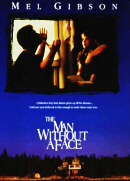
WYSIWYG: The Man Without a
Face is Mel Gibson’s
début as director and, I think, it’s much better helmed than his
Oscar-winning Bravefart. Granted, it doesn’t have Gibson cavorting
his bare ass in front of the camera or have heads and innards splattered
across the screen, therefore it isn’t the kind of movie those who love
his Three Stooges juvenility would line up to see. (And they didn’t.)
The Man Without a
Face
is about the ill-effects of falsifying
otherwise innocent or delicate situations: if it has the depressing moralistic
posturing of Diane Keaton’s The Good Mother—sometimes
truth isn’t enough to open the minds of Philistines—it’s nevertheless
a reminder children are used to shield adults from the fear of exposing
their own willful ignorance. (In America we’re more afraid of not joining
the comfort of pack mentality than the fear of the Judeo-Christian belief
of condemnation for breaking the 9th Commandment.) The way Gibson handles
the subject matter is evidence of his sensitivity to society’s punishing
hypocrisies; it confirms he can overlook his own lack
of finesse and his convenient intolerance about who populate the real world. And not surprising, considering his own brood, he’s an expert in handling
kids—he knows their wandering adventures, use of forbidden language,
their insensitivities and instant querulous eruptions—and
he’s especially adept at what he gets out of his co-star Nick Stahl.
Gibson himself wasn’t his first choice to star in the role and therein may
be a slight discomfort: he hadn’t yet lost his celebrated good looks (clearly
absent by The Patriot), so when the audience gets its first
lengthy views of his Pizzahead, the makeup, despite intentions, is depreciated.
But not for long: when Gibson is really acting he’s worth seeing.
The Man Without A
Face is the last film before
Payback in which he isn’t the tiresome WYSIWYG.
NO
WYSIWYG: The Man Without a
Face is Mel Gibson’s
début as director and, I think, it’s much better helmed than his
Oscar-winning Bravefart. Granted, it doesn’t have Gibson cavorting
his bare ass in front of the camera or have heads and innards splattered
across the screen, therefore it isn’t the kind of movie those who love
his Three Stooges juvenility would line up to see. (And they didn’t.)
The Man Without a
Face
is about the ill-effects of falsifying
otherwise innocent or delicate situations: if it has the depressing moralistic
posturing of Diane Keaton’s The Good Mother—sometimes
truth isn’t enough to open the minds of Philistines—it’s nevertheless
a reminder children are used to shield adults from the fear of exposing
their own willful ignorance. (In America we’re more afraid of not joining
the comfort of pack mentality than the fear of the Judeo-Christian belief
of condemnation for breaking the 9th Commandment.) The way Gibson handles
the subject matter is evidence of his sensitivity to society’s punishing
hypocrisies; it confirms he can overlook his own lack
of finesse and his convenient intolerance about who populate the real world. And not surprising, considering his own brood, he’s an expert in handling
kids—he knows their wandering adventures, use of forbidden language,
their insensitivities and instant querulous eruptions—and
he’s especially adept at what he gets out of his co-star Nick Stahl.
Gibson himself wasn’t his first choice to star in the role and therein may
be a slight discomfort: he hadn’t yet lost his celebrated good looks (clearly
absent by The Patriot), so when the audience gets its first
lengthy views of his Pizzahead, the makeup, despite intentions, is depreciated.
But not for long: when Gibson is really acting he’s worth seeing.
The Man Without A
Face is the last film before
Payback in which he isn’t the tiresome WYSIWYG.
 Once you size up Warren Beatty’s McCabe as a small business dunce and Julie Christie’s druggie Mrs. Miller as a supporting bit (with hair Babs would later borrow for A Star is Born), the only thing left is to wonder if director Robert Altman is going to keep the
wintry setting until the closing act. He does, thanks to Mother
Nature’s unrelenting storms.
McCabe & Mrs. Miller is a frost bite of a movie and the colder and snowier it gets, the more your dissatisfaction circulates. You sit there blank of response, hardly able to plow yourself out of the deep blanket of dreariness—presumably an Altman warning about the murderous dealings of conglomerates. What keeps you from freezing to eternity is watching Beatty’s wussie trots to stay a few steps ahead
of a trio of liquidators. But how can viewers be expected to hold an interest in him when even the boozed, whoring townspeople won’t notice his absence until the first thaw?
Once you size up Warren Beatty’s McCabe as a small business dunce and Julie Christie’s druggie Mrs. Miller as a supporting bit (with hair Babs would later borrow for A Star is Born), the only thing left is to wonder if director Robert Altman is going to keep the
wintry setting until the closing act. He does, thanks to Mother
Nature’s unrelenting storms.
McCabe & Mrs. Miller is a frost bite of a movie and the colder and snowier it gets, the more your dissatisfaction circulates. You sit there blank of response, hardly able to plow yourself out of the deep blanket of dreariness—presumably an Altman warning about the murderous dealings of conglomerates. What keeps you from freezing to eternity is watching Beatty’s wussie trots to stay a few steps ahead
of a trio of liquidators. But how can viewers be expected to hold an interest in him when even the boozed, whoring townspeople won’t notice his absence until the first thaw?
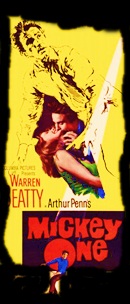 Mickey One is all about Warren Beatty and director Arthur Penn farting
out an “art” flick as gesture to Fellini and Godard, with a decidedly depressing Willard Motley mix of Chicago’s Maxwell Street, DPs, a bit of Nelson Algren and the infamous Marina Towers. Four things going for it, at least for a while—Beatty’s boyish handsomeness hadn’t tipped over yet into sterile plastic, Ghislain Pieree Cloquet’s black and white photography, a friendly jazz score by Eddie Sauter highlighted by some nifty improvisations by the great Stan Getz, and faces. A lot of faces, with
character oozing out of them ala Studs Turkel or a Mike Royko column, blessedly without names. For the first half hour, the gritty imagery flies by and we’re working just as fast to collate it into something coherent, to expect it to make sense and belie its arty fartiness. Beatty’s Mickey is on the run from Detroit mobsters he doesn’t know for a crime he’s not sure he committed. He seeks refuge in Chicago, taking a crack at standup comedy at local dives until he’s offered a gig on Rush Street by Hurd
Hatfield (doing his usual cryptogenics). Warren’s got little if any protection: there are no famous co-stars supporting him, no glam shots in glam outfits propping up iconic airs; what’s coming out of him is a mystifying trust only in himself and apparently distrust in Penn. If there’s an intelligence hidden in the gassy script, we’re not recognizing much beyond the whiffs of urban paranoia but
we see the smarts working in Warren as he’s trying to find something, just as we can see how he found a way to bring a bit of whatever to the rot of The Only Game in Town. (One of Beatty’s unacknowledged gifts early-on was his ability to make himself watchable as a loser or in mundane or confusing scripts, later to become unwatchable in similar follow-ups.) Mickey One has a Let No Man Write My Epitaph
grunginess saving
it as a curiosity. With Alexandra Stewart, Franchot Tone, Jeff Corey and Kamatari Fujiwara as the junk artist, the kind of flora absurda sprouted in too many Fellini movies and would blossom to Academy Award glory, with limp and bummer teeth, in Ryan’s Daughter. One of the Sylbert twins, Richard or Paul, thumbnails it: Mickey One ½.
Mickey One is all about Warren Beatty and director Arthur Penn farting
out an “art” flick as gesture to Fellini and Godard, with a decidedly depressing Willard Motley mix of Chicago’s Maxwell Street, DPs, a bit of Nelson Algren and the infamous Marina Towers. Four things going for it, at least for a while—Beatty’s boyish handsomeness hadn’t tipped over yet into sterile plastic, Ghislain Pieree Cloquet’s black and white photography, a friendly jazz score by Eddie Sauter highlighted by some nifty improvisations by the great Stan Getz, and faces. A lot of faces, with
character oozing out of them ala Studs Turkel or a Mike Royko column, blessedly without names. For the first half hour, the gritty imagery flies by and we’re working just as fast to collate it into something coherent, to expect it to make sense and belie its arty fartiness. Beatty’s Mickey is on the run from Detroit mobsters he doesn’t know for a crime he’s not sure he committed. He seeks refuge in Chicago, taking a crack at standup comedy at local dives until he’s offered a gig on Rush Street by Hurd
Hatfield (doing his usual cryptogenics). Warren’s got little if any protection: there are no famous co-stars supporting him, no glam shots in glam outfits propping up iconic airs; what’s coming out of him is a mystifying trust only in himself and apparently distrust in Penn. If there’s an intelligence hidden in the gassy script, we’re not recognizing much beyond the whiffs of urban paranoia but
we see the smarts working in Warren as he’s trying to find something, just as we can see how he found a way to bring a bit of whatever to the rot of The Only Game in Town. (One of Beatty’s unacknowledged gifts early-on was his ability to make himself watchable as a loser or in mundane or confusing scripts, later to become unwatchable in similar follow-ups.) Mickey One has a Let No Man Write My Epitaph
grunginess saving
it as a curiosity. With Alexandra Stewart, Franchot Tone, Jeff Corey and Kamatari Fujiwara as the junk artist, the kind of flora absurda sprouted in too many Fellini movies and would blossom to Academy Award glory, with limp and bummer teeth, in Ryan’s Daughter. One of the Sylbert twins, Richard or Paul, thumbnails it: Mickey One ½.
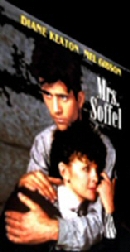 HOOSEGOW DE LUXE:
Woman friends of mine love Mrs.
Soffel, Gilliam Armstrong’s bittersweet,
based-on-fact romancer starring Mel Gibson and Diane Keaton. Partly, they
tell me, it’s the boy-toyism of Gibson’s youthfulness, making them want to
do what Diane does—wrap their protective arms around
his dangerous petulance. They also admire Diane’s character’s courage to move on,
facing the harsh proscriptions for her adultery, for her abandonment of her
children. Chiaroscuristic in style, provocative in its tone, the movie’s
not a “woman’s picture” in the way we regard certain 40s and 50s
melodramas, when the obligatory suffering is faked to be noble and righteous.
Calling it feminist, though, wouldn’t at all be a put-down. In fact, its
early 20th century setting swoons with suffragettism. For no apparent reasoning,
I’m ambivalent towards the movie; I respect it, recognize both stars
are very good—neither has ever been this
controlled—and admire the trappings. Maybe I admire one
of the trappings more than anything else because it seems to overwhelm the
movie: Pittsburgh’s Allegheny County Jail. Designed by Henry Hobson Richardson
in 1885, and completed in 1888 (and, when last checked, still in use for family and juvenile incarceration), it’s a monument to the Piranesian style
of architecture, and by this I mean the jail conforms to the artistic schemes
of the Italian artist Giovanni Battista Piranesi, set forth in his renowned
collection of imaginary prisons entitled Carceri d’Invenzione.
Piranesi saw Roman ruins (sub prisons) as “fantastic, immeasurable dungeons
dominated by immense, gloomy arcades, staircases rising to incredible heights,
and bizarre galleries leading nowhere.” His engravings became an important
influence on 19th century romanticism and also played a role in the development
of early 20th century surrealism. The Allegheny County Jail is
stylistically romantic, and there’s definitely something hugely
incongruous and absurd about it. Not only a great place in which to make
a movie—it’s the real star of
Mrs.
Soffel—it would
also make a great disco or mall, or the prison of Mel’s choice when he finally
ends up in one.
HOOSEGOW DE LUXE:
Woman friends of mine love Mrs.
Soffel, Gilliam Armstrong’s bittersweet,
based-on-fact romancer starring Mel Gibson and Diane Keaton. Partly, they
tell me, it’s the boy-toyism of Gibson’s youthfulness, making them want to
do what Diane does—wrap their protective arms around
his dangerous petulance. They also admire Diane’s character’s courage to move on,
facing the harsh proscriptions for her adultery, for her abandonment of her
children. Chiaroscuristic in style, provocative in its tone, the movie’s
not a “woman’s picture” in the way we regard certain 40s and 50s
melodramas, when the obligatory suffering is faked to be noble and righteous.
Calling it feminist, though, wouldn’t at all be a put-down. In fact, its
early 20th century setting swoons with suffragettism. For no apparent reasoning,
I’m ambivalent towards the movie; I respect it, recognize both stars
are very good—neither has ever been this
controlled—and admire the trappings. Maybe I admire one
of the trappings more than anything else because it seems to overwhelm the
movie: Pittsburgh’s Allegheny County Jail. Designed by Henry Hobson Richardson
in 1885, and completed in 1888 (and, when last checked, still in use for family and juvenile incarceration), it’s a monument to the Piranesian style
of architecture, and by this I mean the jail conforms to the artistic schemes
of the Italian artist Giovanni Battista Piranesi, set forth in his renowned
collection of imaginary prisons entitled Carceri d’Invenzione.
Piranesi saw Roman ruins (sub prisons) as “fantastic, immeasurable dungeons
dominated by immense, gloomy arcades, staircases rising to incredible heights,
and bizarre galleries leading nowhere.” His engravings became an important
influence on 19th century romanticism and also played a role in the development
of early 20th century surrealism. The Allegheny County Jail is
stylistically romantic, and there’s definitely something hugely
incongruous and absurd about it. Not only a great place in which to make
a movie—it’s the real star of
Mrs.
Soffel—it would
also make a great disco or mall, or the prison of Mel’s choice when he finally
ends up in one.
 Stanley & Iris, Jane Fonda’s last movie before a self-imposed retirement back in 1995, was a modest character study about a working class single mother finding romance with and playing teacher to bicycle rider Robert
De Niro who can’t read or write. The element
of stunt is suspected when big name actors play small but, with director Martin Ritt guiding them, these two got right in there to keep it limited and generally persuasive. Especially Jane, reminding us once again how terrific she can be in a Christine Lahti role. Deciding to return to acting fifteen years later, there was the matter-of-course carping Monster-in-Law was beneath her, or she was riding Jennifer Lopez’s
ample patootie to achieve a successful
comeback. (The movie was a b.o. hit.) It’s true what Kael wrote in a review of Klute—Jane’s “motor runs a little fast”—but long-time viewers will recall she
had been nervously ahead in whatever scene since Tall Story, detecting she was already mentally blocking her next. By the time she filmed Stanley & Iris, many of us will remember saying what she needed most was some frivolity—a boost. With Monster-in-Law, her engine tuned just right, she’s having one hellava good time as a recovering obsessive-compulsive. Trying to remain calm as a TV journalist diva interviewing an imbecile, or beaming during her fantasy moment of repeatedly smashing Jennifer’s face into a cake, we share in the joy of her freedom in doing slap happy bitchery. The joy enlarges when Jane gets hers in a plate of tripe. She’s also lucky to have an adept partner in Wanda Sykes as her guardian; these two play off each
other
as if they’re in a different movie. Jennifer’s not so lucky. The opening piddles around her as a temp, a dog walker and with the obligatory gay pal, setting into motion the romcom plot in the cutesy shallow way the fundamentals are checked off in Legally Blonde. Since both films are directed by Robert Luketic, whose forte seems to be swank pretense, no one expects nor wants Jennifer to play a well-situated sweetie pie Reese, not with that ass, yet he can’t keep her from being a near
lethal meh when there’s no tension; she can smile sweetly but she ain’t a sweety. With Jane, a riled up tit-for-tat surfaces—she’s not slouching from intimidation. (She also holds up against Ralph Fiennes in 2002’s Maid in Manhatten, and Lasse Hallström gets an acceptable turn from her opposite Redford in 2005’s An Unfinished Life.) Still, Monster-in-Law is Jane’s show. Reconnecting with her audience and
finding a new one, both following her to Grace and Frankie, she’s bringing to the party a subsurface egalitarianism, which rises considerably in Netflix’s longest running comedy. In Monster-in-Law, even her crow’s feet underscore equality.
Stanley & Iris, Jane Fonda’s last movie before a self-imposed retirement back in 1995, was a modest character study about a working class single mother finding romance with and playing teacher to bicycle rider Robert
De Niro who can’t read or write. The element
of stunt is suspected when big name actors play small but, with director Martin Ritt guiding them, these two got right in there to keep it limited and generally persuasive. Especially Jane, reminding us once again how terrific she can be in a Christine Lahti role. Deciding to return to acting fifteen years later, there was the matter-of-course carping Monster-in-Law was beneath her, or she was riding Jennifer Lopez’s
ample patootie to achieve a successful
comeback. (The movie was a b.o. hit.) It’s true what Kael wrote in a review of Klute—Jane’s “motor runs a little fast”—but long-time viewers will recall she
had been nervously ahead in whatever scene since Tall Story, detecting she was already mentally blocking her next. By the time she filmed Stanley & Iris, many of us will remember saying what she needed most was some frivolity—a boost. With Monster-in-Law, her engine tuned just right, she’s having one hellava good time as a recovering obsessive-compulsive. Trying to remain calm as a TV journalist diva interviewing an imbecile, or beaming during her fantasy moment of repeatedly smashing Jennifer’s face into a cake, we share in the joy of her freedom in doing slap happy bitchery. The joy enlarges when Jane gets hers in a plate of tripe. She’s also lucky to have an adept partner in Wanda Sykes as her guardian; these two play off each
other
as if they’re in a different movie. Jennifer’s not so lucky. The opening piddles around her as a temp, a dog walker and with the obligatory gay pal, setting into motion the romcom plot in the cutesy shallow way the fundamentals are checked off in Legally Blonde. Since both films are directed by Robert Luketic, whose forte seems to be swank pretense, no one expects nor wants Jennifer to play a well-situated sweetie pie Reese, not with that ass, yet he can’t keep her from being a near
lethal meh when there’s no tension; she can smile sweetly but she ain’t a sweety. With Jane, a riled up tit-for-tat surfaces—she’s not slouching from intimidation. (She also holds up against Ralph Fiennes in 2002’s Maid in Manhatten, and Lasse Hallström gets an acceptable turn from her opposite Redford in 2005’s An Unfinished Life.) Still, Monster-in-Law is Jane’s show. Reconnecting with her audience and
finding a new one, both following her to Grace and Frankie, she’s bringing to the party a subsurface egalitarianism, which rises considerably in Netflix’s longest running comedy. In Monster-in-Law, even her crow’s feet underscore equality.
 Harrison Ford’s first real opportunity to act without any safety net is in Peter Weir’s neglected 1986 The Mosquito Coast. He’s novelist Paul Theroux’s bespectacled, slowly-turning-mad survivalist-inventor Allie Fox who
believes America will be
destroyed in a soon-to-come apocalyptic war because of its political and moral flab. To avoid the cataclysm, Harrison takes his family (including wife Helen Mirren and son River Phoenix) to settle in Central America. It’s Lord of the Flies wearing a Swiss Family Robinson cap—Harrison pioneers his new world with ingenuity, building both an air-conditioned jungle abode and an ice factory to supply locals with cool comfort they wouldn’t otherwise have. Thinking he’s escaped the mob mentality and hate, soon the encroachment of self-fulfilling doom comes to fruition. Being a fable is the central reason Harrison succeeds: his legendary-like movie heroes provide him an acceptation; he’s been out of the real world for so long in Lucas-Spielberg galaxies, and had to endure a wholly upchucky love affair with the Amish amazon in Weir’s Witness, it seems inevitable if not punishment for him to go bonkers. How does a man this inventive go so off kilter? By end, having nearly destroyed his family, he’s so thoroughly dislikable we wish Weir had used Theroux’s bloody finish—vultures feasting on the dead body. Moviegoers stayed away in droves—they didn’t want
to see one of their macho “other world” champions self-destruct. It looks even more ominous some forty years later for the beacon of democracy—soon to be destroyed by people with mindsets just like him. Never let it be said fables can’t become reality.
Harrison Ford’s first real opportunity to act without any safety net is in Peter Weir’s neglected 1986 The Mosquito Coast. He’s novelist Paul Theroux’s bespectacled, slowly-turning-mad survivalist-inventor Allie Fox who
believes America will be
destroyed in a soon-to-come apocalyptic war because of its political and moral flab. To avoid the cataclysm, Harrison takes his family (including wife Helen Mirren and son River Phoenix) to settle in Central America. It’s Lord of the Flies wearing a Swiss Family Robinson cap—Harrison pioneers his new world with ingenuity, building both an air-conditioned jungle abode and an ice factory to supply locals with cool comfort they wouldn’t otherwise have. Thinking he’s escaped the mob mentality and hate, soon the encroachment of self-fulfilling doom comes to fruition. Being a fable is the central reason Harrison succeeds: his legendary-like movie heroes provide him an acceptation; he’s been out of the real world for so long in Lucas-Spielberg galaxies, and had to endure a wholly upchucky love affair with the Amish amazon in Weir’s Witness, it seems inevitable if not punishment for him to go bonkers. How does a man this inventive go so off kilter? By end, having nearly destroyed his family, he’s so thoroughly dislikable we wish Weir had used Theroux’s bloody finish—vultures feasting on the dead body. Moviegoers stayed away in droves—they didn’t want
to see one of their macho “other world” champions self-destruct. It looks even more ominous some forty years later for the beacon of democracy—soon to be destroyed by people with mindsets just like him. Never let it be said fables can’t become reality.
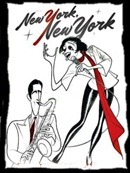 That codger John Simon could on rare occasion deliver a dull-witted nifty: about New York, New York,
he wrote Martin Scorsese’s “directorial vision seems to be no greater than that of a man driving through a downpour without turning on his windshield wipers.” Nowhere in his piece does he intimate the downpour was blow but Julia Phillips did in You’ll Never Eat Lunch In This Town Again and Peter Biskind’s Easy Riders, Raging Bulls unloads, too. Dope-laden improvisation as diarrhetic, NY, NY isn’t so much Scorsese’s “most personal film” about going down Memorabilia Lane as it is a series of holding-it-in trips to the toilet. Most viewers watching are likely to feel their sensory tracts inflamed by its obsessiveness—all agony and zilch ecstasy. Flashing a not very grand art deco style by Boris Leven, who modifies leftover Hello, Dolly sets, and László Kovács’s cinematography imprisoning Scorsese’s love of 30s and 40s Hollywood and NYC, the movie is vexing for its sickie contentiousness: De Niro and Minnelli play off each other as if in the throes of war games. Who’s going to go over the top first? (Answered quickly.) Who’s going to be the first punching bag? (Answered not so quickly.) With or w/o the frenzies, they have more “energy” to burn than should be legally tolerated. Two examples: the wedding chapel and cab fight sequences. Once more doing a variation of Scorsese’s wired ego syndrome, De Niro’s an acting machine without an off switch. Minnelli’s locked into Mother Garland gesturing and befuddled facial expressions, so doll-faced as to be a chronic sexless repulsive, abetted by Sydney Guilaroff’s coifs and odious Theadora Van Runke creations. (Okay, a few red dresses and a green one as brief compensations.) The pre-recordings are sometimes not fully in sync with the strength she physically exerts in lipping the songs; the early warbling is as good as she’s ever been, but in later numbers, including the song “New York, New York,” she abates. (Did enjoy her Peggy Lee imitation, which cues to admit having enjoyed her “Commit Me to Bellevue” marriage ceremony to David Gest—with Liz in widow’s weeds—and the guest shots on Arrested Development.) Scorsese fully restored the “Happy Endings” number, initially shortened or cut altogether because of the film’s running time. The choreographed setpiece attempts to transform itself into a Busby Berkeley homage but De Niro’s two-word critique sums it up: “Sappy Endings.” NY, NY is what happens when artists escape to influences through which they convince themselves their visions are going to pay off. What Richard Dreyfuss thought too, before he experienced the horror of seeing his bloated mug splattered across the screen in Close Encounters. Looking back, all of them were ready for Betty Ford even before opening its doors.
That codger John Simon could on rare occasion deliver a dull-witted nifty: about New York, New York,
he wrote Martin Scorsese’s “directorial vision seems to be no greater than that of a man driving through a downpour without turning on his windshield wipers.” Nowhere in his piece does he intimate the downpour was blow but Julia Phillips did in You’ll Never Eat Lunch In This Town Again and Peter Biskind’s Easy Riders, Raging Bulls unloads, too. Dope-laden improvisation as diarrhetic, NY, NY isn’t so much Scorsese’s “most personal film” about going down Memorabilia Lane as it is a series of holding-it-in trips to the toilet. Most viewers watching are likely to feel their sensory tracts inflamed by its obsessiveness—all agony and zilch ecstasy. Flashing a not very grand art deco style by Boris Leven, who modifies leftover Hello, Dolly sets, and László Kovács’s cinematography imprisoning Scorsese’s love of 30s and 40s Hollywood and NYC, the movie is vexing for its sickie contentiousness: De Niro and Minnelli play off each other as if in the throes of war games. Who’s going to go over the top first? (Answered quickly.) Who’s going to be the first punching bag? (Answered not so quickly.) With or w/o the frenzies, they have more “energy” to burn than should be legally tolerated. Two examples: the wedding chapel and cab fight sequences. Once more doing a variation of Scorsese’s wired ego syndrome, De Niro’s an acting machine without an off switch. Minnelli’s locked into Mother Garland gesturing and befuddled facial expressions, so doll-faced as to be a chronic sexless repulsive, abetted by Sydney Guilaroff’s coifs and odious Theadora Van Runke creations. (Okay, a few red dresses and a green one as brief compensations.) The pre-recordings are sometimes not fully in sync with the strength she physically exerts in lipping the songs; the early warbling is as good as she’s ever been, but in later numbers, including the song “New York, New York,” she abates. (Did enjoy her Peggy Lee imitation, which cues to admit having enjoyed her “Commit Me to Bellevue” marriage ceremony to David Gest—with Liz in widow’s weeds—and the guest shots on Arrested Development.) Scorsese fully restored the “Happy Endings” number, initially shortened or cut altogether because of the film’s running time. The choreographed setpiece attempts to transform itself into a Busby Berkeley homage but De Niro’s two-word critique sums it up: “Sappy Endings.” NY, NY is what happens when artists escape to influences through which they convince themselves their visions are going to pay off. What Richard Dreyfuss thought too, before he experienced the horror of seeing his bloated mug splattered across the screen in Close Encounters. Looking back, all of them were ready for Betty Ford even before opening its doors.
 Chances are you’ll be of one of two minds about Noises Off, Peter Bogdanovich’s 1992 version of one of the West End’s biggest tohubohu comedies. Either laugh your ass off, or, like me (and the majority of the audience I saw the movie with), go through close to two hours of agony. Took until the last third before I laughed, and then only once. Least worthy of characteristics about the British is their
public sublimation about sex, practically a national phobia and never more apparent than in their enthusiasm for theatrical sex farces. Risking the charge of stretching it, they seem to use these kinds of romps as a form of birth control, to wear themselves out so when they go home they’ll be too exhausted to have sex. During my first visit to London in 1971, the big hit on the West End was No Sex Please, We’re British. Londoners could hardly talk about anything else—not even about
Alan Bates’ beautiful work in Butley, or Alec Guinness and Jeremy Brett in Voyage Round My Father. The following year I returned and while Deborah Kerr, looking impossibly more beautiful on stage than she ever did on screen and was very moving and larger-than-life in the otherwise middling The Day After the Fair, all the rage was Maggie Smith in Private Lives. Lucky to get a seat, I wondered afterward why I bothered: Noël Coward’s sophisticated
foursome was turned into rowdy slapstick and the more Smith made a complete ass of herself screeching her lines with hyper-affectation and taking tumbles the louder the laughter and the best I could do is fake enjoyment. (Thank the Gods for the theatre’s handy bar.) My laughs usually come easy but can’t recall ever feeling more discomfort in not finding much to be amused by. Until Noises Off. This movie, as with the play, is alleged take-off about a troupe of actors in a bad sex romp entitled Nothing On in which everything goes sticky-slappy-goofy-crazy-wrong, with the hee-haws clocked in and super-dependent on timing. (Flash on the Tony Curtis-Jerry Lewis Boeing-Boeing.) I have to say there’s not a thing the matter with the cast headed by Michael Caine and Carol Burnett, with Denholm Elliott, Julie Hagerty, Marilu Henner,
Mark Linn-Baker, Christopher Reeves and John Ritter. We’d be hard-pressed to find a group more insanely willing to hop aboard the jejune express with this level of manufactured zest. Or find a comedy better blocked, as there’s hardly any inefficiency in Bogdanovich’s physical schematism. Diagnosing what may have happened is the performers seem to be too rehearsed to allow their own experiences to humanize the inevitable fuck-ups; they negate instinctive or spontaneous reactions
in a production running amuck. (Frequent theatre attendees tend to go with the flow of perils, as do Carol and her audience when a horse shits on stage during a taping of one her skits on The Carol Burnett Show.) From the lack of spontaneity we get actors becoming frenetic mannequins churning the virtually revolving looking glass of chaos. Twenty minutes into this marathon of relentless redundancy, Caine, as the play’s director, sees how hopeless the whole thing is and says, “Hold it!
Hold it! We’ve got a problem here.” Later, and somewhere between the noises of the minority in the audience whooping it up, a voice bellowed no director could do anything to save this production. Was I shouting in my grogginess? No, it was the frankness of Caine’s in-movie assessment.
Chances are you’ll be of one of two minds about Noises Off, Peter Bogdanovich’s 1992 version of one of the West End’s biggest tohubohu comedies. Either laugh your ass off, or, like me (and the majority of the audience I saw the movie with), go through close to two hours of agony. Took until the last third before I laughed, and then only once. Least worthy of characteristics about the British is their
public sublimation about sex, practically a national phobia and never more apparent than in their enthusiasm for theatrical sex farces. Risking the charge of stretching it, they seem to use these kinds of romps as a form of birth control, to wear themselves out so when they go home they’ll be too exhausted to have sex. During my first visit to London in 1971, the big hit on the West End was No Sex Please, We’re British. Londoners could hardly talk about anything else—not even about
Alan Bates’ beautiful work in Butley, or Alec Guinness and Jeremy Brett in Voyage Round My Father. The following year I returned and while Deborah Kerr, looking impossibly more beautiful on stage than she ever did on screen and was very moving and larger-than-life in the otherwise middling The Day After the Fair, all the rage was Maggie Smith in Private Lives. Lucky to get a seat, I wondered afterward why I bothered: Noël Coward’s sophisticated
foursome was turned into rowdy slapstick and the more Smith made a complete ass of herself screeching her lines with hyper-affectation and taking tumbles the louder the laughter and the best I could do is fake enjoyment. (Thank the Gods for the theatre’s handy bar.) My laughs usually come easy but can’t recall ever feeling more discomfort in not finding much to be amused by. Until Noises Off. This movie, as with the play, is alleged take-off about a troupe of actors in a bad sex romp entitled Nothing On in which everything goes sticky-slappy-goofy-crazy-wrong, with the hee-haws clocked in and super-dependent on timing. (Flash on the Tony Curtis-Jerry Lewis Boeing-Boeing.) I have to say there’s not a thing the matter with the cast headed by Michael Caine and Carol Burnett, with Denholm Elliott, Julie Hagerty, Marilu Henner,
Mark Linn-Baker, Christopher Reeves and John Ritter. We’d be hard-pressed to find a group more insanely willing to hop aboard the jejune express with this level of manufactured zest. Or find a comedy better blocked, as there’s hardly any inefficiency in Bogdanovich’s physical schematism. Diagnosing what may have happened is the performers seem to be too rehearsed to allow their own experiences to humanize the inevitable fuck-ups; they negate instinctive or spontaneous reactions
in a production running amuck. (Frequent theatre attendees tend to go with the flow of perils, as do Carol and her audience when a horse shits on stage during a taping of one her skits on The Carol Burnett Show.) From the lack of spontaneity we get actors becoming frenetic mannequins churning the virtually revolving looking glass of chaos. Twenty minutes into this marathon of relentless redundancy, Caine, as the play’s director, sees how hopeless the whole thing is and says, “Hold it!
Hold it! We’ve got a problem here.” Later, and somewhere between the noises of the minority in the audience whooping it up, a voice bellowed no director could do anything to save this production. Was I shouting in my grogginess? No, it was the frankness of Caine’s in-movie assessment.
 No Way To Treat A Lady is a 1968 creepfest as dramedy about serial murders and for the most part stacked in favor of hagslayer Rod Steiger. Because director Jack Smight makes the victims so pathetic, Rod seems to be providing mercy killings as an amusing
public service. (Why Eileen Heckart as cop George Segal’s supercilious mother is overlooked seems a dereliction of duty.) Rod’s very funny playing the gay poser; in blue blazer and gold slacks and mincing lisp, fitting wigs on his next intended victim Barbara Baxley until allergic-to-cats Doris Roberts unexpectedly arrives, he becomes so flummoxed by his inability to kill he can’t keep straight his cover story. (Though all of NYC is on high alert for a killer in masquerade, he gets Baxley to open her door
by offering a free hairpiece; when he’s stymied, he wants her to pay for it.) It’s during this sequence, in which he mimics to menacing perfection “Pickles in the fire place,” we realize the movie would be more charitable if he were a bungler who never gets his fix. Steiger was offered Segal’s part originally but when reading the script he knew the killer would be the star and thus we get an overdose of showing off. Could do without his W.C. Fields (who he’d portray eight years later).
Remick and Segal look good together.
No Way To Treat A Lady is a 1968 creepfest as dramedy about serial murders and for the most part stacked in favor of hagslayer Rod Steiger. Because director Jack Smight makes the victims so pathetic, Rod seems to be providing mercy killings as an amusing
public service. (Why Eileen Heckart as cop George Segal’s supercilious mother is overlooked seems a dereliction of duty.) Rod’s very funny playing the gay poser; in blue blazer and gold slacks and mincing lisp, fitting wigs on his next intended victim Barbara Baxley until allergic-to-cats Doris Roberts unexpectedly arrives, he becomes so flummoxed by his inability to kill he can’t keep straight his cover story. (Though all of NYC is on high alert for a killer in masquerade, he gets Baxley to open her door
by offering a free hairpiece; when he’s stymied, he wants her to pay for it.) It’s during this sequence, in which he mimics to menacing perfection “Pickles in the fire place,” we realize the movie would be more charitable if he were a bungler who never gets his fix. Steiger was offered Segal’s part originally but when reading the script he knew the killer would be the star and thus we get an overdose of showing off. Could do without his W.C. Fields (who he’d portray eight years later).
Remick and Segal look good together.
 During the first twenty years of her career, Meryl Streep was boxed in by her highbrow persona and speechnology. Not solely over her heavily studied and acclaimed performances being of the foreign accent kind, but also due to her
stinginess—her implacable evasiveness—of native warmth; with an audience-perceived haughtiness and a museum face, she’s our showboat expatriate. My conclusion is a paradox: she’s too often never more unAmerican than when playing American. In the racist Deer Hunter, the ineffable Kramer vs. Kramer, the No Doz commercial Falling in Love, Silkwood, Ironweed, the sinus infection Heartburn,
She Devil, Postcards from the Edge and the longer list of other born-in-the-USA postiche, I’m reminded of one of Phoebe’s classic comic putdowns railed at a reformed prostie on All My Children—that she’s “an indigenous immigrant.” This embossment stays with me even in the better American fits, such as The Devil Wears Prada, Doubt, Julie & Julia and, at her most informally comfortable,
It’s Complicated. Before these last four, which come four decades after she started acting, she tried to hide her aura of pseudo lineage imbedded in her acquired DNA, inculcated by and then conferred through pedagogics. The difficulty in responding to the early Streep, and lasting as occasional hangover (for example, The Iron Lady) into the 21st century, is the stringency—a cultured assembly-line so emphatically precise she turns into a humanoid in offense mode;
she’s an icebox as performance art preventing many of us from making contact. Strangely enough, back in 1986, it took Out of Africa for me to eventually defrost. Initially fighting off another acccent—this time a Danish one belonging to Karen Blixen (a.k.a. author Isak Dinesen)—her decreed calibrations are matched to her character, she’s as
distant as Africa in a coffee table pictorial and her Milena Canonero wardrobe the cover. She’s as resolute as Dinesen writes in Out of Africa and Shadows on the Grass, from which screen adapter Kurt Luedtke gets boggy in ploughing the earth in the tradition of Vivien Leigh’s Scarlett in Gone with the Wind and Sally Field’s Edna in Places in the Heart. (A Nobel candidate for literature, Karen’s life is more interesting subsequent Africa.) Streep’s sedate
and mannered stratagem takes a while before melting occurs, yet still not sure at what point it comes. In this recent viewing I recognized the very first moment in being receptive: she’s funny right at the start, finding herself sitting outside in the cold Denmark weather angling to get Klaus Maria Brandauer to marry her. This scene originally bothered me for having used early in a badly processed background, due to problems in filming in England, and was turned off (and still am) by the compromise
re-shoot, the perils of moviemaking Pollack had to work around to lessen the damage to his intended tone-set for Karen and, unfortunately, more bad process shots to come, as well as lousy blocking of the actors, in effect discounting the prestige roadshow on the plains. All these years later, without the weight of obligatory homage to Streep’s technique, I felt free to laugh at Karen’s hardihood assumed to be part of her disposition. Liked how she tangled idiom and pronounced the word Limoges; this “like”
became gravitational, pulling me into this highfaluting trickster stuff, this Robert Brustein master class finery. Luedtke’s script reduces the hold of Karen’s lovesick recollections by allowing misleading conclusions, particularly her syphilis treatment of mercury and arsenic having cured her but, we’re told, left her unable to bear children. While the glamour
pus representations of real Brit Denys Finch-Hatton and his insistent independence from any binding ties aren’t fraudulent, Luedtke doesn’t permit Robert Redford’s version to do this: upon news she’s carrying his child, the real Denys telegraphed her to abort. (Speculation has it she may have had two doomed pregnancies.) Lasting roughly eight to ten years with many absences in between, their romance is likely remembrance as outsized myth, an aggrandizement intertwined into
her musings about Africa—she wants us to be excited without orgasmic detailing, substituted in the movie with John Barry’s recurring theme and Redford washing Streep’s hair. As with Karen’s husband, Denys was unrepentant womanizer who lodged at her Kenyan plantation between flights of fancy and big game-hunting. There’s regret in missing the fun it might have been to hear Redford, in the right size of a role, interact with Miss Accent Extraordinaire guiding
him to speak British. (He wanted to, Pollack vetoed.) Amused Klaus Maria adds the bad boy balance; under-appreciated Michael Kitchen and his exquisite screen love Iman shortchanged as the movie’s interracial subtext. We might want to smack Streep’s Karen for not giving her young cook at least a hug as she prepares to depart Africa; after kneeling in subjugation to plead for her loyal African staff to be given land to live on, what does she have to socially lose at this point? The movie’s closing makes
up for the omission: as lions rest on hallowed ground with a sweeping vista, Streep’s narration, verbatim from Out of Africa, is poignant enough to cause goose flesh and at the same time worthy of good-natured mimicry. From the same source, real Denys would say to Karen, shortly before his Gypsy Moth biplane stalled and crashed over Kenya’s Voi Airport, “You know, this continent of Africa has a terrible strong sense of sarcasm.”
During the first twenty years of her career, Meryl Streep was boxed in by her highbrow persona and speechnology. Not solely over her heavily studied and acclaimed performances being of the foreign accent kind, but also due to her
stinginess—her implacable evasiveness—of native warmth; with an audience-perceived haughtiness and a museum face, she’s our showboat expatriate. My conclusion is a paradox: she’s too often never more unAmerican than when playing American. In the racist Deer Hunter, the ineffable Kramer vs. Kramer, the No Doz commercial Falling in Love, Silkwood, Ironweed, the sinus infection Heartburn,
She Devil, Postcards from the Edge and the longer list of other born-in-the-USA postiche, I’m reminded of one of Phoebe’s classic comic putdowns railed at a reformed prostie on All My Children—that she’s “an indigenous immigrant.” This embossment stays with me even in the better American fits, such as The Devil Wears Prada, Doubt, Julie & Julia and, at her most informally comfortable,
It’s Complicated. Before these last four, which come four decades after she started acting, she tried to hide her aura of pseudo lineage imbedded in her acquired DNA, inculcated by and then conferred through pedagogics. The difficulty in responding to the early Streep, and lasting as occasional hangover (for example, The Iron Lady) into the 21st century, is the stringency—a cultured assembly-line so emphatically precise she turns into a humanoid in offense mode;
she’s an icebox as performance art preventing many of us from making contact. Strangely enough, back in 1986, it took Out of Africa for me to eventually defrost. Initially fighting off another acccent—this time a Danish one belonging to Karen Blixen (a.k.a. author Isak Dinesen)—her decreed calibrations are matched to her character, she’s as
distant as Africa in a coffee table pictorial and her Milena Canonero wardrobe the cover. She’s as resolute as Dinesen writes in Out of Africa and Shadows on the Grass, from which screen adapter Kurt Luedtke gets boggy in ploughing the earth in the tradition of Vivien Leigh’s Scarlett in Gone with the Wind and Sally Field’s Edna in Places in the Heart. (A Nobel candidate for literature, Karen’s life is more interesting subsequent Africa.) Streep’s sedate
and mannered stratagem takes a while before melting occurs, yet still not sure at what point it comes. In this recent viewing I recognized the very first moment in being receptive: she’s funny right at the start, finding herself sitting outside in the cold Denmark weather angling to get Klaus Maria Brandauer to marry her. This scene originally bothered me for having used early in a badly processed background, due to problems in filming in England, and was turned off (and still am) by the compromise
re-shoot, the perils of moviemaking Pollack had to work around to lessen the damage to his intended tone-set for Karen and, unfortunately, more bad process shots to come, as well as lousy blocking of the actors, in effect discounting the prestige roadshow on the plains. All these years later, without the weight of obligatory homage to Streep’s technique, I felt free to laugh at Karen’s hardihood assumed to be part of her disposition. Liked how she tangled idiom and pronounced the word Limoges; this “like”
became gravitational, pulling me into this highfaluting trickster stuff, this Robert Brustein master class finery. Luedtke’s script reduces the hold of Karen’s lovesick recollections by allowing misleading conclusions, particularly her syphilis treatment of mercury and arsenic having cured her but, we’re told, left her unable to bear children. While the glamour
pus representations of real Brit Denys Finch-Hatton and his insistent independence from any binding ties aren’t fraudulent, Luedtke doesn’t permit Robert Redford’s version to do this: upon news she’s carrying his child, the real Denys telegraphed her to abort. (Speculation has it she may have had two doomed pregnancies.) Lasting roughly eight to ten years with many absences in between, their romance is likely remembrance as outsized myth, an aggrandizement intertwined into
her musings about Africa—she wants us to be excited without orgasmic detailing, substituted in the movie with John Barry’s recurring theme and Redford washing Streep’s hair. As with Karen’s husband, Denys was unrepentant womanizer who lodged at her Kenyan plantation between flights of fancy and big game-hunting. There’s regret in missing the fun it might have been to hear Redford, in the right size of a role, interact with Miss Accent Extraordinaire guiding
him to speak British. (He wanted to, Pollack vetoed.) Amused Klaus Maria adds the bad boy balance; under-appreciated Michael Kitchen and his exquisite screen love Iman shortchanged as the movie’s interracial subtext. We might want to smack Streep’s Karen for not giving her young cook at least a hug as she prepares to depart Africa; after kneeling in subjugation to plead for her loyal African staff to be given land to live on, what does she have to socially lose at this point? The movie’s closing makes
up for the omission: as lions rest on hallowed ground with a sweeping vista, Streep’s narration, verbatim from Out of Africa, is poignant enough to cause goose flesh and at the same time worthy of good-natured mimicry. From the same source, real Denys would say to Karen, shortly before his Gypsy Moth biplane stalled and crashed over Kenya’s Voi Airport, “You know, this continent of Africa has a terrible strong sense of sarcasm.”
 Places in the Heart is supposed to be about director Robert Benton’s great grandmother—played by Sally Field—who, suddenly a widow with two small children (one of whom is named Possum!), finds she’s about to suffer the misfortune of the local bank foreclosing on her farm because she’s flat
broke. But her travails are just beginning: Mother Nature unleashes a tornado; shysters are eager to pull fast ones; racial bigotry rears its ugliness. Initially, the 1984 movie appears to be anti-Reagan and only because it’s set in the Depression does one avoid the next thought: Saint Sally & Company are victims of Reagan’s trickle down economics. The movie isn’t really about granny, however, it’s about illusions inspired by the great communicator. Said Benton: “I have never let the truth interfere
with a good story. I’m not in the documentary business, I’m in the theatrical movie business. So lying is my business. And the best lies are the ones I can make closest to the truth.” Sally doesn’t perform his “truth,” she endures it and wins another Oscar. Why John Malkovich didn’t earn the statue for his solicitation—in one sequence he uses rope and gun and accurate voice recognition to get our regard—might have had something to do with running out of commiseration after all of Sally & Company’s troubles.
And Benton misguidedly uses up what’s left of our quota of tolerance: Places in the Heart has one of the most offensively sanctimonious finales imaginable—Reaganesque humbuggery as a long hot summer of Sundays listening to sermons on brotherhood as phony as Ronnie’s religiosity.
Places in the Heart is supposed to be about director Robert Benton’s great grandmother—played by Sally Field—who, suddenly a widow with two small children (one of whom is named Possum!), finds she’s about to suffer the misfortune of the local bank foreclosing on her farm because she’s flat
broke. But her travails are just beginning: Mother Nature unleashes a tornado; shysters are eager to pull fast ones; racial bigotry rears its ugliness. Initially, the 1984 movie appears to be anti-Reagan and only because it’s set in the Depression does one avoid the next thought: Saint Sally & Company are victims of Reagan’s trickle down economics. The movie isn’t really about granny, however, it’s about illusions inspired by the great communicator. Said Benton: “I have never let the truth interfere
with a good story. I’m not in the documentary business, I’m in the theatrical movie business. So lying is my business. And the best lies are the ones I can make closest to the truth.” Sally doesn’t perform his “truth,” she endures it and wins another Oscar. Why John Malkovich didn’t earn the statue for his solicitation—in one sequence he uses rope and gun and accurate voice recognition to get our regard—might have had something to do with running out of commiseration after all of Sally & Company’s troubles.
And Benton misguidedly uses up what’s left of our quota of tolerance: Places in the Heart has one of the most offensively sanctimonious finales imaginable—Reaganesque humbuggery as a long hot summer of Sundays listening to sermons on brotherhood as phony as Ronnie’s religiosity.
 In all the vitriol over Vanessa Redgrave being cast to play her in Arthur Miller’s 1980 adaptation of her memoir Playing for Time, 4 ft eleven Fania Fénelon, nom de théâtre for Fanya Goldstein, was bitchy right about Vanessa’s “short”comings: she’s 5 ft eleven and there isn’t a lot of humor in the portrayal. Let’s chuck the pettiness: if Vanessa attempted to bring considerable levity to the setting of Auschwitz, as half-Jewish Goldstein claimed about herself, who’d be first to scold the non-Jew audacity? Clear is Miller self-proscriptively steered away from any dereliction
of moral duty for the larger theme of survival in the midst of abomination and thus the requirement of an actor to bring heft, as well as height, to the interpretation. (More Édith Piaf or Eydie Gormé, Goldstein’s expressed choice was Liza Minnelli.) Also true is, at the time of filming, it would have been very difficult to name a finer performer who could turn off an audience faster than Vanessa. Unfair, much of the hate has to do with her vocalized politics, especially her sympathies toward the Palestinian cause which convinced Goldstein, erroneously, Vanessa was anti-Semitic. During production in Pennsylvania, there were persistent protests from Jewish organizations and death threats from Zionists. Throw in the seemingly imperialistic familial acting legacy and it’s a formula for suffering the chills. Vanessa’s long-held alienation from our affectons is felt yet used in artistry to bring a nippy, challenging dignity to a shrew who, on 60 Minutes, confirms the Netanyahoo psychosis of often becoming what we hate most. Vanessa had another problem in early filming—differences of approach with original director Joseph Sargent, who, up to 1980, had done only one major serious topic movie, the fair to middling MacArthur starring Gregory Peck. Sargent was replaced by Daniel Mann, a highly regarded “woman’s director” who helped guide Shirley Booth, Anna Magnani and Elizabeth Taylor to Oscars in material from, respectively, William Inge, Tennessee Williams and John O’Hara. Needing to regain respect lost over his controversial treatment of former wife Marilyn Monroe in The Misfits and After the Fall, Miller’s teleplay required the appropriate overlooker to give Vanessa the sensitized center, to make Jane Alexander’s Alma Rosé (niece to composer Gustav Mahler) the major support and caveat about sanguinity, and allow the remaining women their limited due. Mann accedes
with two exceptions: Shirley Knight as Lagerführerin Maria Mandel, the female commandant of the women’s sector in the death camp and judged responsible for as many as 500,000 deaths, is bad in a poorly shaped character, and Maud Adams, glimpsed as the legendary Mala Zimetbaum who spoke at least five languages fluently and the first woman to escape from Auschwitz, gets hanged without an emotional connection to us. (According to witness accounts, Mala was to be burned alive in the crematoria
after being captured, with inmates trying to mercifully speed her demise with poison before reaching the flames.) Mann sacrifices the Nazi men, including Mengele, to cardboarding. The production values are scaled for TV but they’re off-kilter—likely caused by the way Arthur J. Ornitz photographed using Spherical and exacerbating its squeeze effect, necessitating a full scale restoration, with current technology accommodating frame widening to improve watchability. So would the removal
of unnecessary newsreels inserted now and then showing the arrivals of and dispersals from the trains; they’re tinted, meant to hide decades of disintegration, in an effort to blend in with the surroundings, which they don’t do. What Playing for Time does do is give Vanessa the test our more acclaimed actors are compelled to take from time to time
to prove not to others but to themselves they can pass muster in honoring their profession. When trying out for the women’s orchestra of Auschwitz, Vanessa moves to the piano and as she’s about to put her fingers on the keys, she hesitates, rubs her hands on her clothing to remove whatever grime, then kisses the keys. A moment is a triumph of detailing, and it won’t be the only one: receiving a morsel of food from the group’s open-faced slut after servicing a German soldier, Vanessa tries
not to eat it yet can’t resist. Every bite, every chew, every swallow filled with guilt-ridden deliciousness. She may even vomit, with suppression technique taking over. What could she do to equal these scenes? Forty years since first seeing Playing for Time, I had forgotten the finale, during which she sings “La Marseillaise.” It now carries
additional amplification. Did the médiocre au mieux chanteuse, persistent critic of everyone else, pardon her fellow countrymen for snitching on Jews and resistance fighters as life-saving expediency while she did les boites de nuit circuit concealed under the Anglo-Saxon Fénelon? Did she salve the wounds of fellow survivors of the Mädchenorchester von Auschwitz who vigorously disputed her long-delayed version of events, particularly concerning her unsupported attacks on Alma Rosé and
upon her audition she dared play Crematoria Roulette by goading Nazi commanders about her real surname? Dying three years after the drama premiered and her diatribe on 60 Minutes, she never forgave Vanessa, whose only crime remains immortalizing her beyond what’s justifiably deserved.
In all the vitriol over Vanessa Redgrave being cast to play her in Arthur Miller’s 1980 adaptation of her memoir Playing for Time, 4 ft eleven Fania Fénelon, nom de théâtre for Fanya Goldstein, was bitchy right about Vanessa’s “short”comings: she’s 5 ft eleven and there isn’t a lot of humor in the portrayal. Let’s chuck the pettiness: if Vanessa attempted to bring considerable levity to the setting of Auschwitz, as half-Jewish Goldstein claimed about herself, who’d be first to scold the non-Jew audacity? Clear is Miller self-proscriptively steered away from any dereliction
of moral duty for the larger theme of survival in the midst of abomination and thus the requirement of an actor to bring heft, as well as height, to the interpretation. (More Édith Piaf or Eydie Gormé, Goldstein’s expressed choice was Liza Minnelli.) Also true is, at the time of filming, it would have been very difficult to name a finer performer who could turn off an audience faster than Vanessa. Unfair, much of the hate has to do with her vocalized politics, especially her sympathies toward the Palestinian cause which convinced Goldstein, erroneously, Vanessa was anti-Semitic. During production in Pennsylvania, there were persistent protests from Jewish organizations and death threats from Zionists. Throw in the seemingly imperialistic familial acting legacy and it’s a formula for suffering the chills. Vanessa’s long-held alienation from our affectons is felt yet used in artistry to bring a nippy, challenging dignity to a shrew who, on 60 Minutes, confirms the Netanyahoo psychosis of often becoming what we hate most. Vanessa had another problem in early filming—differences of approach with original director Joseph Sargent, who, up to 1980, had done only one major serious topic movie, the fair to middling MacArthur starring Gregory Peck. Sargent was replaced by Daniel Mann, a highly regarded “woman’s director” who helped guide Shirley Booth, Anna Magnani and Elizabeth Taylor to Oscars in material from, respectively, William Inge, Tennessee Williams and John O’Hara. Needing to regain respect lost over his controversial treatment of former wife Marilyn Monroe in The Misfits and After the Fall, Miller’s teleplay required the appropriate overlooker to give Vanessa the sensitized center, to make Jane Alexander’s Alma Rosé (niece to composer Gustav Mahler) the major support and caveat about sanguinity, and allow the remaining women their limited due. Mann accedes
with two exceptions: Shirley Knight as Lagerführerin Maria Mandel, the female commandant of the women’s sector in the death camp and judged responsible for as many as 500,000 deaths, is bad in a poorly shaped character, and Maud Adams, glimpsed as the legendary Mala Zimetbaum who spoke at least five languages fluently and the first woman to escape from Auschwitz, gets hanged without an emotional connection to us. (According to witness accounts, Mala was to be burned alive in the crematoria
after being captured, with inmates trying to mercifully speed her demise with poison before reaching the flames.) Mann sacrifices the Nazi men, including Mengele, to cardboarding. The production values are scaled for TV but they’re off-kilter—likely caused by the way Arthur J. Ornitz photographed using Spherical and exacerbating its squeeze effect, necessitating a full scale restoration, with current technology accommodating frame widening to improve watchability. So would the removal
of unnecessary newsreels inserted now and then showing the arrivals of and dispersals from the trains; they’re tinted, meant to hide decades of disintegration, in an effort to blend in with the surroundings, which they don’t do. What Playing for Time does do is give Vanessa the test our more acclaimed actors are compelled to take from time to time
to prove not to others but to themselves they can pass muster in honoring their profession. When trying out for the women’s orchestra of Auschwitz, Vanessa moves to the piano and as she’s about to put her fingers on the keys, she hesitates, rubs her hands on her clothing to remove whatever grime, then kisses the keys. A moment is a triumph of detailing, and it won’t be the only one: receiving a morsel of food from the group’s open-faced slut after servicing a German soldier, Vanessa tries
not to eat it yet can’t resist. Every bite, every chew, every swallow filled with guilt-ridden deliciousness. She may even vomit, with suppression technique taking over. What could she do to equal these scenes? Forty years since first seeing Playing for Time, I had forgotten the finale, during which she sings “La Marseillaise.” It now carries
additional amplification. Did the médiocre au mieux chanteuse, persistent critic of everyone else, pardon her fellow countrymen for snitching on Jews and resistance fighters as life-saving expediency while she did les boites de nuit circuit concealed under the Anglo-Saxon Fénelon? Did she salve the wounds of fellow survivors of the Mädchenorchester von Auschwitz who vigorously disputed her long-delayed version of events, particularly concerning her unsupported attacks on Alma Rosé and
upon her audition she dared play Crematoria Roulette by goading Nazi commanders about her real surname? Dying three years after the drama premiered and her diatribe on 60 Minutes, she never forgave Vanessa, whose only crime remains immortalizing her beyond what’s justifiably deserved.
 In the two movies they star together, Pretty Poison and Play It As It Lays, Tuesday Weld and Anthony Perkins are healthy-looking unhealthies. It’s the “in” joke of their 3rd cousin casting—the smartass crowd divines
they’re compatible
sickies furnishing head trip jollies. In the former there is some fun: when Tuesday’s pumping lead into Beverly Garland she has this nearly once-in-a-lifetime glee on her mischievous face. In the latter, which author Joan Didion admits is not much like the novel, we need to be on a regimen of downers to match Frank Perry’s direction to be able to associate Tuesday and Tony to the Suffering Empress of Migraines who spreads the virus
that is the eternal question “What does it all mean?” But movie lovers respond differently to Tuesday and Tony; they’re flaunters of pop defiance—kooky neurotics immunized by the absence of magical thinking. The esoteric restiveness Tuesday’s Maria (pronounced Mariah) goes through is blunted surplus satire on top of Didion’s reflections of the L.A. hates and moviemaking; she’s a billboard advertising noncompliance—willfully resisting a career every wannabe would kill for a go. While traveling the smoggy streets
and highways
in a yellow Corvette, Didion’s surrogate speeds through symbolic angst, shooting at road signs, using an emery board to file fingers and peeling the shell off a hard boiled egg while driving, sipping from a car attendant’s bottle of soda, downing tetracycline with booze following an abortion, visiting her young daughter who’s in a cuckoo’s nest for unexplained reasons
and searching for lost connections to her own childhood in God forsaken hell holes. Later she fucks a second rate TV actor after telling her to “dump the fags,” though he’ll likely not learn of her acquiescence enabling the suicide of one of them. By end we accept watching out of compulsiveness, rather like consuming a bag of Ghiradelli dark chocolate squares we lucked upon at the dollar store. (If what we’re learning doesn’t matter much, let’s add this: Tammy Grimes missed
out on a
calling as a nasty, over-articulate Sheliah Graham gossip.) Tuesday’s dreary experiences will be re-experienced as unintended humor several years later in Looking for Mr. Goodbar: Playing Diane Keaton’s sister, a stew who’s found group therapy as cure for her problems, she announces she’s had it with the goodies she’s used to maintain—happy dust, uppers, grass, booze, poppers, pornography—and then downs a pill and utters a more valid mantra than Didion’s book title:
“That’s all I am, a piece of ass.” Hair by George’s salon before Shampoo, looking as good in safari jacket and cutoffs as he does in kiss-off suit, Tony thumbnails the demeanor of Play It As It Lays when he quips to Tuesday, “You’re not exactly a shot of meth.”
In the two movies they star together, Pretty Poison and Play It As It Lays, Tuesday Weld and Anthony Perkins are healthy-looking unhealthies. It’s the “in” joke of their 3rd cousin casting—the smartass crowd divines
they’re compatible
sickies furnishing head trip jollies. In the former there is some fun: when Tuesday’s pumping lead into Beverly Garland she has this nearly once-in-a-lifetime glee on her mischievous face. In the latter, which author Joan Didion admits is not much like the novel, we need to be on a regimen of downers to match Frank Perry’s direction to be able to associate Tuesday and Tony to the Suffering Empress of Migraines who spreads the virus
that is the eternal question “What does it all mean?” But movie lovers respond differently to Tuesday and Tony; they’re flaunters of pop defiance—kooky neurotics immunized by the absence of magical thinking. The esoteric restiveness Tuesday’s Maria (pronounced Mariah) goes through is blunted surplus satire on top of Didion’s reflections of the L.A. hates and moviemaking; she’s a billboard advertising noncompliance—willfully resisting a career every wannabe would kill for a go. While traveling the smoggy streets
and highways
in a yellow Corvette, Didion’s surrogate speeds through symbolic angst, shooting at road signs, using an emery board to file fingers and peeling the shell off a hard boiled egg while driving, sipping from a car attendant’s bottle of soda, downing tetracycline with booze following an abortion, visiting her young daughter who’s in a cuckoo’s nest for unexplained reasons
and searching for lost connections to her own childhood in God forsaken hell holes. Later she fucks a second rate TV actor after telling her to “dump the fags,” though he’ll likely not learn of her acquiescence enabling the suicide of one of them. By end we accept watching out of compulsiveness, rather like consuming a bag of Ghiradelli dark chocolate squares we lucked upon at the dollar store. (If what we’re learning doesn’t matter much, let’s add this: Tammy Grimes missed
out on a
calling as a nasty, over-articulate Sheliah Graham gossip.) Tuesday’s dreary experiences will be re-experienced as unintended humor several years later in Looking for Mr. Goodbar: Playing Diane Keaton’s sister, a stew who’s found group therapy as cure for her problems, she announces she’s had it with the goodies she’s used to maintain—happy dust, uppers, grass, booze, poppers, pornography—and then downs a pill and utters a more valid mantra than Didion’s book title:
“That’s all I am, a piece of ass.” Hair by George’s salon before Shampoo, looking as good in safari jacket and cutoffs as he does in kiss-off suit, Tony thumbnails the demeanor of Play It As It Lays when he quips to Tuesday, “You’re not exactly a shot of meth.”
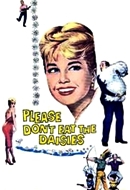 Rarely ever got into Doris Day. She was pleasant enough most of the time, though at some point she always turned into an automat. In her comedies and musicals, she was the virginal Jane Lynch the smartasses cracked jokes about. Of course it’s true she was
miscast as
Ruth Etting in Love Me or Leave Me and when she sang “Ten Cents a Dance,” you weren’t sure for whom she was so mesomorphically shimming in her flashy dress. But the asexual overtones were compelling, like an Amazon on an urbanizing drip. In the popular Pillow Talk, she and Rock Hudson had a good time in what looked to be a party for two but don’t we all wish they hadn’t made those two follow ups? The only time I really like her is in Please
Don’t Eat the Daisies, a comedy based on Jean Kerr’s best seller about the escapades associated with being married to the famous theatre critic Walter Kerr. With names changed and the idiocy rather mild, it’s an unnecessary family picture not too cloying because the critic David Niven and wife Doris have kids as pranksters who get laughs in the background. Doris’s nonchalant responses to the kids surprise: she’s not frantic,
she’s nearly natural in ignoring the fact one of the brats is locked up in a cage or sitting on a barred up window sill of the cramped high rise apartment dropping water bombs. If not a likely choice to be a Niven costar, she matches up with him far better than she does with stiffmeister Cary Grant. The dilemma of critics interacting with the stars they review is given minimal wit, similar to Bob Hope in Critic’s Choice, the juicier possibilities sacrificed for a broader audience. In her last
movie role, Spring Byington lobs off a few good ones and the zingiest is aimed at derrière diva Janis Paige. Customary for Hollywood back then to give Doris a few songs to sing and the two full numbers provided are real bummers. With Doris’s clout, couldn’t she have put her foot down and refuse those few bars of “Whatever Will Be”?
Rarely ever got into Doris Day. She was pleasant enough most of the time, though at some point she always turned into an automat. In her comedies and musicals, she was the virginal Jane Lynch the smartasses cracked jokes about. Of course it’s true she was
miscast as
Ruth Etting in Love Me or Leave Me and when she sang “Ten Cents a Dance,” you weren’t sure for whom she was so mesomorphically shimming in her flashy dress. But the asexual overtones were compelling, like an Amazon on an urbanizing drip. In the popular Pillow Talk, she and Rock Hudson had a good time in what looked to be a party for two but don’t we all wish they hadn’t made those two follow ups? The only time I really like her is in Please
Don’t Eat the Daisies, a comedy based on Jean Kerr’s best seller about the escapades associated with being married to the famous theatre critic Walter Kerr. With names changed and the idiocy rather mild, it’s an unnecessary family picture not too cloying because the critic David Niven and wife Doris have kids as pranksters who get laughs in the background. Doris’s nonchalant responses to the kids surprise: she’s not frantic,
she’s nearly natural in ignoring the fact one of the brats is locked up in a cage or sitting on a barred up window sill of the cramped high rise apartment dropping water bombs. If not a likely choice to be a Niven costar, she matches up with him far better than she does with stiffmeister Cary Grant. The dilemma of critics interacting with the stars they review is given minimal wit, similar to Bob Hope in Critic’s Choice, the juicier possibilities sacrificed for a broader audience. In her last
movie role, Spring Byington lobs off a few good ones and the zingiest is aimed at derrière diva Janis Paige. Customary for Hollywood back then to give Doris a few songs to sing and the two full numbers provided are real bummers. With Doris’s clout, couldn’t she have put her foot down and refuse those few bars of “Whatever Will Be”?
 Plenty, written by the grumbling malcontent David Hare and directed by Fred Schepisi, is about the anguish of a neurotic Englishwoman who is ostensibly meant to symbolize how a future hoped for after the end of W.W.II shrivels
into lame complacency, how the dizzying excitement of fighting the Nazis dissolves into modern barrenness. Don’t know a single English actress of wide appeal who could make this deadened-by-lies-and-life rubbish work—Nicole Kidman, perhaps, though she’s safely Australian—but to put Streep at its center is pure misconception. Streep over-intellectualizes the dour rants, wringing out the unique English reserve
of fortitude, then soaking everything with a snooty inchoative Europluralism. Not getting us to feel the danger in how she’s locked in manic festerings of energy and craziness—suffering as an undiagnosed bipolar—she makes us turn ugly, she makes us want to drug and slap her plenty. At this point in her career, acting doesn’t liberate her, it puts her into bondage; the diagramming, the hermetic preparations and character parameters are deliberately recondite and then redundantly esoteric. The camera and smart audiences spot her educated
deception, know when her acting is not just fenced in but barricaded, when it’s being projected not for feeling but for effects. This has to be what matters most when directors choose her for material like Manhatten, Kramer vs. Kramer, The French Lieutenant’s Woman, Still of the Night, Sophie’s Choice, Silkwood, Falling in Love, Heartburn, Ironweed and A Cry in the Dark. (Less
problematic in Out of Africa.) Her directors are duplicating what other directors used Geraldine Page for in Summer and Smoke, Sweet Bird of Youth, Toys in the Attic, The Happiest Millionaire, Interiors and Nasty Habits. But Streep doesn’t enjoy patrician contempt the way Page does: when merging the pleasure of haughty with her
affectations, she’s often funny—a comfort zone for audiences Streep has yet to provide. It’s a missed opportunity in Plenty, where at some point she’s what? a producer? of a dog food commercial, she blasts an aid with this: “I’ve tried for months to sink to the level of this enterprise.” Had Page pounced, with her tics aflame, the line would go down in one-liner history. Hare’s browbeating
is lost as comic gold; Schepisi and Streep take the nonsense seriously.
Plenty, written by the grumbling malcontent David Hare and directed by Fred Schepisi, is about the anguish of a neurotic Englishwoman who is ostensibly meant to symbolize how a future hoped for after the end of W.W.II shrivels
into lame complacency, how the dizzying excitement of fighting the Nazis dissolves into modern barrenness. Don’t know a single English actress of wide appeal who could make this deadened-by-lies-and-life rubbish work—Nicole Kidman, perhaps, though she’s safely Australian—but to put Streep at its center is pure misconception. Streep over-intellectualizes the dour rants, wringing out the unique English reserve
of fortitude, then soaking everything with a snooty inchoative Europluralism. Not getting us to feel the danger in how she’s locked in manic festerings of energy and craziness—suffering as an undiagnosed bipolar—she makes us turn ugly, she makes us want to drug and slap her plenty. At this point in her career, acting doesn’t liberate her, it puts her into bondage; the diagramming, the hermetic preparations and character parameters are deliberately recondite and then redundantly esoteric. The camera and smart audiences spot her educated
deception, know when her acting is not just fenced in but barricaded, when it’s being projected not for feeling but for effects. This has to be what matters most when directors choose her for material like Manhatten, Kramer vs. Kramer, The French Lieutenant’s Woman, Still of the Night, Sophie’s Choice, Silkwood, Falling in Love, Heartburn, Ironweed and A Cry in the Dark. (Less
problematic in Out of Africa.) Her directors are duplicating what other directors used Geraldine Page for in Summer and Smoke, Sweet Bird of Youth, Toys in the Attic, The Happiest Millionaire, Interiors and Nasty Habits. But Streep doesn’t enjoy patrician contempt the way Page does: when merging the pleasure of haughty with her
affectations, she’s often funny—a comfort zone for audiences Streep has yet to provide. It’s a missed opportunity in Plenty, where at some point she’s what? a producer? of a dog food commercial, she blasts an aid with this: “I’ve tried for months to sink to the level of this enterprise.” Had Page pounced, with her tics aflame, the line would go down in one-liner history. Hare’s browbeating
is lost as comic gold; Schepisi and Streep take the nonsense seriously.
 Portrait in Black is another of producer Ross Hunter’s inglorious vanity productions showcasing the only remaining exploitable asset Lana Turner had—sleazing her way through histrionic sexcapades.
(The boys of Bad Movies We Love are a bit kinder—winking she’s been processed like “a four-course Velveeta banquet.”) In her previous Hunter smörgåsbord, Imitation of Life, Lana pretended to be both a virtuous mother to Sandra Dee and an acclaimed theatre star hoping to nab the leading role in a faux Fellini picture. Her thesping fraudulence, the expensive jewels and furs, the sticky blond globs were overshadowed once Susan Kohner started to pass herself off as white and was knocked around by Troy Donahue and then suffered the most extravagantly humiliating sobbing ever by a daughter at her own mother’s funeral. Nothing comparably ranks in Portrait, a flimsy redo of The Postman Always Rings Twice permitting Lana to survive the original crash to duplicate
all those
sins of the damned, but there are some enjoyable extras: Lana looks hearty in a
Claire Trevor sort of way; gets slammed when her soon-to-be-air-bubbled-in-the-heart husband Lloyd Nolan tells her she needs “a vitamin shot for love deficiency”; fends off Richard Basehart’s advances and a fireplace iron assault; drives for the very first time (after getting her driver’s permit) a finned-up chromed-to-the-max Chrysler Windsor at night in a downpour on California’s Highway 1 without knowing which button to push to start the windshield wipers and earns a mighty slap for her confederate efforts
by lover Anthony Quinn. Hardly a moment when we didn’t fight the gag reflexes of her mother love to Dee in Imitation but in this thriller she’s an indifferent stepmother to Dee and it’s minor fun is watching the stepdaughter scrutinize. (Still, as Dee comes into Quinn’s sights as the next victim and Lana only watches, we’re not too sure she should be spared.) The miscasting of Quinn as a husband murderer is not just too conspicuous, his greasy acting as a doctor smitten to insanity by Lana’s mysterious bewitchment, perhaps brought on by those original paintings on the walls of his pad, is probably the worst star performance of his career. Though the framed abominations are provided a screen credit for the Martin Lowitz Gallery, a depository for mass-produced oil paintings, the artists are not, thus the second smartest move made by Hunter and director Michael Gordon. The smartest is Frank Skinner’s score heightening the rattlebrained trash.
Portrait in Black is another of producer Ross Hunter’s inglorious vanity productions showcasing the only remaining exploitable asset Lana Turner had—sleazing her way through histrionic sexcapades.
(The boys of Bad Movies We Love are a bit kinder—winking she’s been processed like “a four-course Velveeta banquet.”) In her previous Hunter smörgåsbord, Imitation of Life, Lana pretended to be both a virtuous mother to Sandra Dee and an acclaimed theatre star hoping to nab the leading role in a faux Fellini picture. Her thesping fraudulence, the expensive jewels and furs, the sticky blond globs were overshadowed once Susan Kohner started to pass herself off as white and was knocked around by Troy Donahue and then suffered the most extravagantly humiliating sobbing ever by a daughter at her own mother’s funeral. Nothing comparably ranks in Portrait, a flimsy redo of The Postman Always Rings Twice permitting Lana to survive the original crash to duplicate
all those
sins of the damned, but there are some enjoyable extras: Lana looks hearty in a
Claire Trevor sort of way; gets slammed when her soon-to-be-air-bubbled-in-the-heart husband Lloyd Nolan tells her she needs “a vitamin shot for love deficiency”; fends off Richard Basehart’s advances and a fireplace iron assault; drives for the very first time (after getting her driver’s permit) a finned-up chromed-to-the-max Chrysler Windsor at night in a downpour on California’s Highway 1 without knowing which button to push to start the windshield wipers and earns a mighty slap for her confederate efforts
by lover Anthony Quinn. Hardly a moment when we didn’t fight the gag reflexes of her mother love to Dee in Imitation but in this thriller she’s an indifferent stepmother to Dee and it’s minor fun is watching the stepdaughter scrutinize. (Still, as Dee comes into Quinn’s sights as the next victim and Lana only watches, we’re not too sure she should be spared.) The miscasting of Quinn as a husband murderer is not just too conspicuous, his greasy acting as a doctor smitten to insanity by Lana’s mysterious bewitchment, perhaps brought on by those original paintings on the walls of his pad, is probably the worst star performance of his career. Though the framed abominations are provided a screen credit for the Martin Lowitz Gallery, a depository for mass-produced oil paintings, the artists are not, thus the second smartest move made by Hunter and director Michael Gordon. The smartest is Frank Skinner’s score heightening the rattlebrained trash.
 It’s alleged there’s something praiseworthy about Lorenzo Semple, Jr.’s script of Pretty Poison, directed by Noel Black and starring Anthony Perkins and Tuesday Weld. Don’t quite see it. What’s impossible not to see
is when movie makers dare
put Tony and Tuesday together, the danger of amusing psychomania swamping the atmosphere would be inevitable; they’re to the 60s what Sean Young and Patrick Bergin are to the late 80s and early 90s. The psychology of a former teen arsonist fabricating his way into manhood is limpy; when at the movie’s start Tony shows up at a job to fulfil his parole obligations, he feigns as an ecological spy and then graduates to eco terrorist without correlation to the few interspersed hints about his motivations
for the juvenile
arson resulting in his incarceration at a mental facility. The shaky presumption: he’s gone from parentless social misfit to fantasy savior of the environment, detoured by Tuesday. There’s unexpected restraint in the twosome’s fruitcake performing; Tony’s trademark slender frangibility counters Tuesday’s toxic opportunist without a lot of indulgences. And they look good: his weediness isn’t alarming and she looks deboozed—the opposite of her bloat in Wild in the Country
and a few unmentionables. (In their only other movie together, Play It As It Lays, they’re immersed in early 70s Joan Didionism, with Tuesday the one in a cuckoo’s nest.) Reportedly Tuesday claimed she’s at her worst in Pretty Poison but who doesn’t enjoy how she discharges some payback into her mother Beverly Garland, who sparks things up a bit. Those incautious slaps they slam each other with reflect
the
deeper peril Tony is in. (Foreshadowed by Tuesday’s tittering, though the twist at conclusion doesn’t do much to measure the fuller meaning of his acquiescence.) Maybe she has a point about herself: one of her special talents as performer has been to incite actions causing men to want to react violently—she’s a neurotic switch turning on irrationality. Here she’s got to make the transition from petulant young bitch to sociopath thrill killer and the best she achieves is pedestrian warpiness. She allows us
to use
our laughs as antidote to her toxicity.
It’s alleged there’s something praiseworthy about Lorenzo Semple, Jr.’s script of Pretty Poison, directed by Noel Black and starring Anthony Perkins and Tuesday Weld. Don’t quite see it. What’s impossible not to see
is when movie makers dare
put Tony and Tuesday together, the danger of amusing psychomania swamping the atmosphere would be inevitable; they’re to the 60s what Sean Young and Patrick Bergin are to the late 80s and early 90s. The psychology of a former teen arsonist fabricating his way into manhood is limpy; when at the movie’s start Tony shows up at a job to fulfil his parole obligations, he feigns as an ecological spy and then graduates to eco terrorist without correlation to the few interspersed hints about his motivations
for the juvenile
arson resulting in his incarceration at a mental facility. The shaky presumption: he’s gone from parentless social misfit to fantasy savior of the environment, detoured by Tuesday. There’s unexpected restraint in the twosome’s fruitcake performing; Tony’s trademark slender frangibility counters Tuesday’s toxic opportunist without a lot of indulgences. And they look good: his weediness isn’t alarming and she looks deboozed—the opposite of her bloat in Wild in the Country
and a few unmentionables. (In their only other movie together, Play It As It Lays, they’re immersed in early 70s Joan Didionism, with Tuesday the one in a cuckoo’s nest.) Reportedly Tuesday claimed she’s at her worst in Pretty Poison but who doesn’t enjoy how she discharges some payback into her mother Beverly Garland, who sparks things up a bit. Those incautious slaps they slam each other with reflect
the
deeper peril Tony is in. (Foreshadowed by Tuesday’s tittering, though the twist at conclusion doesn’t do much to measure the fuller meaning of his acquiescence.) Maybe she has a point about herself: one of her special talents as performer has been to incite actions causing men to want to react violently—she’s a neurotic switch turning on irrationality. Here she’s got to make the transition from petulant young bitch to sociopath thrill killer and the best she achieves is pedestrian warpiness. She allows us
to use
our laughs as antidote to her toxicity.
 About a mammoth canon dullishly hauled, pushed and hidden by thousands all over the terrains of Spain, Stanley Kramer’s The Pride and the Passion is more
widely derided for its
acute miscasting
of its male leads. Cary Grant is in a weird kind of finned crew cut and poorly fitted embellishments as a 19th Century English officer. We’re hoping Professor Higgins will stop by the caravan to help Cary articulate clearly but even if he did, we wouldn’t be spared the awful truth—Cary was convincing only as himself and seldom if ever as an actor of range. Some postulate he cultivated foremost his image and believe, without disapproval, he perfected being a star. By the mid
50s, though, he
came to a light bulb moment—being a star is all he was; when he tried to be serious, as in this travesty, he failed twice: as the actor he wanted to be and dependability as star. Not long after this picture, and partially because of it, he took psychotropics under a doctor’s supervision, and one of the mind-bending conclusions coming from his trips was the obvious fact audiences didn’t believe him as a British military pansy; they wanted him to remain the persona of comedic suavity and look good enough to snack on. Frank Sinatra
didn’t fare any better as a Spaniard: whatever pretense of credibility was doomed from the start when, in his perpetual tantrum mode, he told the director he wouldn’t—and didn’t—do more than one take per scene and left location shooting seven weeks before completion. (He had to hunt down wife Ava Gardner who, the Madrid press reported, was slurping the fruity Sangria with some of Spain’s eligible toreadors.) The lure for viewers is Sophia Loren’s dance as this epic’s pièce de résistance: with her
lips
parted and moist, her meaty hips defyingly slinky, her boobs bouncy and consumable, she’s absolute trash sanctified. We sense she’s more woman than under-equipped Cary, who during filming fell madly in love with her, could handle. (His need to conquer and marry her was psychologically slimy, the details of which Sophia has always been gracious not to repeat.) The movie has a load of bad studio shots spliced into what is pretty much an outdoor adventure: the sloppiest is with Cary and Sophia the night
before he fires the canon for the first time. We think we know what the prop is they’re gathered around but no bets. There are some idiot fun moments: Cary in a knife duel, freshly starched and pressed; Sinatra furiously whipping mules and later Cary carrying him instead of Sophia through the blown away stone wall of Ávila; the unintentionally duncy as well as problematic Ku Klux Klan-like religious headdresses used during Holy Week. A few pluses: Spain’s castles, cathedrals and wide-open spaces and
a mildly striking sequence when
huge straw balls are set afire and roll down toward a French military camp. No one can account for Kramer’s DGA nomination for this would-be hardticket. Based on C.S. Forester’s The Gun. In VistaVision.
About a mammoth canon dullishly hauled, pushed and hidden by thousands all over the terrains of Spain, Stanley Kramer’s The Pride and the Passion is more
widely derided for its
acute miscasting
of its male leads. Cary Grant is in a weird kind of finned crew cut and poorly fitted embellishments as a 19th Century English officer. We’re hoping Professor Higgins will stop by the caravan to help Cary articulate clearly but even if he did, we wouldn’t be spared the awful truth—Cary was convincing only as himself and seldom if ever as an actor of range. Some postulate he cultivated foremost his image and believe, without disapproval, he perfected being a star. By the mid
50s, though, he
came to a light bulb moment—being a star is all he was; when he tried to be serious, as in this travesty, he failed twice: as the actor he wanted to be and dependability as star. Not long after this picture, and partially because of it, he took psychotropics under a doctor’s supervision, and one of the mind-bending conclusions coming from his trips was the obvious fact audiences didn’t believe him as a British military pansy; they wanted him to remain the persona of comedic suavity and look good enough to snack on. Frank Sinatra
didn’t fare any better as a Spaniard: whatever pretense of credibility was doomed from the start when, in his perpetual tantrum mode, he told the director he wouldn’t—and didn’t—do more than one take per scene and left location shooting seven weeks before completion. (He had to hunt down wife Ava Gardner who, the Madrid press reported, was slurping the fruity Sangria with some of Spain’s eligible toreadors.) The lure for viewers is Sophia Loren’s dance as this epic’s pièce de résistance: with her
lips
parted and moist, her meaty hips defyingly slinky, her boobs bouncy and consumable, she’s absolute trash sanctified. We sense she’s more woman than under-equipped Cary, who during filming fell madly in love with her, could handle. (His need to conquer and marry her was psychologically slimy, the details of which Sophia has always been gracious not to repeat.) The movie has a load of bad studio shots spliced into what is pretty much an outdoor adventure: the sloppiest is with Cary and Sophia the night
before he fires the canon for the first time. We think we know what the prop is they’re gathered around but no bets. There are some idiot fun moments: Cary in a knife duel, freshly starched and pressed; Sinatra furiously whipping mules and later Cary carrying him instead of Sophia through the blown away stone wall of Ávila; the unintentionally duncy as well as problematic Ku Klux Klan-like religious headdresses used during Holy Week. A few pluses: Spain’s castles, cathedrals and wide-open spaces and
a mildly striking sequence when
huge straw balls are set afire and roll down toward a French military camp. No one can account for Kramer’s DGA nomination for this would-be hardticket. Based on C.S. Forester’s The Gun. In VistaVision.
 Usually resist writing about Joan Crawford. Has little to do with her string of horror movies putting an end to her career and I don’t include Whatever Happened to Baby Jane?, in which she’s more tolerable than her co-star. In the late 50s and early 60s, during summer breaks from school,
I’d watch the various TV morning movies, matinées and then the late nighters and get my fill of the staples of the old studio melodramas. As persistent martyr, Joanie was always good for some laughs, which I call the pasquinade factor because even if there was never any belief in her performances, there was nearly always the imitation of glamorous suffering to amuse, to say “Get a load of this shit!” Sometimes she could be effective in spite of herself: in Mildred Pierce she’s
the self-sacrificing mother to a cunt-faced daughter as miniature version of a future plastic fantastic Joanie. What she’s up to in Humoresque is any one’s guess and she’s so mismatched as lover to John Garfield as to make her exit a screamer reprieve; she is, nevertheless, fixating. At other times—the garish Torch Song and the lez-vibed Johnny Guitar, for example—she flips over into camp without the wink and the only thing left is embarrassment and a Carol
Burnett send-up. In the cult candidate Queen Bee—a production she was more personally involved in than any other, having bought the rights to the novel by Edna Lee, insisting she be its star and who would direct, photograph and create her costumes and hair—she’s out to rule the hive as an over-dressed narcissist-buttinsky. In butchess coiffe, she does have moments: when she uses a
rider’s crop to start destroying knickknackery in a guest bedroom, it’s supposed to be psycho bitch scary—an underpinning to why she drives the clucks to suicide. Former lover John Ireland tries to thumbnail her problem: “You’re like some fancy kind of disease—I had it once, now I’m immune.” But nothing Joanie ever does moves us beyond the beginning stages of Psyche 101; her nervus facialis strokes out early. (Faye Dunaway manages similar superficial facials in Mommie Dearest.) Does anyone
know why Barry Sullivan was a major supporting star? Playing Joanie’s embittered boozing spouse, he’s doing nothing he hadn’t done elsewhere; sort of an American version of Michael Rennie, his tall anorexic frame and deep voice often conveyed menace and not only in drama. Whether the attraction of grittiness or steady persona, it kept him steadily acting for fifty years. Yet, if it’s clever for creepy Ireland to alter Sullivan’s plan to counter-sting the queen, what’s not fitting is the
booby prize at the end—the Ann Blyth look-a-like Lucy Marlow. The real thing would be preferable and make more marketable the Lux soap as a guilty pleasure.
Usually resist writing about Joan Crawford. Has little to do with her string of horror movies putting an end to her career and I don’t include Whatever Happened to Baby Jane?, in which she’s more tolerable than her co-star. In the late 50s and early 60s, during summer breaks from school,
I’d watch the various TV morning movies, matinées and then the late nighters and get my fill of the staples of the old studio melodramas. As persistent martyr, Joanie was always good for some laughs, which I call the pasquinade factor because even if there was never any belief in her performances, there was nearly always the imitation of glamorous suffering to amuse, to say “Get a load of this shit!” Sometimes she could be effective in spite of herself: in Mildred Pierce she’s
the self-sacrificing mother to a cunt-faced daughter as miniature version of a future plastic fantastic Joanie. What she’s up to in Humoresque is any one’s guess and she’s so mismatched as lover to John Garfield as to make her exit a screamer reprieve; she is, nevertheless, fixating. At other times—the garish Torch Song and the lez-vibed Johnny Guitar, for example—she flips over into camp without the wink and the only thing left is embarrassment and a Carol
Burnett send-up. In the cult candidate Queen Bee—a production she was more personally involved in than any other, having bought the rights to the novel by Edna Lee, insisting she be its star and who would direct, photograph and create her costumes and hair—she’s out to rule the hive as an over-dressed narcissist-buttinsky. In butchess coiffe, she does have moments: when she uses a
rider’s crop to start destroying knickknackery in a guest bedroom, it’s supposed to be psycho bitch scary—an underpinning to why she drives the clucks to suicide. Former lover John Ireland tries to thumbnail her problem: “You’re like some fancy kind of disease—I had it once, now I’m immune.” But nothing Joanie ever does moves us beyond the beginning stages of Psyche 101; her nervus facialis strokes out early. (Faye Dunaway manages similar superficial facials in Mommie Dearest.) Does anyone
know why Barry Sullivan was a major supporting star? Playing Joanie’s embittered boozing spouse, he’s doing nothing he hadn’t done elsewhere; sort of an American version of Michael Rennie, his tall anorexic frame and deep voice often conveyed menace and not only in drama. Whether the attraction of grittiness or steady persona, it kept him steadily acting for fifty years. Yet, if it’s clever for creepy Ireland to alter Sullivan’s plan to counter-sting the queen, what’s not fitting is the
booby prize at the end—the Ann Blyth look-a-like Lucy Marlow. The real thing would be preferable and make more marketable the Lux soap as a guilty pleasure.
 When Alexander Dumas wrote
La Reine
Margot (Queen
Margot) in 1845, it was first
serialized as two-page installments in French periodicals and readers were reported
to have fainted at the super nasty deeds of Margot’s
mommie Catherine de Médici who orchestrated the infamous 1572 St.
Bartholomew’s Day Massacre against the hated Huguenots just five days after
Margot married Henri of Narvarre. The ensuing bloodbath so revolted the world
even Ivan the Terrible was said to have condemned it. But Dumas (and
the editors) knew the drawing power of murderous bitches, and so do moviemakers.
While Patrice Chéreau’s 1994 French version stars Isabelle Adjani as Margot (looking
distractingly like Jennifer Jones), it’s Virni Lisi who, in personal triumph as Catherine, appropriately holds the bloody mess together. Originally
160 minutes,
Queen
Margot
underwent a major re-edit when
it didn’t perform at the French box office as predicted; despite receiving
praise from Paris critics and winning 5 Césars, the public and many
international critics found it an overload of violence and too often
incomprehensible. Cutting it down to 144 minutes, adding some historically
clarifying comments, the DVD version (at least the one released in America)
still creates problems because the rush of events early on—Margot’s
wedding, her loins burning for fresh flesh (and not her new husband’s), the
secretive plots with allies and conspirators—don’t congeal to make very
clear the slaughter about to commence. Don’t think there’s a light
or a restful moment throughout, and this hurts Adjani enormously: she alternates
between fornicating and pleading for her lover’s life and she gets damned
tiresome very quickly. However, she’s in several memorably provocative scenes
of pruriency and sheer horror, not the least of which are her brother’s accidental
book poisoning and her visitation to the victims of a dual beheading. Chéreau’s depiction of the massacre is perhaps
too frenetic for us to grasp its historic meaning and consequence, yet it’s a bold enactment, unlike
anything we’re seen from French moviemakers before. With Daniel Auteuil, Jean-Hugues Anglade, Vincent
Perez, Thomas Kretschmann and Miguel Bosé.
When Alexander Dumas wrote
La Reine
Margot (Queen
Margot) in 1845, it was first
serialized as two-page installments in French periodicals and readers were reported
to have fainted at the super nasty deeds of Margot’s
mommie Catherine de Médici who orchestrated the infamous 1572 St.
Bartholomew’s Day Massacre against the hated Huguenots just five days after
Margot married Henri of Narvarre. The ensuing bloodbath so revolted the world
even Ivan the Terrible was said to have condemned it. But Dumas (and
the editors) knew the drawing power of murderous bitches, and so do moviemakers.
While Patrice Chéreau’s 1994 French version stars Isabelle Adjani as Margot (looking
distractingly like Jennifer Jones), it’s Virni Lisi who, in personal triumph as Catherine, appropriately holds the bloody mess together. Originally
160 minutes,
Queen
Margot
underwent a major re-edit when
it didn’t perform at the French box office as predicted; despite receiving
praise from Paris critics and winning 5 Césars, the public and many
international critics found it an overload of violence and too often
incomprehensible. Cutting it down to 144 minutes, adding some historically
clarifying comments, the DVD version (at least the one released in America)
still creates problems because the rush of events early on—Margot’s
wedding, her loins burning for fresh flesh (and not her new husband’s), the
secretive plots with allies and conspirators—don’t congeal to make very
clear the slaughter about to commence. Don’t think there’s a light
or a restful moment throughout, and this hurts Adjani enormously: she alternates
between fornicating and pleading for her lover’s life and she gets damned
tiresome very quickly. However, she’s in several memorably provocative scenes
of pruriency and sheer horror, not the least of which are her brother’s accidental
book poisoning and her visitation to the victims of a dual beheading. Chéreau’s depiction of the massacre is perhaps
too frenetic for us to grasp its historic meaning and consequence, yet it’s a bold enactment, unlike
anything we’re seen from French moviemakers before. With Daniel Auteuil, Jean-Hugues Anglade, Vincent
Perez, Thomas Kretschmann and Miguel Bosé.
 In John O’Hara’s A Rage to Live, Grace Caldwell is perhaps a reincarnation of his Gloria Wandrous in BUtterfield 8, only this time
she’s an upper class Pennsylvania heiress. Neither the decadent, boozing party girl of Gloria nor suffering from the after-effects of child molestation as an excuse for frowned upon sexual behavior, Grace nevertheless has a lusty yen for men. Because “vindictive” is often the derogatory used to describe O’Hara’s attitude toward women—avid reader Cary Grant said the author “had nymphomaniacs on the brain”—it’s an amazement he might actually like Grace, even
empathizing with her healthy appetite for sex. This might be why A Rage to Live was his first hugely successful
novel, coming out four years after the end of WWII. Though a major portion of the story takes place before the war, the more significant part of the “messaging” in the work is expounding on what the war years did to American social and cultural conventions and he particularly wanted to zero in on what the period did to the emerging independence of women. Perhaps as a response to, say, William Wyler’s The Best Years of Our Lives, in which the characters reflect a shift in our nation’s
psyche—despite the euphoria of winning the “good war,” American marriage was soon headed into an after-war rush towards materialism as filler to cover up martial incompatibility and sexual unfulfillment. My mother, along with hundreds of thousands of other women who worked the factories during the war and then displaced by the returning soldiers, felt obliged to marry in ‘46, be “the good wife,” have those kids. She didn’t want any of it—she was 19 and thrived on “war years” excitement of Chicago—but
acquiesced to strong societal and familial pressure to marry a G.I. she hardly knew (a handsome hick from Maine who fought in the Pacific along side her brother-in-law) and, no surprise, the marriage ended quickly. Rosie the Riveter the obvious emblem but the “itch” not exclusive to class: when agreeing to marry the gentleman farmer Sidney Tate, Grace confesses up front she’s not one of those cherished wedding night virgins. Committing to monogamy, she’s thoughtfully lying, knowing her well-intended faithfulness
would be contingent on not succumbing to temptation. Then would come Bannon. After discovering her indiscretions, Sidney lectures antipathetically to Grace about learning and sticking to the rules—“when it’s hard to obey the rules, that’s when they mean something.” Explaining what they “mean,” he concludes: “What it amounts to is you said to hell with my rules, and the hell with me.” These rules are supposed to be (and on screen try to sound like) Protestant-authorized yet reveal double-edged
contempt: Sidney believing he’s entitled to do the decreeing while Grace rejects obedience. In BU 8 Gloria is punished for being the “slut of all times”; in A Rage to Live Grace, surviving her husband (and a son), questions why her sexcapades need to be punished at all. Her plea for sexual suffrage is ignored in the movie of A Rage to Live—she’s guilt-tripped instead. Minus O’Hara’s heft, presented
as wide-screen b & w television, director Walter Grauman and adapter John T. Kelley don’t deliver much beyond economized soap. They’ve got Elizabeth Taylor in their heads but are stuck with Suzanne Pleshette. Over at IMDb it’s written Anne Bancroft was original choice—she already played a postpartum version of Grace in The Pumpkin Eater the year before—but United Artists hoped to lure Liz to play the character as a follow up to the movie BU 8. The next option: allow Suzanne
to be Taylorized, including copying the hairdo from the 1961 Oscar ceremony at which she won her first. Other bits lifted: Suzanne’s ailing mother is none other than Carmen Mathews, who played Dina Merrill’s high society mother in BU 8, and if you’ve seen the movie you’ll be hard-pressed not to laugh at the blatant ripoff fate of Ben Gazzara’s Bannon. He’s the right enticement, though: as one of those N.Y. Sicilian smolderers, his ever-oozing carnality means both satisfaction in getting
off and danger afterwards because his grungy if implicit sadism suggests you could be roughed up. As Sidney, Brad Dillman serves up as best he can the verbatim O’Hara male authority edicts, and Bethel Leslie the typical suffering shrew who forces a garish showdown with Suzanne. (Leslie gets a small fun bit when she throws a drink into husband Peter Graves’s face and wastes not a second pouring herself a refill.) The movie makers barely got away with updating the setting of BU8; updating
A Rage to Live might have been sufferable had Suzanne’s Grace pushed back, giving the finger to the gawking moralists by saying to hell with the old constructs; neutralizing the novel’s kicker, she’s sent running after her tyrant husband. Unusually succinct about after-the-war discontent and the false tenor of The Best Years of Our Lives, my mother might be speaking for a lot of women when she said, “I wasn’t alone.
There were a lot more Virginia Mayos than Myrna Loys.”
In John O’Hara’s A Rage to Live, Grace Caldwell is perhaps a reincarnation of his Gloria Wandrous in BUtterfield 8, only this time
she’s an upper class Pennsylvania heiress. Neither the decadent, boozing party girl of Gloria nor suffering from the after-effects of child molestation as an excuse for frowned upon sexual behavior, Grace nevertheless has a lusty yen for men. Because “vindictive” is often the derogatory used to describe O’Hara’s attitude toward women—avid reader Cary Grant said the author “had nymphomaniacs on the brain”—it’s an amazement he might actually like Grace, even
empathizing with her healthy appetite for sex. This might be why A Rage to Live was his first hugely successful
novel, coming out four years after the end of WWII. Though a major portion of the story takes place before the war, the more significant part of the “messaging” in the work is expounding on what the war years did to American social and cultural conventions and he particularly wanted to zero in on what the period did to the emerging independence of women. Perhaps as a response to, say, William Wyler’s The Best Years of Our Lives, in which the characters reflect a shift in our nation’s
psyche—despite the euphoria of winning the “good war,” American marriage was soon headed into an after-war rush towards materialism as filler to cover up martial incompatibility and sexual unfulfillment. My mother, along with hundreds of thousands of other women who worked the factories during the war and then displaced by the returning soldiers, felt obliged to marry in ‘46, be “the good wife,” have those kids. She didn’t want any of it—she was 19 and thrived on “war years” excitement of Chicago—but
acquiesced to strong societal and familial pressure to marry a G.I. she hardly knew (a handsome hick from Maine who fought in the Pacific along side her brother-in-law) and, no surprise, the marriage ended quickly. Rosie the Riveter the obvious emblem but the “itch” not exclusive to class: when agreeing to marry the gentleman farmer Sidney Tate, Grace confesses up front she’s not one of those cherished wedding night virgins. Committing to monogamy, she’s thoughtfully lying, knowing her well-intended faithfulness
would be contingent on not succumbing to temptation. Then would come Bannon. After discovering her indiscretions, Sidney lectures antipathetically to Grace about learning and sticking to the rules—“when it’s hard to obey the rules, that’s when they mean something.” Explaining what they “mean,” he concludes: “What it amounts to is you said to hell with my rules, and the hell with me.” These rules are supposed to be (and on screen try to sound like) Protestant-authorized yet reveal double-edged
contempt: Sidney believing he’s entitled to do the decreeing while Grace rejects obedience. In BU 8 Gloria is punished for being the “slut of all times”; in A Rage to Live Grace, surviving her husband (and a son), questions why her sexcapades need to be punished at all. Her plea for sexual suffrage is ignored in the movie of A Rage to Live—she’s guilt-tripped instead. Minus O’Hara’s heft, presented
as wide-screen b & w television, director Walter Grauman and adapter John T. Kelley don’t deliver much beyond economized soap. They’ve got Elizabeth Taylor in their heads but are stuck with Suzanne Pleshette. Over at IMDb it’s written Anne Bancroft was original choice—she already played a postpartum version of Grace in The Pumpkin Eater the year before—but United Artists hoped to lure Liz to play the character as a follow up to the movie BU 8. The next option: allow Suzanne
to be Taylorized, including copying the hairdo from the 1961 Oscar ceremony at which she won her first. Other bits lifted: Suzanne’s ailing mother is none other than Carmen Mathews, who played Dina Merrill’s high society mother in BU 8, and if you’ve seen the movie you’ll be hard-pressed not to laugh at the blatant ripoff fate of Ben Gazzara’s Bannon. He’s the right enticement, though: as one of those N.Y. Sicilian smolderers, his ever-oozing carnality means both satisfaction in getting
off and danger afterwards because his grungy if implicit sadism suggests you could be roughed up. As Sidney, Brad Dillman serves up as best he can the verbatim O’Hara male authority edicts, and Bethel Leslie the typical suffering shrew who forces a garish showdown with Suzanne. (Leslie gets a small fun bit when she throws a drink into husband Peter Graves’s face and wastes not a second pouring herself a refill.) The movie makers barely got away with updating the setting of BU8; updating
A Rage to Live might have been sufferable had Suzanne’s Grace pushed back, giving the finger to the gawking moralists by saying to hell with the old constructs; neutralizing the novel’s kicker, she’s sent running after her tyrant husband. Unusually succinct about after-the-war discontent and the false tenor of The Best Years of Our Lives, my mother might be speaking for a lot of women when she said, “I wasn’t alone.
There were a lot more Virginia Mayos than Myrna Loys.”
 Akira Kurosawa is often eulogized as the visual version of Shakespeare. We’ve heard this equivalency long before
he passed, as far back as The Throne of Blood, and, to make the connection seemingly indisputable, his 1985 epic splash Ran is touted to be the
ultimate King Lear in warlord drag. Writing the screenplay on and off for years, basing it on Segoku-era military leader Mori Motonari who had three sons, he acknowledged using the Bard’s tragedy to frame the bloody tohubohu of sixteenth-century Japan because he needed to make sense of what is inscrutable Shõgun action, to keep it from becoming another Kagemusha. (Could be said uncomplicatedly the latter is about a horse dethroning a fake.) As with Lear,
themes abound: the suffering of lovelessness, deserved or not; the battles of inheritance; treachery; nihilism; and, obviously, chaos. These and other motifs drift in and out like the inclement weather did while filming and become the movie’s saving grace, a feast of atmospherics by compromise with nature. The fog and chill of Mt. Fuji were storyboarded before shooting started; the volatile weather enhanced what the Bard might be envious of—the soaked-in-disease ambiance, which in turn adds intense
contrast to the Oscar-winning costume designs by Emi Wada and Oscar-nominated art/set direction and lensing. But let’s be honest, the punches in the prolixity of Lear don’t easily roll. They didn’t for Laurence Olivier, either, in the 1983 Granada Television’s economized video version, though he managed to capture Lear dispensing and suffering from the biffs: his hands spin from his gray bearded face and then blows a lewd, incestuous kiss to his beloved Cordelia—yet is
it a kiss?—and
he virtually sings an agonizing aria mixed with disdain and hurt when he’s turned away by his two other daughters, bitches Goneril and Regan. Kurosawa’s vistas and bloodbaths are compensation for pent-up emotions without actors verbally expressing them, forfeiting the rot of familial dysfunction to choreographed pantomime, to horses, landscapes and rifles. If the peril in the theatre of Bushido is much the same in Shakespeare’s tragedy—the pathologies keeping us in a deep freeze—the settings
and tempestuous action are satisfying substitutes, delivering the master playwright’s pre-cinematic senses the British usually and over-respectfully avoid. Some time before Ran, Peter O’Toole wanted to play Lear with Kurosawa directing. It’s okay to grieve the lost experience.
Akira Kurosawa is often eulogized as the visual version of Shakespeare. We’ve heard this equivalency long before
he passed, as far back as The Throne of Blood, and, to make the connection seemingly indisputable, his 1985 epic splash Ran is touted to be the
ultimate King Lear in warlord drag. Writing the screenplay on and off for years, basing it on Segoku-era military leader Mori Motonari who had three sons, he acknowledged using the Bard’s tragedy to frame the bloody tohubohu of sixteenth-century Japan because he needed to make sense of what is inscrutable Shõgun action, to keep it from becoming another Kagemusha. (Could be said uncomplicatedly the latter is about a horse dethroning a fake.) As with Lear,
themes abound: the suffering of lovelessness, deserved or not; the battles of inheritance; treachery; nihilism; and, obviously, chaos. These and other motifs drift in and out like the inclement weather did while filming and become the movie’s saving grace, a feast of atmospherics by compromise with nature. The fog and chill of Mt. Fuji were storyboarded before shooting started; the volatile weather enhanced what the Bard might be envious of—the soaked-in-disease ambiance, which in turn adds intense
contrast to the Oscar-winning costume designs by Emi Wada and Oscar-nominated art/set direction and lensing. But let’s be honest, the punches in the prolixity of Lear don’t easily roll. They didn’t for Laurence Olivier, either, in the 1983 Granada Television’s economized video version, though he managed to capture Lear dispensing and suffering from the biffs: his hands spin from his gray bearded face and then blows a lewd, incestuous kiss to his beloved Cordelia—yet is
it a kiss?—and
he virtually sings an agonizing aria mixed with disdain and hurt when he’s turned away by his two other daughters, bitches Goneril and Regan. Kurosawa’s vistas and bloodbaths are compensation for pent-up emotions without actors verbally expressing them, forfeiting the rot of familial dysfunction to choreographed pantomime, to horses, landscapes and rifles. If the peril in the theatre of Bushido is much the same in Shakespeare’s tragedy—the pathologies keeping us in a deep freeze—the settings
and tempestuous action are satisfying substitutes, delivering the master playwright’s pre-cinematic senses the British usually and over-respectfully avoid. Some time before Ran, Peter O’Toole wanted to play Lear with Kurosawa directing. It’s okay to grieve the lost experience.
 Robert Mulligan’s 1960 The Rat Race has several redemptions. First, it provides one of the few dramatic roles candied Debbie Reynolds would play and not too shabbily. Two, the Garson Kanin script has been enjoyably trashed
up by John Michael Hayes’
screamers in roughly the same way his screamers trashed BUtterfield 8 the same year. Three, and best of all, there’s Irish-American Catholic Kay Medford so indulgently haranguing as a stereotypic Jewish landlady, and with huge thanks from the audience, she steals the proceedings. (She’d also do a smaller, much milder version as a motel owner familiar with Laurence Harvey’s “regular like” habits in BU 8.) She’s amazingly relaxed as a hag turning dumbfounding
bits—extracting “agony” compensation, mixing grape soda with Rye—into mini-sparklers diverting attention away from Debbie and Tony Curtis. No discounting, either, bar owner Jack Oakie’s gem about “tops and bottoms.” Dumber still is the decision, whether by Mulligan or Paramount, to have allowed famed Hitchcock cinematographer Robert Burks to turn the N. Y. settings into pronounced television fakery, a far remove from the civilized pans of Joseph Ruttenberg and Charles Harten in BU 8. And the gaudy
Technicolor aggravates the sham of the slummy—The Rat Race needed b & w, grittier than what Burks did with A Patch of Blue. (Whatever else to be said about King Vidor’s The Fountainhead, Burks curtails Rand’s hysteria with an ersatz noiriness.) Elmer Bernstein’s main title music (variations of which are heard again in 1964’s The Carpetbaggers) is the strongest dramatic
feature until Don Rickles arrives as the sweating repulsive misogynist Nellie, slur name intended.
Robert Mulligan’s 1960 The Rat Race has several redemptions. First, it provides one of the few dramatic roles candied Debbie Reynolds would play and not too shabbily. Two, the Garson Kanin script has been enjoyably trashed
up by John Michael Hayes’
screamers in roughly the same way his screamers trashed BUtterfield 8 the same year. Three, and best of all, there’s Irish-American Catholic Kay Medford so indulgently haranguing as a stereotypic Jewish landlady, and with huge thanks from the audience, she steals the proceedings. (She’d also do a smaller, much milder version as a motel owner familiar with Laurence Harvey’s “regular like” habits in BU 8.) She’s amazingly relaxed as a hag turning dumbfounding
bits—extracting “agony” compensation, mixing grape soda with Rye—into mini-sparklers diverting attention away from Debbie and Tony Curtis. No discounting, either, bar owner Jack Oakie’s gem about “tops and bottoms.” Dumber still is the decision, whether by Mulligan or Paramount, to have allowed famed Hitchcock cinematographer Robert Burks to turn the N. Y. settings into pronounced television fakery, a far remove from the civilized pans of Joseph Ruttenberg and Charles Harten in BU 8. And the gaudy
Technicolor aggravates the sham of the slummy—The Rat Race needed b & w, grittier than what Burks did with A Patch of Blue. (Whatever else to be said about King Vidor’s The Fountainhead, Burks curtails Rand’s hysteria with an ersatz noiriness.) Elmer Bernstein’s main title music (variations of which are heard again in 1964’s The Carpetbaggers) is the strongest dramatic
feature until Don Rickles arrives as the sweating repulsive misogynist Nellie, slur name intended.
 DIRTY WINDOWS: One
of the staples of British entertainment is the periodic bow to butlers and
housekeepers who help impose Upstairs/Downstairs separations
between the classes. Part of our attraction to these kind of stories is,
if we’re lucky, the head butler or housekeeper is endowed with a magnanimity
overwhelming and thus shaming the stiff upper class snobs who in the process
are taught lessons about the “real” world from the Leona Helmsley
“little people.” There’s suppose to be deep satisfaction in servants
always being smarter and more humane than their masters but, knowing their
place in society, never let on they are. The Ismail Merchant-James Ivory movie
The Remains of the
Day
deals with another kind of servant—the
drip-dried butler who hasn’t a purpose beyond the menial, a servant who offers
his life as a sacrifice on the alter of subservience, even in the face of
moral abjection. This movie, spending an inordinate amount of time telling us
how emotionally stunted its central character is, has a severe handicap right
from the start: Anthony Hopkins’ held-in, meticulously mannered
performance—a tour de force of repression, a monument to emptiness.
(A hangover from the never-used script by Harold Pinter?) Japanese-English
novelist Kauo Ishiguro’s caution about the trap of servitude is lost here
in what is the least satisfying Merchant-Ivory production since The
Bostonians. How could the moviemakers possibly think two and
a half hours of sullen monotony, without ever bringing a single smile to the audience, serve any useful purpose? Certainly not as
entertainment, and while one can’t argue the artful stringency of the
performances, all the labor is a substitute for Sominex. (Only Michel Lonsdale
as the French diplomat with aching feet sparks a minor interest—mainly
because he’s looking more like Martin Scorsese than ever.) Most glaring of
omissions: it’s never explained to us what qualities Emma Thompson’s character
sees in Hopkins’ fearful mess. In her final scene, aboard a bus and crying,
I didn’t believe a minute of her pain. (Who would have ever thought,
after his mesmerizing villainy in The Jewel in the Crown, Tom
Pigott Smith would be the right choice as a husband?) Once more Merchant
and Ivory hope the exquisite irony built into the classic stories they
film will magically appear to give us a wallop of a climax but, as in
The Bostonians and with Howards End, they somehow
manage to de-emphasize ironies and thus we’re robbed of the satisfaction of
fulfillment. This was apparent in Howards End, when
the audience is waiting for the payoff to detonate—when Emma Thompson
realizes the residence had been willed to her almost from the start.
There was a chance at the neat
twist here in
Remains had not the screenplay opened with Christopher Reeves
already in possession of the residence wherein Hopkins and
Thompson work. Prejudice a sub theme, viewers need Reeves as the surprise new owner. For all the household staff employed
to keep the old mansion in shape, didn’t anyone ever think to have the doors
and their moldings whitewashed or, more urgently, clean the windows? (Even Glenda Jackson’s peons wash them in Alan Bridges’ The
Return of the Soldier.) Such laxity grounds for dismissal. Tony and
Emma, you’re fired!
DIRTY WINDOWS: One
of the staples of British entertainment is the periodic bow to butlers and
housekeepers who help impose Upstairs/Downstairs separations
between the classes. Part of our attraction to these kind of stories is,
if we’re lucky, the head butler or housekeeper is endowed with a magnanimity
overwhelming and thus shaming the stiff upper class snobs who in the process
are taught lessons about the “real” world from the Leona Helmsley
“little people.” There’s suppose to be deep satisfaction in servants
always being smarter and more humane than their masters but, knowing their
place in society, never let on they are. The Ismail Merchant-James Ivory movie
The Remains of the
Day
deals with another kind of servant—the
drip-dried butler who hasn’t a purpose beyond the menial, a servant who offers
his life as a sacrifice on the alter of subservience, even in the face of
moral abjection. This movie, spending an inordinate amount of time telling us
how emotionally stunted its central character is, has a severe handicap right
from the start: Anthony Hopkins’ held-in, meticulously mannered
performance—a tour de force of repression, a monument to emptiness.
(A hangover from the never-used script by Harold Pinter?) Japanese-English
novelist Kauo Ishiguro’s caution about the trap of servitude is lost here
in what is the least satisfying Merchant-Ivory production since The
Bostonians. How could the moviemakers possibly think two and
a half hours of sullen monotony, without ever bringing a single smile to the audience, serve any useful purpose? Certainly not as
entertainment, and while one can’t argue the artful stringency of the
performances, all the labor is a substitute for Sominex. (Only Michel Lonsdale
as the French diplomat with aching feet sparks a minor interest—mainly
because he’s looking more like Martin Scorsese than ever.) Most glaring of
omissions: it’s never explained to us what qualities Emma Thompson’s character
sees in Hopkins’ fearful mess. In her final scene, aboard a bus and crying,
I didn’t believe a minute of her pain. (Who would have ever thought,
after his mesmerizing villainy in The Jewel in the Crown, Tom
Pigott Smith would be the right choice as a husband?) Once more Merchant
and Ivory hope the exquisite irony built into the classic stories they
film will magically appear to give us a wallop of a climax but, as in
The Bostonians and with Howards End, they somehow
manage to de-emphasize ironies and thus we’re robbed of the satisfaction of
fulfillment. This was apparent in Howards End, when
the audience is waiting for the payoff to detonate—when Emma Thompson
realizes the residence had been willed to her almost from the start.
There was a chance at the neat
twist here in
Remains had not the screenplay opened with Christopher Reeves
already in possession of the residence wherein Hopkins and
Thompson work. Prejudice a sub theme, viewers need Reeves as the surprise new owner. For all the household staff employed
to keep the old mansion in shape, didn’t anyone ever think to have the doors
and their moldings whitewashed or, more urgently, clean the windows? (Even Glenda Jackson’s peons wash them in Alan Bridges’ The
Return of the Soldier.) Such laxity grounds for dismissal. Tony and
Emma, you’re fired!
 THE WRONG STUFF: Philip Kaufman’s The Right Stuff is dense with buffoonery. The audience I saw it with back in 1983 laughed out of anxiety; they seemed uneasy and unsure as to why they laughed because the subject—the Mercury
Space Mission—is treated beyond its inherent humor. Almost the entire cast is discombobulated, directed to be a form of near-malicious caricature pretending to be funsy patriotism, in accordance with Tom Wolfe’s view in the book. Filled with distortions and fabrications that really can’t be excused, Kaufman tried, pleading artistic license, when he said to USA Today, “I’m more concerned with truth than facts.” If accepted, and if you accept Wolfe’s intent, you should know neither Kaufman nor
Wolfe ever spoke to any of the astronauts or their wives. The search for astronauts with the right physical and heroic stuff was given the big push after the launching of the Russian sputnik on October 4, 1957. The movie shows NASA sending officials all over the country to solicit candidates for the space program. It didn’t; instead, letters were sent to military pilots thought to have the right quality—the right touch of madness; out of 110 invitations, only 56 pilots responded. When NASA publicly presents
the first seven astronauts, the movie has their wives present in Washington D.C.; not one wife attended the unveiling. Alan Shepard’s flight into space—the first in our country—wasn’t witnessed by all seven wives at Louise Shepard’s home. Mrs. Shepard was home, because at the time NASA rules forbade the wife of an astronaut from appearing at the launch site. (The other wives watched in person at then-named Cape Canaveral.) Does Kaufman believe he’s made a better movie by unnecessarily meddling with facts and twisting events
to suit his needs to make history a joke? His needs are at their ugliest during the movie’s worst sequence: Gus Grissom’s re-entry into earth’s atmosphere and the pre-mature blowing of the hatch in the capsule which resulted in its sinking and almost caused Grissom’s death by drowning. In the movie, there’s not a trace of Kaufman’s “truth” in what he purports: Grissom, perhaps because he was drinking the night before or wasn’t psychologically prepared, panicked as he re-entered the atmosphere and blew open
the hatch to escape a sudden case of claustrophobia. He’s treated as if he’s not the heroic macho NASA wants to peddle and isn’t given a ticker tape parade or a visit to the White House Shepard and his wife were granted. Provided in lieu, according to the movie, was a half-hearted ceremony at an air base and afterwards the Grissoms were hurried off to a dingy room at the Starlite Motel facing a rocky, unusable portion of the Florida beach, with the frenzied press clamoring at their door. What really happened
was the Grissoms were roomed in the VIP quarters of Patrick Air Base, with no beach, no press, and no arguments between Grissom and his wife about the blowing of the hatch. In the movie, Veronica Cartwright’s Mrs. Grissom, angered she can’t go to the White House, brays, “Is this how they’re treating an honorary hatch blower?” Kaufman avoids clarifying NASA did investigate the hatch blowing but couldn’t reach a conclusion because the capsule was at the bottom of the ocean. In testimony, Grissom speculated
the hatch blew because a loose halyard was secured only by a single screw. A year later, after his own mission, Wally Schirra was given permission to blow his hatch. “It went right through my hand and I had bruises that lasted a few days. Gus had no bruises at all after his flight. I said to Gus, ‘I guess you couldn’t have done that.’ He had a smile as wide as the Pacific.” As if to balance the shameful distortion of a dead man—Grissom would be killed, along with two other astronauts, in 1967 when a fire swept
through their capsule being readied for another Apollo mission—Kaufman does a number on Annie Glenn, the wife of astronaut-later Senator John Glenn. While the actress Mary Jo Deschanel has Mrs. Glenn’s past stuttering down pat, it’s nevertheless a vision of horrors. Says Rene Carpenter, ex-wife of Scott Carpenter: “Annie was horrified. She is a resourceful, aggressive person, and she thought the movie made her look like a deaf-mute retard.” Playing John Glenn, Ed Harris is almost psycho. Redeeming his scenes
with Deschanel, and they may even be classified as tender, you can’t help being suspicious of the gung ho Kaufman infuses this screen Glenn with, as if he was out to destroy Glenn’s presidential ambitions. Sam Shepard’s Chuck Yeager is a welcomed respite: his lankiness is more real to us, as his humor isn’t fully displaced by mockery—except for his wolf calls and his last scene, where he walks away from a crash with a burned face and still chewing gum. Fred Ward comes closest to looking like Grissom. Dennis Quaid’s Gordo Cooper is perky but I got so tired of his constant smiling I wanted to whack him one. Scott Glenn, as Alan Shepard, is too muscled up and showoffy; his biceps look like they’ve produced baby biceps. Media blurbsters called The Right Stuff “an important movie.” What’s important about it? Does Kaufman’s idea of “truth” promote fact? Does it treat the people involved in the space
program fairly? (The engineers look like rejects from Hogan’s Heroes.) Is it a movie making us proud of our space achievements? Or make us aware how the program would advance technology, communication and medicine? The only good things in this crap ass movie were the sound effects of a phone ringing in two scenes. The rings were so clear and precise, so right there, members of the audience involuntarily jumped in unison—the only genuine moves in this travesty filled with jerks.
THE WRONG STUFF: Philip Kaufman’s The Right Stuff is dense with buffoonery. The audience I saw it with back in 1983 laughed out of anxiety; they seemed uneasy and unsure as to why they laughed because the subject—the Mercury
Space Mission—is treated beyond its inherent humor. Almost the entire cast is discombobulated, directed to be a form of near-malicious caricature pretending to be funsy patriotism, in accordance with Tom Wolfe’s view in the book. Filled with distortions and fabrications that really can’t be excused, Kaufman tried, pleading artistic license, when he said to USA Today, “I’m more concerned with truth than facts.” If accepted, and if you accept Wolfe’s intent, you should know neither Kaufman nor
Wolfe ever spoke to any of the astronauts or their wives. The search for astronauts with the right physical and heroic stuff was given the big push after the launching of the Russian sputnik on October 4, 1957. The movie shows NASA sending officials all over the country to solicit candidates for the space program. It didn’t; instead, letters were sent to military pilots thought to have the right quality—the right touch of madness; out of 110 invitations, only 56 pilots responded. When NASA publicly presents
the first seven astronauts, the movie has their wives present in Washington D.C.; not one wife attended the unveiling. Alan Shepard’s flight into space—the first in our country—wasn’t witnessed by all seven wives at Louise Shepard’s home. Mrs. Shepard was home, because at the time NASA rules forbade the wife of an astronaut from appearing at the launch site. (The other wives watched in person at then-named Cape Canaveral.) Does Kaufman believe he’s made a better movie by unnecessarily meddling with facts and twisting events
to suit his needs to make history a joke? His needs are at their ugliest during the movie’s worst sequence: Gus Grissom’s re-entry into earth’s atmosphere and the pre-mature blowing of the hatch in the capsule which resulted in its sinking and almost caused Grissom’s death by drowning. In the movie, there’s not a trace of Kaufman’s “truth” in what he purports: Grissom, perhaps because he was drinking the night before or wasn’t psychologically prepared, panicked as he re-entered the atmosphere and blew open
the hatch to escape a sudden case of claustrophobia. He’s treated as if he’s not the heroic macho NASA wants to peddle and isn’t given a ticker tape parade or a visit to the White House Shepard and his wife were granted. Provided in lieu, according to the movie, was a half-hearted ceremony at an air base and afterwards the Grissoms were hurried off to a dingy room at the Starlite Motel facing a rocky, unusable portion of the Florida beach, with the frenzied press clamoring at their door. What really happened
was the Grissoms were roomed in the VIP quarters of Patrick Air Base, with no beach, no press, and no arguments between Grissom and his wife about the blowing of the hatch. In the movie, Veronica Cartwright’s Mrs. Grissom, angered she can’t go to the White House, brays, “Is this how they’re treating an honorary hatch blower?” Kaufman avoids clarifying NASA did investigate the hatch blowing but couldn’t reach a conclusion because the capsule was at the bottom of the ocean. In testimony, Grissom speculated
the hatch blew because a loose halyard was secured only by a single screw. A year later, after his own mission, Wally Schirra was given permission to blow his hatch. “It went right through my hand and I had bruises that lasted a few days. Gus had no bruises at all after his flight. I said to Gus, ‘I guess you couldn’t have done that.’ He had a smile as wide as the Pacific.” As if to balance the shameful distortion of a dead man—Grissom would be killed, along with two other astronauts, in 1967 when a fire swept
through their capsule being readied for another Apollo mission—Kaufman does a number on Annie Glenn, the wife of astronaut-later Senator John Glenn. While the actress Mary Jo Deschanel has Mrs. Glenn’s past stuttering down pat, it’s nevertheless a vision of horrors. Says Rene Carpenter, ex-wife of Scott Carpenter: “Annie was horrified. She is a resourceful, aggressive person, and she thought the movie made her look like a deaf-mute retard.” Playing John Glenn, Ed Harris is almost psycho. Redeeming his scenes
with Deschanel, and they may even be classified as tender, you can’t help being suspicious of the gung ho Kaufman infuses this screen Glenn with, as if he was out to destroy Glenn’s presidential ambitions. Sam Shepard’s Chuck Yeager is a welcomed respite: his lankiness is more real to us, as his humor isn’t fully displaced by mockery—except for his wolf calls and his last scene, where he walks away from a crash with a burned face and still chewing gum. Fred Ward comes closest to looking like Grissom. Dennis Quaid’s Gordo Cooper is perky but I got so tired of his constant smiling I wanted to whack him one. Scott Glenn, as Alan Shepard, is too muscled up and showoffy; his biceps look like they’ve produced baby biceps. Media blurbsters called The Right Stuff “an important movie.” What’s important about it? Does Kaufman’s idea of “truth” promote fact? Does it treat the people involved in the space
program fairly? (The engineers look like rejects from Hogan’s Heroes.) Is it a movie making us proud of our space achievements? Or make us aware how the program would advance technology, communication and medicine? The only good things in this crap ass movie were the sound effects of a phone ringing in two scenes. The rings were so clear and precise, so right there, members of the audience involuntarily jumped in unison—the only genuine moves in this travesty filled with jerks.
 The same year as the Warner Bros hit Ocean’s 11 with the Rat Pack, there was Fox’s Seven Thieves. Caper movies were (and still are) box office, providing audiences
any number of ways to delight in watching stars get away with law-breaking. But there was always this sticky little thing called the Hays Production Code, which in 1960 still ruled, demanding crimes be punished. Its prissy morality had been somewhat abridged to find work-arounds so those committing non-violent offenses wouldn’t necessarily have to be sent to the big house, as long as the felonies weren’t profitable. Ocean’s 11 used a crematoria. Seven Thieves uses a clever play on reversal of fortune: discovering the currency they’ve successfully stolen has been traceably marked to impede efforts to spend it, two of the Monte Carlo casino heisters quietly return the loot before anyone notices what’s missing and then receive a surprise most of us won’t see coming. Enjoyable, with ageing workhorse Henry Hathaway directing a good cast: Edward G. Robinson, Rod Steiger,
Eli Wallach, Alexander Scourby, Sebastian Cabot, some uncredited drop-ins and Joan Collins who once more overcomes Hollywood’s persistent need to trash her. (The choreography she bumps to was created by stripper Candy Barr, whose frequent bouts of infamy included a highly publicized conviction for marijuana possession—reportedly hidden in a bra—and her friendship with Jack Ruby, the killer of Lee Harvey Oswald.) Listening to the music score, you wonder if your ear is correctly recognizing the sneaking
in of themes from other movies; in case you don’t they are from Laura, Love is a Many Splendored Thing and The Best of Everything. CinemaScope, in black & white.
The same year as the Warner Bros hit Ocean’s 11 with the Rat Pack, there was Fox’s Seven Thieves. Caper movies were (and still are) box office, providing audiences
any number of ways to delight in watching stars get away with law-breaking. But there was always this sticky little thing called the Hays Production Code, which in 1960 still ruled, demanding crimes be punished. Its prissy morality had been somewhat abridged to find work-arounds so those committing non-violent offenses wouldn’t necessarily have to be sent to the big house, as long as the felonies weren’t profitable. Ocean’s 11 used a crematoria. Seven Thieves uses a clever play on reversal of fortune: discovering the currency they’ve successfully stolen has been traceably marked to impede efforts to spend it, two of the Monte Carlo casino heisters quietly return the loot before anyone notices what’s missing and then receive a surprise most of us won’t see coming. Enjoyable, with ageing workhorse Henry Hathaway directing a good cast: Edward G. Robinson, Rod Steiger,
Eli Wallach, Alexander Scourby, Sebastian Cabot, some uncredited drop-ins and Joan Collins who once more overcomes Hollywood’s persistent need to trash her. (The choreography she bumps to was created by stripper Candy Barr, whose frequent bouts of infamy included a highly publicized conviction for marijuana possession—reportedly hidden in a bra—and her friendship with Jack Ruby, the killer of Lee Harvey Oswald.) Listening to the music score, you wonder if your ear is correctly recognizing the sneaking
in of themes from other movies; in case you don’t they are from Laura, Love is a Many Splendored Thing and The Best of Everything. CinemaScope, in black & white.
 BEAUTIFUL
PLAIN JANE: Gilbert’s
Shirley
Valentine purposely reminds moviegoers
of his 60s hit Alfie. The central characters—in the former, a
housewife bored with the if-this-is-Thursday-it’s-steak-day routine; in the
latter, a womanizing cad—face the camera to more or less wink their
smarts at the audience in far more satisfying ways than Sarah Palin managed
to. The difference between the two characters is what makes them companion
as well as comparison pieces: Shirley is unrelentingly good and decent in
her ordinariness, whereas Alfie’s relentlessly amoral hypnotic
lecher. But you love them equally, as you probably know people just
like them. Pauline Collins’ Shirley is a peculiarly
smashing success because you keep thinking how it can
be for a character who isn’t particularly interesting can be this beautifully
interesting to watch. Perhaps it’s Collins’ scrubbed features—she’s
pleasing in her plumpness. She’s isn’t what you’d
call a hot turn-on by any stretch, but she’s safe; there’s something reassuring and refreshing
about her no-nonsense attitude. And this Shirley isn’t above being an equal
opportunity exasperater: she bugs teacher, husband and tourist alike. Tom
Conti’s amorous Greek is rather like a Sam Elliott gambling he can do
an accent. Joanna Lumley, one of the blasted broads of AbsolutelyFabulous, plays a high class hooker.
BEAUTIFUL
PLAIN JANE: Gilbert’s
Shirley
Valentine purposely reminds moviegoers
of his 60s hit Alfie. The central characters—in the former, a
housewife bored with the if-this-is-Thursday-it’s-steak-day routine; in the
latter, a womanizing cad—face the camera to more or less wink their
smarts at the audience in far more satisfying ways than Sarah Palin managed
to. The difference between the two characters is what makes them companion
as well as comparison pieces: Shirley is unrelentingly good and decent in
her ordinariness, whereas Alfie’s relentlessly amoral hypnotic
lecher. But you love them equally, as you probably know people just
like them. Pauline Collins’ Shirley is a peculiarly
smashing success because you keep thinking how it can
be for a character who isn’t particularly interesting can be this beautifully
interesting to watch. Perhaps it’s Collins’ scrubbed features—she’s
pleasing in her plumpness. She’s isn’t what you’d
call a hot turn-on by any stretch, but she’s safe; there’s something reassuring and refreshing
about her no-nonsense attitude. And this Shirley isn’t above being an equal
opportunity exasperater: she bugs teacher, husband and tourist alike. Tom
Conti’s amorous Greek is rather like a Sam Elliott gambling he can do
an accent. Joanna Lumley, one of the blasted broads of AbsolutelyFabulous, plays a high class hooker.
 Josh Logan’s deplorable movie version of
South
Pacific prompts detractors
to wonder if the unusually high acclaim for the Bartlett Sher Broadway
revival might suggest there’s more to the musical than a wussy fondness for
antiquity. In breathtaking HD, the PBS airing of Sher’s production validates
some of the raving. Right off the bat, Kelli O’Hara, looking and acting an
awful like Reba McEntire, is inestimably more tolerable as Nellie Forbush
than that zit on the ass of movies Mitzi Gaynor. O’Hara’s the right vision
to persuade she’s a Little Rock hick and she brings some refreshment
to the lyrics of the lumpy songs and an unwavering if sometimes sharply piercing
range of voice to pull them off. (Having missed her work in Sher’s equally
celebrated Light in the Piazza, there is an innocence
about her Nellie making ideal casting as quite fetching Clara—an
aureole-like charm circling around retard emotions.) Playing Emile de
Becque, Brazilian Paulo Szot has the expanding diaphragm of a matinée profundo
and those who love the curdles of “Some Enchanted Evening” will
not be disappointed how he churns the cheese, but for my tastes he’s a bit
too sinisterly hulky-looking, recalling Joe Spinell’s Willi Cicci in
The Godfather and The Godfather II. Throughout
Szot’s performance I kept thinking how much better Antonio Banderas would
be as needed star and actor. Because neither Szot nor O’Hara achieve stellar
luminance as stage personalities in the production, the unintended star
becomes Andrew Samonsky, whose enviable thinness as Lt. Joseph Cable
is more attractive than John Kerr’s. Some of what makes him riveting
is a rather disconcerting drawback—his resemblance to James Woods. The
calculated butch gait and posturing don’t escape notice, either, yet the
lures come together almost erotically when engaged for his seduction
of Liat. Our investment in Andrew reminds us the musical has a lousy
second act: it’s not and never has been acceptable for the character Cable
to die off stage. Why can’t he expire in Liat’s arms? The rushed conclusion
joining Nellie and Emile also lacks the kind of emotional welling we’re
set up for. Much appreciated is this South
Pacific is not an overly frenetic danced-to-perfection entertainment
leaving you lurching for a 5 Hour Energy shot. And, finally, after all
these years, the insipid “Happy Talk” moves beyond nails scratching
against a blackboard. Director Sher re-energizes a classic show while at
the same time reconfirming—having been hemmed in by restrictions in order to get
the rights—his praise worthy skills can’t do much to deepen its theme
of racial harmony. The daughters of Rogers and Hammerstein continue the legacy
of their fathers’ lightheadedness.
Josh Logan’s deplorable movie version of
South
Pacific prompts detractors
to wonder if the unusually high acclaim for the Bartlett Sher Broadway
revival might suggest there’s more to the musical than a wussy fondness for
antiquity. In breathtaking HD, the PBS airing of Sher’s production validates
some of the raving. Right off the bat, Kelli O’Hara, looking and acting an
awful like Reba McEntire, is inestimably more tolerable as Nellie Forbush
than that zit on the ass of movies Mitzi Gaynor. O’Hara’s the right vision
to persuade she’s a Little Rock hick and she brings some refreshment
to the lyrics of the lumpy songs and an unwavering if sometimes sharply piercing
range of voice to pull them off. (Having missed her work in Sher’s equally
celebrated Light in the Piazza, there is an innocence
about her Nellie making ideal casting as quite fetching Clara—an
aureole-like charm circling around retard emotions.) Playing Emile de
Becque, Brazilian Paulo Szot has the expanding diaphragm of a matinée profundo
and those who love the curdles of “Some Enchanted Evening” will
not be disappointed how he churns the cheese, but for my tastes he’s a bit
too sinisterly hulky-looking, recalling Joe Spinell’s Willi Cicci in
The Godfather and The Godfather II. Throughout
Szot’s performance I kept thinking how much better Antonio Banderas would
be as needed star and actor. Because neither Szot nor O’Hara achieve stellar
luminance as stage personalities in the production, the unintended star
becomes Andrew Samonsky, whose enviable thinness as Lt. Joseph Cable
is more attractive than John Kerr’s. Some of what makes him riveting
is a rather disconcerting drawback—his resemblance to James Woods. The
calculated butch gait and posturing don’t escape notice, either, yet the
lures come together almost erotically when engaged for his seduction
of Liat. Our investment in Andrew reminds us the musical has a lousy
second act: it’s not and never has been acceptable for the character Cable
to die off stage. Why can’t he expire in Liat’s arms? The rushed conclusion
joining Nellie and Emile also lacks the kind of emotional welling we’re
set up for. Much appreciated is this South
Pacific is not an overly frenetic danced-to-perfection entertainment
leaving you lurching for a 5 Hour Energy shot. And, finally, after all
these years, the insipid “Happy Talk” moves beyond nails scratching
against a blackboard. Director Sher re-energizes a classic show while at
the same time reconfirming—having been hemmed in by restrictions in order to get
the rights—his praise worthy skills can’t do much to deepen its theme
of racial harmony. The daughters of Rogers and Hammerstein continue the legacy
of their fathers’ lightheadedness.
 The 1961 Splendor in the Grass is a vexing fraud in which Audrey Christie as Natalie Wood’s mother insists “a woman doesn’t like that sort of thing” but avoids explaining, whether Natalie does or doesn’t, she’ll
end up another Audrey or in the loony bin. She hasn’t any idea what’s coming big time—punishment for being a “good girl” who said no to Warren Beatty. In the earliest draft of his first original screenplay, playwright William Inge didn’t center the story on teenage hormones raging into psychosis, wanting instead to balance the idealism of young love and rising sexual impulse without any banner-waving virginity pledges in uptight Kansas, set mostly before the stock market crash of 1929. Director
Elia Kazan, however, was eager to enliven things, wanting to pour some heavy duty intensity on top of the compassionate hokum. During pre-production rewrites he was not sold on Natalie, an overused commodity, but when meeting her and hearing she was undergoing psychoanalysis, he saw the opportunity to ratchet up the Freudian dramatics. And did he ever: the movie was then and might still be sickly impacting. A teenager when seeing it for the first time, I couldn’t get it out of my mind and parts of it have stayed
with me more strongly than I should admit to: the opening waterfall sequence with Natalie & Warren making out; the hysteria of sexual desire being denied and the sexist “Juanita” solutions; Barbara Loden coming close to be being gang-banged (its prurience here and instances elsewhere were added by Kazan and had to be sharply cut to avert censorship battles); the apprehension in the reunion finale, during which my big-mouth mother, who dragged me along because she didn’t want to go to a movie house alone,
loudly gasped, “Look, he’s got a ring on!” All these years later, the question still not answered: for whom was Splendor made? And speaking for many of us, favorite critic David Oberman over at Movie Kinks “still can’t ascertain its point” after seeing the fulmination twice. Having initially restricted audiences under 17, Warner Bros. was reticent to predict the
movie would become a hit on the scale of A Summer Place, one of its late 50s/early 60s unwed preggers chronicles also having an unhealthy mother in Constance Ford. But ASP was designed for teens, wrapped in Max Steiner’s love theme as a leaky condom. The prestige of Kazan and Inge manically going off the deep end about teen sex did propel box office success by attracting the very teens theatres
were supposed to keep away; by the time Splendor arrived at local neighborhoods, insanely double-billed with Kirk Douglas’s Town Without Pity about a rape trial of a 16 year old, teens made up most of the audience at matinees and on date nights. (Bantam provided the chance to re-experience the traumas when publishing Inge’s screenplay, becoming a popular if hidden read in high school
study halls.) The mixed signals appear to be not having teen sex is dangerous for the unhinged while teen audiences needn’t stop making out in the passion pits of convertibles and theatre balconies. Though smart adults spotted the movie’s other major deficiency, it wasn’t easy back in ’61 for teens to detect the disquieting elements permeating throughout Natalie’s performance, what with her Extra Strength timorousness and self-consciousness resulting in hyper-revulsive
fright. There are tipoffs: she doesn’t look as if she ever stepped foot in a high school except for photo shoots (her work schedule during those required credit years tell us she spent most of her school days on set); her unpersuasive acting in repeatedly moaning “No, Bud, no” to Warren, whose persuasive résumé she couldn’t say no to in her private life; getting mired in ever-lasting busy work of using her mouth, darting eyes, hands and rising voice as substitute for
sexual frustration—the “Did he spoil you?” sequence so heebeegeebee we all want her committed for our own relief. (Exploiting private information Natalie told Kazan, he gave the info to Christie as catalytic dialogue.) But did it ever make sense, especially to homespun auteur Inge, poor Natalie has to pay for her mother’s ignorant inculcation of sex hatred by ending up in a cracker factory for two and a half years? At the end, when she’s voicing over without sufficient
emotional resonance a verse from Wordsworth’s Ode: Intimations of Immortality, his lament gets lost: what splendors and glories are to be remembered above her horrible ordeal? Known to TV viewers of Max Shulman’s The Many Loves of Dobie Gillis as rich kid Milton Armitage, Warren made his short-lived but still auspicious Broadway début in November, 1958, in Inge’s A Loss of Roses, for which, after only 25 performances, he was Tony-nominated as best featured actor in a
play, giving him considerable edge in getting cast in Splendor. (Tennessee Williams and James Leo Herlihy, authors of the stories to become Warren’s next two films, were likewise infatuated, as was Life magazine when calling him “the most exciting American male in movies.” One of Kazan’s earlier candidates was Troy Donahue.) Aware of what the mirror reflects, Warren’s “local boy” freshness as approach
to his own magnetism makes fitting the one due process in the movie we can believe—his doofus ends up back in rigid Lily-white Kansas living in a dump with a wife who’ll quite likely endure bruising from discrimination. Loden is a katzenjammer flapper at war with daddy Pat Hingle; Christie and Hingle the nightmare pairing never to be joined. Brando said of Kazan: “He was an arch-manipulator of actors’ feelings.” And no less a bullying manipulator of playwrights and the
audience.
The 1961 Splendor in the Grass is a vexing fraud in which Audrey Christie as Natalie Wood’s mother insists “a woman doesn’t like that sort of thing” but avoids explaining, whether Natalie does or doesn’t, she’ll
end up another Audrey or in the loony bin. She hasn’t any idea what’s coming big time—punishment for being a “good girl” who said no to Warren Beatty. In the earliest draft of his first original screenplay, playwright William Inge didn’t center the story on teenage hormones raging into psychosis, wanting instead to balance the idealism of young love and rising sexual impulse without any banner-waving virginity pledges in uptight Kansas, set mostly before the stock market crash of 1929. Director
Elia Kazan, however, was eager to enliven things, wanting to pour some heavy duty intensity on top of the compassionate hokum. During pre-production rewrites he was not sold on Natalie, an overused commodity, but when meeting her and hearing she was undergoing psychoanalysis, he saw the opportunity to ratchet up the Freudian dramatics. And did he ever: the movie was then and might still be sickly impacting. A teenager when seeing it for the first time, I couldn’t get it out of my mind and parts of it have stayed
with me more strongly than I should admit to: the opening waterfall sequence with Natalie & Warren making out; the hysteria of sexual desire being denied and the sexist “Juanita” solutions; Barbara Loden coming close to be being gang-banged (its prurience here and instances elsewhere were added by Kazan and had to be sharply cut to avert censorship battles); the apprehension in the reunion finale, during which my big-mouth mother, who dragged me along because she didn’t want to go to a movie house alone,
loudly gasped, “Look, he’s got a ring on!” All these years later, the question still not answered: for whom was Splendor made? And speaking for many of us, favorite critic David Oberman over at Movie Kinks “still can’t ascertain its point” after seeing the fulmination twice. Having initially restricted audiences under 17, Warner Bros. was reticent to predict the
movie would become a hit on the scale of A Summer Place, one of its late 50s/early 60s unwed preggers chronicles also having an unhealthy mother in Constance Ford. But ASP was designed for teens, wrapped in Max Steiner’s love theme as a leaky condom. The prestige of Kazan and Inge manically going off the deep end about teen sex did propel box office success by attracting the very teens theatres
were supposed to keep away; by the time Splendor arrived at local neighborhoods, insanely double-billed with Kirk Douglas’s Town Without Pity about a rape trial of a 16 year old, teens made up most of the audience at matinees and on date nights. (Bantam provided the chance to re-experience the traumas when publishing Inge’s screenplay, becoming a popular if hidden read in high school
study halls.) The mixed signals appear to be not having teen sex is dangerous for the unhinged while teen audiences needn’t stop making out in the passion pits of convertibles and theatre balconies. Though smart adults spotted the movie’s other major deficiency, it wasn’t easy back in ’61 for teens to detect the disquieting elements permeating throughout Natalie’s performance, what with her Extra Strength timorousness and self-consciousness resulting in hyper-revulsive
fright. There are tipoffs: she doesn’t look as if she ever stepped foot in a high school except for photo shoots (her work schedule during those required credit years tell us she spent most of her school days on set); her unpersuasive acting in repeatedly moaning “No, Bud, no” to Warren, whose persuasive résumé she couldn’t say no to in her private life; getting mired in ever-lasting busy work of using her mouth, darting eyes, hands and rising voice as substitute for
sexual frustration—the “Did he spoil you?” sequence so heebeegeebee we all want her committed for our own relief. (Exploiting private information Natalie told Kazan, he gave the info to Christie as catalytic dialogue.) But did it ever make sense, especially to homespun auteur Inge, poor Natalie has to pay for her mother’s ignorant inculcation of sex hatred by ending up in a cracker factory for two and a half years? At the end, when she’s voicing over without sufficient
emotional resonance a verse from Wordsworth’s Ode: Intimations of Immortality, his lament gets lost: what splendors and glories are to be remembered above her horrible ordeal? Known to TV viewers of Max Shulman’s The Many Loves of Dobie Gillis as rich kid Milton Armitage, Warren made his short-lived but still auspicious Broadway début in November, 1958, in Inge’s A Loss of Roses, for which, after only 25 performances, he was Tony-nominated as best featured actor in a
play, giving him considerable edge in getting cast in Splendor. (Tennessee Williams and James Leo Herlihy, authors of the stories to become Warren’s next two films, were likewise infatuated, as was Life magazine when calling him “the most exciting American male in movies.” One of Kazan’s earlier candidates was Troy Donahue.) Aware of what the mirror reflects, Warren’s “local boy” freshness as approach
to his own magnetism makes fitting the one due process in the movie we can believe—his doofus ends up back in rigid Lily-white Kansas living in a dump with a wife who’ll quite likely endure bruising from discrimination. Loden is a katzenjammer flapper at war with daddy Pat Hingle; Christie and Hingle the nightmare pairing never to be joined. Brando said of Kazan: “He was an arch-manipulator of actors’ feelings.” And no less a bullying manipulator of playwrights and the
audience.
 DON’T MAKE EM LIKE THIS
ANYMORE: Fred
Zinnemann’s 1960 The
Sundowners wasn’t well received at the
box office. No one wanted to see a movie about Australian sheepherders
with not much more than a pot to piss in, not when Ben-Hur
was still playing to packed houses, and Psycho was giving
moviegoers a new pop icon in Norman Bates who helped change shower habits,
and Cary Grant and Tony Curtis were hanging bras and panties on a pink sub
in Operation Petticoat, and certainly not when Liz was waking
up ravishingly slugged after a hard night with Laurence Harvey in
BUtterfield 8. After all these years, though,
The Sundowners
remains the higher model of built-to-last
craftsmanship—a period piece surviving our super Pentium-speed decay.
With a little patience, you become engrossed by what’s clearly a labor of
love. Zinnemann worked in defiance of the odds, making his most endearing
story with perhaps only his foreknowledge as comfort in the fact it would take years
before the movie would be recognized as a classic. In their covered wagon,
Robert Mitchum and wife Deborah Kerr, their dutiful son and sheep dog, and
Peter Ustinov trek to where the seasonal jobs are. Mitchum’s a weekend boozer
who wants to “keep on the move”—he can’t stand things
getting stuck in park; Kerr dreams of her own place, nervously guarding the money
jar in which there’s a hard-earned down payment. Frictional opposites, yet
these two really have it for each other: they do in this picture what Mitchum
fantasized about in Heaven Knows, Mr. Allison. Working to sustain
an Aussie accent but still retaining his humorously American gigolo gait,
he’s as marvelous to watch against type as Kerr, who sheds the great lady
affectations; together they’re positively hale. And with her down-under tan,
Kerr’s never looked more so. Ustinov furnishes more evidence as to why he
won 1960’s best supporting actor Oscar (for Spartacus); Glynis
Johns a tad bit too spunky; and the lovely Dina Merrill the ever-ready real
thing as a high strung society type. Playing Merrill’s husband is Ewen Solon,
who’d pass for Zinnemann’s twin. Nominated for 5 Oscars: best film, director,
actress, supporting actress (Johns) and adapted screenplay (Isobel Lennart).
Kerr won the N.Y. Critics Award; Mitchum the National Board of Review
honor.
DON’T MAKE EM LIKE THIS
ANYMORE: Fred
Zinnemann’s 1960 The
Sundowners wasn’t well received at the
box office. No one wanted to see a movie about Australian sheepherders
with not much more than a pot to piss in, not when Ben-Hur
was still playing to packed houses, and Psycho was giving
moviegoers a new pop icon in Norman Bates who helped change shower habits,
and Cary Grant and Tony Curtis were hanging bras and panties on a pink sub
in Operation Petticoat, and certainly not when Liz was waking
up ravishingly slugged after a hard night with Laurence Harvey in
BUtterfield 8. After all these years, though,
The Sundowners
remains the higher model of built-to-last
craftsmanship—a period piece surviving our super Pentium-speed decay.
With a little patience, you become engrossed by what’s clearly a labor of
love. Zinnemann worked in defiance of the odds, making his most endearing
story with perhaps only his foreknowledge as comfort in the fact it would take years
before the movie would be recognized as a classic. In their covered wagon,
Robert Mitchum and wife Deborah Kerr, their dutiful son and sheep dog, and
Peter Ustinov trek to where the seasonal jobs are. Mitchum’s a weekend boozer
who wants to “keep on the move”—he can’t stand things
getting stuck in park; Kerr dreams of her own place, nervously guarding the money
jar in which there’s a hard-earned down payment. Frictional opposites, yet
these two really have it for each other: they do in this picture what Mitchum
fantasized about in Heaven Knows, Mr. Allison. Working to sustain
an Aussie accent but still retaining his humorously American gigolo gait,
he’s as marvelous to watch against type as Kerr, who sheds the great lady
affectations; together they’re positively hale. And with her down-under tan,
Kerr’s never looked more so. Ustinov furnishes more evidence as to why he
won 1960’s best supporting actor Oscar (for Spartacus); Glynis
Johns a tad bit too spunky; and the lovely Dina Merrill the ever-ready real
thing as a high strung society type. Playing Merrill’s husband is Ewen Solon,
who’d pass for Zinnemann’s twin. Nominated for 5 Oscars: best film, director,
actress, supporting actress (Johns) and adapted screenplay (Isobel Lennart).
Kerr won the N.Y. Critics Award; Mitchum the National Board of Review
honor.
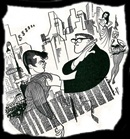 Except for Sweet Smell of Success, which I saw again during TCM’s tribute, was Tony Curtis any good? The greasy curls, the “low life” persona, the years of waste in one bad sex comedy
after another, he personified the
pinups from the old movie magazines a little too well—he solicited as a “pretty boy.” Remember when the Empress wrote about Marcello in A Special Day being a “little loose in the seat”? Fits Curtis and evident in Paris When it Sizzles, too. (He and Louis Jourdan might have triumphed together in La Cage aux folles.) But in a role which needs whorishness, as in Sweet Smell, he holds
up, he deliciously becomes the slime bag he portrays. He’s not afraid of Burt Lancaster as actor, either, and it’s another treat for foofs the otherwise domineering Burt allows all of his co-stars their moments—including Martin Milner in the scene during which he’s trying not to have to kiss Lancaster’s ass while eager to stomp on Tony’s. The movie itself really holds up, infected with Walter Winchell menace and Dorothy Kilgallen bitch venom, and the seamy heavy “night life” b & w look is like sludge
to plow through. Have always had it for ex-stripper Barbara Nichols. Her harsh blondness and shrill voice were trademarks unfortunately narrowing her opportunities, and the buxom cheapness had been over-exposed in those sleazy men’s magazines of the 50s. Yet she had an innate agreeableness about her, an endearing way of working her not-so-smarts. You didn’t feel a need to protect her, as you did with Marilyn; she had grit and empathy. In Sweet Smell
of Success, director Alexander Machendrick tones her down, even letting her whisper, and guides her in pulling off a difficult sequence during which Curtis pimps her out. It remains no small feat she’s memorable against the likes of Lancaster and Curtis.
Except for Sweet Smell of Success, which I saw again during TCM’s tribute, was Tony Curtis any good? The greasy curls, the “low life” persona, the years of waste in one bad sex comedy
after another, he personified the
pinups from the old movie magazines a little too well—he solicited as a “pretty boy.” Remember when the Empress wrote about Marcello in A Special Day being a “little loose in the seat”? Fits Curtis and evident in Paris When it Sizzles, too. (He and Louis Jourdan might have triumphed together in La Cage aux folles.) But in a role which needs whorishness, as in Sweet Smell, he holds
up, he deliciously becomes the slime bag he portrays. He’s not afraid of Burt Lancaster as actor, either, and it’s another treat for foofs the otherwise domineering Burt allows all of his co-stars their moments—including Martin Milner in the scene during which he’s trying not to have to kiss Lancaster’s ass while eager to stomp on Tony’s. The movie itself really holds up, infected with Walter Winchell menace and Dorothy Kilgallen bitch venom, and the seamy heavy “night life” b & w look is like sludge
to plow through. Have always had it for ex-stripper Barbara Nichols. Her harsh blondness and shrill voice were trademarks unfortunately narrowing her opportunities, and the buxom cheapness had been over-exposed in those sleazy men’s magazines of the 50s. Yet she had an innate agreeableness about her, an endearing way of working her not-so-smarts. You didn’t feel a need to protect her, as you did with Marilyn; she had grit and empathy. In Sweet Smell
of Success, director Alexander Machendrick tones her down, even letting her whisper, and guides her in pulling off a difficult sequence during which Curtis pimps her out. It remains no small feat she’s memorable against the likes of Lancaster and Curtis.
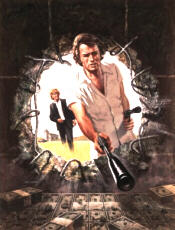 Not long into Michael Cimino’s début Thunderbolt and
Lightfoot we start wondering where he’s headed: a straight’s secret homoerotic fantasy? A Midnight Cowboy turned into a Butch Preacher and the Transvestite Kid? We’re amused and intrigued by the sexually-tinged camaraderie between Clint Eastwood and Jeff Bridges who bait each other with come-ons but never unzip to consummate. To get the 70s pulse, I looked up old reviews by some
New York critics and the words “misogynistic,” “latent homosexual” and “anti-heterosexual” frequently popped up and very derisively. Seems a lot of the press, and users commenting over at IMDb, got pissed over Cimino not having the guts to travel the route to climax so they slammed him by intimating he was hiding in the closet. (Nearing the end of his life, he was photographed at Clint’s side looking discomfortingly transy.) But the carpers’ disappointment
doesn’t make the movie any more or less a reflection of American males’ chauvinist attitudes toward women and animus of gays; the opposite occurs as Cimino’s ambiguity adds a potent charge. The real scorn is aimed specifically at braggarts like George Kennedy, who could easily turn anyone anti-male. (Can’t think of another actor I get sick of faster, except Samuel L. Jackson.) Minus the invert overtones, the movie’s not about much, really—it’s like a 20 year-old’s daydream of libertine bandits who have
to pay a half-price for their wrongdoing. Unlike the fake mod derelict buddies stuff of Ratso and Buck, or the glamor boys gunned into the pop myth of Butch Cassidy and the Sundance Kid, the duo here offer up a bit of white trash romanticism: sizing up Clint when first running into him, Jeff says, “We’d be good together.” Because they don’t seize on their compatibilities, Thunderbolt and
Lightfoot attains cult status.
Not long into Michael Cimino’s début Thunderbolt and
Lightfoot we start wondering where he’s headed: a straight’s secret homoerotic fantasy? A Midnight Cowboy turned into a Butch Preacher and the Transvestite Kid? We’re amused and intrigued by the sexually-tinged camaraderie between Clint Eastwood and Jeff Bridges who bait each other with come-ons but never unzip to consummate. To get the 70s pulse, I looked up old reviews by some
New York critics and the words “misogynistic,” “latent homosexual” and “anti-heterosexual” frequently popped up and very derisively. Seems a lot of the press, and users commenting over at IMDb, got pissed over Cimino not having the guts to travel the route to climax so they slammed him by intimating he was hiding in the closet. (Nearing the end of his life, he was photographed at Clint’s side looking discomfortingly transy.) But the carpers’ disappointment
doesn’t make the movie any more or less a reflection of American males’ chauvinist attitudes toward women and animus of gays; the opposite occurs as Cimino’s ambiguity adds a potent charge. The real scorn is aimed specifically at braggarts like George Kennedy, who could easily turn anyone anti-male. (Can’t think of another actor I get sick of faster, except Samuel L. Jackson.) Minus the invert overtones, the movie’s not about much, really—it’s like a 20 year-old’s daydream of libertine bandits who have
to pay a half-price for their wrongdoing. Unlike the fake mod derelict buddies stuff of Ratso and Buck, or the glamor boys gunned into the pop myth of Butch Cassidy and the Sundance Kid, the duo here offer up a bit of white trash romanticism: sizing up Clint when first running into him, Jeff says, “We’d be good together.” Because they don’t seize on their compatibilities, Thunderbolt and
Lightfoot attains cult status.
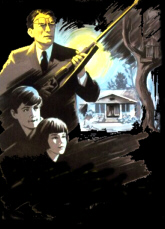 For
Yankee baby boomers in high school during the early
60s, when the civil rights movement was about to explode, Harper Lee’s
To Kill a
Mockingbird wasn’t only required
reading, it was a communal experience—socially unifying as
well as instructive. Lee’s memory book—about the South’s
rabid racism of the 30s as seen through the eyes of moral giant Atticus Finch’s
tomboy daughter—derives its emotional welling by the simplistic
device of shattering childhood innocence. (And it swept countless boomers
into their lasting love of novels.) Indisputably Lee packs in the
moral pointers, and thus earns the Pulitzer Prize But Robert Mulligan’s
movie is so sincere an adaptation by Horte Foote it’s close to being
deadly, decreeing in advance every feeling we’re suppose to feel during
every scene, planting the ethics and lack of them too
manipulatively; after a while we’re numbed by the rigging.
Perhaps something dangerous happens to many quiet liberal viewers now: watching
the trial, we get angry at Gregory Peck’s Oscar-winning Atticus for not going
after the alleged victim’s blatant lies as she leaves herself open for
brutal cross-examination, and railroaded Tom is such a victimized setup that
the cavernous nostrils of Brock Peters, who plays him, become scene-stealing
respite. During the movie, we’re apt to be reminded of another rigged
melodrama—Peck’s The Man in the Gray Flannel
Suit. Not only because the star is once again the Mount Rushmore
of decency, but also due to both movies being so overly manufactured they
look counterfeit. Remember the perfectly peeling washing machine in the kitchen
of TMITGFS? During the beginning of
Mockingbird, a grown Scout narrates how hot it was in
Alabama yet when the camera scans the houses, with screens covering the windows,
those windows aren’t opened—not even
cracked!—and an aged bundled-up Ruth White looks like a candidate
for heat stroke and making the dismissal of details worse, Peck remarks how
warm it is while wearing a sweater, vest, shirt and tie. Petty? Maybe, if
the movies hadn’t been stacked with endless caricatures and preachy lessons.
In the role Rock Hudson (on the basis of his work in Something of
Value) was scheduled to play, Peck rises above his own self-parody
out of sheer solemnity, with help from Russell Harlan’s halo-like black and
white photography, and together they pushed voters in recent American Film
Institute polls to name Atticus the screen’s top hero and the movie the second
most inspiring of all time. Harlan’s night compositions, all of which came
out of Universal’s backlot, have those menacing, spectral fears from of our
childhood. The opening cigar box credits furnished by Stephen Frankfort.
Along with Salinger’s The Catcher in the Rye, Steinbeck’s
Of Mice and Men, and Vonnegut’s
Slaughterhouse-Five,
To Kill a
Mockingbird, celebrating
its 60th anniversary (and selling about a million copies each year), continues
to be one of the most debated and censored books in schools. We boomers would
like to say, “Go figure,” but the Shirley Sherrod episode, the Trayvon Martin case and every racist outrage during the Twitler years and GQP states won’t
let us.
For
Yankee baby boomers in high school during the early
60s, when the civil rights movement was about to explode, Harper Lee’s
To Kill a
Mockingbird wasn’t only required
reading, it was a communal experience—socially unifying as
well as instructive. Lee’s memory book—about the South’s
rabid racism of the 30s as seen through the eyes of moral giant Atticus Finch’s
tomboy daughter—derives its emotional welling by the simplistic
device of shattering childhood innocence. (And it swept countless boomers
into their lasting love of novels.) Indisputably Lee packs in the
moral pointers, and thus earns the Pulitzer Prize But Robert Mulligan’s
movie is so sincere an adaptation by Horte Foote it’s close to being
deadly, decreeing in advance every feeling we’re suppose to feel during
every scene, planting the ethics and lack of them too
manipulatively; after a while we’re numbed by the rigging.
Perhaps something dangerous happens to many quiet liberal viewers now: watching
the trial, we get angry at Gregory Peck’s Oscar-winning Atticus for not going
after the alleged victim’s blatant lies as she leaves herself open for
brutal cross-examination, and railroaded Tom is such a victimized setup that
the cavernous nostrils of Brock Peters, who plays him, become scene-stealing
respite. During the movie, we’re apt to be reminded of another rigged
melodrama—Peck’s The Man in the Gray Flannel
Suit. Not only because the star is once again the Mount Rushmore
of decency, but also due to both movies being so overly manufactured they
look counterfeit. Remember the perfectly peeling washing machine in the kitchen
of TMITGFS? During the beginning of
Mockingbird, a grown Scout narrates how hot it was in
Alabama yet when the camera scans the houses, with screens covering the windows,
those windows aren’t opened—not even
cracked!—and an aged bundled-up Ruth White looks like a candidate
for heat stroke and making the dismissal of details worse, Peck remarks how
warm it is while wearing a sweater, vest, shirt and tie. Petty? Maybe, if
the movies hadn’t been stacked with endless caricatures and preachy lessons.
In the role Rock Hudson (on the basis of his work in Something of
Value) was scheduled to play, Peck rises above his own self-parody
out of sheer solemnity, with help from Russell Harlan’s halo-like black and
white photography, and together they pushed voters in recent American Film
Institute polls to name Atticus the screen’s top hero and the movie the second
most inspiring of all time. Harlan’s night compositions, all of which came
out of Universal’s backlot, have those menacing, spectral fears from of our
childhood. The opening cigar box credits furnished by Stephen Frankfort.
Along with Salinger’s The Catcher in the Rye, Steinbeck’s
Of Mice and Men, and Vonnegut’s
Slaughterhouse-Five,
To Kill a
Mockingbird, celebrating
its 60th anniversary (and selling about a million copies each year), continues
to be one of the most debated and censored books in schools. We boomers would
like to say, “Go figure,” but the Shirley Sherrod episode, the Trayvon Martin case and every racist outrage during the Twitler years and GQP states won’t
let us.
 Torn
Curtain is a movie nobody really wanted
to make, and you can feel the attitude almost immediately. Alfred Hitchcock
had screenplay problems from the very
beginning, having originally intended to be about the infamous
Guy Burgess case having sent England reeling—later done as a TV special by
John Schlesinger in 1983 entitled An Englishman Abroad starring
Alan Bates—but ending up a leftover from North by Northwest and
The Prize. Universal forced upon
him Paul Newman and Julie Andrews as box office draws.
Eager to make a movie with Hitch, both stars realized too late he didn’t give a damn. On
the first day of shooting, Andrews says, he told cast and crew “the
fun was over—the creative part was finished with the
script—and the rest is a bore.” There’s not an ounce of creativity or fun evident throughout; while
not a total yawn (its ineptness and miscasting are too infuriating to put us to sleep, the opposite of the coma induced by incompetence in Hitch’s Topaz), it’s a lazy rehash of Hitchcock tricks, visually ugly, and
quite nearly idiotic: by any measure Newman should have been pronounced dead
by the victim he later helps kill; the escape by bus is a howler; and what we wouldn’t give to waste Lila Kedrova when she keeps repeating “Amerdeecan sponsor, Amerdeecan sponsor.” As the camera closes in on Andrews, we can count the ridges on her teeth. Bernard Herrmann wrote
a score Hitchcock rejected; could it have been any worse than what John Addison
supplied?
Torn
Curtain is a movie nobody really wanted
to make, and you can feel the attitude almost immediately. Alfred Hitchcock
had screenplay problems from the very
beginning, having originally intended to be about the infamous
Guy Burgess case having sent England reeling—later done as a TV special by
John Schlesinger in 1983 entitled An Englishman Abroad starring
Alan Bates—but ending up a leftover from North by Northwest and
The Prize. Universal forced upon
him Paul Newman and Julie Andrews as box office draws.
Eager to make a movie with Hitch, both stars realized too late he didn’t give a damn. On
the first day of shooting, Andrews says, he told cast and crew “the
fun was over—the creative part was finished with the
script—and the rest is a bore.” There’s not an ounce of creativity or fun evident throughout; while
not a total yawn (its ineptness and miscasting are too infuriating to put us to sleep, the opposite of the coma induced by incompetence in Hitch’s Topaz), it’s a lazy rehash of Hitchcock tricks, visually ugly, and
quite nearly idiotic: by any measure Newman should have been pronounced dead
by the victim he later helps kill; the escape by bus is a howler; and what we wouldn’t give to waste Lila Kedrova when she keeps repeating “Amerdeecan sponsor, Amerdeecan sponsor.” As the camera closes in on Andrews, we can count the ridges on her teeth. Bernard Herrmann wrote
a score Hitchcock rejected; could it have been any worse than what John Addison
supplied?
 Most of us haven’t had a chance to see Andrew Sinclair’s 1972 movie of Dylan Thomas’s play for voices Under Milk Wood. Never widely released in theatres and limited editions on tape
or DVD often difficult to find. Unsurprising there’s comparison of this movie to John Huston’s version of
James Joyce’s The Dead. Having seen both now, I prefer, with reservations, UMW. Sinclair does what Huston didn’t—allow for the accentuation of voice over actors in scenes, to concentrate on the pleasures of melodious profusion of words. With the exception of Donal McCann’s beautiful delivery of Joyce’s conclusion in voice over, The Dead is a confining structure of actors in amateur
hour recitations feeling much longer than a mere 83 minutes. Not badly done, it’s just done without solving the adaptation dilemma of Joyce, which is how to showcase the characters’ reminiscences as great listening. Had Huston silenced the recorded sound and used the actors to dub over their lines, their voices might have ascended to the level of joyous “transport” to the inner sanctuary of the audience’s imagination as the “art” of both
the author and a play for voices. There
are “movie scenes” in UMW too, and a few of them, the ones with Richard Burton having sex with a local slattern, are downright terrible and gratuitous, but most of the scenes are staged for the words to dominant. And they’re not depressing as with Huston’s settings, which made me feel trapped in a funeral parlor. In additional to being the first voice, Burton plays a drunk with way too much method: he appears sometimes so wiped
you can’t get over the shock; with blurry and beady eyes and bloated kisser, he’s ready for the ending of Under the Volcano. Some of his recitals are sublime—whirlish and dazzling—in “transporting” us to a paradisiacal Dylan Thomas Thesaurus called Llareggub (the backward spelling of “bugger all”) where we’re going to hear about dreams and memories. Other moments, he’s speeding through the verse the way a bum badly hung over would try to fake it and what’s infuriating is no one stopped
him. (Booze by then altered his personality almost
straight off and a listener can detect his contempt and boredom, irritants not present in his 1954 recording.) Peter O’Toole looks only a bit less bombed but his emaciation, a preview of his Don Quixote in Man of La Mancha, doesn’t diminish his dignity. Foofs note with amusement: he, not his love object Elizabeth Taylor, gets credits for his hairdresser and makeup artist.
Most of us haven’t had a chance to see Andrew Sinclair’s 1972 movie of Dylan Thomas’s play for voices Under Milk Wood. Never widely released in theatres and limited editions on tape
or DVD often difficult to find. Unsurprising there’s comparison of this movie to John Huston’s version of
James Joyce’s The Dead. Having seen both now, I prefer, with reservations, UMW. Sinclair does what Huston didn’t—allow for the accentuation of voice over actors in scenes, to concentrate on the pleasures of melodious profusion of words. With the exception of Donal McCann’s beautiful delivery of Joyce’s conclusion in voice over, The Dead is a confining structure of actors in amateur
hour recitations feeling much longer than a mere 83 minutes. Not badly done, it’s just done without solving the adaptation dilemma of Joyce, which is how to showcase the characters’ reminiscences as great listening. Had Huston silenced the recorded sound and used the actors to dub over their lines, their voices might have ascended to the level of joyous “transport” to the inner sanctuary of the audience’s imagination as the “art” of both
the author and a play for voices. There
are “movie scenes” in UMW too, and a few of them, the ones with Richard Burton having sex with a local slattern, are downright terrible and gratuitous, but most of the scenes are staged for the words to dominant. And they’re not depressing as with Huston’s settings, which made me feel trapped in a funeral parlor. In additional to being the first voice, Burton plays a drunk with way too much method: he appears sometimes so wiped
you can’t get over the shock; with blurry and beady eyes and bloated kisser, he’s ready for the ending of Under the Volcano. Some of his recitals are sublime—whirlish and dazzling—in “transporting” us to a paradisiacal Dylan Thomas Thesaurus called Llareggub (the backward spelling of “bugger all”) where we’re going to hear about dreams and memories. Other moments, he’s speeding through the verse the way a bum badly hung over would try to fake it and what’s infuriating is no one stopped
him. (Booze by then altered his personality almost
straight off and a listener can detect his contempt and boredom, irritants not present in his 1954 recording.) Peter O’Toole looks only a bit less bombed but his emaciation, a preview of his Don Quixote in Man of La Mancha, doesn’t diminish his dignity. Foofs note with amusement: he, not his love object Elizabeth Taylor, gets credits for his hairdresser and makeup artist.
 Before The Hurt Locker
stole the thunder, the critics’ darlings were George Clooney and
his painfully timely
Up in the
Air. It’s clear early in why neither
won the top Oscars many thought in early December 2009 were
inevitable—who the hell wants to sit in a theatre or at home
as an unemployed and watch people get fired by an executioner?
Or by “fourth grader” Anna Kendrick? (The irony in the applause
by critics is many of them were pink-slipped by early 2010.) If Clooney
isn’t at his neutral best as a hatchet man, he’s at his
smoothest—a Cary Grant type appearing a bit like Alan Arkin’s
son Adam. The pleasure square-jawed Clooney brings to audiences is icy charm,
a remoteness allowing us to give him the once-over and objectify, and
while we sense there’s something missing in his persona, we continue, at least for
now, to be held. His appareled class and roguish
demeanor—exemplified by his shit-eating
grin—are calculation. These attributes, if they are such,
make him ideal casting for terminating people from their livelihood and for
dating starlets who don’t speak English. Probable trouble ahead: Clooney
has been so high in the rarefied air of super celebrity his stature
elicits minuscule emotional response. In the telethon for Haiti, he
didn’t register a single spark as a mortal male. The gas in his engine of fakery is close to empty.
Before The Hurt Locker
stole the thunder, the critics’ darlings were George Clooney and
his painfully timely
Up in the
Air. It’s clear early in why neither
won the top Oscars many thought in early December 2009 were
inevitable—who the hell wants to sit in a theatre or at home
as an unemployed and watch people get fired by an executioner?
Or by “fourth grader” Anna Kendrick? (The irony in the applause
by critics is many of them were pink-slipped by early 2010.) If Clooney
isn’t at his neutral best as a hatchet man, he’s at his
smoothest—a Cary Grant type appearing a bit like Alan Arkin’s
son Adam. The pleasure square-jawed Clooney brings to audiences is icy charm,
a remoteness allowing us to give him the once-over and objectify, and
while we sense there’s something missing in his persona, we continue, at least for
now, to be held. His appareled class and roguish
demeanor—exemplified by his shit-eating
grin—are calculation. These attributes, if they are such,
make him ideal casting for terminating people from their livelihood and for
dating starlets who don’t speak English. Probable trouble ahead: Clooney
has been so high in the rarefied air of super celebrity his stature
elicits minuscule emotional response. In the telethon for Haiti, he
didn’t register a single spark as a mortal male. The gas in his engine of fakery is close to empty.
 “WHAT DO YA SAY, TEACH?”: Made in 1967, Robert Mulligan’s Up the Down Staircase remains a reasonably honest look at public inner-city schools back in the 60s. Based on the very popular Bel Kaufman comic “diary” with doodles, letters and built-in
lectures, the movie is funny as well as unafraid to show the poor and crowded environment or the drippy slice-of-life vignettes. (Suicidal Alice, played by Ellen O’Mara as an advance warning of Mayim Bialik, can really make your flesh crawl.) The movie’s a touchstone for generations of high schoolers up to baby boomer age (but from there onward departs quite a bit in movies like Arthur Hiller’s 1984 Teachers and John N. Smith’s 1995 Dangerous Minds wherein we’re finally caught in the trap of
our own apathy). UTDS does envision the future—the mountainous paperwork educators are forced to spend time on, the school bureaucracy as enemy, buttinsky parents as censors, lazy parents abdicating their responsibilities to teachers who are unofficially tagged as classroom
psychiatrist, pastor, referee, reluctant guardian and sex educator. (And conveniently get blamed when Johnny and Amber fuck...up.) Looking pretty and then-appropriate with romantic aspiration, Sandy Dennis had just come off her award-winning Honey in Who’s Afraid of Virginia Woolf? and as she still carried—and did perpetually—her verbal charley-horse acting technique, she didn’t get the reception she deserved. As teacher, her speech spasms are what students pray for—someone to rule over
and stomp on, until such luck runs out. Once idealism falls to practicality and governance, power battles subside. But one crisis is followed by another and Dennis’s “teach” must decide if she’s a glutton for more punishment. The supporting cast is top-drawer on-and-off-Broadway: Patrick Bedford, Sorrell Brooke, Eileen Heckart, Roy Poole, Jean Stapleton, Frances Sternhagen, Ruth White, Frances Sternhagen. The mandatory swarthy loner-failure, Jeff Howard has startling appeal and still a puzzle as to why he was rarely seen again.
“WHAT DO YA SAY, TEACH?”: Made in 1967, Robert Mulligan’s Up the Down Staircase remains a reasonably honest look at public inner-city schools back in the 60s. Based on the very popular Bel Kaufman comic “diary” with doodles, letters and built-in
lectures, the movie is funny as well as unafraid to show the poor and crowded environment or the drippy slice-of-life vignettes. (Suicidal Alice, played by Ellen O’Mara as an advance warning of Mayim Bialik, can really make your flesh crawl.) The movie’s a touchstone for generations of high schoolers up to baby boomer age (but from there onward departs quite a bit in movies like Arthur Hiller’s 1984 Teachers and John N. Smith’s 1995 Dangerous Minds wherein we’re finally caught in the trap of
our own apathy). UTDS does envision the future—the mountainous paperwork educators are forced to spend time on, the school bureaucracy as enemy, buttinsky parents as censors, lazy parents abdicating their responsibilities to teachers who are unofficially tagged as classroom
psychiatrist, pastor, referee, reluctant guardian and sex educator. (And conveniently get blamed when Johnny and Amber fuck...up.) Looking pretty and then-appropriate with romantic aspiration, Sandy Dennis had just come off her award-winning Honey in Who’s Afraid of Virginia Woolf? and as she still carried—and did perpetually—her verbal charley-horse acting technique, she didn’t get the reception she deserved. As teacher, her speech spasms are what students pray for—someone to rule over
and stomp on, until such luck runs out. Once idealism falls to practicality and governance, power battles subside. But one crisis is followed by another and Dennis’s “teach” must decide if she’s a glutton for more punishment. The supporting cast is top-drawer on-and-off-Broadway: Patrick Bedford, Sorrell Brooke, Eileen Heckart, Roy Poole, Jean Stapleton, Frances Sternhagen, Ruth White, Frances Sternhagen. The mandatory swarthy loner-failure, Jeff Howard has startling appeal and still a puzzle as to why he was rarely seen again.
 Hitch’s Vertigo has been caressingly restored by Robert A. Harris and James C. Katz; you feel you’re being fondled into accepting a false reëvaluation—that this movie isn’t the bore you’ve always remembered it to
be and instead is a masterpiece.
The restoration possibly establishes it as one of Hitch’s best-looking color movies; though there’s been the usual bitching from the usual suspects over Harris and Katz altering originally intended colors, what they achieve is both befitting and enhancing—many of the colors have a nutsy vividness, commingling with the equally nutsy story. (They also boosted the sound effects.) But Vertigo is still a movie from Twerp City; it still has Kim Novak, in
hideous hair and even more repulsive eyebrows, sleepwalking through it as a pretentious dumb-dumb (like any of her other strolls); and it still has James Stewart being what he could never be—a romantic. When Sight & Sound’s editor Nick James claimed Vertigo as “the ultimate critics’ film” and “it’s a dream-like film about people who are not sure who they are but who are busy reconstructing themselves
and each other to fit a kind of cinema ideal of the ideal soul-mate,” he’s confessing an embarrassment of riches about the crops of critics who voted the snoozer “the greatest film of all time” not just once—which is insulting enough—but twice.
Hitch’s Vertigo has been caressingly restored by Robert A. Harris and James C. Katz; you feel you’re being fondled into accepting a false reëvaluation—that this movie isn’t the bore you’ve always remembered it to
be and instead is a masterpiece.
The restoration possibly establishes it as one of Hitch’s best-looking color movies; though there’s been the usual bitching from the usual suspects over Harris and Katz altering originally intended colors, what they achieve is both befitting and enhancing—many of the colors have a nutsy vividness, commingling with the equally nutsy story. (They also boosted the sound effects.) But Vertigo is still a movie from Twerp City; it still has Kim Novak, in
hideous hair and even more repulsive eyebrows, sleepwalking through it as a pretentious dumb-dumb (like any of her other strolls); and it still has James Stewart being what he could never be—a romantic. When Sight & Sound’s editor Nick James claimed Vertigo as “the ultimate critics’ film” and “it’s a dream-like film about people who are not sure who they are but who are busy reconstructing themselves
and each other to fit a kind of cinema ideal of the ideal soul-mate,” he’s confessing an embarrassment of riches about the crops of critics who voted the snoozer “the greatest film of all time” not just once—which is insulting enough—but twice.
 Barcelona won’t confess any regret over giving Woody Allen a million and a half Euros to help make Vicky Cristina Barcelona but perhaps those responsible for extending public funds should be thrashed anyway. Presented in an icteric light, the city’s barely given the aphrodisiacal function suggested by the title. Apparently Allen is at low ebb, even at desperately low ebb, and as a side effect he turns the metropolis into something ordinary and the view from Muntanya de Montjuic into a haze of pollution; he’s using locales without any breath of scope, or ingratiation, without an adult visitor’s sense of liberation. Dredging up a screenplay written years ago, he “updates” its poop de droopiness from San Fran to the Gaudi fantasyland and molds it around Scarlett Johansson as Cristina, Javier Bardem as
Juan
Antonio and Penélope Cruz as Maria Elena. What isn’t clear is if Vicky (Rebecca Hall) was original to the story—or if she’s Woody, oozing his tired brand of neurosis, excessively on display when she drills Javier about his abrupt self-entitled proposition in a restaurant. (And it doesn’t look too original for Hall to tower over Chris Messina.) Putting Javier at the center of a ménage à trois
is tantalizing but when Woody takes himself out of the bed and imports Vicky as his surrogate quatre, the gig of cosmo sexuality turns sour, another bout of anhedonia. Woody wouldn’t permit himself carnal knowledge with another man on screen, but he could get a good actor—someone like Jon Hamm fashionably unshaven or use Messina—to at least suggest a heating of the sheets with Javier. How metro delicious it might have been for Maria Elena to aim her gun at the crotches of Juan Antonio and Vick. VCB is a ménage à pas moyen.
Barcelona won’t confess any regret over giving Woody Allen a million and a half Euros to help make Vicky Cristina Barcelona but perhaps those responsible for extending public funds should be thrashed anyway. Presented in an icteric light, the city’s barely given the aphrodisiacal function suggested by the title. Apparently Allen is at low ebb, even at desperately low ebb, and as a side effect he turns the metropolis into something ordinary and the view from Muntanya de Montjuic into a haze of pollution; he’s using locales without any breath of scope, or ingratiation, without an adult visitor’s sense of liberation. Dredging up a screenplay written years ago, he “updates” its poop de droopiness from San Fran to the Gaudi fantasyland and molds it around Scarlett Johansson as Cristina, Javier Bardem as
Juan
Antonio and Penélope Cruz as Maria Elena. What isn’t clear is if Vicky (Rebecca Hall) was original to the story—or if she’s Woody, oozing his tired brand of neurosis, excessively on display when she drills Javier about his abrupt self-entitled proposition in a restaurant. (And it doesn’t look too original for Hall to tower over Chris Messina.) Putting Javier at the center of a ménage à trois
is tantalizing but when Woody takes himself out of the bed and imports Vicky as his surrogate quatre, the gig of cosmo sexuality turns sour, another bout of anhedonia. Woody wouldn’t permit himself carnal knowledge with another man on screen, but he could get a good actor—someone like Jon Hamm fashionably unshaven or use Messina—to at least suggest a heating of the sheets with Javier. How metro delicious it might have been for Maria Elena to aim her gun at the crotches of Juan Antonio and Vick. VCB is a ménage à pas moyen.
 Nine hours of Richard Burton as Wagner. And often in such excruciating close up the pockmarks look like craters. And at a worn 56 he’s a chick magnet (!) and the Bavarian fairy
king is gaga for him.
Is it my imagination or does
he seem unusually peripatetic, even more than in Where Eagles Dare? He probably would have had a personal triumph as the perpetually penniless ego maniac if we could follow the jumbled narratives director Tony Palmer and writer Charles Wood compile. The first few hours are challenging to follow: recognized by Palmer as his mistake, Burton is too old to play the young Wagner and, worse, we can’t really be sure he’s suppose to be the young Wagner since the inserts of flash forwards and flashbacks
show no facial differential or much coherency. (In a later episode, Ludwig halts the royal train and gambols through the forest with a male companion transitioning to the coming-years-later demise of the king without any meaningful correlation.) The narrator’s not much help—the voice is both oddly faraway and intimate yet only occasionally informative. Sometimes we can’t tell where we’re at except by the famous locales and when the settings are muzzed up by photographer Vittorio Storaro, we wander from room to theatre to splendiferous
hall shrouded in a chronic fatigue-inducing amber haze. This 2005 DVD version of Wagner, filmed in 1982, also suffers from fluctuating sound and excessively loud music; the volume controls on our remotes come in very handy. All these interferences make it difficult to gauge Burton’s performance in the largest role of his career. He was not in good shape during the grueling seven months of filming—he was in physical deterioration,
suffered seizures, intermittently and sometimes heavily drank. He would, tho, tell Palmer he had an affinity with Wagner, coming to the set proclaiming “I am Wagner!” and the infusion of commitment has its moments. With severely gimpy arms making it impossible to convincingly hold a baton to conduct, he’s quite the humorously vindictive glimpse of Wagner raging against Jews and his benefactors who regularly cut him off. Lacking clarification in the script
to tell us what Wagner’s seeking to accomplish in his masterworks, we do feel the desperate drive of the music’s oppressive intemperance. And its forebodingness: historians continue to debate if Wagner, despite the frequency of involuntary exiles prompted by creditors, was a pre-Nazi nationalist and if much of Hitler’s frenzied megalomania was inspired by his Teutonic musical extravagances and prejudices, the latter published with malice and aroused public enmity. (What Burton did to Winston Churchill very soon after playing him in The Gathering Storm.) Burton’s Wagner also suggests he’d
have been willing
to
guiltlessly dispense with his adversaries if he hadn’t been dependent upon them to foot the bills. His relationship with Cosima, dignified by Vanessa Redgrave, is, like so much of the epic drama, a confusing mess. What’s derived from their affair is the husbands of Wagner’s women granted him accession as warped adoration. By the time Wagner nears its end, we wish one of them would demand and receive “satisfaction,” as great
artists are pains in the ass. With Laurence Olivier, John Gielgud, Ralph Richardson largely wasted; László Gálffi as Ludwig, Marthe Keller, Ronald Pickup as Nietzsche, and in brevity Gabriel Byrne, Cyril Cusack, Franco Nero, Barbara Leigh-Hunt and Joan Greenwood.
Nine hours of Richard Burton as Wagner. And often in such excruciating close up the pockmarks look like craters. And at a worn 56 he’s a chick magnet (!) and the Bavarian fairy
king is gaga for him.
Is it my imagination or does
he seem unusually peripatetic, even more than in Where Eagles Dare? He probably would have had a personal triumph as the perpetually penniless ego maniac if we could follow the jumbled narratives director Tony Palmer and writer Charles Wood compile. The first few hours are challenging to follow: recognized by Palmer as his mistake, Burton is too old to play the young Wagner and, worse, we can’t really be sure he’s suppose to be the young Wagner since the inserts of flash forwards and flashbacks
show no facial differential or much coherency. (In a later episode, Ludwig halts the royal train and gambols through the forest with a male companion transitioning to the coming-years-later demise of the king without any meaningful correlation.) The narrator’s not much help—the voice is both oddly faraway and intimate yet only occasionally informative. Sometimes we can’t tell where we’re at except by the famous locales and when the settings are muzzed up by photographer Vittorio Storaro, we wander from room to theatre to splendiferous
hall shrouded in a chronic fatigue-inducing amber haze. This 2005 DVD version of Wagner, filmed in 1982, also suffers from fluctuating sound and excessively loud music; the volume controls on our remotes come in very handy. All these interferences make it difficult to gauge Burton’s performance in the largest role of his career. He was not in good shape during the grueling seven months of filming—he was in physical deterioration,
suffered seizures, intermittently and sometimes heavily drank. He would, tho, tell Palmer he had an affinity with Wagner, coming to the set proclaiming “I am Wagner!” and the infusion of commitment has its moments. With severely gimpy arms making it impossible to convincingly hold a baton to conduct, he’s quite the humorously vindictive glimpse of Wagner raging against Jews and his benefactors who regularly cut him off. Lacking clarification in the script
to tell us what Wagner’s seeking to accomplish in his masterworks, we do feel the desperate drive of the music’s oppressive intemperance. And its forebodingness: historians continue to debate if Wagner, despite the frequency of involuntary exiles prompted by creditors, was a pre-Nazi nationalist and if much of Hitler’s frenzied megalomania was inspired by his Teutonic musical extravagances and prejudices, the latter published with malice and aroused public enmity. (What Burton did to Winston Churchill very soon after playing him in The Gathering Storm.) Burton’s Wagner also suggests he’d
have been willing
to
guiltlessly dispense with his adversaries if he hadn’t been dependent upon them to foot the bills. His relationship with Cosima, dignified by Vanessa Redgrave, is, like so much of the epic drama, a confusing mess. What’s derived from their affair is the husbands of Wagner’s women granted him accession as warped adoration. By the time Wagner nears its end, we wish one of them would demand and receive “satisfaction,” as great
artists are pains in the ass. With Laurence Olivier, John Gielgud, Ralph Richardson largely wasted; László Gálffi as Ludwig, Marthe Keller, Ronald Pickup as Nietzsche, and in brevity Gabriel Byrne, Cyril Cusack, Franco Nero, Barbara Leigh-Hunt and Joan Greenwood.
 Explaining why so many male moviegoers are hooked on 1968’s Where Eagles Dare isn’t as easy as it seems. The triviameisters over at Cinema Retro, in their lavish single edition celebrating the movie, set out
to uncover
secrets for its compulsive watchability but, armed with fresh angles, rare pictures and anecdotes, they don’t quite get to a revelatory summation. Long acknowledged guesses for its success include the odd couple casting of Richard Burton and Clint Eastwood; the roster of back-numbers in ludicrous support; the dusky sylvan environs; and the mission impossible tasks dreamt up by Alistair MacLean, the culprit responsible for the genre of gung-ho WWII shoot-’em-ups starting with The Guns of Navarone.
A portion of our compulsion might be in director Brian G. Hutton’s do or die efforts in overcoming obstacles to finish the movie. Burton, for instance, went on a three-day bender with buddies Richard Harris and Peter O’Toole and, from accounts verified by cast members, daily guzzled bottles of vodka on set. Huge snow storms and deep freeze temperatures also caused delays. One of the cult factors about the movie’s repeat appeal is anytime it shows up on the telly somewhere, many of us watch transfixed; it
seems to add to the experience knowing the movie’s not that good. The stronger equivalent might be comfort food—being bloated yet sated after pigging out on Weiner schnitzel and pomme frites or a dozen White Castle. Agree with others I’ve spoken to about how irredeemable we feel in being unable to resist looking forward to the various executions, making a game out of adding up the number of krauts Dick and Clint zap to Hell. (Untrue but Clint seems to waste more baddies than in any of
his other
films combined.) The favorite sequence remains the wipeout in the castle’s great hall, relishing lispy Anton Diffring, Engelbert Humperdinck clone Derren Nesbitt and sneery frau Olga Lowe going down. Okay, plausibly the core addiction—the guiltless pleasure in Nazi body counts. Catching Where Eagles Dare for the umpteenth time the other day, the reliable high didn’t take its usual hold. An intervention happened:
with
growing apprehension about what’s happening in our nation and Europe, where good people are flummoxed to incapacitation by the reëmerging virus having previously killed roughly 60 million people, the Hollywood fantasies ejaculating a celebratory destruction of Nazism aren’t cutting it anymore; they’re passé and delusive. Going back to reëducate myself about the tenor of the times, when FDR was preparing America for a second war against Germany, someone famous keeps popping up—wealthy adulterer, racist and Nazi
apologist Charles Lindbergh. After meetings with FDR, during which Lindbergh went orgasmic over Hitler’s successes in revitalizing Germany, the president publicly censured him and his positions—one of them infamously ballyhooing Hitler would do wonders for a conquered Europe. A shock but not much of a surprise Americans and Europeans today are willing to forget history, or worse be brutishly proud of their ignorance in not knowing any, and be eager to auto-click their heels to “Heil Twitler!”
and rationalize Putin. The curtain closes on Where Eagles Dare and reopens, in BingeArama, with World at War and, for the homefront, North and South.
Explaining why so many male moviegoers are hooked on 1968’s Where Eagles Dare isn’t as easy as it seems. The triviameisters over at Cinema Retro, in their lavish single edition celebrating the movie, set out
to uncover
secrets for its compulsive watchability but, armed with fresh angles, rare pictures and anecdotes, they don’t quite get to a revelatory summation. Long acknowledged guesses for its success include the odd couple casting of Richard Burton and Clint Eastwood; the roster of back-numbers in ludicrous support; the dusky sylvan environs; and the mission impossible tasks dreamt up by Alistair MacLean, the culprit responsible for the genre of gung-ho WWII shoot-’em-ups starting with The Guns of Navarone.
A portion of our compulsion might be in director Brian G. Hutton’s do or die efforts in overcoming obstacles to finish the movie. Burton, for instance, went on a three-day bender with buddies Richard Harris and Peter O’Toole and, from accounts verified by cast members, daily guzzled bottles of vodka on set. Huge snow storms and deep freeze temperatures also caused delays. One of the cult factors about the movie’s repeat appeal is anytime it shows up on the telly somewhere, many of us watch transfixed; it
seems to add to the experience knowing the movie’s not that good. The stronger equivalent might be comfort food—being bloated yet sated after pigging out on Weiner schnitzel and pomme frites or a dozen White Castle. Agree with others I’ve spoken to about how irredeemable we feel in being unable to resist looking forward to the various executions, making a game out of adding up the number of krauts Dick and Clint zap to Hell. (Untrue but Clint seems to waste more baddies than in any of
his other
films combined.) The favorite sequence remains the wipeout in the castle’s great hall, relishing lispy Anton Diffring, Engelbert Humperdinck clone Derren Nesbitt and sneery frau Olga Lowe going down. Okay, plausibly the core addiction—the guiltless pleasure in Nazi body counts. Catching Where Eagles Dare for the umpteenth time the other day, the reliable high didn’t take its usual hold. An intervention happened:
with
growing apprehension about what’s happening in our nation and Europe, where good people are flummoxed to incapacitation by the reëmerging virus having previously killed roughly 60 million people, the Hollywood fantasies ejaculating a celebratory destruction of Nazism aren’t cutting it anymore; they’re passé and delusive. Going back to reëducate myself about the tenor of the times, when FDR was preparing America for a second war against Germany, someone famous keeps popping up—wealthy adulterer, racist and Nazi
apologist Charles Lindbergh. After meetings with FDR, during which Lindbergh went orgasmic over Hitler’s successes in revitalizing Germany, the president publicly censured him and his positions—one of them infamously ballyhooing Hitler would do wonders for a conquered Europe. A shock but not much of a surprise Americans and Europeans today are willing to forget history, or worse be brutishly proud of their ignorance in not knowing any, and be eager to auto-click their heels to “Heil Twitler!”
and rationalize Putin. The curtain closes on Where Eagles Dare and reopens, in BingeArama, with World at War and, for the homefront, North and South.
 In Elia: A Life, Kazan wrote about Wild River ending up the opposite of what he intended—a “homage to the spirit of FDR; my hero was to be a resolute New Dealer engaged in
the difficult task of convincing
‘reactionary’
country people that (the TVA) was necessary, in the name of the public good, for them to move off their land and allow themselves to be relocated. Now I found my sympathies were with the obdurate old lady (Jo Van Fleet) who lived on the island that was to be inundated and who refused to be patriotic. I was all for her.” Ignoring his loathsome use of “patriotic,” her obstinacy as an anti-heroine is off-putting. She’s a pre-Tea Party illiterate insistent in believing nothing good comes from government, cherishing
the island land as tantamount to a willingness to become a self-sacrifice to resist change for the betterment of the valley. Well, Jo Van Fleet always did stern & stubborn well, but this time she’s not getting much empathy. It’s probably because Kazan, at the urging of Spyros Skouras, cast Monty Clift and used his load of problems to change the central male character’s resoluteness to weak bureaucrat and gave the old bitch an excess toughness. (Today she’d be hailed as another Cliven Bundy.) Not
unexpectedly, Monty gets threatened and physically kicked around and is saved again by a hungry-for-love woman beyond his amatory capabilities. The accommodation to Monty’s foibles—his accident and the subsequent booze and drugs to deal with mental and physical pain bringing forth his wonky actor’s concentration—hasn’t worked since Raintree County. Kazan’s miscalculation is not staging
a fight to Monty’s advantage, to edit out his impotency. Not only does Monty need the fix, so do we; we’re tired of watching him as a loser.
Yet it’s pleasant to see him looking fairly healthy, mostly clear-eyed; Kazan insisted he stay sober during the entire shoot and, except for the final day of filming, he succeeded. Have some quibbles about Lee Remick: picking up Monty’s sexual slack, she’s the aggressor in romance, acting as his protectorate. With her smarts, what’s she doing there living like that? She’s a misfit as sloven. Whether it’s soul mate Liz, or Lee or Donna Reed or Hope Lange, Monty’s heavy-browed moodiness, his schizoid
sensitivity, overshadows. We’re absorbed by his distraction: while never certain where he’s going to take us, we are sure his splattered emotionality will take us there. What keeps him from flashing dangers-of-the-flesh advisories is his impish plaintiveness, manifest in performances long before the disfigurement: his overgrown adolescent “actor’s studio” melancholy is impossible to dismiss. Works for him in The Heiress and Red
River, and especially so in A Place in the Sun, wherein his brooding and panting for Liz help us avoid the rigged tragedy besetting him: being put to death for only plotting instead of actually killing nag hag Shelley Winters. His deterioration as an insecure shambles became discomforting to look at and we became discomforted by how the directors used his neuroses as freak show, peaking in Judgment at Nuremberg and Freud. But something more
damaging happened to his legacy: All his pre-Raintree performances would be affected; what’s thought to have been the art of the actor seems to be early evidence as a pre-ordained basket case.
In Elia: A Life, Kazan wrote about Wild River ending up the opposite of what he intended—a “homage to the spirit of FDR; my hero was to be a resolute New Dealer engaged in
the difficult task of convincing
‘reactionary’
country people that (the TVA) was necessary, in the name of the public good, for them to move off their land and allow themselves to be relocated. Now I found my sympathies were with the obdurate old lady (Jo Van Fleet) who lived on the island that was to be inundated and who refused to be patriotic. I was all for her.” Ignoring his loathsome use of “patriotic,” her obstinacy as an anti-heroine is off-putting. She’s a pre-Tea Party illiterate insistent in believing nothing good comes from government, cherishing
the island land as tantamount to a willingness to become a self-sacrifice to resist change for the betterment of the valley. Well, Jo Van Fleet always did stern & stubborn well, but this time she’s not getting much empathy. It’s probably because Kazan, at the urging of Spyros Skouras, cast Monty Clift and used his load of problems to change the central male character’s resoluteness to weak bureaucrat and gave the old bitch an excess toughness. (Today she’d be hailed as another Cliven Bundy.) Not
unexpectedly, Monty gets threatened and physically kicked around and is saved again by a hungry-for-love woman beyond his amatory capabilities. The accommodation to Monty’s foibles—his accident and the subsequent booze and drugs to deal with mental and physical pain bringing forth his wonky actor’s concentration—hasn’t worked since Raintree County. Kazan’s miscalculation is not staging
a fight to Monty’s advantage, to edit out his impotency. Not only does Monty need the fix, so do we; we’re tired of watching him as a loser.
Yet it’s pleasant to see him looking fairly healthy, mostly clear-eyed; Kazan insisted he stay sober during the entire shoot and, except for the final day of filming, he succeeded. Have some quibbles about Lee Remick: picking up Monty’s sexual slack, she’s the aggressor in romance, acting as his protectorate. With her smarts, what’s she doing there living like that? She’s a misfit as sloven. Whether it’s soul mate Liz, or Lee or Donna Reed or Hope Lange, Monty’s heavy-browed moodiness, his schizoid
sensitivity, overshadows. We’re absorbed by his distraction: while never certain where he’s going to take us, we are sure his splattered emotionality will take us there. What keeps him from flashing dangers-of-the-flesh advisories is his impish plaintiveness, manifest in performances long before the disfigurement: his overgrown adolescent “actor’s studio” melancholy is impossible to dismiss. Works for him in The Heiress and Red
River, and especially so in A Place in the Sun, wherein his brooding and panting for Liz help us avoid the rigged tragedy besetting him: being put to death for only plotting instead of actually killing nag hag Shelley Winters. His deterioration as an insecure shambles became discomforting to look at and we became discomforted by how the directors used his neuroses as freak show, peaking in Judgment at Nuremberg and Freud. But something more
damaging happened to his legacy: All his pre-Raintree performances would be affected; what’s thought to have been the art of the actor seems to be early evidence as a pre-ordained basket case.
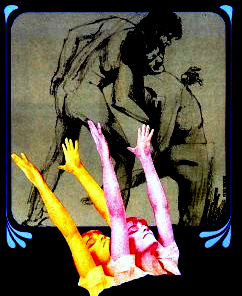 LAWRENCE ON LOVE: Ken Russell’s Women in Love looks and sounds much better five decades removed from the initial snipping that the movie isn’t the novel, having short-changed
D.H. Lawrence’s search for and the balance in “the finality of love,” Russell hyperbolizing the famous moments more than clarifying them.
The movie is, all and all, respectful and yes, it “gets” the author. In order to do so, the “getting” are hurdles accomplished by sprinting, swimming, wrestling, writhing and sledding through the novel’s highlights as showpieces. And why not? For all of Lawrence’s intense preoccupation with sex and his meanderings about relationships between the sexes, he cleverly encases them as titled showoff chapters in the book. What saves Russell from the gallows he was sentenced to by critics who convicted him of lurid
floridity is not only what Lawrence leaves unresolved remains unresolved in the movie, it’s also the director’s (in)famous penchant for the elaborate romanticized by Billy Williams’s photography, through which comes the inevitability some of the imagery will overpower us more than the source. What’s pleasantly surprising is how much Russell and adapter Larry Kramer extracted using the Gregg method. Lawrence’s daring, his quest for new kinds of emotionally, sexually and intellectually satisfying
relationships with both sexes, to find an alterative to marriage, to seek out the perfect bond between men in which nakedness doesn’t corrupt, never came to fruition, not because he didn’t try but because he didn’t have many fearless free thinkers to join him. In this regard, he rigged the story because Rupert (Alan Bates) remains the priest of love while the other three in his foursome are conveniently flawed, locked in by their social and cultural conscriptions and contagions. Rupert’s woman to love is Ursula
(Jennie Linden) who’s emotionally jealous and obstinate; Rupert’s bromance is Gerald (Oliver Reed), who admits he can’t feel or understand much except anger and suffering of women and who becomes unfortunately involved with Ursula’s sculptress sister Gudrun (Glenda Jackson), a castrating sadist/Bohemian whose Isadorian free-associating shouldn’t excite Gerald as much as warn him away. If there’s impatience in viewers before arriving at Zermatt, it likely comes from Linden; she’s not bad, she delivers her
load of lines with clear intent, but when closed-minded, shrill and whiny you can’t fathom how the wordsmith Rupert, the guru of love exploration, tolerates her. (D.H. did because he’s writing about his wife Frieda.) Reed, at his most attractive in top hat, is a match for Jackson—they’re both misfits—and there’s conviction when he explicates Gerald’s limitations, only we’re not sure where they come from. (Arrows point every which way: the nutcase mother, the debilitated father, the sibling he accuses of murder-suicide.)
Jackson’s face and voice congeal with instant commandeering authority; she’s a few light years away from Lawrence’s “soft” physicality of Gudrun. But she really zeroes in on his description of the character: “Cross the threshold, and you found her completely, completely cynical about the social world and its advantages. Once inside the house of her soul, and there was a pungent atmosphere of corrosion, an inflamed darkness of sensation, and a vivid, subtle, critical consciousness.” Jackson’s performance would
be the beginning of what she would do without peer for roughly thirty years: compel, subjugate, infuriate. Bates is the fantasy embodiment of Lawrence, without hint of illness a version of a maturing pretty boy who was the author in his pretty boy youth. With the script necessarily stripped of prologues, Bates has to start right in on Lawrence’s verbosity on sex and what he achieves—for example, with the fig—is no small feat of showmanship. He maintains a cordiality even while the negatives encircle him and
in the last scene, speaking his last line, straight from the novel, there’s an echo of tragedy in the Lawrentian declaration: after Bates’ own death, it came to public light he was a tormented bisexual. Unable to balance his needs in relationships, he became Gerald. It is at Zermatt where the movie loses focus quite understandably: entitled “Snowed Up” in the novel, the lengthy chapter is Lawrence anatomizing the Gerald/Gudrun coupling, the unavoidable contagious destructiveness in power and
control games. Alternately provocative and gasbaggy, this climax is bruising and steady with insightfulness, he’s at a zenith in elucidating the maelstroms of inner conflicts. Russell and Kramer try to compress while maintaining integrity but we’re bogged down with the intentionally repulsive casting of Vladek Sheybal as Loerke. He’s meant to be repugnant insect to Gerald, but the prejudicial stereotyping on screen defuses not just the climax (though beautifully framed), it absolves Gudrun’s oxymoron: “Life
doesn’t really matter—it is one’s art that is central. What one does in one’s life has peu de rapport, it doesn’t signify much.” Does anyone believe Lawrence’s breakthrough art isn’t significantly dependent on his life?
LAWRENCE ON LOVE: Ken Russell’s Women in Love looks and sounds much better five decades removed from the initial snipping that the movie isn’t the novel, having short-changed
D.H. Lawrence’s search for and the balance in “the finality of love,” Russell hyperbolizing the famous moments more than clarifying them.
The movie is, all and all, respectful and yes, it “gets” the author. In order to do so, the “getting” are hurdles accomplished by sprinting, swimming, wrestling, writhing and sledding through the novel’s highlights as showpieces. And why not? For all of Lawrence’s intense preoccupation with sex and his meanderings about relationships between the sexes, he cleverly encases them as titled showoff chapters in the book. What saves Russell from the gallows he was sentenced to by critics who convicted him of lurid
floridity is not only what Lawrence leaves unresolved remains unresolved in the movie, it’s also the director’s (in)famous penchant for the elaborate romanticized by Billy Williams’s photography, through which comes the inevitability some of the imagery will overpower us more than the source. What’s pleasantly surprising is how much Russell and adapter Larry Kramer extracted using the Gregg method. Lawrence’s daring, his quest for new kinds of emotionally, sexually and intellectually satisfying
relationships with both sexes, to find an alterative to marriage, to seek out the perfect bond between men in which nakedness doesn’t corrupt, never came to fruition, not because he didn’t try but because he didn’t have many fearless free thinkers to join him. In this regard, he rigged the story because Rupert (Alan Bates) remains the priest of love while the other three in his foursome are conveniently flawed, locked in by their social and cultural conscriptions and contagions. Rupert’s woman to love is Ursula
(Jennie Linden) who’s emotionally jealous and obstinate; Rupert’s bromance is Gerald (Oliver Reed), who admits he can’t feel or understand much except anger and suffering of women and who becomes unfortunately involved with Ursula’s sculptress sister Gudrun (Glenda Jackson), a castrating sadist/Bohemian whose Isadorian free-associating shouldn’t excite Gerald as much as warn him away. If there’s impatience in viewers before arriving at Zermatt, it likely comes from Linden; she’s not bad, she delivers her
load of lines with clear intent, but when closed-minded, shrill and whiny you can’t fathom how the wordsmith Rupert, the guru of love exploration, tolerates her. (D.H. did because he’s writing about his wife Frieda.) Reed, at his most attractive in top hat, is a match for Jackson—they’re both misfits—and there’s conviction when he explicates Gerald’s limitations, only we’re not sure where they come from. (Arrows point every which way: the nutcase mother, the debilitated father, the sibling he accuses of murder-suicide.)
Jackson’s face and voice congeal with instant commandeering authority; she’s a few light years away from Lawrence’s “soft” physicality of Gudrun. But she really zeroes in on his description of the character: “Cross the threshold, and you found her completely, completely cynical about the social world and its advantages. Once inside the house of her soul, and there was a pungent atmosphere of corrosion, an inflamed darkness of sensation, and a vivid, subtle, critical consciousness.” Jackson’s performance would
be the beginning of what she would do without peer for roughly thirty years: compel, subjugate, infuriate. Bates is the fantasy embodiment of Lawrence, without hint of illness a version of a maturing pretty boy who was the author in his pretty boy youth. With the script necessarily stripped of prologues, Bates has to start right in on Lawrence’s verbosity on sex and what he achieves—for example, with the fig—is no small feat of showmanship. He maintains a cordiality even while the negatives encircle him and
in the last scene, speaking his last line, straight from the novel, there’s an echo of tragedy in the Lawrentian declaration: after Bates’ own death, it came to public light he was a tormented bisexual. Unable to balance his needs in relationships, he became Gerald. It is at Zermatt where the movie loses focus quite understandably: entitled “Snowed Up” in the novel, the lengthy chapter is Lawrence anatomizing the Gerald/Gudrun coupling, the unavoidable contagious destructiveness in power and
control games. Alternately provocative and gasbaggy, this climax is bruising and steady with insightfulness, he’s at a zenith in elucidating the maelstroms of inner conflicts. Russell and Kramer try to compress while maintaining integrity but we’re bogged down with the intentionally repulsive casting of Vladek Sheybal as Loerke. He’s meant to be repugnant insect to Gerald, but the prejudicial stereotyping on screen defuses not just the climax (though beautifully framed), it absolves Gudrun’s oxymoron: “Life
doesn’t really matter—it is one’s art that is central. What one does in one’s life has peu de rapport, it doesn’t signify much.” Does anyone believe Lawrence’s breakthrough art isn’t significantly dependent on his life?
 WUSA is arguably the least liked and certainly the least viewed of the ten movies Paul Newman and Joanne Woodward starred in together. Directed by Stuart Rosenberg, based on Robert Stone’s screenplay of his best selling A Hall of Mirrors, it’s a 1970
caveat about the perniciousness of right wing radio and in spite
of the serious subject matter,
the public—well, the lib boomers—treated it like box office poison. (The movie was quickly pulled, received relatively little exposure on TV for more than forty years, and is now a Blu-ray release.) The white Christian anti-Commie radio speak had been transmitting throughout rural America for decades, and noisily during the McCarthy and Goldwater and now Twitler heydays, but the Surrealistic Pillow crowd wasn’t and maybe still not listening to the subversive God & country phenomenon slowly spreading to
the
larger urban centers, not just during
the Vietnam War but presently. The movie’s few audiences probably didn’t have much energy left to respond, involved as they were in the era of sex, drugs, rock & roll and the growing protests over the war, about which the daily bummer news on TV was creating a virtual national paralysis. Even the aftereffects of the chaos of the 1968 Democratic convention and the infamy of Kent State failed to set off an alarm. Rather, those calamities, aggravated by the Chicago Seven and Weathermen and other eruptions of dissent,
impelled an embattled political party to make the disastrous mistake of choosing an honorable wus as Nixon’s opponent in the 1972 Presidential election. WUSA doesn’t name real people or events, but during its major set piece—a Return-America-to-Us-Whiteys rally in a New Orleans auditorium—the camera pans the faces of the voters giving Nixon his landslide. (Viewers are keenly aware the local participants have zilch
inkling of the movie’s intentions.) WUSA might have been effectively prophetic if it avoided being so damned indifferent. The cast typifies this as a form of katzenjammer: Paul is an apathetic boozer mouthing empty profundities; looking great wearing a mane, Joanne is a scarred dummy succumbing to police state fears; as fascists, Pat Hingle and Wayne Rogers sinisterly spiel threats—some
of them in a Playboy Club! Laurence
Harvey’s
physical deterioration overwhelms whatever connections his opportunistic con artist has with political combat. He appears to be used as an indirect gateway to The Manchurian Candidate, providing Anthony Perkins a not-so-surprising climb to the upper balcony to protect us from home-grown bigots as terrorists. (The approbation he receives for his efforts mirrors the pathology of national politics, past and present.) In complimentary flock of hair, Tony has the movie’s knottiest scenes to try to pull
off, partly
due to the quivers in his voice, partly due to Stone’s script mangling the character’s motives. Influential critics at the time of the movie’s release were dismissive of the powder keg right wing radio would become; had they condescended to travel through small town America and turned on the car radio they’d have seen and heard how the mix of jingo and the Lord so beloved by the Garrison Keillor types made parochial listeners vulnerable to the thunderclapping mendacities from future
Rushies and Twitlers.
WUSA is arguably the least liked and certainly the least viewed of the ten movies Paul Newman and Joanne Woodward starred in together. Directed by Stuart Rosenberg, based on Robert Stone’s screenplay of his best selling A Hall of Mirrors, it’s a 1970
caveat about the perniciousness of right wing radio and in spite
of the serious subject matter,
the public—well, the lib boomers—treated it like box office poison. (The movie was quickly pulled, received relatively little exposure on TV for more than forty years, and is now a Blu-ray release.) The white Christian anti-Commie radio speak had been transmitting throughout rural America for decades, and noisily during the McCarthy and Goldwater and now Twitler heydays, but the Surrealistic Pillow crowd wasn’t and maybe still not listening to the subversive God & country phenomenon slowly spreading to
the
larger urban centers, not just during
the Vietnam War but presently. The movie’s few audiences probably didn’t have much energy left to respond, involved as they were in the era of sex, drugs, rock & roll and the growing protests over the war, about which the daily bummer news on TV was creating a virtual national paralysis. Even the aftereffects of the chaos of the 1968 Democratic convention and the infamy of Kent State failed to set off an alarm. Rather, those calamities, aggravated by the Chicago Seven and Weathermen and other eruptions of dissent,
impelled an embattled political party to make the disastrous mistake of choosing an honorable wus as Nixon’s opponent in the 1972 Presidential election. WUSA doesn’t name real people or events, but during its major set piece—a Return-America-to-Us-Whiteys rally in a New Orleans auditorium—the camera pans the faces of the voters giving Nixon his landslide. (Viewers are keenly aware the local participants have zilch
inkling of the movie’s intentions.) WUSA might have been effectively prophetic if it avoided being so damned indifferent. The cast typifies this as a form of katzenjammer: Paul is an apathetic boozer mouthing empty profundities; looking great wearing a mane, Joanne is a scarred dummy succumbing to police state fears; as fascists, Pat Hingle and Wayne Rogers sinisterly spiel threats—some
of them in a Playboy Club! Laurence
Harvey’s
physical deterioration overwhelms whatever connections his opportunistic con artist has with political combat. He appears to be used as an indirect gateway to The Manchurian Candidate, providing Anthony Perkins a not-so-surprising climb to the upper balcony to protect us from home-grown bigots as terrorists. (The approbation he receives for his efforts mirrors the pathology of national politics, past and present.) In complimentary flock of hair, Tony has the movie’s knottiest scenes to try to pull
off, partly
due to the quivers in his voice, partly due to Stone’s script mangling the character’s motives. Influential critics at the time of the movie’s release were dismissive of the powder keg right wing radio would become; had they condescended to travel through small town America and turned on the car radio they’d have seen and heard how the mix of jingo and the Lord so beloved by the Garrison Keillor types made parochial listeners vulnerable to the thunderclapping mendacities from future
Rushies and Twitlers.
 The Young
Victoria
is a decent bio romancer; with great set decoration by Maggie Gray and
Oscar-winning costumes by Sandy Powell, with a Schubert-inspired score by
Ilan Eschkeri. Engaging, mostly factual, admirably performed, especially
by Emily Blunt in the title role. And slight—too slight,
I think, to be anything more than a reasonably budgeted Masterpiece Theater
tease, if $35,000,000 is a sensible expenditure on what amount to coming
attractions. Seems the director Jean-Marc Vallée and writer Julian
Fellowes, in sticking to the love affair of Victoria and first cousin Albert
(Rupert Friend), decided to do away with the kids. We don’t need to see them
popping out the womb, or throwing up during dinner at Windsor Castle or getting
cranky during a Winchester Abbey doings, but their omission prevents us from
seeing the couple, known as the grandparents of Europe’s royality, as more
than figureheads of everlasting adoration. After all, they had nine children.
(Some of the births were the Royals’ unintentional bestowing of consequential
curse—Victoria was an originating carrier of hemophilia,
passing the disease to son Leopold and as transporters to daughters Beatrice
and Alice, the latter the mother of Russia’s Alexandra who bore perhaps
the most famous hemophiliac in history.) With the kids locked in the closets,
and the genetic time bomb conveniently dismissed, what’s left
is Albert’s premature death and it too gets the shaft. Just as this blue
hair matinee special starts to get viewers into its rhythm, suddenly
those black screens begin announcing pertinent info to alert the end is upon
us. Whammo! Albert’s gone and Victoria’s laying out his clothes, which she
did ritualistically until she died forty years later. Typhoid finished him
off but we’re not let in on its deeper tragedy—he reportedly
picked it up at home, at Windsor Castle. As historians are quick to point
out, he also suffered from stomach problems (maybe cancer) for two years
and his weakened physical condition worsened when he tried to quell a growing
scandal one of the sons was involved in with a trampy actress, about which
Victoria believed was the catalyst to Albert’s passing. Outwardly he
was prudish and fastidious, more so than his wife, and
such a stickler for efficiency that he was not only what we might refer to
as Mr. Mom, his administrative prowess was so valued
he was drafted, by popular demand, into various government responsibilities. (He was for the
abolishment of slavery, had respect for the working class, sought reform
and broadening of education, and laid the foundation to keep the Royals above
the dangers of shifting politics.) Almost none of this is but scarcely suggested
in The Young
Victoria; instead, the melodramatic
concerns are the Queen’s battles with her mother the Duchess of Kent
(Miranda Richardson) and her assumed lover Sir John Conroy (Mark Strong).
You’re reminded a bit of Jean Simmons’
Young Bess, which also had a twosome wanting to grab powers via regency. Friend’s Albert sometimes flashes
a wussified Omar Sharif, and Blunt looks a bit silly when finally crowned,
in a ceremony actually having its own silly moments filmed but
cut from the theatrical release and show up as extras on DVD. (I’d have restored
almost all the deleted scenes, and specifically the longer sequence of the
Duchess’s lover getting tossed.) Two of the producers: the Duchess of Access
Sarah Ferguson and Martin Scorsese.
The Young
Victoria
is a decent bio romancer; with great set decoration by Maggie Gray and
Oscar-winning costumes by Sandy Powell, with a Schubert-inspired score by
Ilan Eschkeri. Engaging, mostly factual, admirably performed, especially
by Emily Blunt in the title role. And slight—too slight,
I think, to be anything more than a reasonably budgeted Masterpiece Theater
tease, if $35,000,000 is a sensible expenditure on what amount to coming
attractions. Seems the director Jean-Marc Vallée and writer Julian
Fellowes, in sticking to the love affair of Victoria and first cousin Albert
(Rupert Friend), decided to do away with the kids. We don’t need to see them
popping out the womb, or throwing up during dinner at Windsor Castle or getting
cranky during a Winchester Abbey doings, but their omission prevents us from
seeing the couple, known as the grandparents of Europe’s royality, as more
than figureheads of everlasting adoration. After all, they had nine children.
(Some of the births were the Royals’ unintentional bestowing of consequential
curse—Victoria was an originating carrier of hemophilia,
passing the disease to son Leopold and as transporters to daughters Beatrice
and Alice, the latter the mother of Russia’s Alexandra who bore perhaps
the most famous hemophiliac in history.) With the kids locked in the closets,
and the genetic time bomb conveniently dismissed, what’s left
is Albert’s premature death and it too gets the shaft. Just as this blue
hair matinee special starts to get viewers into its rhythm, suddenly
those black screens begin announcing pertinent info to alert the end is upon
us. Whammo! Albert’s gone and Victoria’s laying out his clothes, which she
did ritualistically until she died forty years later. Typhoid finished him
off but we’re not let in on its deeper tragedy—he reportedly
picked it up at home, at Windsor Castle. As historians are quick to point
out, he also suffered from stomach problems (maybe cancer) for two years
and his weakened physical condition worsened when he tried to quell a growing
scandal one of the sons was involved in with a trampy actress, about which
Victoria believed was the catalyst to Albert’s passing. Outwardly he
was prudish and fastidious, more so than his wife, and
such a stickler for efficiency that he was not only what we might refer to
as Mr. Mom, his administrative prowess was so valued
he was drafted, by popular demand, into various government responsibilities. (He was for the
abolishment of slavery, had respect for the working class, sought reform
and broadening of education, and laid the foundation to keep the Royals above
the dangers of shifting politics.) Almost none of this is but scarcely suggested
in The Young
Victoria; instead, the melodramatic
concerns are the Queen’s battles with her mother the Duchess of Kent
(Miranda Richardson) and her assumed lover Sir John Conroy (Mark Strong).
You’re reminded a bit of Jean Simmons’
Young Bess, which also had a twosome wanting to grab powers via regency. Friend’s Albert sometimes flashes
a wussified Omar Sharif, and Blunt looks a bit silly when finally crowned,
in a ceremony actually having its own silly moments filmed but
cut from the theatrical release and show up as extras on DVD. (I’d have restored
almost all the deleted scenes, and specifically the longer sequence of the
Duchess’s lover getting tossed.) Two of the producers: the Duchess of Access
Sarah Ferguson and Martin Scorsese.



Text COPYRIGHT © Ralph Benner 2007, 2008, 2009, 2010, 2011, 2012, 2013, 2014, 2015 All Rights Reserved.