
|
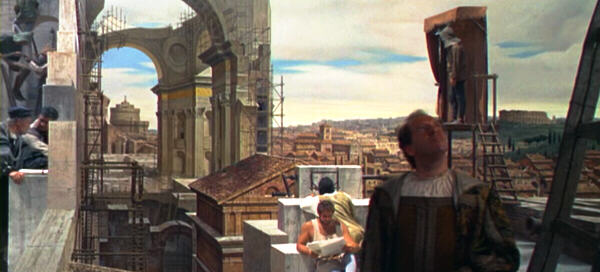
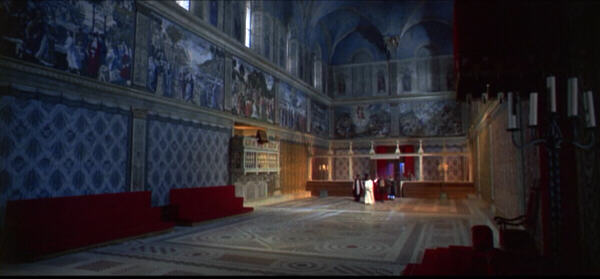
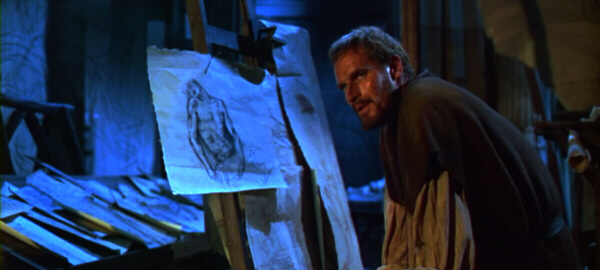
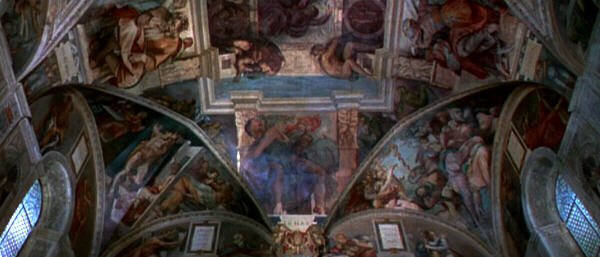
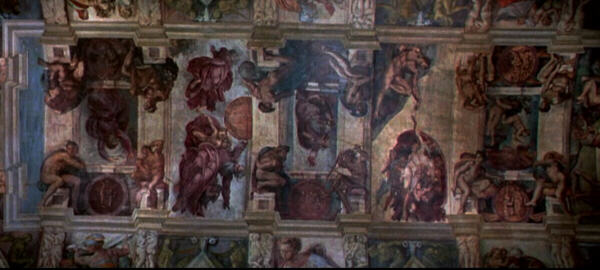
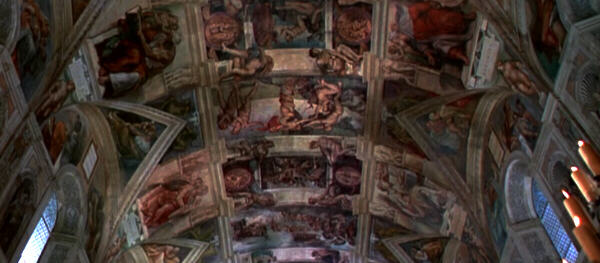
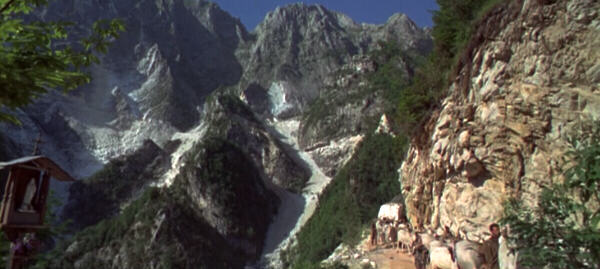
LESS THE RAPTURE Irving Stone’s biographical novel The Agony and the Ecstasy covers eleven periods of Michelangelo, from early artist to his death. It’s a sweeping, fast-moving narrative, backed by a convincing bibliography; you know why moviemakers wanted to make it—at least a part of it—into a prestige roadshow. Carol Reed’s production, with a script by Philip Dunne, concentrates on Book Seven: The Pope. Between uprisings and skirmishes, the warrior pontiff Julius II demands Michelangelo paint the ceiling of the Vatican’s barn-like Sistine Chapel. Michelangelo balks but, in order not to become victim of Julius’s infamous wrath, attempts to fulfil the pope’s request of portraits of the twelve apostles until realizing the commission’s mediocrity and then surrenders to an elaborate “vision” which would take more than four years to complete. Stone’s “chapter” is about a hundred pages long; the movie feels much longer and is far less satisfying. Needn’t be manically wired, like Minnelli’s Lust for Life, but hoping for some drive, a little push, wouldn’t be asking a lot. And maybe just a little carnal pulse? Cautious prober as any director, Reed acquiesces to the terms of reticent biography and, while not entirely avoiding Michelangelo’s private life, steers away with some broadstrokes: In a brothel, a whore laughs, “You can search the whole world and you will never find Michelangelo in a house like this.” After Diane Cilento, playing Contessina de Medici, kisses Charlton Heston’s Michelangelo and he politely rebuffs, she asks if it’s another woman. He says no and waits a second or two to add, as we see a sketch of a male in an erotic repose, “It’s not that either.” If it’s not that, then what? He laments his experience with love has “left me empty” and “God crippled me.” (This noodle-headed safety also explains the mini-documentary opening the movie—“The Artist Who Did Not Want to Paint”—giving us only a brief medium shot of David in fig leaf Monty, a periodic censorship first imposed by none other than Leonardo da Vinci, and lasting forty years, likely not intended to protect virginal eyes as it was to gall its creator. But we do applaud the first close-up view of David’s foot, which belongs to one of the greatest sets ever reproduced; from those we see in the doc, toes could be described as fetish.) In their vain search for reality in the myth of incorruptibility, historians as well as respectful moviemakers accede to Michelangelo’s self-imposed celibacy without having to examine the eclipsing consequences of some of his art: David and the Sistine Chapel frescoes as “spiritual homosexuality.” (Part of his refrain from sexual acts with men may have been the impact of Leonardo, who—unlike himself as a surly, physically sloppy butch—was a fragrant dandy showboating around Florence and castigated for having been arrested for sodomy on a presumed tattletaling of a male whore, coinciding with moral authorities trying to eradicate the spread of “Florenzers.”) Shaped by the expertise of caressing tools, David is Michelangelo’s masturbatory coming-out, and comments, letters and sonnets to and about cobalt blue-eyed Tommaso are confirmation the genius’s love and adoration of male beauty extended beyond the artistry of painting and sculpture, or visits to morgues to survey cadavers. Not even author Stone, who asserted never finding evidence of Michelangelo being gay, can prevent his readers’ inescapable visions of ejaculations between the lines. (Nor can Cilento, who reminds Heston one of those sonnets was “indiscreet.”) Inadequate as caresser of statuary, Heston is his customary roadshow presence; as Julius wearing deluxe armor and chain mail, Rex Harrison does his usual regal bit and despite the redundant “my son,” excels in the last twenty minutes; Cilento has a delectably out-of-the-ordinary speaking instrument. Aldofo Celi, Fausto Tozzi, Venantino Venantini and other supporting actors are poorly served by dubbing. Why didn’t Alex North overrule Franco Potenza’s wretched chorus music? Using TODD AO, Leon Shamroy does some sunny outdoor pans but is woefully deficient with the exalting masterpiece so agonizingly produced. Though the Vatican considered the request to allow Reed to film in the Sistine Chapel, the decision to build it to approximate scale is one half the movie’s only artistry; the second half is attempting the working toils endured in painting the ceiling, kinds of scaffolding argued over and built, and the 1960s achievement in the duplication of the ceiling’s 46 artistic depictions aided by photographic blowups to be outlined and colorized by a flourishing industry of profligate counterfeiters. (The very controversial restoration of the chapel started in 1984 and completed in 1989, and smaller restoratons on-going until 1999, would reveal, sans the centuries of candlelight damage, Michelangelo having expansively applied surprisingly brighter colors than art experts originally believed.) “The Artist Who Did Not Want to Paint” written and directed by Vincenzo Labella, music by Jerry Goldsmith and narrated by Marvin Miller, the dispenser of checks in TV’s The Millionaire and narrator and announcer for the long-running The F.B.I. series. Preview cards and early reviews suggested Agony would be a hit; instead, it bombed. (Opening 12/23/1965 at the Cinestage, running 19 weeks.) Oscar nominations for color cinematography, color art direction, sound, original musical score (North), color costumes (Vittorio Nino Novarese). ROLL OVER IMAGES BELOW, INCLUDING SOUVENIR COVER ENLARGED
Text COPYRIGHT © 2000 RALPH BENNER (Revised 3/2023) All Rights Reserved.
|
 p>
p>